Project Parameters
| Parameter | Value |
|---|---|
| Process route | Twin stations: 200 t/h nine-body six-effect tubular falling-film MEE + 280 t/h 2+1-effect tubular falling-film MVR |
| Industry | Pulp & paper — ammonium-sulfite process, straw / non-wood fiber |
| Feed type & key components | Ammonium-sulfite weak black liquor and yellow liquor; ammonium lignosulfonate, hemicellulose sugars, silica from straw |
| Evaporation capacity | 480 t/h total (200 + 280, two evaporation stations) |
| Region | Northeast China (Heilongjiang) |
Representative process configuration compiled from published industry project data. Indicative values, not a process guarantee.
Project Description
Ammonium-sulfite pulping is the non-wood route that Chinese straw-pulp mills run where the recovered-liquor chemistry points to ammonium rather than sodium: the spent liquor’s lignosulfonates feed fertilizer and binder markets, and the yellow liquor streams carry their own value. The published project behind this configuration stands in Heilongjiang and is genuinely industrial in scale — two evaporation stations totaling 480 t/h for a mill’s ammonium-sulfite black and yellow liquors.
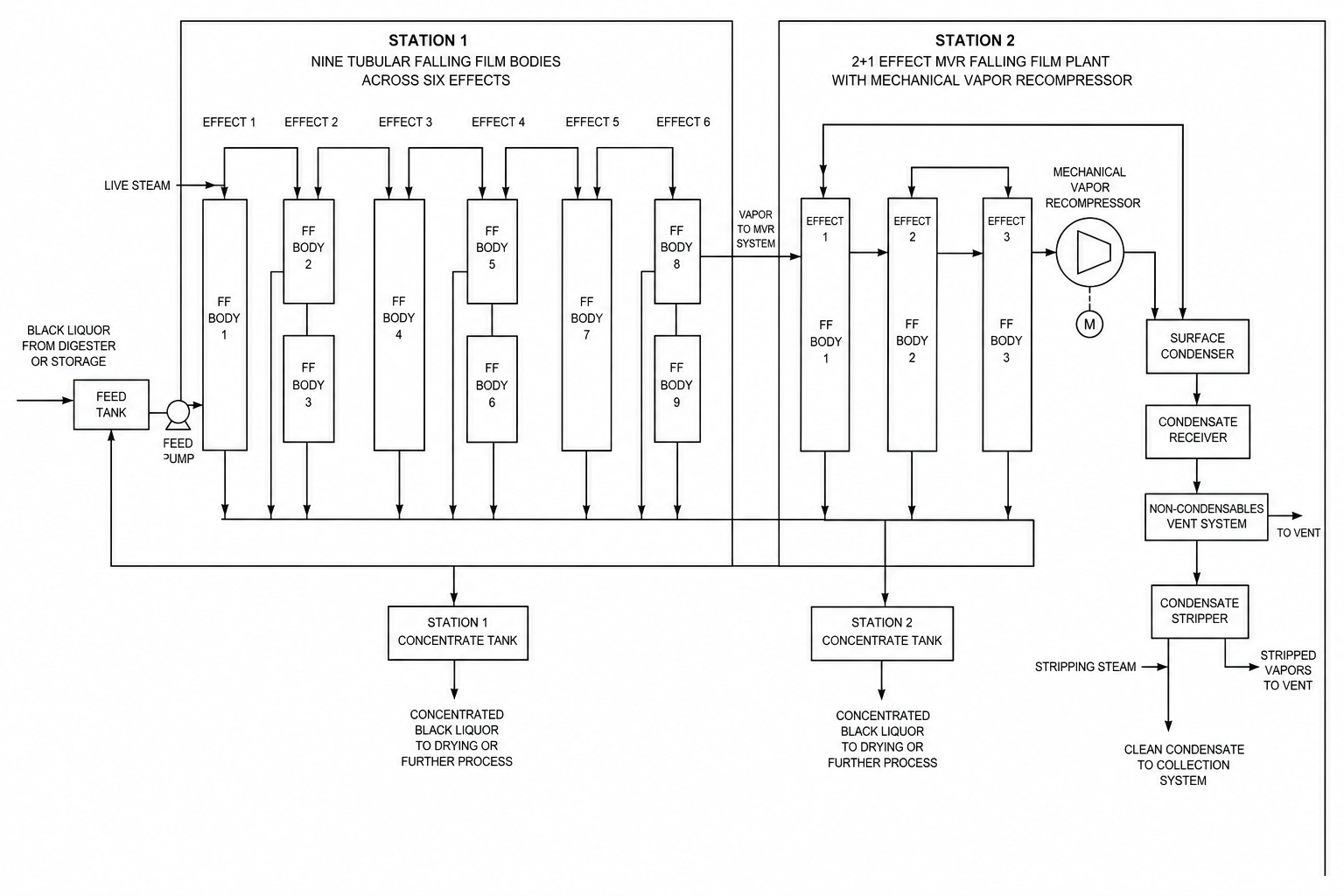
Station one is a 200 t/h multi-effect installation of nine bodies in six effects — the body-heavy architecture that scaling-prone, high-volume liquors force, splitting the dirtiest effects into parallel bodies so washing rotation never idles the station. Station two is a 280 t/h MVR plant in 2+1-effect tubular falling-film form: two effects of falling-film concentration plus one finisher effect, all under mechanical vapor recompression. One site, two technologies, chosen by the liquor each handles.
Process Technology
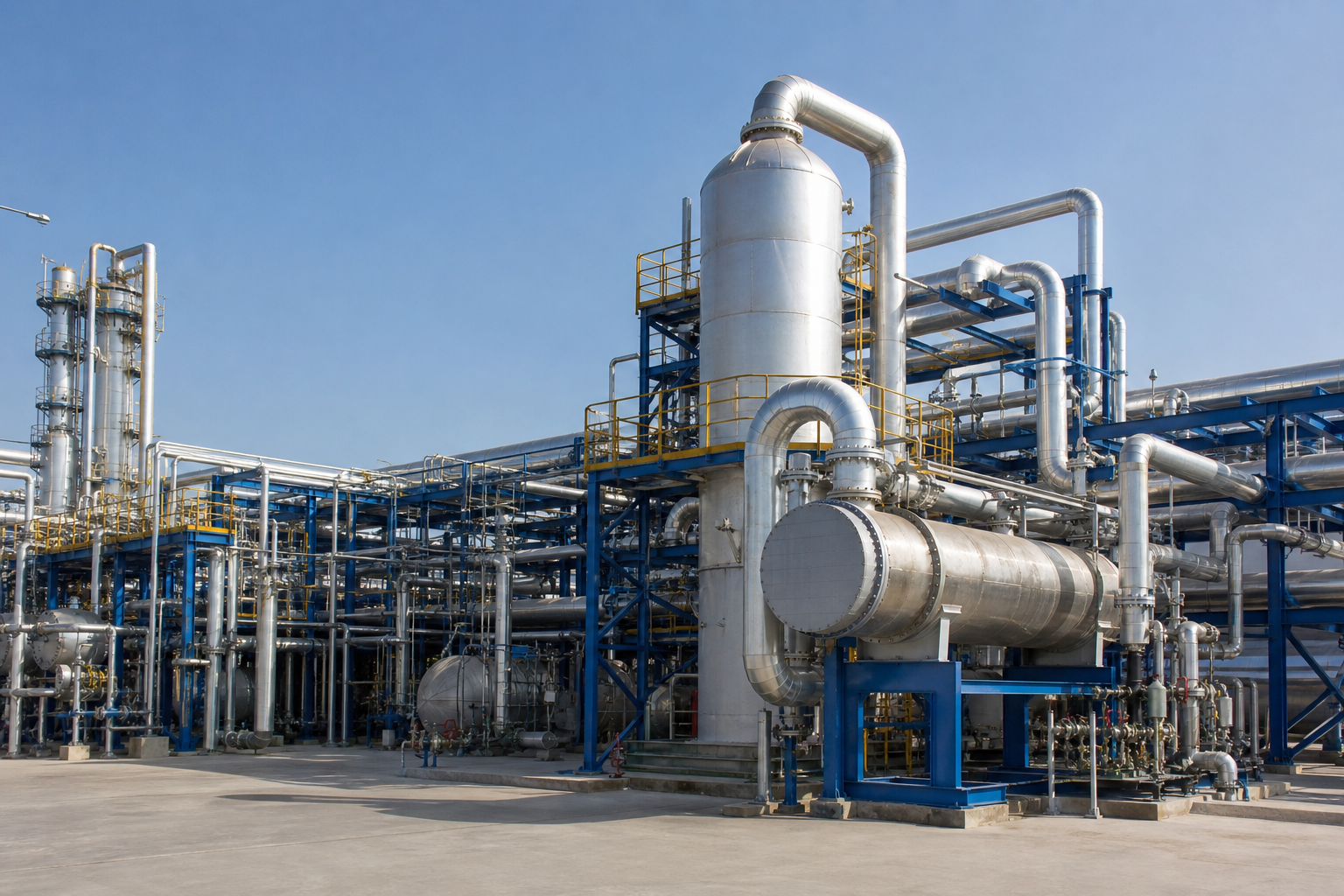
Straw-based ammonium-sulfite liquor is among the hardest feeds in industrial evaporation. Straw carries silica into the cook; the ammonium chemistry leaves lignosulfonates that raise viscosity aggressively; and the yellow liquor streams add sugar loads that caramelize on carelessly hot surfaces. The nine-body six-effect station answers with tubular falling-film bodies in multiplicity: many bodies mean each runs at conservative vapor load, the silica-bearing effects rotate through washing while clean bodies carry the duty, and the station as a whole stays on line through the fouling calendar that straw liquor writes.
The 280 t/h MVR station takes the complementary duty in 2+1-effect form — a compact effect count under vapor recompression. MVR economics suit the liquor volumes a growing mill must handle without expanding its boiler: the recompressor recycles the latent heat electrically, and the 2+1 architecture (two falling-film effects plus a finisher body) keeps the temperature lift small — exactly what a viscous, boiling-point-elevated sulfite liquor needs, because every degree of lift the compressor must supply is paid in power.
Between the stations, the mill routes by liquor class: the heavier black-liquor trains through the multi-effect station where steam economy carries the fouling burden; the cleaner, higher-volume streams through the MVR station where electric economy meets gentler duty. Strong liquor discharges at the solids the recovery or lignosulfonate-sales path requires; yellow liquor concentrates to its own product specification.
Condensate segregation matters double at sulfite mills: the ammonium chemistry puts ammonia and sulfur dioxide traces into the vapor path, so foul condensate strips and the clean circuits return to washing. At 480 t/h combined, the water recovered is a river by industrial standards — the condensate header is as much a product as the strong liquor.
Equipment Configuration
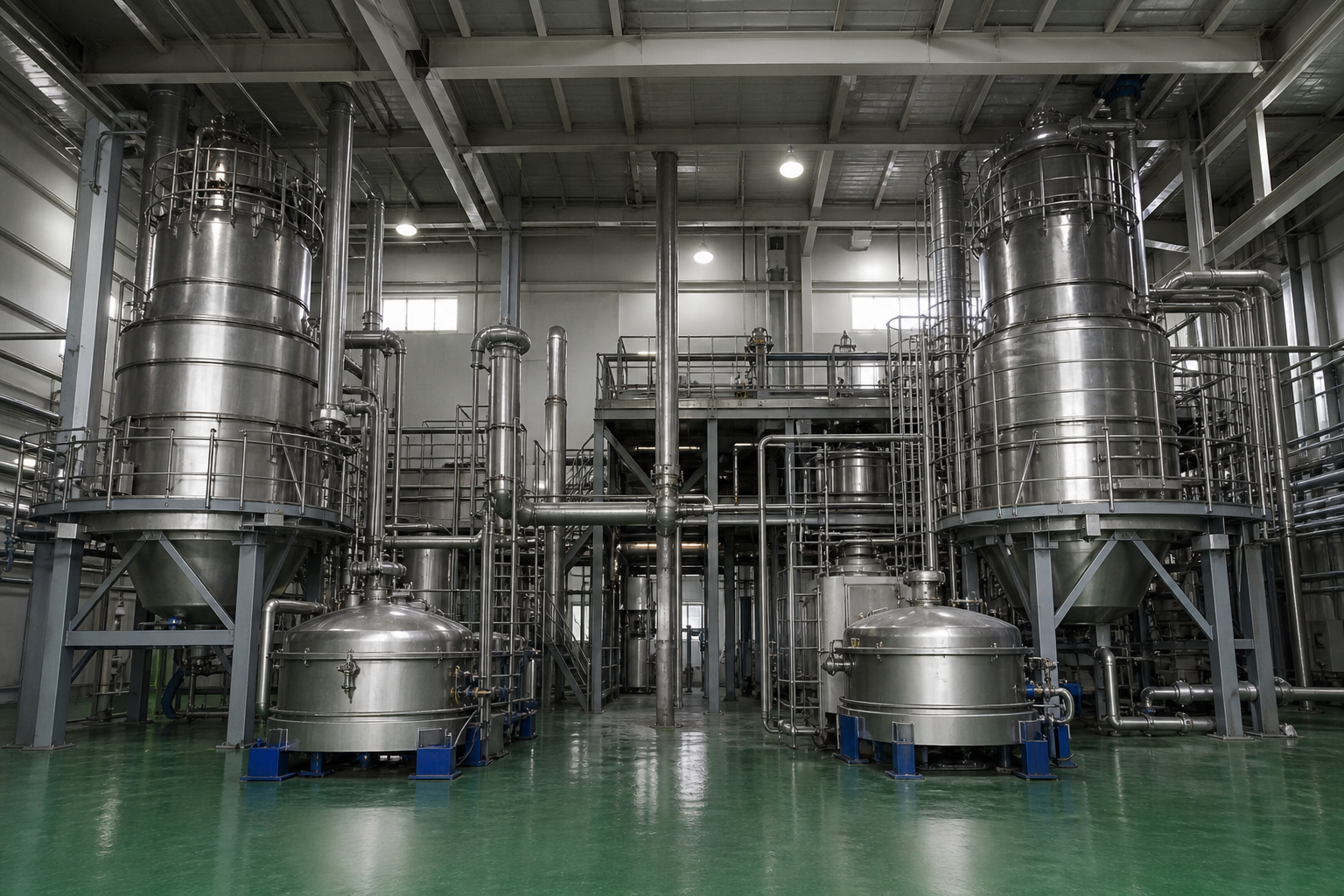
One set of the following equipment is typical for this duty:
- Weak black and yellow liquor feed handling with screening
- Station 1: nine-body six-effect tubular falling-film MEE, 200 t/h
- Station 2: 2+1-effect tubular falling-film MVR plant, 280 t/h
- Mechanical vapor recompressor train for the MVR station
- Surface condensers, vacuum systems, segregated condensate headers with stripping
- Strong-liquor storage at recovery / product solids
- Body-rotation washing and CIP across both stations
Performance & Outcome
Compiled from published industry project data, indicative: twin-station complexes of this class evaporate 480 t/h of ammonium-sulfite black and yellow liquors, combining six-effect steam economy with MVR electric economy across the two stations. Availability and washing-cycle figures are quoted per project liquor specification.
Simplified PFD
The simplified process flow diagram above shows the two stations — the nine-body multi-effect train and the 2+1-effect MVR plant — with segregated condensate recovery.