Project Parameters
| Parameter | Value |
|---|---|
| Process route | Eight-effect tubular falling-film evaporation |
| Industry | Chlor-alkali / fine chemicals — spent caustic recovery |
| Feed type & key components | Spent caustic lye bearing sodium hydroxide and potassium hydroxide |
| Evaporation capacity | 80 t/h water removal |
| Construction materials | Caustic-service steel / nickel-bearing alloys at the hot end (indicative) |
Representative process configuration compiled from published industry project data. Indicative values, not a process guarantee.
Project Description
A chemical site in the Alashan region of Inner Mongolia discharges a spent caustic stream in which sodium hydroxide and potassium hydroxide occur together at dilute concentration — the residue of washing, neutralization and process duties elsewhere on the plant. The alkali content is far too valuable to neutralize and discharge: caustic and caustic potash are tradeable products and paid inputs, and the region’s water balance makes wholesale discharge of the carrier water equally unattractive. The task is recovery-grade concentration: remove the water cleanly and return the alkali values at a concentration the site can re-use or sell.
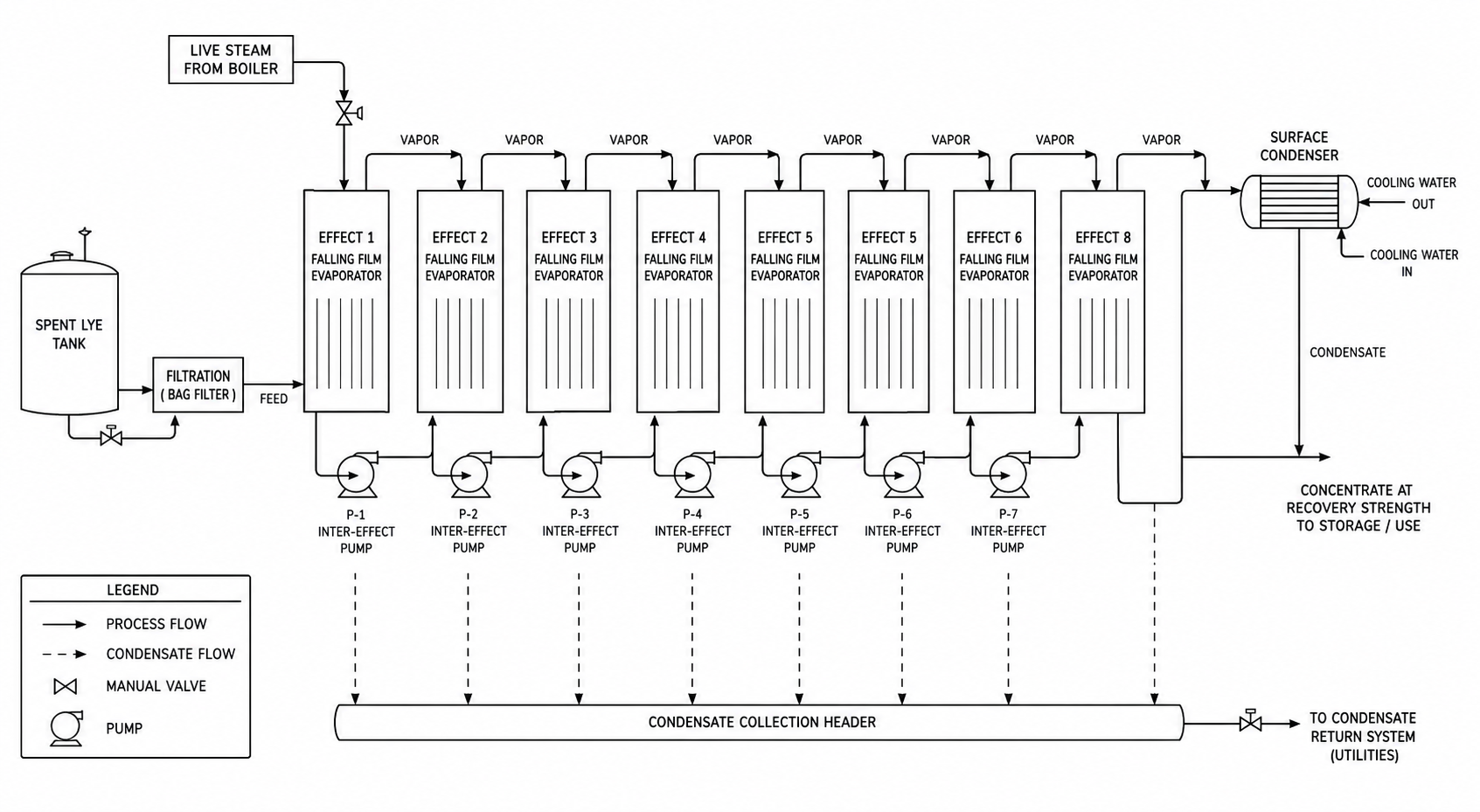
The reference configuration is a single 80 t/h eight-effect tubular falling-film train. Eight effects is a deliberately deep cascade: each kilogram of live steam is re-used as heating vapor eight times in descending temperature steps, and for a continuously operating, large single-duty concentrator this is where multi-effect engineering pays for its complexity in steam saved per ton of water evaporated.
Process Technology
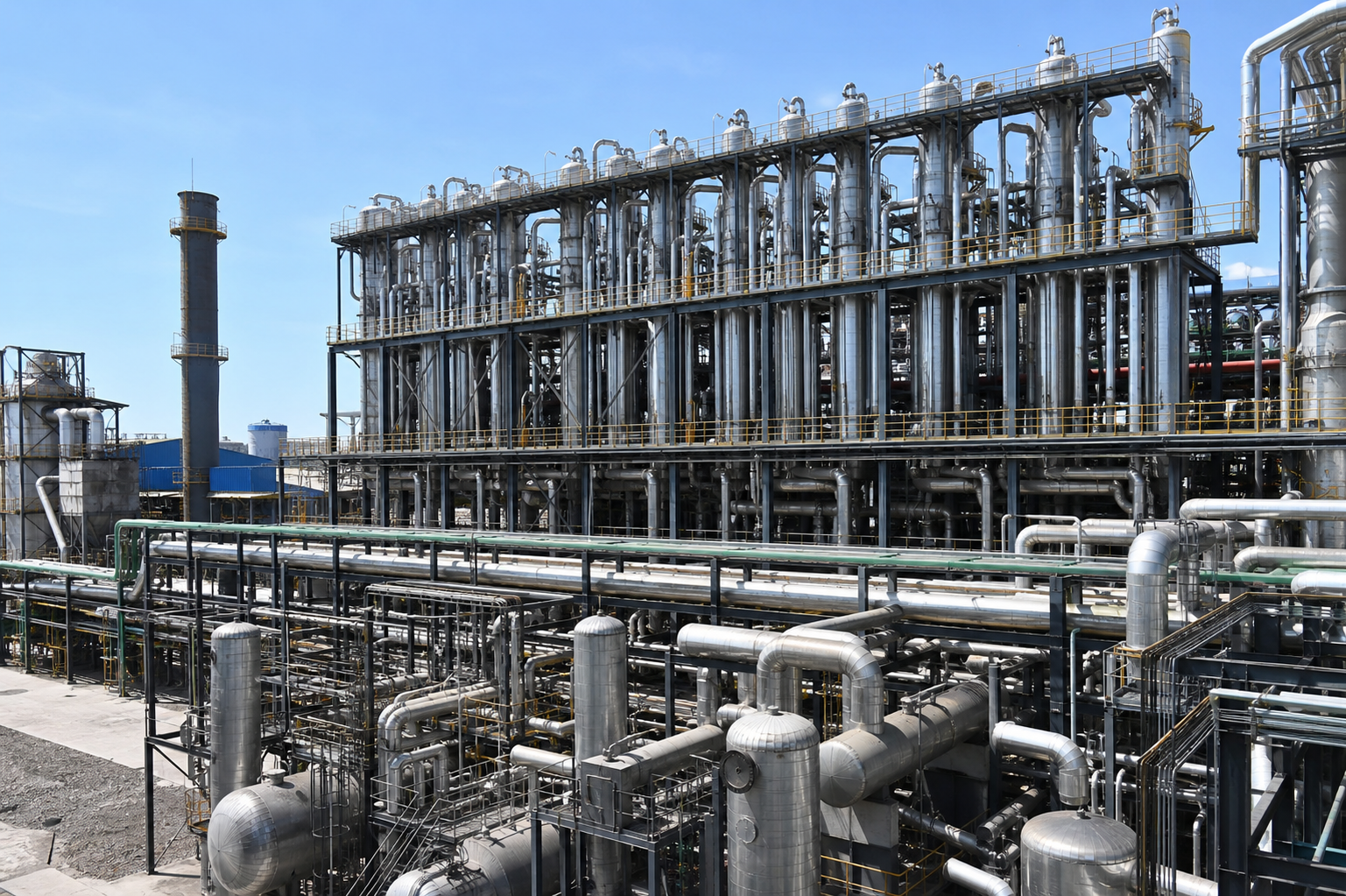
Spent lye is collected, allowed to shed entrained oils and suspended matter, and filtered before entering the train. Feed is preheated in stages against condensate and product, then filmed down the tubes of the first effect, which operates at the highest temperature of the cascade. Live steam heats only this first effect; every subsequent effect is heated by the vapor from its predecessor and operates at a lower pressure and temperature, so the train drives itself down a designed temperature ladder from a single steam input.
Tubular falling-film bodies are the right selection for caustic service: the liquor films under gravity with high transfer coefficients and low product-side temperature difference, important for concentrated alkali whose viscosity climbs steeply and whose boiling point elevation is substantial. As the liquor advances through the effects its caustic concentration rises step by step; the back effects, operating under deep vacuum, carry the duty at the highest concentration where the viscosity and boiling-point penalties are greatest, and the effect temperatures are chosen so that no body exceeds the temperature at which the caustic-service materials and product color tolerances are stressed.
Concentrate leaves the eighth effect at the target alkali strength for recovery — either a commercial-strength lye for internal re-use or feed to a finishing concentration or solid-alkali step depending on the site’s offtake. Vapor from the last effect condenses in a surface condenser; the condensate, stripped of alkali carryover by demisters through the train, is hot, clean water returned to the site’s utility circuit. Caustic service at the hot end sets the material selection, with nickel-bearing and caustic-rated steels indicative where concentration and temperature combine most aggressively.
Equipment Configuration
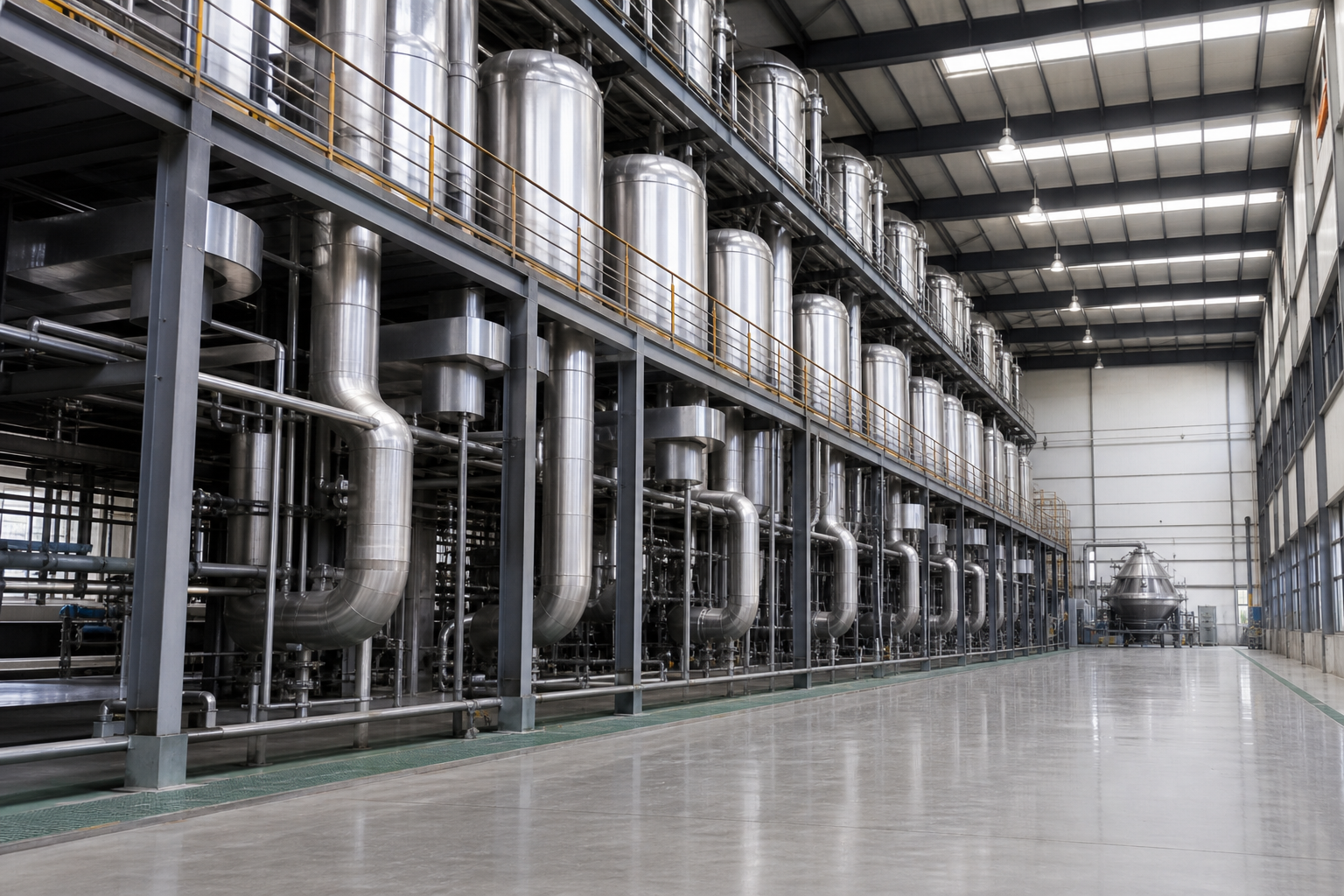
One train of this class comprises:
- Spent-lye collection, oil separation and filtration
- Eight tubular falling-film bodies with inter-effect pumps, transfer controls and demisters
- Live-steam header to effect one, surface condenser and vacuum system on effect eight
- Feed/product and feed/condensate heat-recovery preheater train
- Concentrate forwarding at recovery strength with density-based control
- Condensate collection, polish check and routing to site utilities
Performance & Outcome
Compiled from published industry project data, indicative: eight-effect trains of this class concentrate spent caustic at capacities around 80 t/h water removal with steam economy in the range that only deep multi-effect cascades reach, recovering sodium and potassium hydroxide values at re-usable strength and returning hot condensate to utilities. Steam economy, product concentration and recovery depend on feed alkali strength and are quoted per project.
For context on where this equipment class fits, see Chlor-Alkali Evaporation Systems.