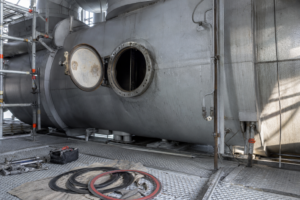
Choosing an industrial crystallizer comes down to three questions in order: how does the feed’s solubility respond to temperature (which fixes the supersaturation method), what crystal size and distribution does the product specification demand (which fixes the growth architecture), and what throughput and solids load must the machine survive (which fixes the circulation design). On structure — the axis buyers feel most — there are three mainstream types: forced-circulation (FC) crystallizers produce 0.2–0.5 mm crystals and shrug off heavy slurry duty; DTB (draft-tube-baffle) units produce 0.5–1.5 mm uniform crystals with low secondary nucleation; Oslo fluidized-bed units produce the largest, purest crystals at 2–5 mm with CV under 5%. This guide walks the full selection logic — classification, type-by-type comparison, decision tree, economics, and scale-up from laboratory to plant — with the numbers that separate the types.
What Every Crystallizer Is Actually Controlling
Crystallization is the controlled departure of a solute from a supersaturated solution. Whatever the vessel looks like, three variables decide the outcome:
- Supersaturation control. Crystals form only in the supersaturated state, and how far past saturation you operate — and where — sets nucleation rate. Supersaturation is generated by evaporating solvent, cooling the solution, or both (flash/vacuum).
- Nucleation versus growth balance. Precise control of temperature and agitation determines whether energy goes into making many small new crystals or into growing the crystals already present. Product size lives on this balance point.
- Heat-transfer efficiency. Evaporative crystallizers are evaporators first; heat-transfer performance directly drives energy cost. The scale of the lever (illustrative calculation): a 5% heat-transfer improvement in a 100,000 t/year sugar plant is worth about $300k annually.
Everything a crystallizer design does — draft tubes, baffles, fluidized beds, elutriation legs — is an arrangement of these three controls. The full thermal side of evaporation-crystallization is covered on the crystallization technology page.
Classification Axis 1: Batch or Continuous
Continuous crystallizers take feed and discharge product simultaneously, hold the slurry at steady state, and deliver consistent quality at high throughput — the OSLO family is the classic continuous architecture. The price is higher capital cost and less flexibility when the product changes.
Batch (fed-batch) crystallizers cycle through charge, crystallize, and discharge. They suit small volumes, multi-product plants, and development work, and they give the operator complete freedom over the cooling or evaporation trajectory — which is why pharmacopoeia-grade crystals with demanding shape specifications are often grown batch-wise in agitated vessels. The trade is lower automation and labor intensity per kilogram.
Classification Axis 2: How Supersaturation Is Generated
- Evaporative crystallization boils off solvent at temperature; DTB-type evaporative crystallizers are the standard for large scale (sodium sulfate, potassium chloride) at the cost of significant energy — mitigated 20–30% by multi-effect or MVR arrangements.
- Cooling crystallization holds concentration and drops temperature; simplest thermally, best for feeds whose solubility falls steeply with temperature and for heat-sensitive products, but the cooling rate must be controlled or crystals agglomerate.
- Vacuum (flash) crystallization drops pressure so the solution flashes adiabatically — low-temperature operation that protects fine chemicals and food organics like lactose, at the price of a vacuum system that adds maintenance burden relative to atmospheric designs.
Feed solubility behavior picks the method: steep solubility-temperature slope favors cooling; flat slope forces evaporation. Materials with inverted solubility (gypsum-class) are their own special problem, dominated by scale management rather than crystal elegance.
Classification Axis 3: The Three Mainstream Structures
The structural families buyers actually choose among — FC, DTB, Oslo — differ in where crystals grow and what protects them from breakage (crystal-size figures below are typical published ranges):

Forced-circulation (FC) crystallizer
A high-speed pump forces slurry through an external heat exchanger and back into the flash chamber, where rapid evaporation generates supersaturation directly in the loop. Crystals are small — 0.2–0.5 mm — because nucleation and crystal-crystal collision dominate. FC tolerates high slurry densities and aggressive duty (evaporation-to-dryness approaches, salt recovery, wastewater ZLD), is the simplest to maintain, and pays for it in pump power.
DTB (draft-tube-baffle) crystallizer
A central draft tube with a low-speed axial impeller circulates the slurry internally; an annular baffle isolates a quiet settling zone where fines dissolve or leave and coarse crystals settle for harvest. Crystals run 0.5–1.5 mm and uniform, secondary nucleation is suppressed, and the machine serves general inorganic salts and any product where size consistency matters. DTB bodies adapt to vacuum-cooling, evaporative, direct-contact-freezing, and reaction crystallization. Full treatment in the DTB crystallizer principle and application guide.
Oslo (fluidized-bed / suspension-bed) crystallizer
Supersaturation is generated in a separate chamber, then the supersaturated liquor flows up through a fluidized bed of crystals, depositing solute gently on crystal surfaces. The result is the largest (2–5 mm) and purest crystals — impurities controllable below 0.1% — at low energy cost, in exchange for the most complex hydraulics and the tallest vessels. Details in the Oslo crystallizer guide.
DP: the DTB variant
The DP (double-propeller) crystallizer modifies DTB by adding a counter-rotating helical blade set in the annular gap outside the draft tube, opposing the internal propeller. The counter-push slashes secondary nucleation and enlarges average crystal size; for a target size it shortens residence time and raises capacity, with low circulation resistance and uniform flow. Its limitation is manufacturing: large counter-propellers are hard to build, capping unit size.
FC vs DTB vs Oslo: The Comparison Table
| Criterion | FC (forced circulation) | DTB (draft-tube-baffle) | Oslo (fluidized bed) |
|---|---|---|---|
| Crystal size | 0.2–0.5 mm | 0.5–1.5 mm | 2–5 mm |
| Growth mechanism | Nucleation-dominated, high collision rate | Internal circulation with controlled growth | Dedicated fluidized-bed growth zone |
| Size uniformity (CSD) | Wide | Narrow | Narrowest, CV < 5% |
| Energy demand | High (high-head pump) | Medium | Low to medium (gentle circulation) |
| Maintenance | Simplest; rugged and washable | Medium | Most complex — hydraulic balance needs monitoring |
| Best-fit duty | Drying-out, salt recovery, wastewater ZLD | General inorganic salts; size-consistency-critical chemicals | High-purity chemicals where large uniform crystals are the product |
Oslo Versus Conventional Stirred Vessels: Ten Dimensions
Against traditional agitated-tank, tubular, and plate crystallizers, the fluidized-bed concept differs across ten measurable axes: suspended gentle growth versus mechanical-stir abrasion; near-zero mechanical contact versus impeller-driven circulation; large coarse crystals versus small scattered ones; narrow classified size distribution versus wide; minimal versus heavy secondary nucleation; a purpose-built fines-destruction system versus limited fines management; lower versus higher circulation-pump energy; supersaturation released gradually through crystal contact versus flashing up and collapsing locally; higher mechanical complexity demanding precise operation versus simple ruggedness; and longer runs between cleanings versus frequent washdowns.
The payoff shows up in product economics: an externally reported paracetamol line moving from batch stirred tanks to Oslo raised yield from 85% to 92% and crystal uniformity by 30%; continuous 24/7 fluidized-bed operation lifts throughput 20–50% over equivalent batch arrangements.
Laboratory and Pilot Scale: Where Selection Really Happens
Laboratory crystallizers in the 30–70 L/h class (DTB and Oslo configurations, modular single-vessel designs with integrated heating, cooling, and agitation) exist precisely to de-risk selection: adjustable temperature, supersaturation, and stirring let process engineers map the metastable zone and growth kinetics of the actual feed before anyone commits capital. Small-scale runs serve research (5–20 L), process development (20–100 L), and pilot production (100–200 L) as a smooth scale-up platform toward industrial units. High-precision work favors the Oslo configuration; higher throughput favors DTB. The blunt field truth: a competent small-scale campaign is the most reliable selection instrument available — geometry alone never substitutes for it.

A Five-Step Selection Decision Tree
- Solubility curve. Steep temperature response → cooling crystallization. Flat response → evaporative. Both manageable → vacuum/flash for heat-sensitive feeds.
- Target crystal size. Below 0.5 mm or size-indifferent → FC. 0.5–1.5 mm with consistency → DTB. Above 2 mm, maximum purity → Oslo.
- Slurry solids and scaling tendency. Heavy solids loads and scaling feeds push toward FC robustness; delicate crystal architectures require DTB/Oslo protection from shear.
- Heat sensitivity. Degradable organics operate under vacuum at reduced temperature, favoring DTB vacuum-cooling or Oslo evaporative bodies.
- Scale. Small batch or multi-product → stirred batch vessels; large continuous duty → the type from steps 1–4 in continuous configuration, validated at pilot scale.
Economics: What Each Class Costs and Returns
Oslo equipment investment runs 30–50% above conventional stirred crystallizers, with the yield, purity, and energy improvements typically recovering the difference in one to two years. Continuous operation adds 20–50% throughput over batch. Budget anchors (industry-reported ranges): small batch units run $10k–50k; large continuous evaporative crystallizer trains exceed $500k. Energy remains the dominant operating line on evaporative duty — multi-effect staging or MVR recompression cuts evaporation energy 20–30% (see the MVR technology overview). For mixed-salt feeds where the crystallizer must also separate salt species rather than just grow them, the selection problem widens into fractional crystallization, covered on the salt separation page.

Anti-Fouling and Operating Practice
Four measures prevent the crystal-on-wall deposition that shortens crystallizer runs: forced circulation to sweep heat-transfer surfaces; supersaturation control to avoid local over-concentration at hot spots; polished internal surfaces that deny nuclei a foothold; and scraper blades in cooling-surface machines. Operating discipline does the rest: hold supersaturation at 90–95% of the metastable limit to prevent agglomeration, and on cooling duty limit the temperature ramp to about 0.5 °C per hour to keep the population uniform. Oslo-class machines reportedly stretch maintenance intervals to 6–12 months.
The Crystallizer Is Not an Island
Final caveat before purchase orders: crystal quality is decided by the whole train. Upstream filtration and conditioning determine what impurities reach the growth zone; downstream centrifugation and drying determine what survives to the bag. A crystallizer chosen in isolation from its neighbors — however elegant the selection — underdelivers. Design the chain: pretreatment, crystallization, solid-liquid separation, drying, and where ZLD applies, the brine-concentration stages ahead of the crystallizer as profiled in the zero liquid discharge solutions. Evaporator-side architecture choices interact with the crystallizer directly; the circulation evaporator guide covers that interface.
Process Modules of a Crystallization Train
| Module | Function | Typical Hardware | Selection Driver |
|---|---|---|---|
| Feed pretreatment | Control what impurities reach the growth zone | Filtration, clarification, pH adjustment | Feed impurity spectrum and solids load |
| Crystallizer body | Generate supersaturation and grow crystals | FC, DTB, Oslo, or batch stirred vessel | Target size, slurry solids, scaling tendency |
| Fines management | Hold the crystal-size distribution | Fines-dissolution loop, elutriation leg | CSD specification |
| Vapor and vacuum system | Set operating temperature, condense vapor | Condenser, vacuum plant, venting | Heat sensitivity, cooling-water temperature |
| Solid-liquid separation | Dewater the crystal slurry | Centrifuge, filter, screen-bowl | Crystal size and fragility |
| Drying and handling | Deliver final moisture without attrition | Fluidized-bed, rotary, flash dryer | Thermal sensitivity, caking behavior |
| Mother-liquor recycle and purge | Balance yield against impurity accumulation | Recycle piping, purge valve, recovery stage | Impurity buildup kinetics |
When This Route May Not Fit
Not every duty justifies the refined architectures this guide walks through. Budget-limited pure-wastewater ZLD duty, where the salt product is a disposal form rather than a sale, is served adequately by a forced-circulation crystallizer — paying DTB or Oslo capital for crystal elegance nobody buys is capital misallocated. DP designs cap out where manufacturing limits on large counter-rotating propellers end, so very large single trains must return to conventional DTB. Oslo hydraulics do not tolerate high suspended-solids feeds or scaling liquors; the fluidized bed needs relatively clear supersaturated liquor to do its work. And multi-product plants running short campaigns with frequent changeover should stay with batch stirred vessels, whatever the crystal-size tables promise — teardown and cleaning between products dominate their economics.
What Must Be Verified
Selection claims must be anchored to measurements before capital commits. The metastable-zone width and growth kinetics of the actual feed — measured in a small-scale campaign, never assumed from pure-water data. The product specification in verifiable terms: target crystal size, distribution width, and purity limits, because each step up the FC-DTB-Oslo ladder is paid for by those numbers. The pilot-to-plant mapping: how the chosen configuration’s residence time, circulation rate, and supersaturation level translate from the 30-70 L/h test unit to the industrial body. And the feed’s solids and scaling tendency, which can veto an architecture the crystal-size target alone would select.
FAQ
What are the three main types of industrial crystallizer?
Forced-circulation (FC), DTB (draft-tube-baffle), and Oslo (fluidized-bed) crystallizers. FC makes 0.2–0.5 mm crystals with the simplest maintenance; DTB makes 0.5–1.5 mm uniform crystals with suppressed secondary nucleation; Oslo makes 2–5 mm high-purity crystals with CV under 5%.
How do I choose between cooling and evaporative crystallization?
Follow the solubility curve. If solubility falls steeply with temperature, cooling crystallization is thermally cheaper. If the curve is flat, evaporative crystallization is the workable route. Heat-sensitive feeds take vacuum/flash crystallization, which lowers operating temperature while combining both effects.
Which crystallizer type gives the largest, purest crystals?
Oslo fluidized-bed units. Crystals grow gently in a suspended bed with supersaturation released gradually through crystal contact, yielding 2–5 mm crystals with impurity content controllable below 0.1% and CV under 5%.
What does an Oslo crystallizer cost relative to conventional designs?
Roughly 30–50% more in capital than conventional stirred crystallizers, typically recovered within one to two years through higher yield, higher purity, and lower energy. Small batch crystallizers start around $10k–50k; large continuous evaporative trains exceed $500k.
Can evaporation energy in crystallization be reduced?
Yes — multi-effect staging or mechanical vapor recompression cuts evaporation energy by 20–30%, and feed preheating from condensate recovers additional heat at near-zero cost.