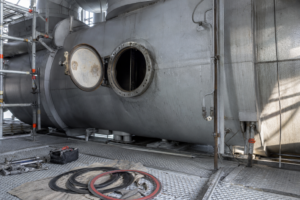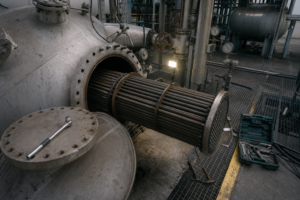
An Oslo crystallizer — also called a suspension-bed or Krystal crystallizer — is the machine you buy when the product is defined by its crystals: supersaturation is generated in a separate chamber, then the supersaturated liquor flows up through a fluidized bed where crystals grow gently to 2–5 mm with narrow size distributions (classified-bed products typically reach CV around 20–30%; single-digit CV in reported applications comes after product screening) and impurity content controllable below 0.1% in reported applications. Because heat transfer and crystal growth happen in different places, and because almost nothing mechanical touches the growing crystals, Oslo units run continuously at 20–50% higher effective throughput than batch equivalents, at low circulation energy — the trade being a taller, more hydraulically demanding plant that asks for precise control. This guide covers the structure, the countercurrent growth mechanism, evaporative and cooling variants, operating discipline, economics, and the honest list of what Oslo machines do not suit.
One Machine, Three Names, One Idea
Oslo, suspension-bed, and Krystal crystallizer all label the same architecture, named for the city where it was industrialized. Classified by material circulation, it stands beside forced-circulation (FC) units with external pump loops and DTB units with internal draft tubes as one of the three mainstream structures — the positioning and full comparison live in the industrial crystallizer selection guide. The Oslo idea is singular: decouple supersaturation generation from crystal growth. Make the liquor supersaturated somewhere the crystals are not, then let that liquor release its supersaturation onto crystals it meets on the way through a fluidized bed. The result is one of the gentlest, most uniform growth environments in crystallizer practice.

Structure: Three Sections
- Evaporation (or cooling) chamber — where mother liquor reaches supersaturation by boiling or by heat exchange. Crystals are absent here by design.
- Fluidized crystal bed — the lower vessel section where supersaturated liquor enters from below, fluidizes the suspended crystal mass, and deposits solute onto crystal surfaces as it rises.
- Circulation system — the pump and piping that keep the loop alive: drawing near-clear liquor from the top, sending it through the supersaturation step, and returning it to the bed.
Because heat transfer happens where there are no crystals, the heat-exchange surfaces stay clean far longer than in machines that boil slurry directly — one of the type’s quiet economic advantages.
The Working Cycle
- The circulation pump draws liquor from the top of the vessel — nearly crystal-free, because the bed below has already stripped the solids out.
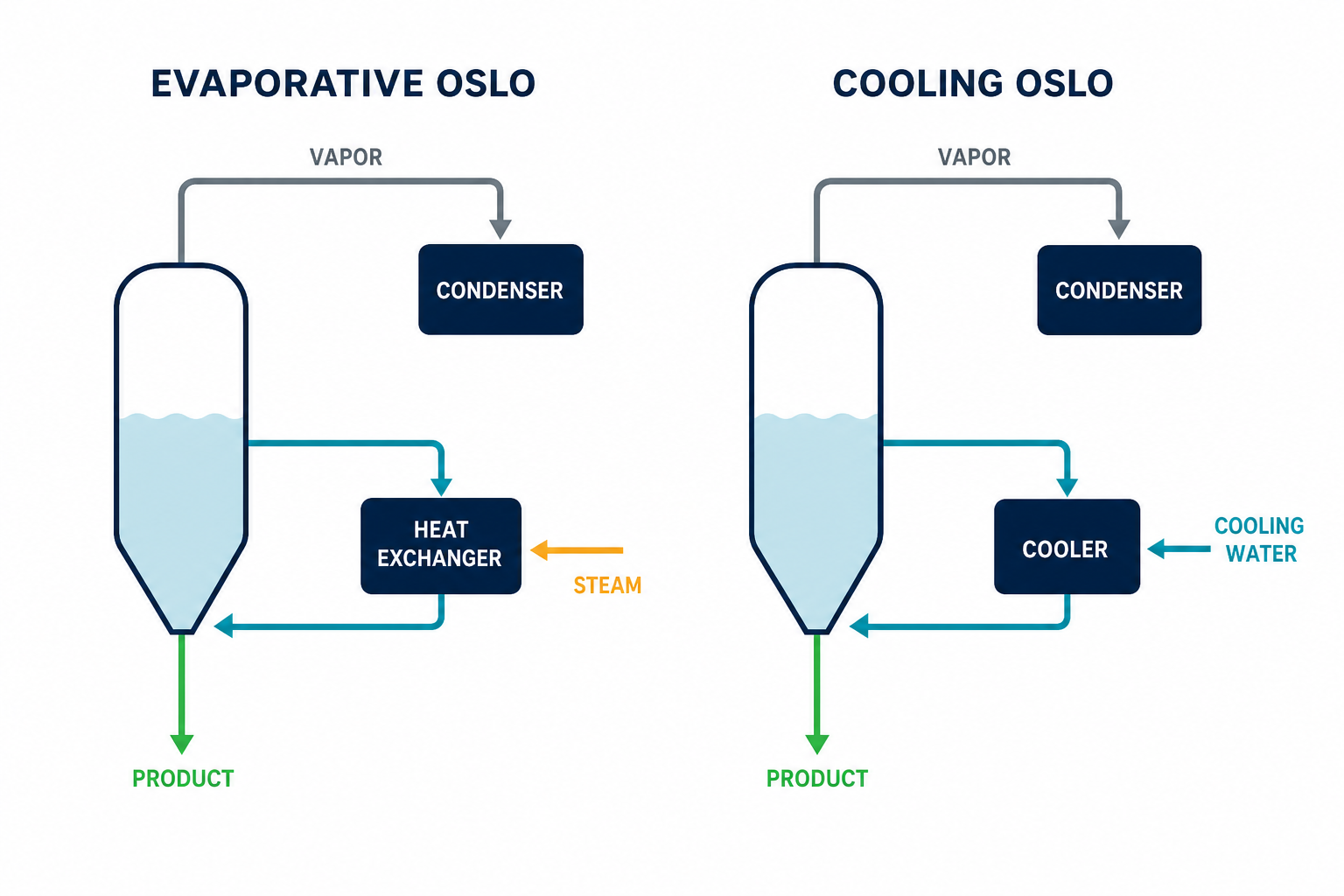
- The clear liquor passes the heater (evaporative designs) or the cooler (cooling designs), which raises its supersaturation to the target level.
- Supersaturated liquor travels down a central downturn pipe into the lower bed zone.
- It rises slowly through the fluidized crystal mass; supersaturation falls as it climbs, and solute deposits onto crystal surfaces.
- Crystals classify themselves hydraulically: the largest sit at the bottom as product, smaller crystals ride higher and keep growing.
- Liquor reaching the pump inlet is close to clarified — only liquid recirculates.
- Product crystals are drawn off the bottom of the bed.
The Countercurrent Mechanism, and Why It Matters
The core of the design is that supersaturated solution meets crystal particles countercurrently — freshest supersaturation at the bed bottom where the biggest crystals wait, gently declining supersaturation as liquor rises past progressively smaller crystals. Two consequences follow. First, crystals grow uniformly: every crystal sees a smooth supersaturation history rather than shocks, which is how the machine holds product CV around the 20–30% band typical of classified-bed operation, with single-digit figures reported only after post-crystallization screening. Second, secondary nucleation — the collision-and-abrasion mechanism that floods other crystallizers with fines — is minimal, because there is no impeller shearing the slurry and no violent boiling where crystals live. Adjustable circulation rate gives the operator direct control over bed fluidization and supersaturation release rate, hence over both size and habit.
The discipline this demands is real: supersaturation must stay inside the narrow metastable zone, or the bed triggers uncontrolled nucleation and the classification collapses. And throughput per unit vessel volume runs below slurry-circulation types (DTB, FC), limited by fluidization velocity and the solids concentration the bed can carry. Oslo plants are also physically tall — the bed needs its height — with hydraulic balancing that wants instrumentation, not intuition.
Oslo Versus Conventional Crystallizers: Ten Dimensions That Matter to Buyers
| Dimension | Oslo fluidized bed | Conventional stirred/tubular/plate |
|---|---|---|
| Growth environment | Suspension in flowing liquor; no abrasion sources | Mechanical stirring wears and chips crystals |
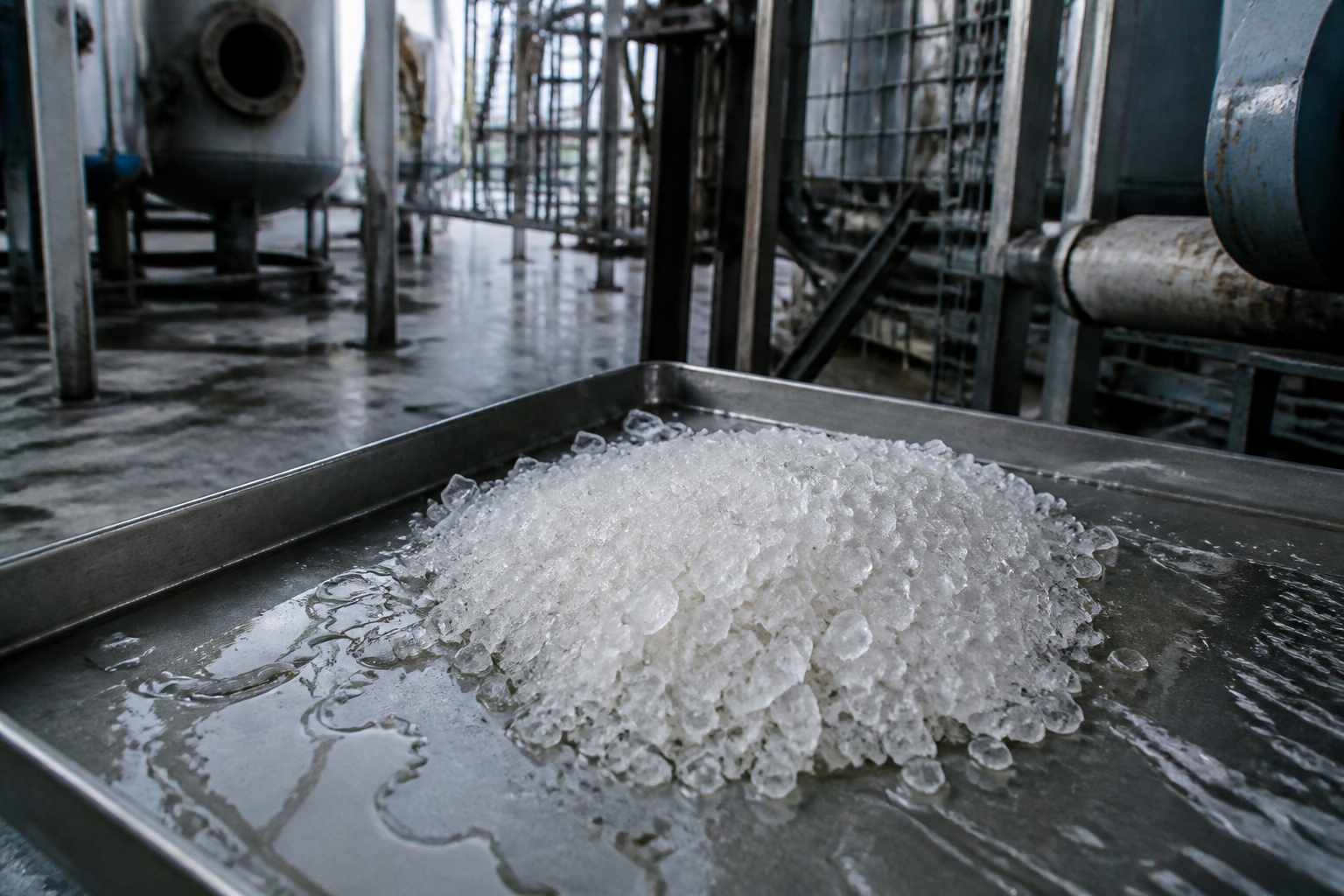
| Crystal size and shape | Large, coarse, well-formed (2–5 mm) | Small and scattered |
| Size distribution | Narrow — CV around 20–30% for classified bed product (single-digit CV typically requires screening) | Wide |
| Secondary nucleation | Extremely low — no impeller in the bed | High — stirring and pumping generate fines continuously |
| Fines management | Purpose-built fines-destruction circuit | Limited |
| Circulation energy | Low — little mechanical motion | High-power circulation required |
| Supersaturation release | Gradual, through crystal contact — smooth | Local spikes and collapses — hard to control |
| Cleanability / run length | Fewer deposits; long campaigns between washdowns | Frequent cleaning |
| Complexity | Structurally complex; needs precise hydraulic balance | Simple and forgiving |
| Purity ceiling | Impurities below 0.1% controllable in reported applications | Limited by mother-liquor occlusion |
The measurable outcomes behind that table (external industry references): continuous 24/7 operation lifts throughput 20–50% over batch arrangements, and an externally reported paracetamol application moved from 85% yield in batch tanks to 92% in Oslo service with crystal uniformity up 30%.
Evaporative Oslo and Cooling Oslo
The architecture runs on both supersaturation methods. Evaporative Oslo bodies boil the circulating liquor — standard for potassium chloride, sodium sulfate, potassium sulfate, and urea-class products where solubility barely moves with temperature and the tonnage justifies the vapor system. Cooling Oslo bodies generate supersaturation in a tubular cooler (sometimes with flash assistance) and are the natural fit for salts whose solubility falls steeply: ammonium chloride, sodium acetate, sodium thiosulfate, potassium nitrate, silver nitrate, copper sulfate, magnesium sulfate, nickel sulfate. Cooling Oslo also earns its place on chloride-bearing wastewater duties, where gentle low-temperature crystallization recovers salts without baking them onto heat-transfer surfaces. The KCl duty in particular is profiled end-to-end in the potassium chloride evaporation and crystallization solutions write-up.
Operating Discipline: Two Numbers
- Hold supersaturation at 90–95% of the metastable limit (supplier-recommended operating band for classified-bed service). Push higher and the bed nucleates spontaneously; the distribution widens and classification degrades.
- Match the cooling ramp to the duty – single-digit °C per hour in industrial service, dropping toward 0.5 °C per hour for high-purity and fine-chemical work where nucleation discipline outweighs throughput. Faster ramps shock nucleation and sacrifice uniformity — the exact property the machine was bought for.
Industrially reported maintenance intervals run 6–12 months — the clean-surfaces dividend of separating heat transfer from crystal growth. Operators reach competence in one to two weeks, though the plant does expect automation literacy: bed density, circulation rate, and supersaturation belong on the control system. General crystallizer control practice is surveyed on the crystallization technology page.
Economics
Capital cost runs 30–50% above conventional crystallizers of equivalent duty (industry-reported comparison). The recovery comes from the yield, purity, and energy line items: higher first-pass yield (the paracetamol 85%→92% pattern), sellable purity grades (impurities below 0.1% in reported applications), low circulation energy, and long campaigns between cleanings. Typical payback lands within one to two years. Where the Oslo unit is one stage of a larger separation train — as in zero-liquid-discharge salt recovery — the governing economics belong to the whole train rather than any single vessel; that architecture is laid out on the ZLD solutions page.
Oslo or DTB?
The neighboring architecture — DTB, with its internal draft tube and baffle — makes a different trade: circulation, growth, and clarification folded into one vessel, simpler and more compact, more tolerant of high evaporation load, at somewhat lower size ceiling (1.0–3.0 mm typical). The working rule: choose Oslo when crystal perfection — maximum size, tightest distribution, highest purity — is the product specification and complexity is affordable; choose DTB when tonnage, simplicity, and robustness dominate the requirement at still-excellent quality. The full comparison, including the DP draft-tube variant that pushes DTB size upward, is in the DTB crystallizer guide.
Where Oslo Machines Excel — and Where They Do Not Fit
- Inorganic salts: KCl, Na2SO4, potassium sulfate, urea — large-granule fertilizer and industrial salt grades.
- Cooling-duty salts: ammonium chloride, sodium acetate, sodium thiosulfate, potassium nitrate, silver nitrate, copper sulfate, magnesium sulfate, nickel sulfate.
- Pharmaceutical: paracetamol-class APIs and vitamin C where purity and uniformity carry the specification.
- Food: sugar, salt, amino acids.
- Fine chemicals: pigments, fragrances, agrochemical intermediates.
The honest exclusion list: highly sensitive compounds and very easily soluble materials fit poorly in standard Oslo service — though design modification adapts the machine to most feeds. Plants tight on vertical space, or teams without automation capability, are better served by DTB or FC. And applications where crystal size is irrelevant (waste-salt volume reduction, for instance) gain nothing from Oslo refinement — forced circulation does that job cheaper.
Laboratory Oslo: Purity Development at 5–200 L/h
Integrated laboratory Oslo systems at 5–200 L/h (supplier-published equipment specifications) — with steam generator, chiller, and vacuum system, plus downstream centrifuge and dryer — carry purity-critical processes from research through pilot scale on the same architecture as the plant. Progressive crystallization in the bench-scale bed reduces occlusion (inclusions) by letting crystals grow slowly and reject impurities to the lattice exterior — a property that suits the architecture to development work on battery-material precursors, high-value fine chemicals, and pharmaceutical API polishing (illustrative applications). Materials run SS304/316L for food and GMP duty, with duplex, titanium, and SMO 254 for corrosive media; mirror finishes to Ra ≤ 0.4 μm (supplier specification) and FAT/SAT protocols are standard practice.
FAQ
What is an Oslo crystallizer?
A fluidized-bed (suspension-bed) crystallizer, also sold as a Krystal crystallizer. Supersaturation is generated in a separate evaporation or cooling chamber, then released onto crystals growing in a fluidized bed below — producing large (2–5 mm), uniform (CV around 20–30% from the bed, lower after screening), high-purity (impurities below 0.1% in reported applications) crystals.
Why do Oslo crystallizers make bigger crystals than stirred tanks?
Three reasons: no impeller abrades or chips the growing crystals, supersaturation is released gently through crystal contact instead of flashing violently, and the bed hydraulically classifies crystals so each size class grows at its own level. Secondary nucleation — the fines factory in stirred tanks — is almost eliminated.
What products are made in Oslo crystallizers?
Potassium chloride, sodium sulfate, potassium sulfate, and urea on evaporative duty; ammonium chloride, sodium acetate, sodium thiosulfate, potassium nitrate, silver nitrate, copper, magnesium, and nickel sulfates on cooling duty; plus pharmaceutical APIs such as paracetamol and vitamin C, food-grade sugar and salt, and fine-chemical pigments and intermediates.
Oslo or DTB — which should I choose?
Choose Oslo when maximum crystal size, tightest distribution, and highest purity are the specification and you can operate a taller, more hydraulically demanding plant. Choose DTB when capacity, simplicity, and robustness matter more, at 1.0–3.0 mm quality. Waste-salt duty where size is irrelevant is better served by forced circulation.
What are the main operating constraints of an Oslo crystallizer?
Supersaturation must stay within the narrow metastable zone (supplier-recommended band of roughly 90–95% of the limit); cooling ramps should stay gentle (single-digit °C/h industrially, toward 0.5 °C/h in high-purity work); throughput per vessel volume runs below slurry-circulation types; and the machine needs precise hydraulic balancing and instrumentation-literate operation. Payback on the 30–50% capital premium typically lands within one to two years.