What This Page Covers
Sodium sulfate is the most common co-product salt in chemical, pharmaceutical, textile, and fermentation wastewater, and it can be recovered as a sellable industrial product rather than landfilled as hazardous mixed salt — provided the crystallization route is matched to the feed. Two proven architectures dominate: MVR forced-circulation evaporative crystallization for large continuous flows, and vacuum or freezing crystallization for hydrate control and waste minimization. Externally published references illustrate both: a vendor-published forced-circulation MVR design concentrates sodium sulfate at 31% and 90 °C with an evaporation duty of 28,500 kg/h, and a supplier-published scraped-surface vacuum crystallizer case treating 5 t/d of RO reject recovered 98% of the feed as distillate and cut disposal spending by roughly 2.5 million RMB per year — external industry references, not EvapCryst deliveries, indicative rather than project guarantees. This page explains when to use each route and the design details that decide whether the plant runs or fouls.
Where Sodium Sulfate Loads Come From
Sodium sulfate appears wherever sulfuric acid neutralization or sulfate-bearing raw materials meet sodium: as a by-product in chemical synthesis, in pharmaceutical intermediate production, in viscose and textile dyeing auxiliaries, in flue gas desulfurization liquor, and — increasingly — in biotech fermentation. One representative case is long-chain dibasic acid (DC10–DC15) production by bio-fermentation for nylon, polyester, adhesive, and bio-solvent synthesis: the fermentation generates large volumes of high-salt wastewater whose pollution concentration is high and biodegradability poor, making conventional biological treatment ineffective and salt recovery the only economically rational route.
Recovered sodium sulfate itself is a commodity with steady demand — in paper and pulp processing, in detergents and cleaning agents, in glass manufacturing, in textile processing, and in chemical synthesis. In animal nutrition, the sulfur content of sodium sulfate (over 20% by weight) supports livestock and poultry metabolism with higher biological availability than other sulfate sources, which sustains a feed-grade market. In other words, the output of a well-designed recovery plant is a product with buyers, not a waste with a disposal invoice.
The Core Difficulty: One Salt, Two Crystal Forms
Sodium sulfate crystallizes as anhydrous salt (rhombic crystals or white powder) or as decahydrate — Glauber’s salt, transparent monoclinic crystals containing ten waters of hydration. The two forms convert into each other depending on temperature and humidity conditions, and this hydrate equilibrium is the central design problem.
Three consequences follow. Hydration state control is difficult: a crystallizer aimed at anhydrous product must stay above the hydrate transition region, while a decahydrate route must operate below it, and drifting across the boundary produces off-spec mixed product. Solubility changes sharply with temperature, so precise temperature control is required to hold the working supersaturation — the driving force that decides whether crystals grow or the system nucleates fines. And crystal growth is sensitive to solution concentration, temperature, and agitation speed, so improper control in any one of these variables produces uneven crystal shape and size that degrade the centrifuge and drying performance downstream.
Practical crystallization control therefore rests on four levers: strict temperature control of the crystallizer body, precise adjustment of solution concentration to hold supersaturation in the metastable zone, deliberate seed addition to direct crystal growth rather than spontaneous nucleation, and controlled agitation that keeps solutes uniformly distributed without breaking crystals. These levers apply identically to every sodium sulfate crystallizer regardless of heating or cooling source.
Route 1: MVR Forced-Circulation Evaporative Crystallization
For large, continuous sodium sulfate flows — by-product recovery in chemical and pharmaceutical plants — the reference architecture is MVR evaporation feeding a forced-circulation (FC) crystallizer. A vendor-published commissioned design for a Shandong pharmaceutical producer — an external industry reference, not an EvapCryst delivery — illustrates the complete heat and mass balance:
- Two-stage feed preheating. Raw solution at 25 °C is preheated to 60 °C by heat exchange with 99 °C condensate, then raised to the 94 °C system operating temperature with fresh steam in a second preheater before entering the evaporator.
- FC evaporation-crystallization. The designed evaporation temperature is 90 °C, the sodium sulfate concentration is 31%, the boiling point rise is 4 °C, and the evaporation duty is 28,500 kg/h. Crystals grow in the circulated slurry until they reach discharge size.
- Controlled slurry discharge. Crystal content in the discharge is held at 10–15%, the range that suits downstream thickening and centrifuge separation.
- Thickening and separation. The crystal slurry enters a thickener where solids rise to 50–70% by volume; clarified mother liquor overflows to the mother liquor tank, and the underflow reports to the centrifuge. Mother liquor recycles to the evaporator.
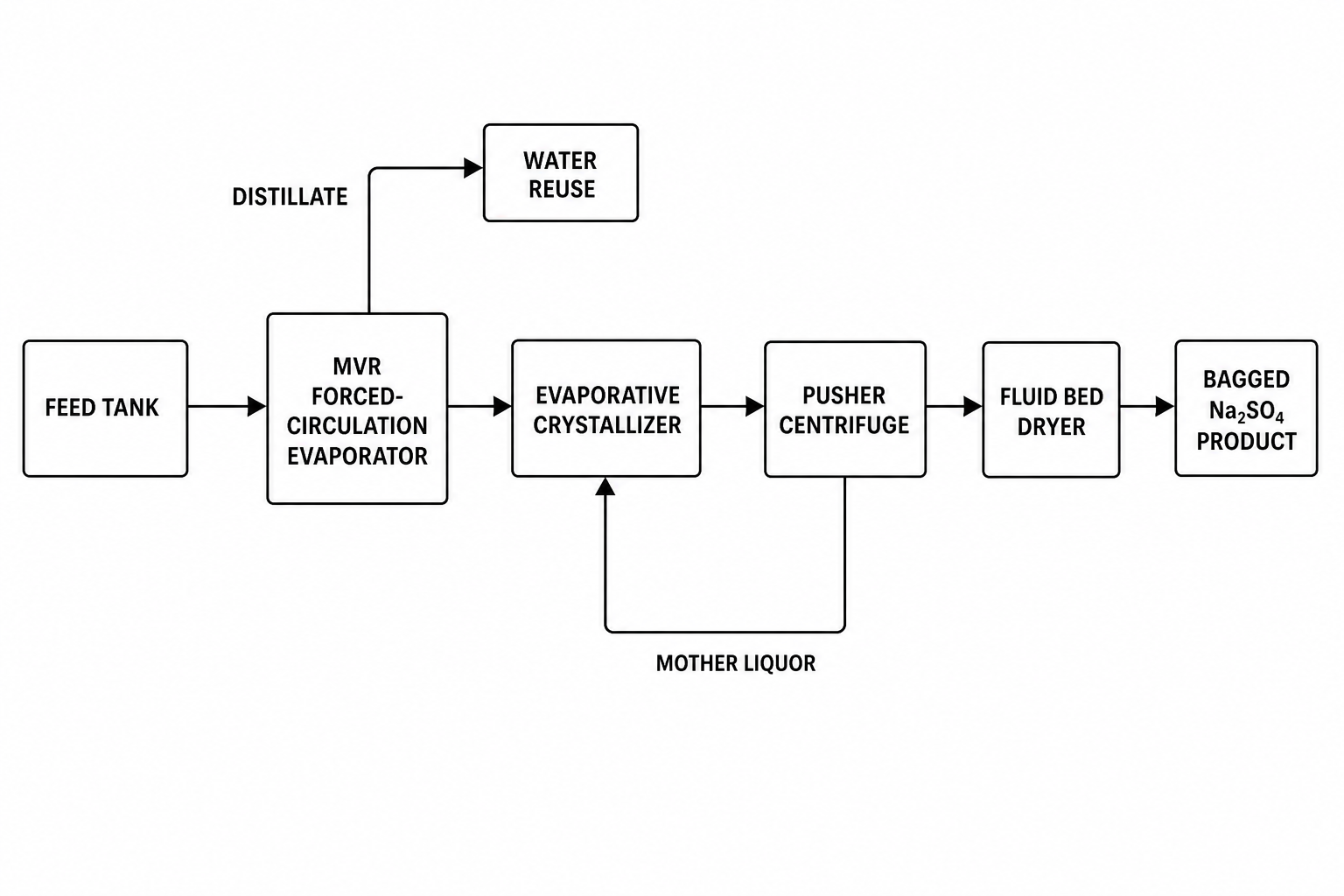
Two design details in this reference plant deserve attention because they generalize. First, large-particle product is obtained by crystallization parameter optimization — extending crystal growth time and controlling the number of nuclei in solution — not by forcing throughput. Second, the entire layout was explicitly engineered against the risk of sodium sulfate crystals plugging lines: pump selection and equipment installation geometry are chosen to keep crystal-laden streams moving, with no dead legs where slurry can settle and harden.
The MVR driver changes the operating economics of this route relative to steam-heated multi-effect plants. Because the compressor recycles secondary vapor as the heating medium, fresh steam is consumed mainly during start-up, and electricity replaces boiler fuel per ton of water evaporated — an industry-reported 50–80% evaporation OPEX reduction range for MVR in chemical service, indicative and not a project guarantee.
| Process Module | Candidate Equipment Types | Selection Rationale | Indicative Operating Envelope |
|---|---|---|---|
| Feed preheating | Two-stage plate or tubular preheaters (condensate + steam trim) | Recovers condensate heat before the evaporator | 25 °C raised to 60 °C, then 94 °C in the published reference |
| MVR forced-circulation evaporation | FC crystallizer body with MVR compressor | Handles slurry duty and crystal growth in one loop | 90 °C, 31% Na₂SO₄, 4 °C BPR, 28,500 kg/h duty (vendor-published reference) |
| Slurry discharge control | Density-controlled discharge piping | Holds crystal content in the separable range | 10–15% crystal content |
| Thickening & separation | Thickener; centrifuge | Clarifies mother liquor and dewaters crystals | 50–70% solids underflow |
| Drying | Fluidized-bed dryer | Delivers free-flowing bulk product | Set by product grade |
Configuration, materials, and operating ranges depend on actual feed, temperature, pressure, corrosion review, fouling behavior, utilities, and project capacity.
Route 2: Vacuum and Freezing Crystallization for Waste Streams
Where the objective is waste minimization rather than salt production — small daily volumes of sulfate-bearing RO reject, for example — vacuum and freezing crystallization routes are often the better fit, because they manage the hydrate equilibrium directly instead of fighting it.
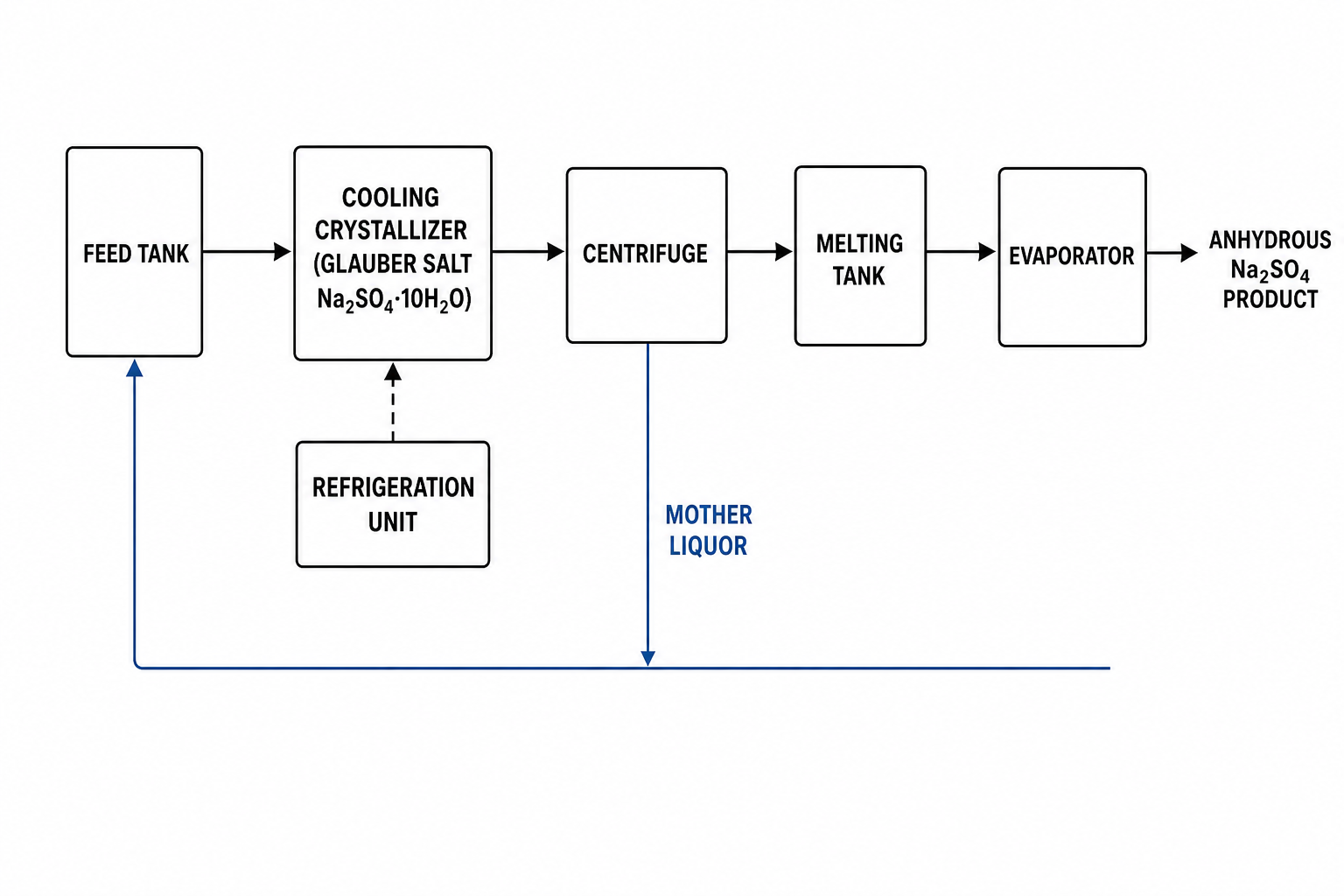
A supplier-published application — an external industry reference, not an EvapCryst delivery, indicative rather than a project guarantee — describes a scraped-surface vacuum crystallization unit treating the cleaning wastewater of a Japanese multinational film and camera manufacturer. The plant’s RO system produced about 5 tons of reject per day, previously hauled away for outsourced disposal at roughly 2,500 RMB per ton — about 12,000 RMB per day. The installed steam-heated scraped-surface low-temperature drying-crystallization unit processes the full 5 t/d without any pretreatment, extracting more than 98% of the feed as distilled liquid and discharging the remaining 2% as dry crystals with moisture content of 10% or less, automatically packed into ton bags. The reported saving is approximately 2.5 million RMB per year, net of the unit’s own operating costs — the gross disposal avoidance runs higher (about 12,000 RMB per day of avoided hauling), with the balance consumed by steam, power, consumables and residual dry-crystal disposal. The lesson generalizes: when disposal costs run above roughly 2,000–2,500 RMB per ton, on-site minimization hardware pays back quickly even at modest daily volumes.
For sulfate recovery from fermentation wastewater, the reference process combines three unit operations in series: MVR evaporation and concentration, frozen crystallization, and fluidized-bed drying, recovering industrial-grade sodium sulfate from the DC10–DC15 fermentation broth wastewater. Freezing crystallization exploits the hydrate chemistry — as the liquor cools, decahydrate crystallizes preferentially, separating sulfate from the mother liquor at low thermal cost — while the fluidized bed delivers a dry, free-flowing product suitable for bulk sale.
Choosing the Crystallizer Configuration
Sodium sulfate service spans four crystallizer families, selected on supersaturation generation method and product objectives:
| Configuration | How Supersaturation Is Created | Best Fit for Na2SO4 | Watch-outs |
|---|---|---|---|
| Forced circulation (FC) | Evaporation under circulation heating | Large continuous by-product recovery; anhydrous product above hydrate transition | Crystal attrition; tube scaling; plugging in under-designed lines |
| Vacuum (flash) crystallizer | Adiabatic flashing at reduced pressure | Waste minimization; low-temperature concentration | Vacuum system sizing; entrainment control |
| Cooling / freezing crystallizer | Heat removal via jackets or scraped surfaces | Decahydrate (Glauber’s salt) recovery; fermentation liquors | Hydrate transition management; scraper wear |
| DTB / Oslo growth type | Evaporation with classified crystal bed | Coarse, uniform product where crystal size commands premium | Higher complexity; fines management discipline |
For mixed-salt wastewater where sodium sulfate coexists with sodium chloride, salt-splitting — separate crystallization of the two salts — is the upstream decision; see our evaporative crystallization technology overview for how phase behavior drives that separation.
Mother Liquor Management and Product Value
The mother liquor loop is where sodium sulfate plants quietly lose yield or product quality. Centrifuge mother liquor carries dissolved sulfate plus every accumulated impurity — organics from fermentation or synthesis, chlorides, and color bodies — and it recycles to the evaporator. Purge too little and impurities build until the crystal product stains or smells; purge too much and sulfate yield drops. Density and composition monitoring on the recycled stream, with a trim purge, keeps the loop in specification.
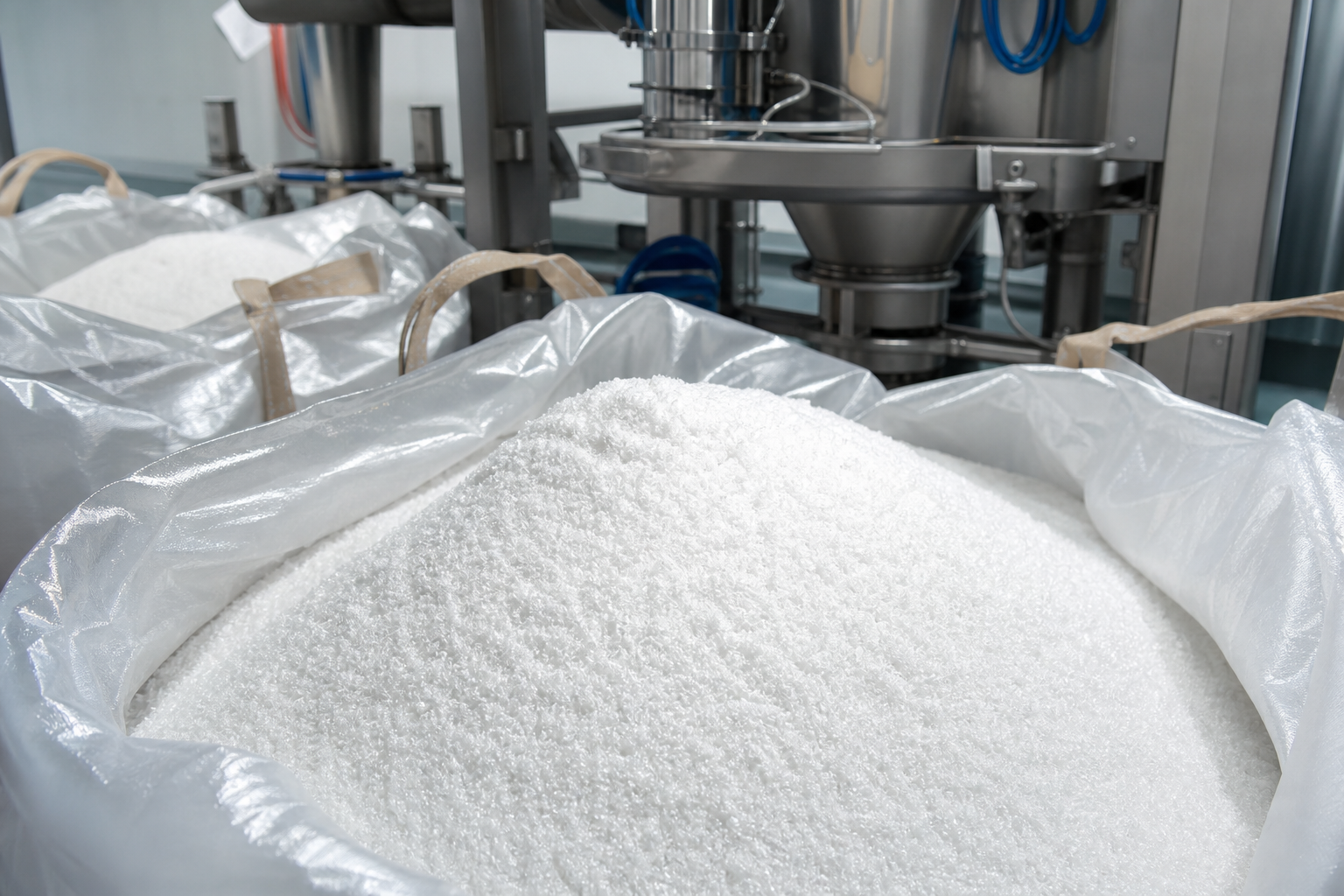
Product placement should be scoped before the plant is built, because it sizes the drying and packaging section: paper-grade and detergent-grade sodium sulfate tolerate lower purity than feed-grade, and glass or synthesis applications sit in between. Fluidized-bed drying after centrifugation is the standard route to a free-flowing bulk product; see our mother liquor recovery solutions page for the yield and quality economics of the loop.
Design Details That Decide Availability
Sodium sulfate’s plugging and scaling behavior is predictable, and the countermeasures are known: slurry lines designed with continuous slopes and no dead legs; pumps selected for crystal-laden duty rather than clear-liquid duty; boiling point rise (4 °C in the reference design) correctly included in the heat transfer calculation so the heater surface does not run unintentionally hot; and CIP connections positioned so the crystallizer body, not just the tubes, can be washed. Plants that respect these details run years between forced outages; plants that treat sodium sulfate like a benign salt spend their winters clearing hardened decahydrate from blocked lines.
Related Resources
- Forced Circulation Evaporation — the geometry behind high-rate slurry evaporation.
- Cooling Crystallization — supersaturation by heat removal, and when freezing beats evaporation.
- Zero Liquid Discharge Solutions — the end-of-pipe context for sulfate-bearing RO reject.
- Mother Liquor Recovery — purge strategy and yield protection in recycling crystallization loops.
- Chemical & Agrochemical Industry Solutions — sodium sulfate duties across synthesis and fermentation plants.
When This Route May Not Fit
Crystallization recovery is not the universal answer for sulfate loads. Where the liquor is dilute, volumes small, and disposal cheap — unit costs well below the roughly 2,000 RMB per ton threshold cited in the reference case — hauling concentrate off site beats on-site hardware. Where organic impurities, color bodies, or chlorides dominate the feed, the recovered salt may miss every product grade and revert to a waste. If sodium chloride coexists at significant levels and no salt-splitting step is planned, the output is mixed salt with few buyers. And where boiling point rise runs high in the real liquor, the MVR compressor lift budget can rule out the electric route before economics are even discussed.
What Must Be Verified
Validation focus: a full water analysis across feed variation — sodium, sulfate, chloride, organics, COD, and color — because the phase behavior and product grade both follow from it. Confirm the Na₂SO₄–NaCl–H₂O phase diagram and the hydrate transition temperature on the actual liquor, not handbook values. Measure boiling point rise at endpoint concentration; the 4 °C reference figure does not transfer. Assess scaling and plugging tendency for slurry-line velocities and dead-leg elimination. Establish the product outlet — grade specification and a buyer — before sizing drying and packaging, and verify local power, steam, and refrigeration availability against the selected route.
Frequently Asked Questions
Why is sodium sulfate harder to crystallize than sodium chloride?
Sodium sulfate exists as anhydrous salt and as decahydrate (Glauber’s salt), which convert between forms with temperature and humidity. Its solubility also changes sharply with temperature. The crystallizer must therefore control hydration state and hold supersaturation precisely through temperature, concentration, seeding, and agitation — otherwise product form and crystal size drift off specification.
What does an industrial MVR sodium sulfate crystallization plant look like in numbers?
A commissioned pharmaceutical-industry design runs two-stage feed preheating from 25 °C to 60 °C (against 99 °C condensate) and then to 94 °C, evaporates at 90 °C with a 4 °C boiling point rise at 31% sodium sulfate concentration, with an evaporation duty of 28,500 kg/h, slurry discharge at 10–15% crystal content, and thickening to 50–70% solids before centrifugation.
When should I use freezing or vacuum crystallization instead of MVR evaporation?
Use vacuum or freezing routes when the goal is waste minimization on modest daily volumes, or when decahydrate recovery fits the chemistry — for example sulfate recovery from fermentation wastewater via MVR concentration plus frozen crystallization and fluidized-bed drying. Use MVR forced-circulation evaporation for large continuous by-product streams where the salt is sold as anhydrous product.
Is recovered sodium sulfate actually sellable?
Yes. Recovered sodium sulfate serves the paper and pulp industry, detergents, glass manufacturing, textiles, and chemical synthesis, and its sulfur content above 20% supports a feed-grade market thanks to high biological availability. Product grade requirements determine how tight the impurity purge and drying sections must be.
How much does on-site crystallization save versus hauling sulfate waste off site?
In a supplier-published case (external industry reference, not an EvapCryst delivery), 5 t/d of RO reject previously disposed off site at about 2,500 RMB per ton (roughly 12,000 RMB per day) was treated by a scraped-surface vacuum crystallizer recovering 98% as distillate and 2% as dry crystal — saving approximately 2.5 million RMB per year, net of the unit’s own operating costs (the gross hauling avoidance is closer to 4.4 million RMB per year at 12,000 RMB per day). Savings scale directly with disposal unit cost and daily volume.
Carrying a sodium sulfate stream? Send the water analysis, daily volume, current disposal or product plans, and local energy tariffs — in exchange you will receive a first-pass screening that matches the crystallization route (MVR forced-circulation, vacuum, or freezing) to your feed and salt outlet.