Vinasse — the spent wash left after molasses-based ethanol fermentation — is one of the most concentrated organic effluents in the process industries, with a chemical oxygen demand (COD) of typically 100,000–150,000 mg/L and a biochemical oxygen demand (BOD) of 60,000–90,000 mg/L. Yet it is also a resource: every cubic meter carries potassium, nitrogen, and phosphorus that can be sold as organic fertilizer or feed-grade supplement. The proven solution is a mechanical vapor recompression (MVR) forced-circulation evaporation train that concentrates thin stillage (typically 8–15% dry matter) to 35–50% solids, optionally further to 88–90% solids, followed by scraped-surface drying and granulation. Industry-published systems in this class treat 10–500 tonnes of vinasse per day and cut evaporation energy by up to 60% versus single-effect steam operation, and return the recovered water as condensate for fermentation-loop reuse — the practical route to zero liquid discharge for a molasses distillery.
Why Vinasse Is Not Corn Stillage
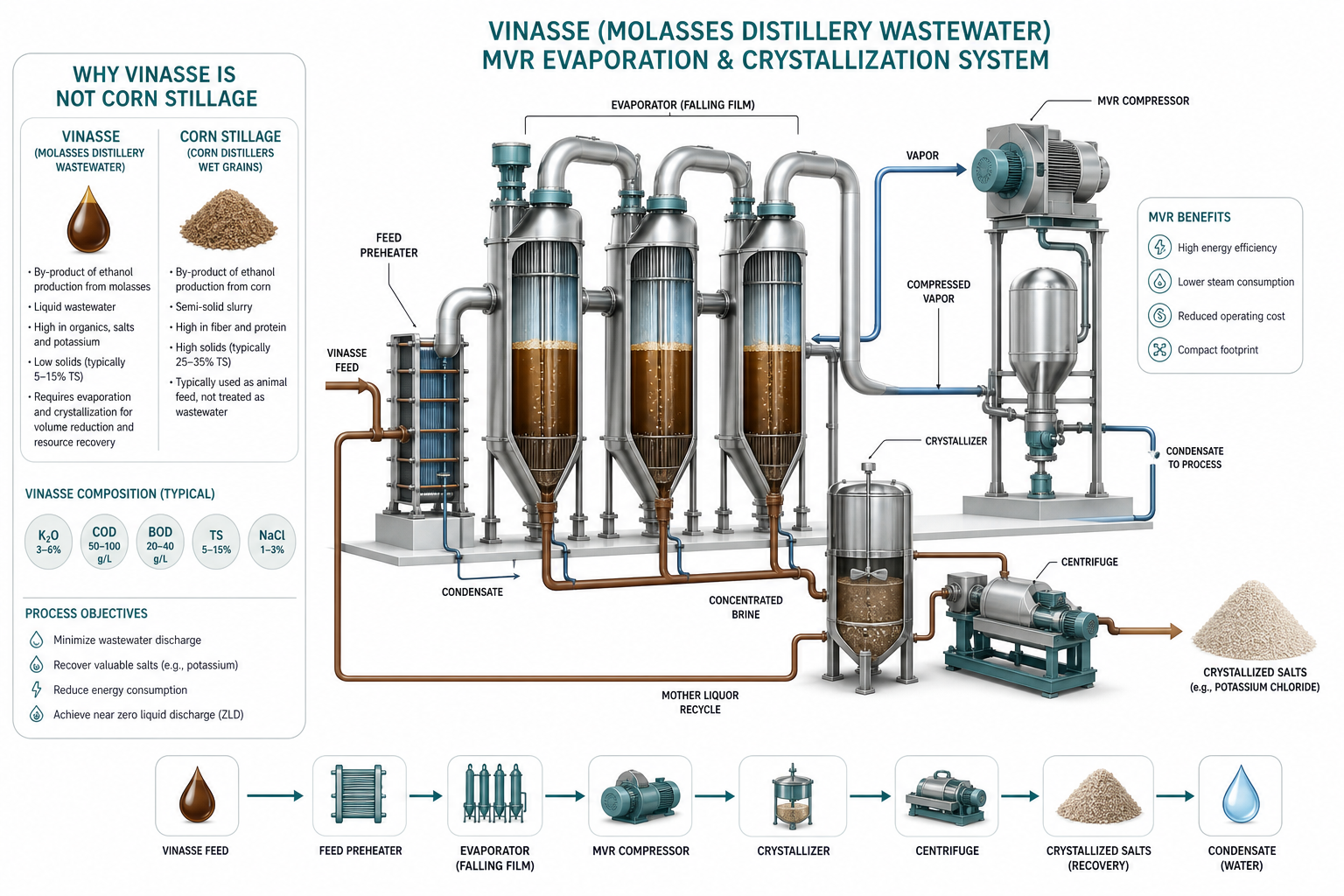
Many distillery evaporation references come from grain ethanol and DDGS plants, but molasses vinasse behaves differently in four ways that directly drive equipment selection:
- Potassium-rich, not protein-rich. Molasses carries a heavy load of potassium salts from the sugar beet or cane field. The concentrate is sold as a potassium-organic fertilizer (or feed additive in controlled formulations), not as a high-protein feed like corn DDGS.
- Aggressive scale formers. Calcium sulfate, calcium oxalate, and organic calcium salts precipitate on hot surfaces, so designs that let liquor boil on the tube wall scale up rapidly.
- Strong foaming tendency. Residual sugars, proteins, and saponins stabilize foam, which increases entrainment carryover into the condensate unless separator design accounts for it.
- Low inlet solids. Raw vinasse typically enters at 8–15% dry matter, so the evaporation load per tonne of product is very large — which is exactly why energy consumption, not tankage, dominates operating cost.
The scale of the problem is easy to underestimate. Industry-reported figures put China’s molasses alcohol production above 500,000 tonnes per year, generating close to 2,500 tonnes of organic pollutants every day (published estimates) — roughly the wastewater load of a city of 900,000 residents. Discharging untreated vinasse throws away 0.7–1 tonne of organic matter for every tonne of alcohol produced.
Raw Vinasse Characteristics (Typical Design Basis)
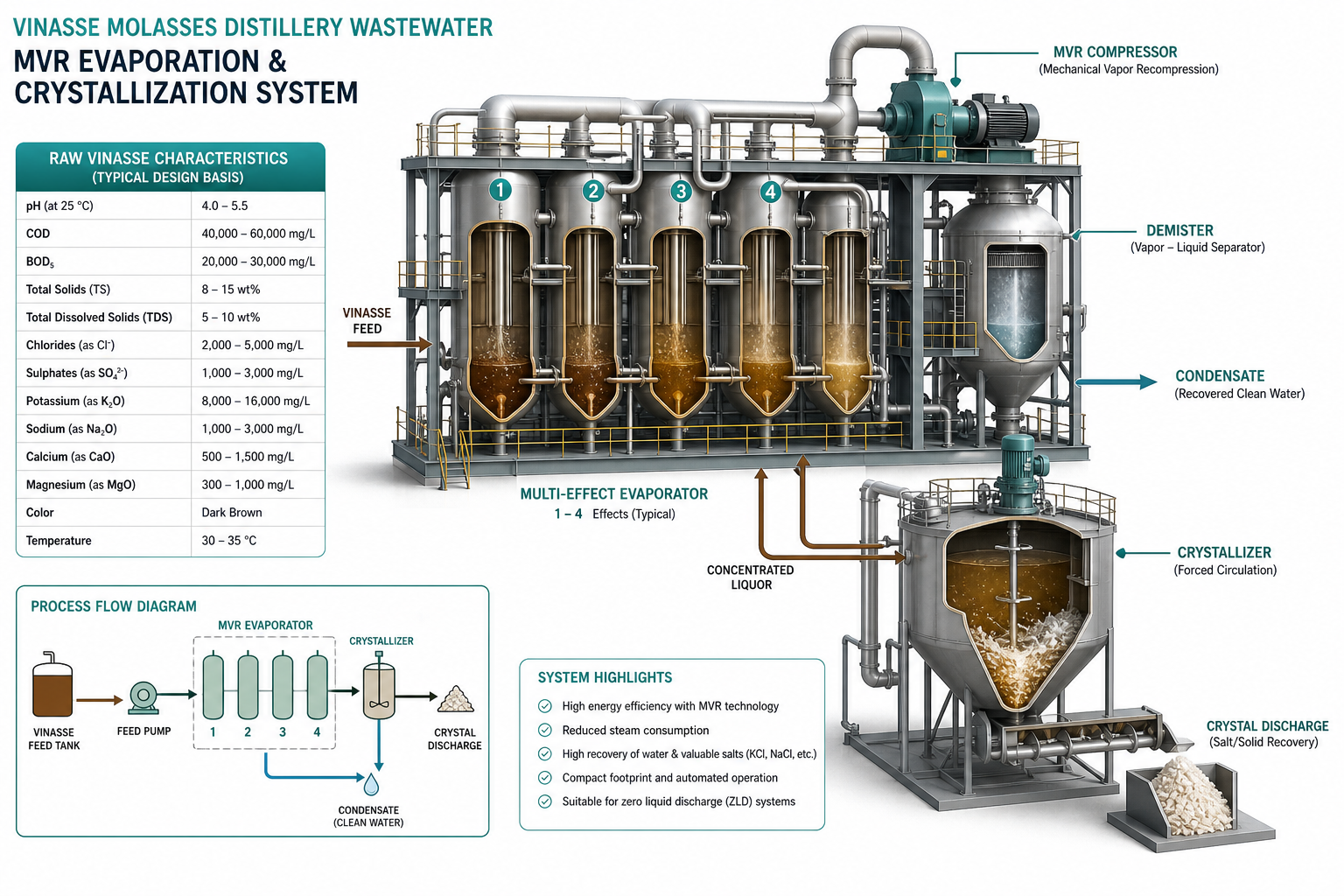
| Parameter | Illustrative Range | Design Consequence |
|---|---|---|
| COD | 100,000–150,000 mg/L | Direct biological treatment requires massive dilution |
| BOD | 60,000–90,000 mg/L | High biogas potential if anaerobic pre-treatment is added |
| Dry matter (raw) | typically 8–15% | Large evaporation duty per tonne of final product |
| Key nutrients | K, N, P plus fulvic-acid organics | Concentrate is marketable as organic fertilizer |
| Other constituents | Organic acids (acetic, butyric), high salinity | Corrosion and odor control drive material selection |
The ranges above are an illustrative feed envelope assembled from published vinasse characterizations, not a project datasheet; site-specific analysis governs design.
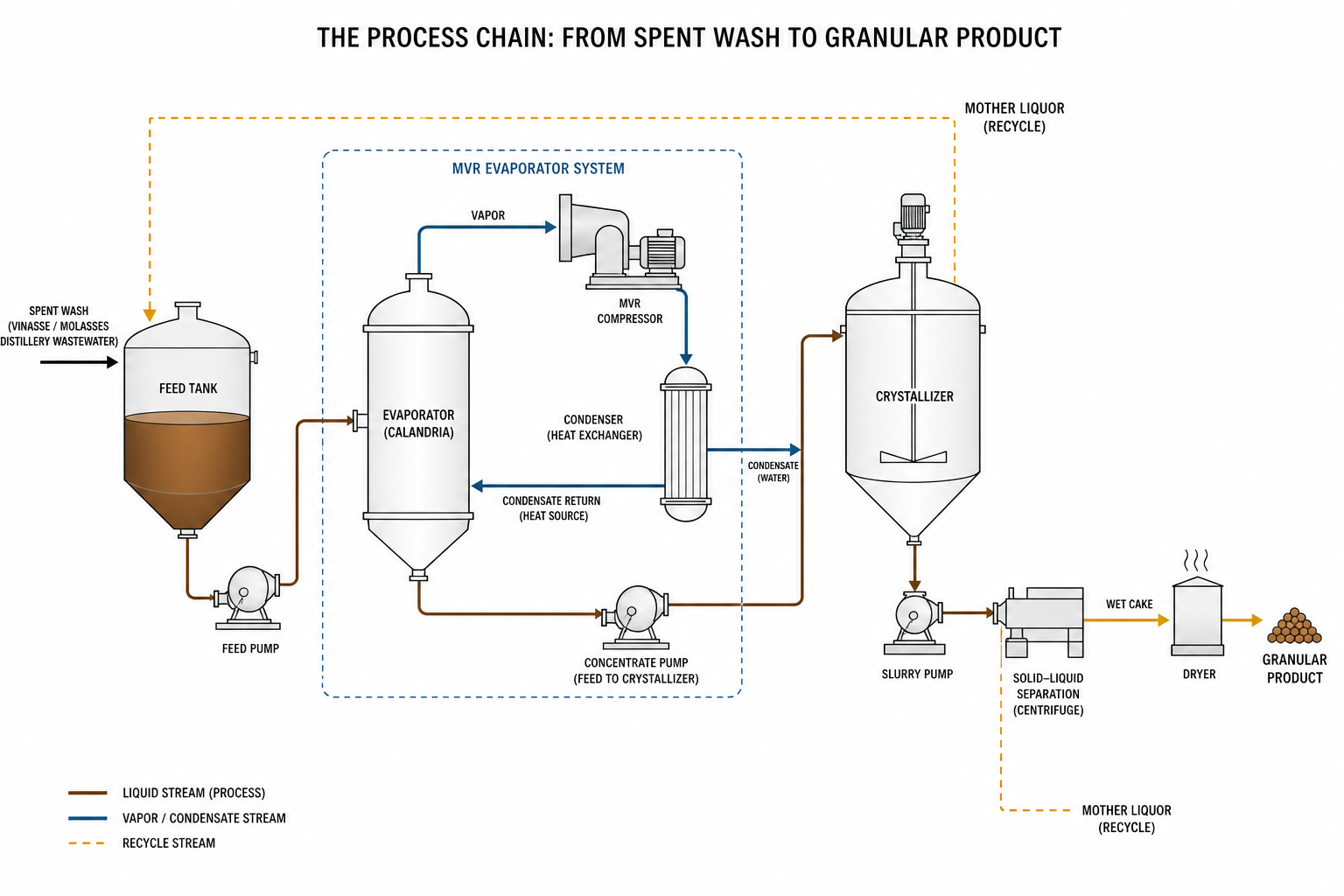
The Process Chain: From Spent Wash to Granular Product
1. Pre-treatment and optional anaerobic stage
Screening removes residual grain and fiber. Where biogas recovery is attractive, an anaerobic digester ahead of the evaporator removes part of the soluble COD and yields methane that can cover startup steam or drive the MVR compressor electrically. Digestate liquor then feeds the evaporator at a lower fouling load than raw vinasse.
2. MVR forced-circulation evaporation
The evaporator body is a forced-circulation design: a large-flow pump pushes liquor through the heat exchanger tubes at velocities high enough that boiling is suppressed inside the tubes and occurs only in the flash separator. This keeps the heat transfer surface wetted and washing, which is the only reliable way to run calcium-rich vinasse between cleanings. Under MVR, the secondary vapor from the separator is recompressed by a centrifugal or roots compressor and returned to the shell side as heating steam — live steam is needed only for startup preheating. For plants without favorable electricity tariffs, the same evaporator bodies run as double- or triple-effect systems, reusing vapor from effect to effect and cutting energy use by up to 60% compared with single-effect operation.
3. Deep concentration
For fertilizer-grade slurry, concentrating to 30–40% solids is often the economic stopping point; the slurry can be granulated directly or sold as liquid fertilizer. For a dry granular product, a second concentration stage takes the liquor (starting from pre-concentrated vinasse at roughly 60% solids) up to 88–90% solids under low-temperature vacuum, which preserves the fulvic-acid and nutrient value that high-temperature drying would degrade.
4. Scraped-surface drying
Above about 88% solids, viscosity and stickiness climb steeply and ordinary dryers foul. A paddle-type scraped-surface dryer keeps the mass moving against heated surfaces and discharges a solid cake with final moisture of 3% or less.
5. Granulation and packing
Dry extrusion granulation forms the cake into uniform pellets, with size and shape adjustable to the fertilizer or feed market being served. The granular product is stable, baggable, and far cheaper to transport than liquid vinasse concentrate.
At procurement level the chain resolves into four core modules:
| Module | Candidate Equipment Types | Selection Rationale | Indicative Operating Envelope |
|---|---|---|---|
| Pre-treatment and digestion | Screens; anaerobic digester (optional) | Removes fiber; biogas offsets startup steam or compressor power | Digestate feed at lower fouling load |
| MVR evaporation | Forced-circulation body; centrifugal or roots compressor | Suppresses tube boiling; handles calcium-rich scaling liquor | 20–40 kWh per tonne water (published range) |
| Deep concentration | Second-stage forced-circulation body under vacuum | Low-temperature path preserves fulvic-acid nutrient value | 30–40% slurry or 88–90% solids endpoint |
| Drying and granulation | Scraped-surface paddle dryer; extrusion granulator | Stickiness above 88% solids excludes ordinary dryers | Final moisture 3% or less |
Configuration, materials, and ranges depend on actual feed, corrosion review, fouling behavior, utilities, and project capacity.
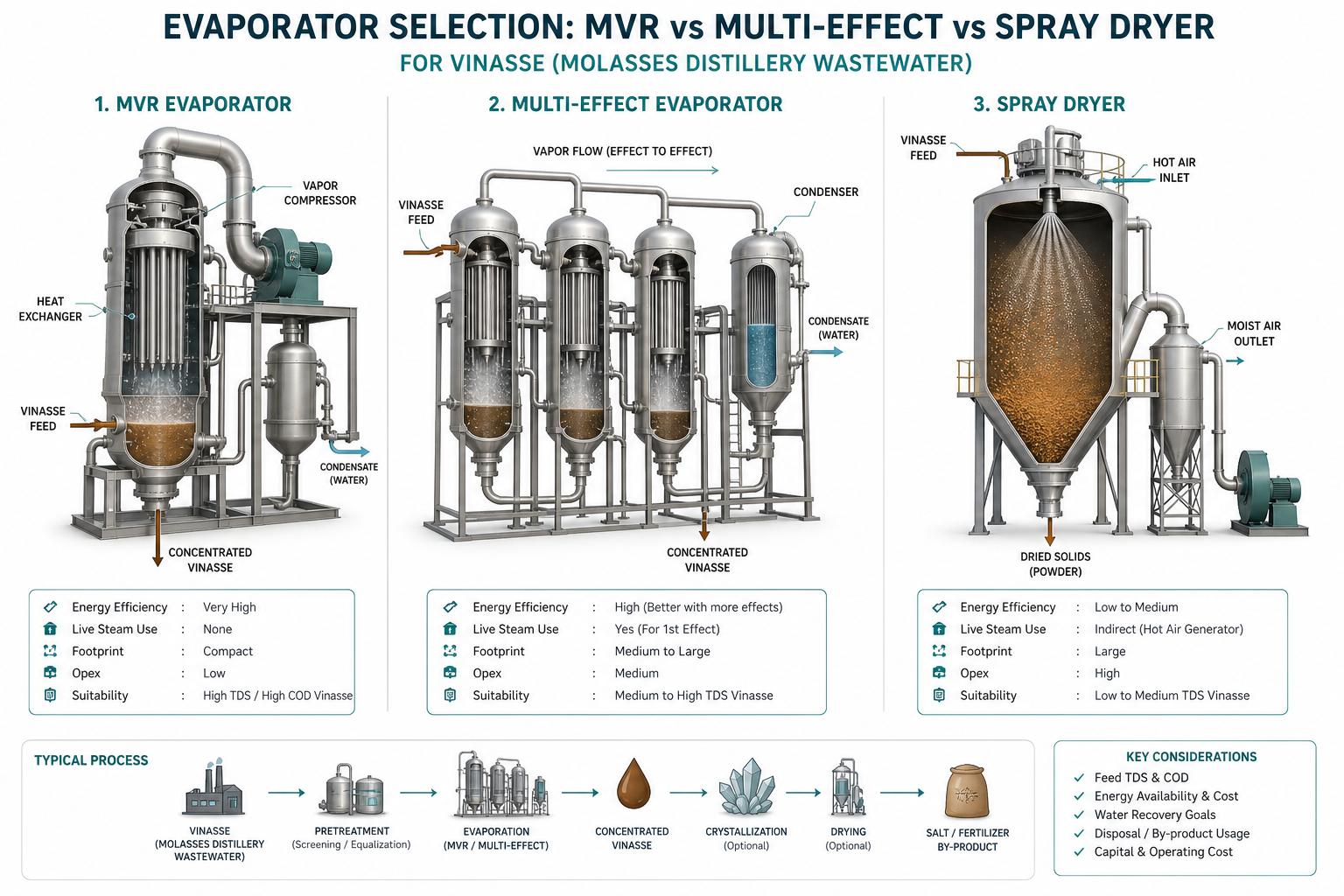
Evaporator Selection: MVR versus Multi-Effect versus Spray Drying
| Option | Energy Character | Notes for Vinasse |
|---|---|---|
| MVR forced circulation | Near-zero live steam after startup; energy demand shifts to electricity; evaporation duty typically delivered at 20–40 kWh per tonne of water for high-BPE organics | Best where electricity is competitively priced; lowest operating cost at scale |
| Double/triple-effect forced circulation | Steam consumption cut up to 60% versus single effect (industry-reported) | Proven fallback where power tariffs are high or steam is cheap; same bodies can often be MVR-retrofitted |
| Spray drying | Highest energy input; traditionally coal-fired | Air emissions, CO2 penalty, and high cost make it a last resort for vinasse |
| Evaporation ponds | No energy, huge land | Groundwater contamination risk; increasingly prohibited |
More background on compressor-driven evaporation is covered in MVR evaporation systems, and the drying and granulation stages are described in drying and packing systems.
Condensate Quality and Closing the Water Loop
Because vinasse is foaming and carries volatile organic acids and alcohols, the first condensate is not boiler-feed quality. A well-designed vapor-liquid separator with demister stages, plus condensate segregation by effect, lets the plant route the cleanest fraction to fermentation dilution water and send the dirtier fraction to a small polishing stage (anaerobic or aerobic). The target is practical zero liquid discharge: no liquid leaves the site except as product moisture and boiler blowdown. A full treatment of this design philosophy is in our zero liquid discharge solutions overview.
Materials, Sizing, and OPEX Drivers
- Wetted parts: SS316L is the baseline; titanium or higher alloys are specified where chloride or aggressive organic acids are high. Evaporators in this duty are PLC-controlled, with automatic regulation of temperature, flow, and pressure.
- Capacity range: standard designs cover 10–500 tonnes of wastewater per day, with larger trains built as parallel bodies sharing one vapor system.
- OPEX drivers, in order: energy price ratio (steam vs. electricity), target final solids, and cleaning frequency. Each of these is a process decision made before the equipment is fabricated — which is why a heat-and-material balance on the actual vinasse analysis is the first engineering deliverable, not an afterthought.
Five Failure Modes Seen in Vinasse Evaporation Projects
- Porting a falling-film design from corn stillage service. Calcium scale and high viscosity at concentration blind falling-film distributors; forced circulation is the robust choice for this liquor.
- Undersized separator / demister. Foam carryover sends COD into the condensate and the “closed water loop” quietly fails.
- Ignoring boiling point elevation at high solids. As solids climb past roughly 50%, viscosity and BPE rise together and the available temperature difference collapses; compressor lift must be checked at end-of-concentration conditions, not just at design inlet.
- Assuming condensate is clean. Volatile acids and fusel oils contaminate the first condensate; segregation and polishing must be in the P&ID from day one.
- Mismatched dryer. Above 88% solids the concentrate is sticky and adhesive; only scraped-surface or paddle dryers handle it without turning into a cleaning outage.
Product Quality and Market Outlets
The granular end product from this route is a potassium-rich organic fertilizer with adjustable pellet size, stable handling, and nutrient value preserved by low-temperature vacuum concentration — a meaningful advantage over spray drying, whose higher thermal load degrades fulvic-acid organics. Distilleries that pair the evaporator with an anaerobic front end additionally recover biogas from the removed COD, which typically offsets the startup steam demand of the evaporation train. The combined plant therefore sells two products — alcohol and fertilizer — from one feedstock, while buying neither fresh dilution water for treatment nor land for pond storage.
Validation focus. Figures in this article reflect industry-reported practice and published distillery-effluent characterizations, not EvapCryst deliveries — indicative, not a project guarantee. Before committing this route, analyze the actual vinasse in full (COD, dry matter, potassium, calcium, sulfate), measure viscosity and foaming on real liquor, and confirm concentrate offtake within hauling distance. The checklist below consolidates these gates.
When This Route May Not Fit
Evaporation-and-recovery is the wrong first move where land and dilution water remain cheap and discharge limits are loose: a distillery with pond capacity and weak enforcement gets more value from conventional storage than from an MVR train that must be financed against fertilizer revenue. The route also misfits small or seasonal molasses operations, because forced-circulation bodies and scraped-surface dryers only pay back across sustained throughput, and a plant running a few months per crush season carries the capital all year. Where the local power tariff is high and biogas is absent, multi-effect steam or a hybrid becomes the better energy choice even though the bodies themselves stay the same. And where no offtake exists for potassium-rich concentrate — liquid or granular — the project relocates pollution rather than recovering value.
What Must Be Verified
Before a vinasse project is committed, the following must be verified against site data rather than the illustrative envelope above. A full analysis of the actual vinasse — COD, BOD, dry matter, potassium, calcium, sulfate, oxalate, and chloride — because scale formers and corrosion drivers set both the evaporator type and the alloy plan. Measured viscosity and boiling point elevation at end-of-concentration solids, checked against available compressor lift where MVR is planned. Foaming and entrainment behavior, confirmed by evaporation trials on real liquor rather than literature values. Condensate quality targets by effect, against fermentation dilution requirements. A credible fertilizer offtake for the concentrate at the chosen solids endpoint, and a utility review of electricity versus steam pricing that fixes the MVR-versus-multi-effect decision.
Frequently Asked Questions
What is vinasse and why is it so hard to treat?
Vinasse is the liquid residue after molasses fermentation and ethanol stripping. It typically contains COD of 100,000–150,000 mg/L, BOD of 60,000–90,000 mg/L, high salinity, organic acids, and a strong dark color. Its concentration means biological treatment requires huge dilution water volumes, while its potassium and nutrient content makes concentration-and-recovery the more economical route.
Can vinasse really be turned into fertilizer or animal feed?
Yes. Evaporation to 30–40% solids yields a liquid organic fertilizer; deeper concentration to 88–90% solids followed by scraped-surface drying (final moisture ≤3%) and extrusion granulation produces a stable, baggable potassium-rich organic fertilizer. Formulated feed-grade outlets are also practiced where the molasses source and impurity profile are controlled.
Why forced circulation instead of falling film for vinasse?
Vinasse contains calcium sulfate, calcium oxalate, and organic scale precursors, and its viscosity rises steeply with solids. Forced circulation suppresses boiling inside the tubes, keeping the heating surface scoured and wetted. Falling-film designs, which depend on a stable gravity film on the tube wall, foul and dry out rapidly on this liquor.
How much energy does MVR save compared with steam-driven evaporation?
MVR reuses all secondary vapor as heating steam after mechanical recompression, so live steam is consumed only at startup. Against a single-effect steam system, multi-effect forced circulation already cuts energy use by up to 60%, and MVR goes further by replacing most of the remaining steam with electricity — typically the lowest-cost option where power tariffs are reasonable.
What capacity range is available?
Standard molasses-wastewater evaporation systems are engineered from 10 to 500 tonnes per day of wastewater feed. Larger distilleries run parallel evaporator bodies on a shared vapor and condensate system, sized from the actual vinasse analysis and target solids.
Next step: send your vinasse analysis, daily feed rate, and target product form, and receive a first-pass screening of the process direction and boundary conditions — inputs exchanged for engineering direction.