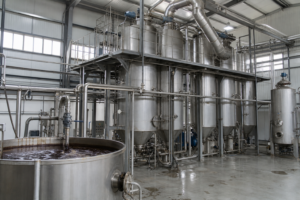
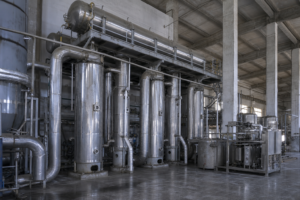
Xylose — the pentose sugar extracted from corn cobs and other hemicellulose-rich biomass and the feedstock for xylitol — is won or lost in the evaporation and crystallization section. The hydrolysis liquor that reaches this section is hot, acidic, colored and loaded with organic impurities, while the product itself is heat-sensitive and its viscosity climbs steeply as it concentrates. The solution that works is a two-stage concentration design — pre-concentration on multi-effect falling-film or MVR evaporation followed by finish concentration at low temperature — feeding a controlled cooling crystallization step that fixes crystal size and purity, with mother liquor recycled to recover the sugar left behind. Plants that respect the material’s thermal and viscosity limits recover more sugar per ton of cob, at lower energy per ton of product, than plants that treat xylose liquor like generic wastewater.
From Corn Cob to Crystal: Where Evaporation Sits in the Process
Xylose and xylitol are made from agricultural residues — corn cobs principally, with sugarcane bagasse, sawdust and straw also used. The chain is: size reduction of the raw material; dilute-acid hydrolysis that cleaves hemicellulose into pentose sugars; neutralization; then the purification-and-concentration sequence that defines product economics — decolorization (typically activated carbon), filtration and ion-exchange refining, evaporation concentration, crystallization, centrifugal separation and drying. Every step before evaporation exists to protect it: the cleaner the liquor entering the evaporator, the higher the heat-transfer coefficient stays and the fewer color bodies get concentrated into the crystal later.
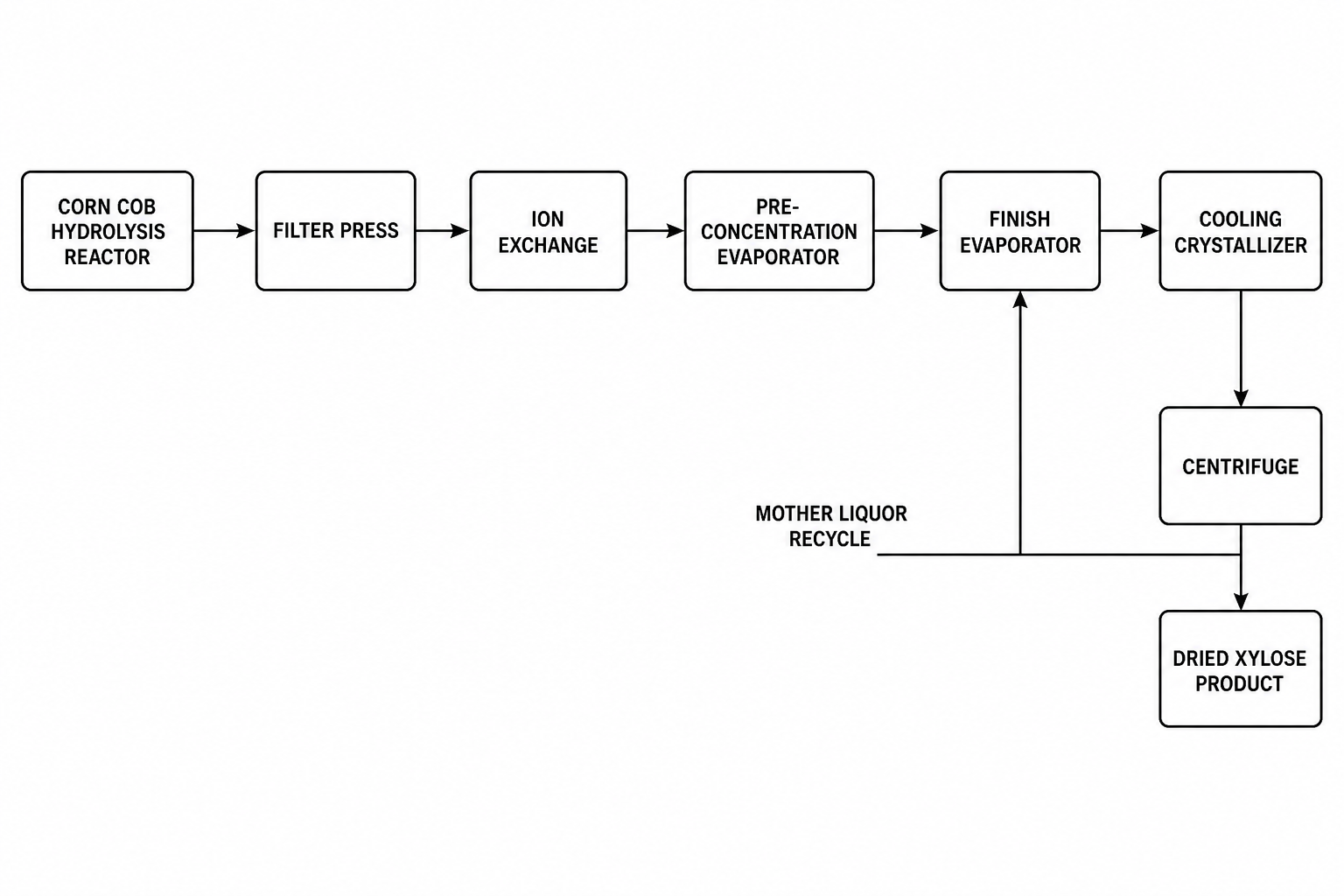
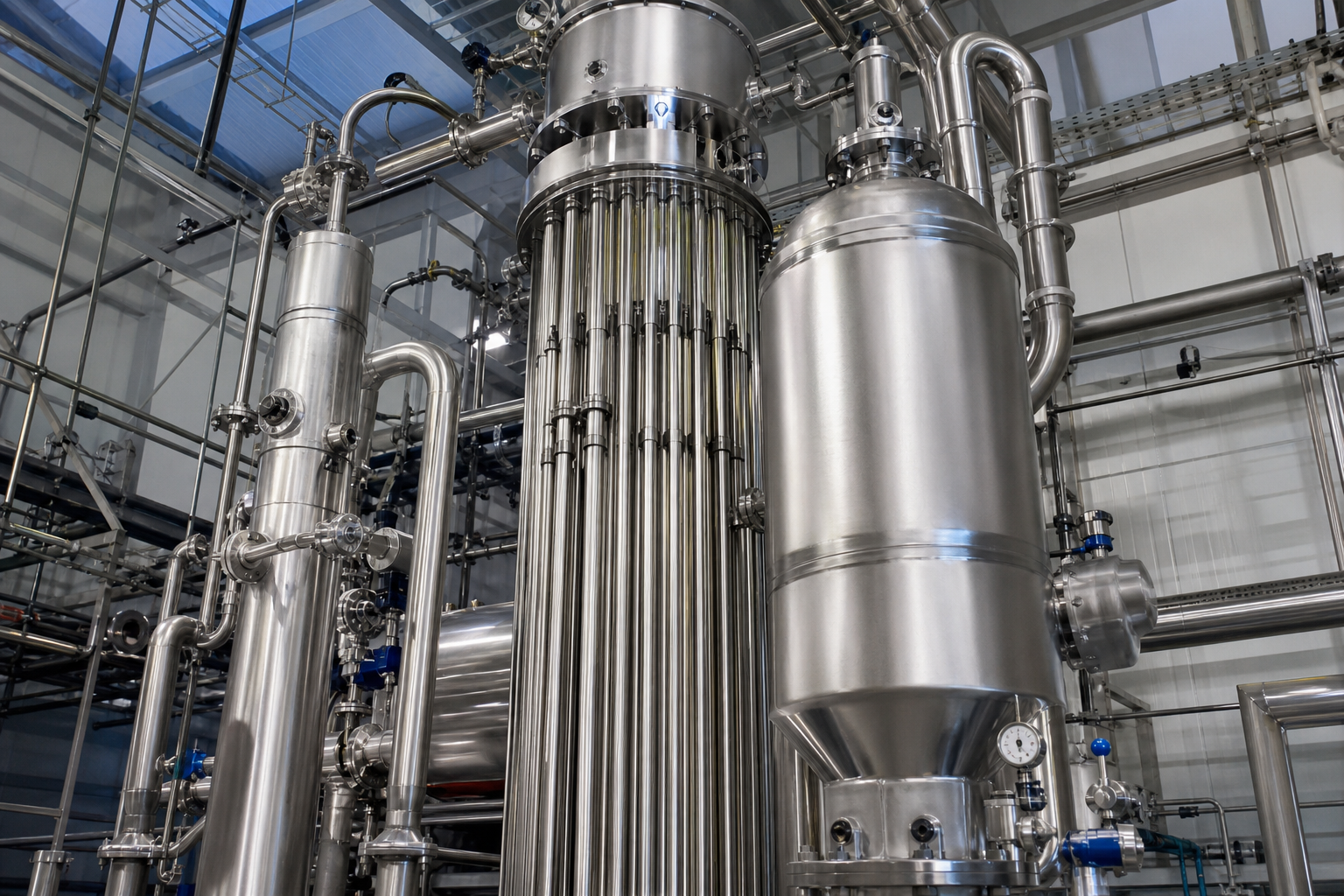
Evaporation is a key production link rather than a utility add-on, for a simple reason: the hydrolysis liquor is mostly water. Removing that water dominates the plant’s energy budget, and the sugar’s intolerance of long hot residence times dominates its quality. Both constraints point at the same equipment family — vacuum falling-film evaporators with short residence time — which is why falling-film technology has displaced other evaporator types across the fermentation and corn-processing industries.
The Two Material Constraints That Size the Equipment
Viscosity. Sugar solutions thicken steeply with concentration. Published reference behavior is instructive: a glucose-type aqueous solution at 30% solids and 50°C has a viscosity around 2 cP, while at 75–78% solids and 60°C it reaches roughly 100 cP. Design practice keeps falling-film duties below about 450 cP; beyond that, film distribution fails, dry patches form and tubes foul. The consequences for xylose are direct: as liquor approaches crystallization concentration, the evaporator needs generous heat-transfer area, larger distribution perforations and often a forced-circulation finisher where a falling film would starve. Under identical capacity, heating area for sugar service runs substantially larger — on the order of 30% more than for thin media such as dairy or water duty — because evaporation intensity is deliberately kept low.
Heat sensitivity. Pentose sugars and their impurities darken and degrade with temperature and time. Color formed in the evaporator survives decolorization downstream only at a cost, or not at all. The design response is vacuum operation — boiling temperatures are held low across the train — plus short residence time per pass and clean distribution so no liquor element lingers hot. The same logic drives effect-count economics: adding effects lowers the temperature driving force per effect, which is exactly what a heat-sensitive sugar wants.
Two-Stage Concentration: Pre-Concentration and Finish Concentration
Splitting the evaporation duty into two stages is the standard robust design for xylose liquor. Stage one — pre-concentration takes the dilute refined liquor (single-digit to low-double-digit solids) up to an intermediate concentration where viscosity is still film-friendly and fouling is mild; this is where the overwhelming majority of the water leaves, so this stage is where multi-effect design or MVR pays for itself. Stage two — finish concentration raises the liquor to crystallization feed concentration at low temperature, often in a separate body configured for higher viscosity (forced circulation or a specially rated falling film), with shorter runs and washing built into the schedule.
| Parameter | Pre-Concentration Stage | Finish Concentration Stage |
|---|---|---|
| Feed solids | Dilute refined liquor | Intermediate concentrate |
| Water removed | Majority of total duty | Small fraction, high viscosity impact |
| Preferred configuration | Multi-effect falling film or MVR | Low-temperature body rated for viscosity; forced circulation where film limits are exceeded |
| Design focus | Energy efficiency per ton of water | Color control, fouling management, accurate final concentration |
| Cleaning philosophy | Long campaigns; scheduled CIP | Shorter cycles; wash designed into operation |
Crystallization: Cooling Into Product
Xylose crystallizes from the concentrated liquor by cooling — the solubility of the sugar falls with temperature while that of the impurities largely does not. The engineering is classic cooling-crystallization discipline: seed the liquor deliberately rather than letting it nucleate itself; cool along a program that keeps supersaturation inside the metastable zone so crystals grow rather than multiply; manage the slurry’s rising viscosity as temperature drops; and classify or hold long enough for the crystal size distribution the market wants. Vacuum (adiabatic) cooling and surface-cooled crystallizers are both applied, the choice trading utility simplicity against fouling behavior at high solids.
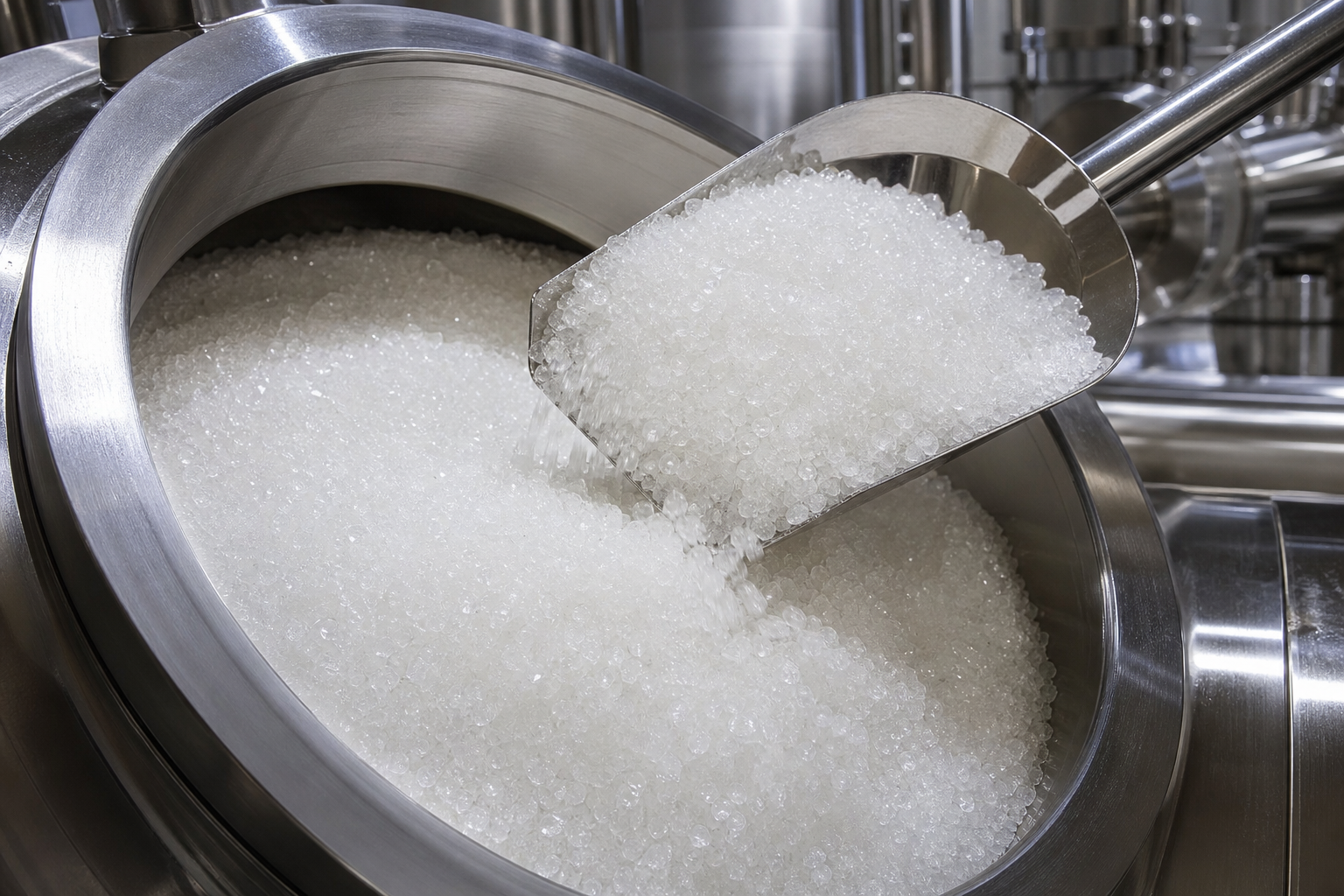
The mother liquor deserves as much design attention as the crystals. First-pass crystallization never exhausts the sugar, so mother liquor returns — to finish concentration directly, or into the purification train where impurity levels demand it. Each recycle concentrates non-sugars, so the scheme includes a purge whose sugar content is recovered or accepted; this balance between recovery rate and impurity ceiling is one of the two or three decisions that most influence overall sugar yield per ton of raw material. Centrifugation then separates and washes the crystals, and a low-temperature dryer delivers the free-flowing product without caking.
Energy and System Selection: Multi-Effect, MVR, or Hybrid
Because pre-concentration removes the bulk of the water, its scheme decides the plant’s energy signature. Multi-effect evaporation remains the reference choice: three or four effects are the sweet spot for sugar service — beyond that, each additional effect raises equipment cost significantly while the incremental operating-cost saving becomes small and the liquor’s total residence time lengthens, which heat-sensitive sugars penalize. MVR compression cuts live-steam consumption dramatically where electricity is economically favorable and suits the low-temperature profile the sugar demands; it is increasingly the default for new fermentation-industry concentration. TVR sits between them where the site has suitable motive steam. A competent comparison prices each scheme against the site’s actual steam-and-power balance and includes the ancillary loads — condenser water, vacuum system, electrical infrastructure — rather than headline steam figures alone.
Integration with the purification train is the other half of the design. Ion-exchange and carbon regeneration consume water and heat; evaporator condensate, being hot and clean, is the natural make-up for those services; and the decolorization load downstream of evaporation depends directly on how gently the liquor was heated upstream. The evaporation system and the refinery should be engineered as one heat-and-water balance.
Hygienic Design and Materials
Xylose for food and pharma applications is produced under hygienic design rules: polished austenitic stainless wetted surfaces, clean-in-place circuits designed into the evaporator bodies and crystallizers, full drainability, and validated cleaning programs between campaigns. The acid hydrolysis heritage of the liquor also argues for material diligence — pH excursions and chloride accumulation at hot points follow the same alloy-selection logic that protects any evaporation train, and are covered in our corrosion and material-selection discussion for brine-class duties.
Scope of a Delivered Solution
A xylose concentration-and-crystallization project spans: characterization of the actual hydrolysis and refined liquors (solids, viscosity-temperature behavior, color, mineral content); selection and sizing of the two-stage evaporation train; the crystallization system with its cooling, seeding and classification design; centrifuge, dryer and packing integration; energy system engineering (multi-effect, MVR or hybrid); hygienic and materials engineering; and automation holding the concentration and cooling programs that crystal quality depends on. Published application references in the wider fermentation and corn-processing field — glucose, vitamin-C and xylitol concentration duties — describe the same family of governing material constraints.
Validation focus. The design above leans on assumptions that must be verified against the actual liquor before equipment is fixed: the refined liquor’s viscosity-temperature-concentration curve (it sizes the finish stage and decides where falling film hands over to forced circulation), its color-formation kinetics at candidate boiling temperatures, and the impurity build-up behavior that sets the mother-liquor purge policy. Verification runs on measured liquor properties across the concentration range, bench cooling-crystallization tests with the real liquor for yield and crystal-size behavior, and fouling trials on heated surfaces – not on generic sugar-service assumptions.
Read as process modules, the xylose route looks like this – candidate equipment types, the selection rationale, and the indicative operating envelope each module must cover (envelopes derived from published industry data, not project specifications):
| Process Module | Candidate Equipment Types | Selection Rationale | Indicative Operating Envelope |
|---|---|---|---|
| Liquor purification | Activated carbon, filtration, ion exchange | Protects evaporator heat transfer and crystal color | Decolorization ahead of concentration |
| Pre-concentration | Multi-effect falling film or MVR | Bulk water removal at best energy per ton | Dilute liquor up to intermediate solids |
| Finish concentration | Low-temperature falling film or forced-circulation body | Viscosity and color control at final solids | Film duty kept below about 450 cP design practice |
| Cooling crystallization | Vacuum adiabatic or surface-cooled crystallizer | Solubility fall with temperature drives yield | Seeded, metastable-zone cooling program |
| Crystal separation | Centrifuge with crystal washing | Mother-liquor removal sets crystal purity | Purge policy balances yield against impurity ceiling |
| Drying | Low-temperature dryer | Free-flowing product without caking | Gentler duty than generic sugar drying |
Configuration, materials, and operating ranges depend on the actual feed, temperatures, pressures, corrosion review, fouling behavior, utilities, and project capacity.
When This Route May Not Fit
This route assumes a refined liquor worth crystallizing. Where the hydrolysis and purification stages cannot deliver decolorized, low-mineral liquor, cooling crystallization yields off-color crystal and the project degenerates into syrup production. Very small campaigns may not amortize a two-stage train with MVR or four effects; a simple single-effect vacuum pan is honest equipment at that scale. If the product is xylitol rather than xylose, the hydrogenation step changes the downstream balance and the crystallization duty with it. And sites whose power is expensive while steam is cheap should check whether the MVR default inverts before committing.
What Must Be Verified
Before the train is configured: the actual liquor’s viscosity-concentration-temperature curve through to crystallization feed solids; its heat-sensitivity limits expressed as acceptable boiling temperature and residence time; color and mineral analysis of the refined liquor, which set the decolorization load and the purge policy; and a bench cooling-crystallization test confirming yield and crystal size on the real material. On utilities, the site’s steam-versus-power economics decides multi-effect, MVR, or hybrid. Hygienic requirements for the target market – food versus pharma – fix the materials and cleaning scope. Each of these inputs changes equipment selection; none can be substituted by generic sugar-service data.
FAQ
Why does xylose liquor need two-stage concentration?
Because its constraints change as it concentrates. Early on the liquor is thin and the job is bulk water removal, which favors energy-optimized multi-effect or MVR falling film. Near crystallization feed concentration, viscosity rises steeply and color formation becomes the risk, so the duty shifts to a low-temperature finish stage rated for thick liquor. One stage cannot be optimal for both.
How viscous can sugar liquor get before falling-film evaporators struggle?
Design practice for falling-film duty tops out around 450 cP; above that, film distribution breaks down and surfaces foul. Sugar solutions pass from a few cP at moderate solids to around 100 cP at high solids, which is why finish concentration often uses forced circulation and why sugar service carries generous heating area — roughly 30% more than thin-media duty at equal capacity.
Multi-effect or MVR for a xylose plant?
Three or four effects are the proven sweet spot for sugar service; more effects buy small operating savings at disproportionate capital cost and longer hot residence time. MVR suits sites where power is favorable and cuts steam sharply while matching the low temperatures xylose needs. The decision belongs to the site’s steam-versus-power economics.
How is crystal size controlled in xylose crystallization?
By seeding deliberately and cooling along a program that holds supersaturation in the metastable zone, so existing crystals grow instead of new nuclei forming. Slurry viscosity, agitation intensity and crystal residence time are managed together, and classified discharge or fines destruction tightens the size distribution.
What happens to the xylose mother liquor?
It is recycled — to finish concentration or through the purification train — because it still carries recoverable sugar. The recycle works against rising impurity concentration, so the design fixes a purge policy that balances sugar recovery rate against purity of the crystal crop; this policy is a main driver of yield per ton of corn cobs.
To start a first-pass screening, send the hydrolysis-liquor analysis (solids, viscosity behavior, color, minerals) and the target outputs – crystal specification and yield intent – for this concentration-and-crystallization route.