Dimethyl carbonate (DMC) production from natural gas or coal is fundamentally a methanol-derivative project wrapped around one of the hardest routine separations in the commodity chemicals industry: breaking the DMC-methanol azeotrope. An integrated fossil-to-DMC complex links syngas, methanol synthesis, one of four DMC reaction routes, and – decisively for plant economics – a purification train built on pressure-swing, extractive, or azeotropic distillation that recovers methanol at purities the reaction section can reuse. Projects that treat the reaction chemistry as the whole story and the separations as an afterthought pay for it in steam, yield, and off-spec product; integrated solution providers scope the whole chain from the feedstock to battery- or polycarbonate-grade product.
Four Routes to DMC, and What Fossil Integration Changes
DMC was historically made from phosgene – a route now effectively obsolete for new plants on safety and environmental grounds. Modern capacity uses four families of technology:
| Route | Key Inputs | Co-products / Loops | Notes for Fossil-based Projects |
|---|---|---|---|
| Methanol oxidative carbonylation (liquid phase) | Methanol, CO, O2, CuCl catalyst system | Water; catalyst corrosion management | Direct methanol route; chloride corrosion drives metallurgy selection |
| Methanol oxidative carbonylation (gas phase, methyl nitrite cycle) | Methanol, CO, O2, NO | Methyl nitrite regenerated in closed loop | NOx handling; strong fit with large methanol complexes |
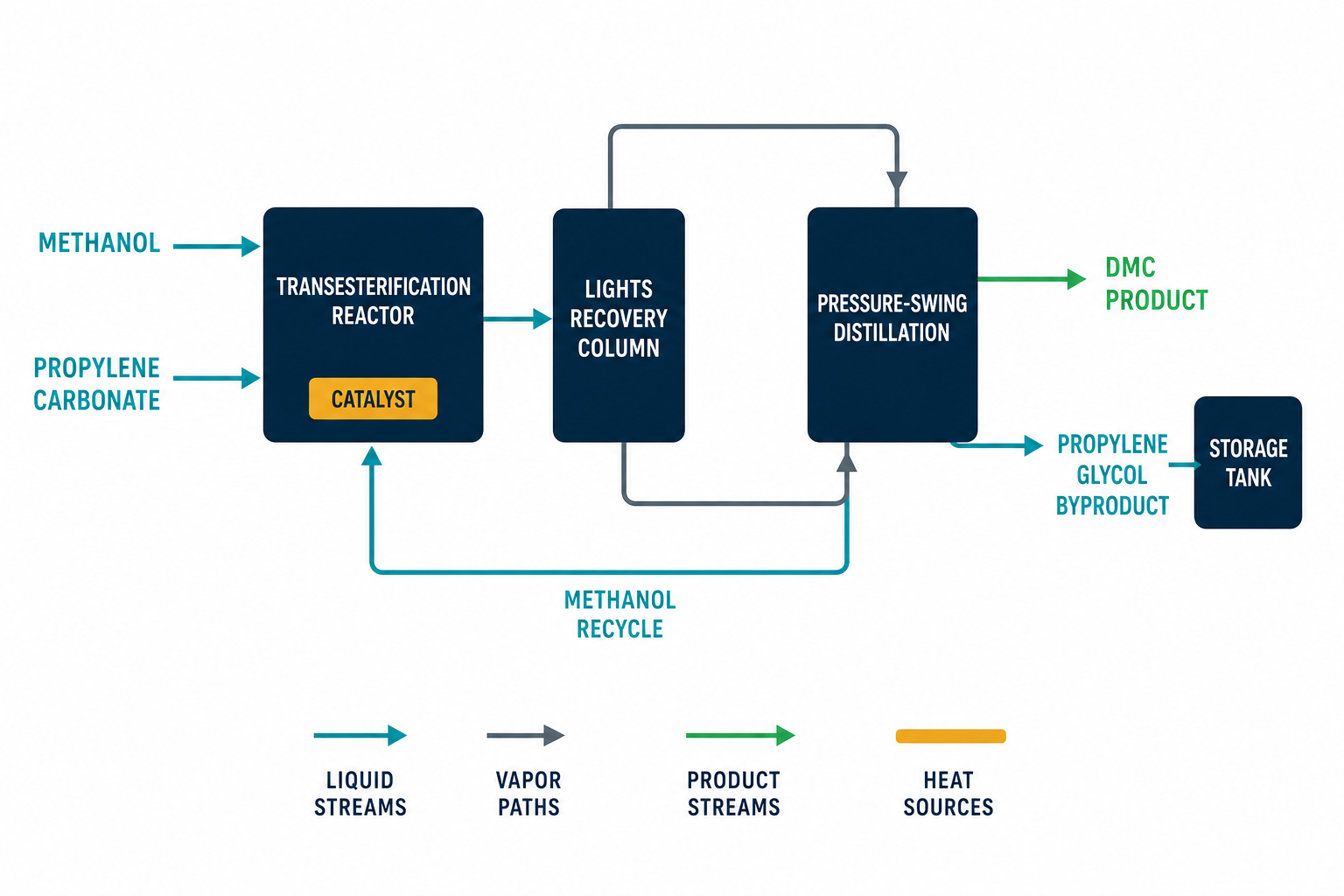
| Transesterification | Propylene oxide (or ethylene carbonate), CO2, methanol | Propylene glycol co-product (stoichiometric ~0.84 t per t DMC) | Dominant where PO is available; glycol marketing is part of plant economics |
| Urea alcoholysis | Urea, methanol | Ammonia (2 mol per mol DMC) recycled to the urea plant | Natural coupling for coal-to-chemicals sites with existing urea capacity |
Natural-gas- and coal-based integration matters because both feedstocks arrive as syngas first. Coal and natural gas are converted to syngas, then to methanol; the DMC island then draws methanol, CO, and (for the ureal route) ammonia/urea from the surrounding complex. The result is a single material loop in which methanol is simultaneously the feedstock, the reaction medium, and the recycle stream – and the distillation train that separates DMC from methanol is the gatekeeper of the entire economy.
The Azeotrope: Why DMC Purification Is the Real Project
Methanol and DMC form a minimum-boiling azeotrope at atmospheric pressure, boiling near 63-64°C at a composition of roughly 70% methanol to 30% DMC. Conventional distillation at atmospheric pressure cannot cross this barrier: the column overhead simply reproduces the azeotropic mixture no matter how many trays are added. Every DMC plant therefore deploys one of four strategies:
| Separation Strategy | Principle | Typical Operating Window | Trade-offs |
|---|---|---|---|
| Pressure-swing distillation | Azeotrope composition shifts (and can disappear) with pressure | High-pressure columns operating on the order of 2-3 MPa where the azeotrope breaks | No entrainer; thick-walled vessels and higher compressor/pump energy |
| Azeotropic distillation | Entrainer (historically benzene or cyclohexane) forms a ternary overhead | Atmospheric or modest pressure | Entrainer losses and toxicity concerns; largely superseded |
| Extractive distillation | Selective solvent alters relative volatility of methanol vs DMC | Solvent-to-feed ratios set by solvent selection | Solvent recovery column adds energy but keeps system additive-free |
| Membrane / hybrid pervaporation | Membrane preferentially permeates methanol | Debottleneck and polish duty | Scale and membrane lifetime; usually hybridized with distillation |
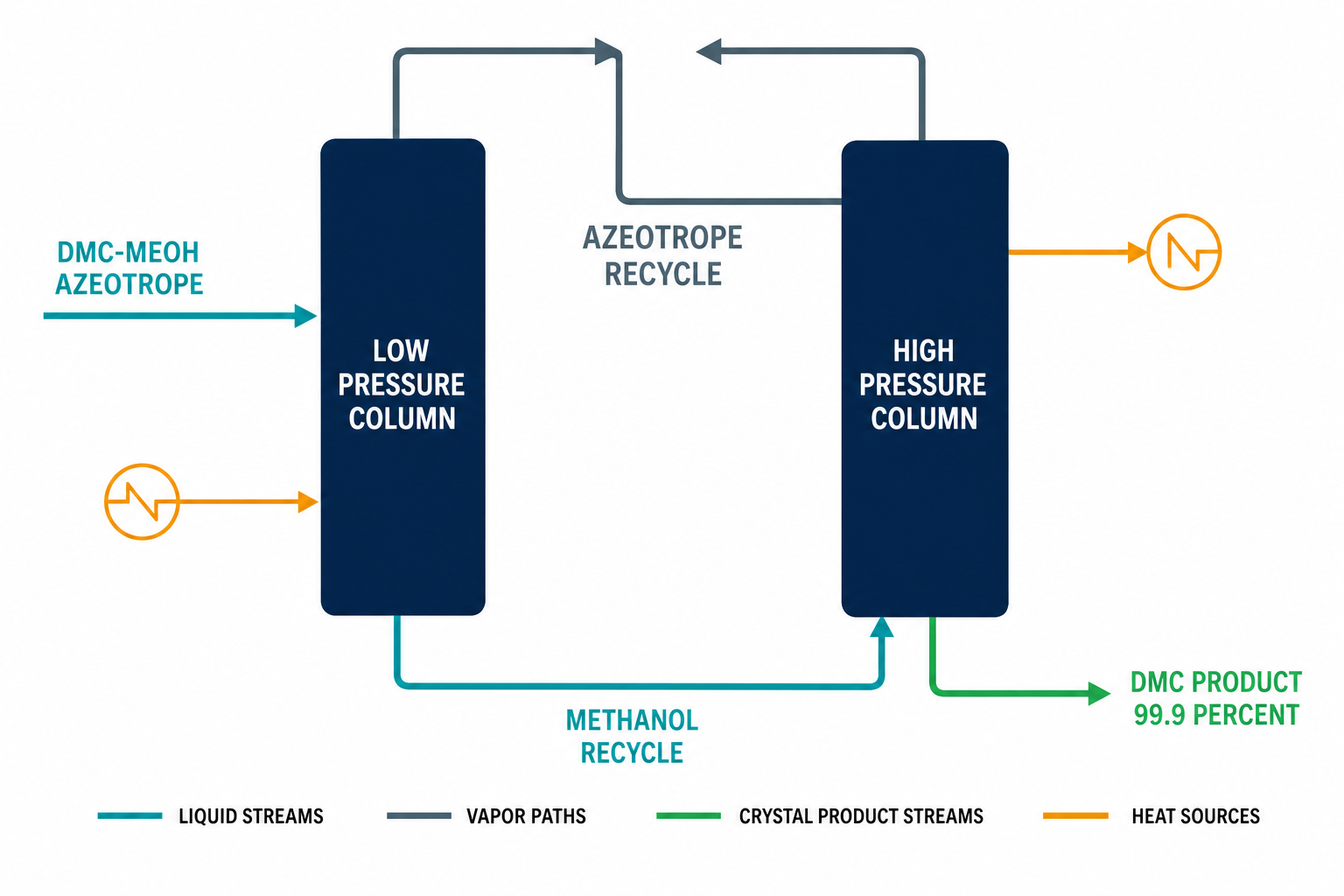
The pressure-swing approach deserves emphasis for fossil-integrated projects: at elevated pressure the DMC-methanol azeotrope weakens sufficiently that conventional columns in series can deliver polymer-grade and battery-grade DMC without any entrainer contacting the product. The price is mechanical – heavy-wall columns rated around 2-3 MPa class – but on a coal or gas complex where steam and power are internally generated, the trade frequently wins.
Product Grade Requirements Drive the Flowsheet
Two premium outlets set the bar:
- Battery / electrolyte grade: DMC destined for lithium-ion electrolyte must meet stringent limits on water, free acid, residual methanol, and conductive impurities – typically at the tens-of-ppm level or below for moisture and individual contaminants. This demands final drying/polishing columns, nitrogen-blanketed storage, and loading systems that preserve purity to the customer’s tank.
- Polycarbonate (non-phosgene) grade: DMC used to make diphenyl carbonate and then polycarbonate must be free of the same reactive impurities; DMC’s value as a green carbonylating agent – replacing phosgene and dimethyl sulfate in pharmaceutical and agrochemical synthesis – likewise punishes trace chlorides and sulfur species.
Grade control is won or lost in the details of the purification train: column materials for chloride-bearing services on the oxidative carbonylation routes, reboiler design that avoids local overheating and discoloration, and methanol recycle quality – methanol returning from the azeotrope-breaking columns carries DMC traces that, if allowed to accumulate, throttle reaction equilibrium in the synthesis loop.
Physical Hazards That Shape Plant Design
Two properties of DMC dominate layout and safety engineering. First, DMC is a low-flash-point liquid (flash point in the vicinity of 17°C, closed cup) – the whole reaction, distillation, storage, and loading envelope is Zone-classified hazardous area, requiring explosion-proof electrical equipment, nitrogen blanketing, and relief philosophy sized for fire exposure. Second, DMC’s melting point sits just above 0°C (approximately 2-4°C), so temperate- and cold-climate sites must heat-trace and insulate lines, columns draw-offs, and storage to prevent freezing during upsets and winter shutdowns – a detail that regularly surfaces when designs executed for warm-weather sites are replicated in cold climates.
Energy Integration on a Fossil Complex
DMC plants are steam-intensive almost entirely because of the azeotrope: high reflux ratios and, in pressure-swing designs, elevated operating pressures concentrate reboiler duty. Integration levers reported in published methanol-complex practice include:
- Heat coupling between methanol synthesis and DMC purification – using synthesis-loop heat or compressor discharge heat as reboiler duty for the high-pressure DMC column.
- MVR on selected columns – mechanical vapor recompression on the methanol recovery column, where temperature lifts are modest, compresses the plant’s steam signature.
- Double-effect column arrangements – high-pressure column overheads condensing against low-pressure reboilers.
- Water and effluent closure – process condensates from the syngas and methanol islands are stripped and reused; on zero-liquid-discharge sites the blowdown streams are evaporated to dryness with salt recovery.
Scope of an Integrated Fossil-to-DMC Project
Integrated solution suppliers serving this space scope from the feedstock interface (natural gas or coal gasification syngas, methanol synthesis, CO recovery) through the DMC island (reaction, catalyst handling, azeotrope-breaking purification, product polishing) to utilities and off-sites (tankage with winterization, nitrogen systems, flare, loading). The commercial logic for buying the integration rather than assembling it piecewise is the same as in other methanol-derivative chains such as POM production or fine-chemical vanillin plants: the interfaces – methanol recycle quality, steam balance, product purity chain – are where value leaks, and a single accountable engineering partner carries the guarantees across those interfaces.
Validation focus. The flowsheet decisions above rest on assumptions that deserve verification before any investment: the vapor-liquid equilibrium behavior of the actual DMC-methanol system at the intended pressure (the pressure-swing window is composition- and impurity-sensitive), the CO and methanol quality the upstream island will actually deliver across turndown, the impurity targets the commercial grade requires under the buyer’s own analytical methods, and the corrosion allowance implied by the selected catalyst chemistry. Verification runs on measured VLE data for the real liquor, corrosion testing of candidate alloys against the catalyst-bearing streams, and a purity-chain audit from column to loading – not on handbook assumptions.
Read as process modules, an integrated fossil-to-DMC project looks like this – candidate equipment types, the selection rationale, and the indicative operating envelope each module must cover (envelopes derived from published industry data, not project specifications):
| Process Module | Candidate Equipment Types | Selection Rationale | Indicative Operating Envelope |
|---|---|---|---|
| Feedstock interface | Syngas generation, methanol synthesis, CO recovery | Methanol and CO quality set DMC-island stability | Interface purity is a live operating variable |
| DMC reaction island | Oxidative carbonylation, transesterification, or urea alcoholysis reactors | Route fixed by co-product economics on the site | Catalyst make-up and bleed as routine variables |
| Azeotrope-breaking purification | Pressure-swing, extractive, or azeotropic columns; hybrid membranes | The gatekeeper of plant economics | High-pressure columns on the order of 2-3 MPa (published window) |
| Product polishing | Drying/polish columns, nitrogen-blanketed storage, closed loading | Battery- and polycarbonate-grade protection | Tens-of-ppm impurity targets |
| Winterization and utilities | Heat-traced lines and tankage, nitrogen, flare, loading | DMC freezes just above 0°C | Melting point approximately 2-4°C |
| Effluent closure | Condensate stripping and reuse; ZLD evaporation where required | Total water closure on constrained sites | Salt recovery from blowdown streams |
Configuration, materials, and operating ranges depend on the actual feed, temperatures, pressures, corrosion review, fouling behavior, utilities, and project capacity.
Explore the underlying capabilities: solvent recovery and distillation systems for azeotrope-breaking and methanol recycle columns, MVR evaporation for energy-integrated columns and effluent concentration, and zero liquid discharge solutions for total-effluent closure. Battery-grade producers will also find our lithium carbonate evaporation and crystallization solutions relevant, since DMC and lithium salts meet in the same electrolyte supply chain.
Catalyst Management and Plant Reliability
Route selection shows up in maintenance planning as much as in yield. The liquid-phase oxidative carbonylation route runs on copper-chloride catalyst systems whose chloride chemistry is corrosive to common steels; reactors, loops, and columns in catalyst-bearing service are specified in high-alloy materials with strict weld control, and catalyst make-up and bleed rates become routine operating variables. The gas-phase methyl-nitrite route avoids liquid catalyst corrosion but must police its NOx balance – the circulating methyl nitrite intermediate is both the process’s enabler and its hazard, demanding tight containment and relief design. Transesterification plants run on comparatively benign homogeneous alkali catalysts, but the catalyst must be separated from product and glycol streams (washing, ion exchange, or distillation), which adds its own consumables and effluent load.
Reliability-critical equipment across all routes is a short list: synthesis-loop compressors, high-pressure column reboilers operating in fouling service, and the pump seals handling low-flash-point DMC and methanol. Turnaround intervals and spare strategies for these items set plant availability, and availability – more than yield – decides whether a DMC asset outperforms its peers. Integrated suppliers therefore quote availability targets alongside consumption figures, and experienced buyers hold them to both.
One further reliability note specific to fossil-integrated sites: coal-based complexes deliver syngas and steam with different composition swings than gas-based ones, and CO purity feeding oxidative carbonylation is a live variable. Upsets in the methanol island propagate into the DMC island through CO and methanol quality – another argument for buying the complex-wide integration rather than an isolated DMC unit.
When This Route May Not Fit
An integrated fossil-to-DMC complex is a methanol-derivative bet: where the site has no surplus methanol, CO, or (for the urea route) ammonia, the integration premise collapses and a standalone transesterification unit on purchased propylene oxide may be the honest scope. Sites in warm climates without winterization stakes still must treat the 2-4°C melting point seriously. Where the product is commodity-grade only, entrainer-free pressure-swing hardware and battery-grade polish are over-specification. And if effluent closure is not actually required by permit, the ZLD block is optional weight rather than value.
What Must Be Verified
Before the route is fixed, four checks dominate: measured VLE data for the real DMC-methanol system at candidate pressures, since the azeotrope’s pressure shift decides whether pressure-swing works; the CO and methanol quality envelope the upstream island will deliver, including upset composition; the commercial grade specification confirmed with the actual buyer – water, free acid, residual methanol, and conductive impurity limits, measured by the buyer’s methods; and corrosion testing of candidate alloys against the chloride-catalyst or NOx-bearing streams of the selected route. Freeze-protection design for the site’s worst-case winter completes the input set.
Frequently Asked Questions
Why can’t DMC and methanol be separated by ordinary distillation?
They form a minimum-boiling azeotrope at atmospheric pressure (near 63-64°C, roughly 70% methanol). A conventional atmospheric column cannot cross that composition. Plants break the azeotrope with pressure-swing distillation (columns around 2-3 MPa where the azeotrope disappears), extractive distillation, azeotropic distillation with an entrainer, or hybrid membrane systems.
Which DMC route fits a coal or natural gas complex best?
It depends on the co-products available. Gas-phase methanol oxidative carbonylation pairs naturally with large methanol complexes; urea alcoholysis pairs with sites that already make urea, since the ammonia co-product recycles to the urea plant; transesterification fits where propylene oxide is at hand, with propylene glycol co-produced at a stoichiometric ratio of roughly 0.84 tonnes per tonne of DMC.
What purity does battery-grade DMC require?
Electrolyte-grade DMC typically specifies water and individual contaminants at tens-of-ppm levels or below, with tight limits on free acid, residual methanol, and conductive impurities. Achieving this requires polish drying columns, nitrogen-blanketed storage, and closed loading – purity must be protected all the way to the customer’s tank.
Does DMC freeze in winter?
Yes – its melting point is only about 2-4°C. Cold-climate projects must heat-trace and insulate piping, column draw-offs, and storage tanks, and design for freeze protection during shutdowns and upsets.
How is energy consumption reduced in DMC purification?
The main levers are heat integration between the methanol island and the DMC columns, double-effect column arrangements where high-pressure overheads drive low-pressure reboilers, and mechanical vapor recompression on columns with modest temperature lifts. On coal- and gas-based complexes, internally generated steam and power make these integrations especially attractive.
To begin scoping, send the feedstock context (syngas or purchased methanol), the intended DMC route and capacity, and the target product grade – that input set supports a first-pass process-direction screening.