Project Parameters
| Parameter | Value |
|---|---|
| Process route | Starch milk → liquefaction → saccharification → isomerization → purification → evaporation concentration to F55 syrup |
| Industry | Food & fermentation — starch sweeteners / high-fructose syrup |
| Feed type & key components | Glucose liquor from enzymatic starch conversion; isomerized fructose-glucose stream; heat-sensitive sugars |
| Product scale | 100,000 tpy F55 fructose syrup; fructose content 55±1% |
| Project timeline | Designed 2014; trial-run production 2015 |
| Construction materials | SS304/SS316L food-grade wetted parts |
Representative process configuration compiled from published industry project data. Indicative values, not a process guarantee.
Project Description
F55 — the 55% fructose blend that sweetens the world’s cola — is made by splitting glucose from enzymatic starch conversion, isomerizing part of it to fructose, blending to the 55% specification, and concentrating the result to shipping solids. The 100,000 tpy plant behind this configuration, designed in 2014 and in trial-run production in 2015 in Northeast China, runs that whole chain under full-process intelligent control: from starch milk entering liquefaction to packaged syrup leaving the line, the published record describes an operation supervised end-to-end from an automated control center.
The published operating results define the class: a continuous operating rate above 98%, unit energy consumption down more than 20%, unit water consumption down more than 30%, and fructose content held at 55±1% — the tolerance demanded by international beverage-grade standards. In a sweetener plant those numbers come primarily from the evaporation and energy-integration design, because concentration is where the steam goes and where sugar quality is won or lost.
Process Technology
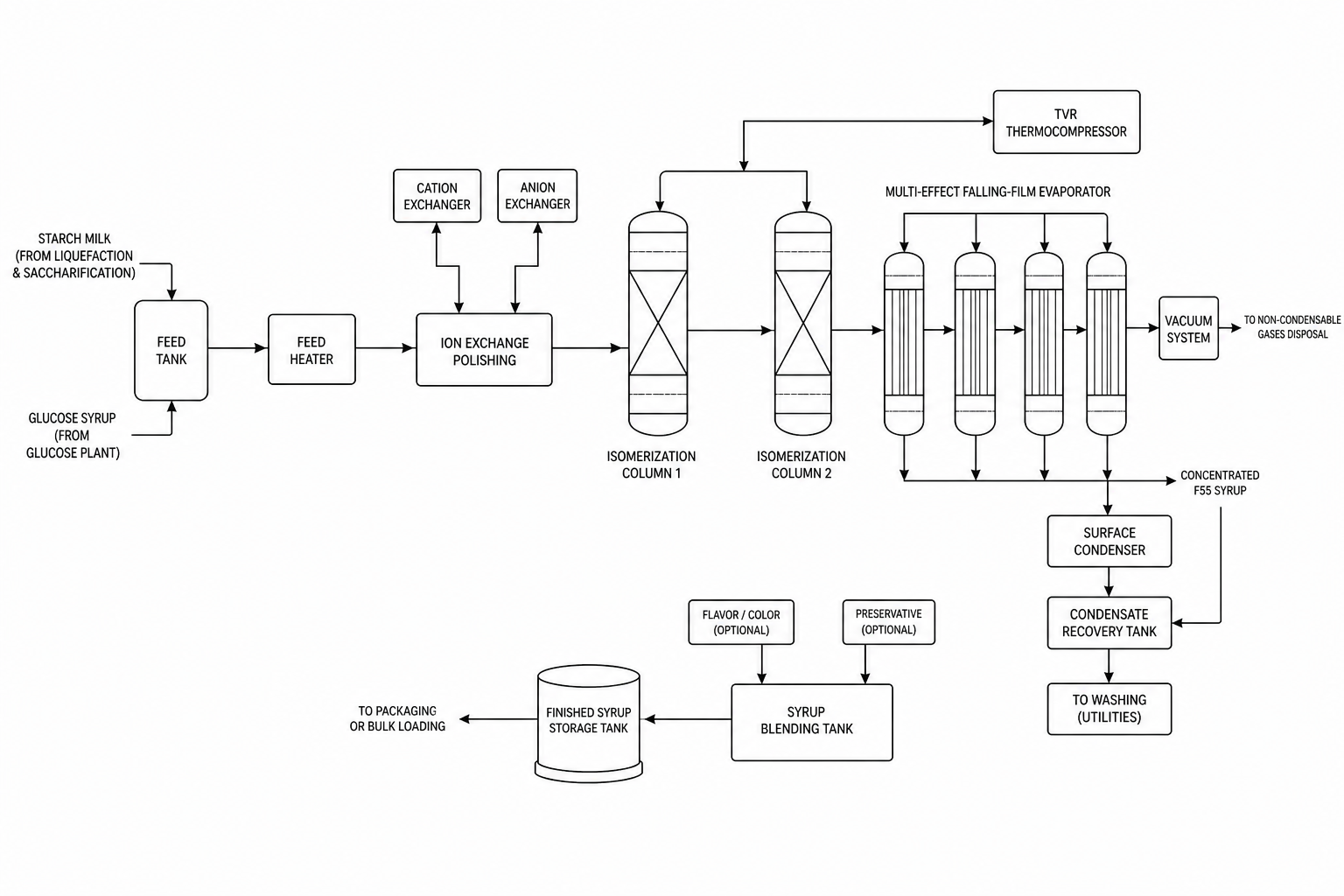
Glucose liquor from saccharification passes ion-exchange purification before concentration — ash and color precursors removed while the liquor is still thin, because every impurity that survives purification concentrates with the syrup. The isomerization section converts a controlled fraction of glucose to fructose across immobilized enzyme columns, and chromatographic separation produces the fructose-rich stream that blends back to exactly 55%.
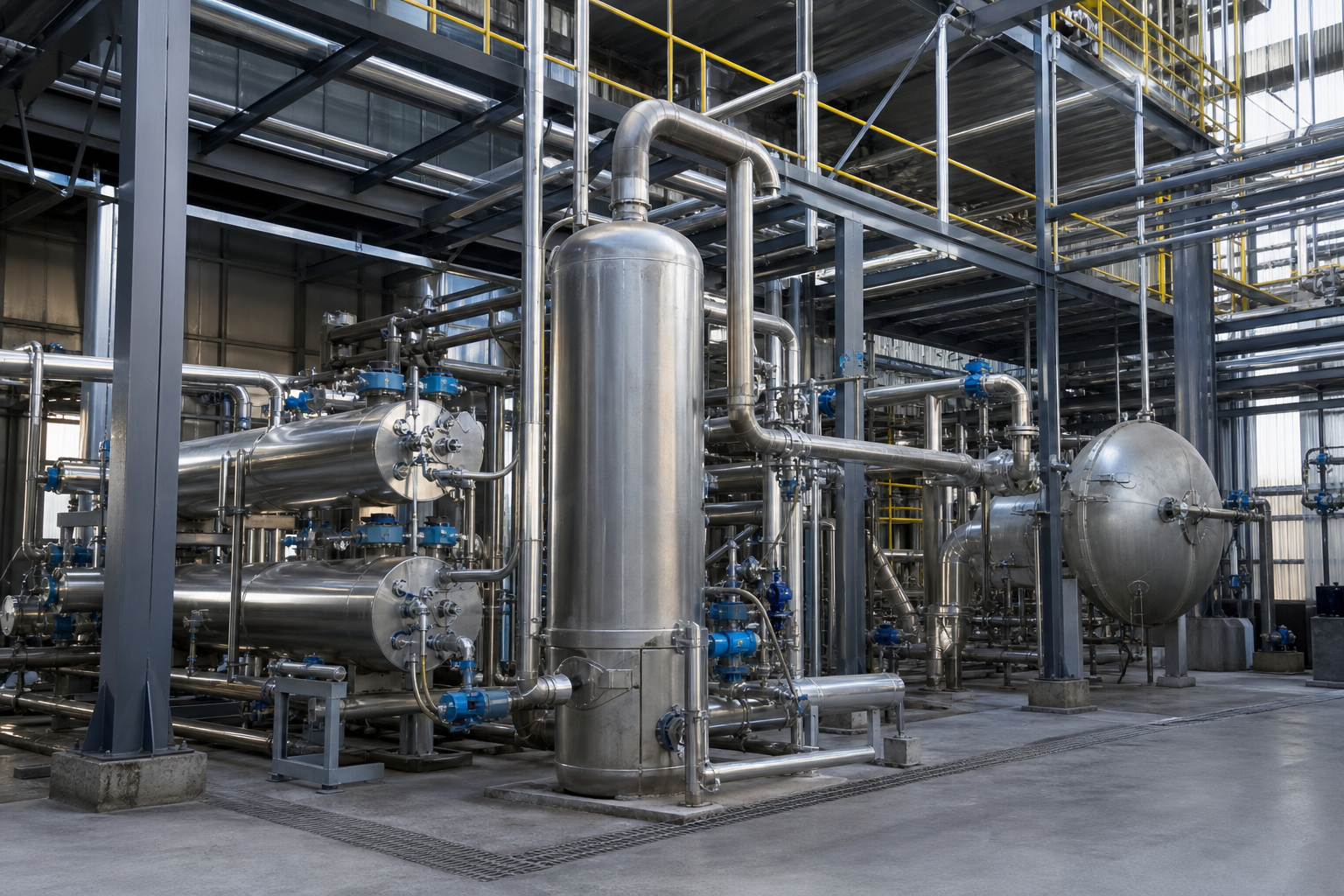
Evaporation runs in falling-film service under vacuum, the standard geometry for fructose syrup worldwide: the liquor descends heating surfaces as a thin film with seconds of contact at low temperature difference, protecting color and preventing invert-sugar degradation. Multi-effect arrangement reuses vapor between bodies — the direct mechanism behind the published 20% energy reduction — with thermal vapor recompression injecting motive steam into effect vapor where the site balance favors it. The final body concentrates to shipping solids under vacuum, with the surface condenser closing the vapor loop.
Condensate is the second product: clean hot water from the later effects returns to starch washing and liquefaction dilution, which is where the published 30% water reduction lives. First-effect condensate with volatile organics is segregated for separate treatment.
The intelligent-control layer matters in ways specific to sugar: solids profile through the effects, body temperatures, and feed-forward control from the isomerization section all run closed-loop, because a syrup plant earns the 98% continuous rate by never letting a deviation cook color into the product. Between campaigns, CIP circuits restore film surfaces — sugar fouling is gentle but constant.
Equipment Configuration
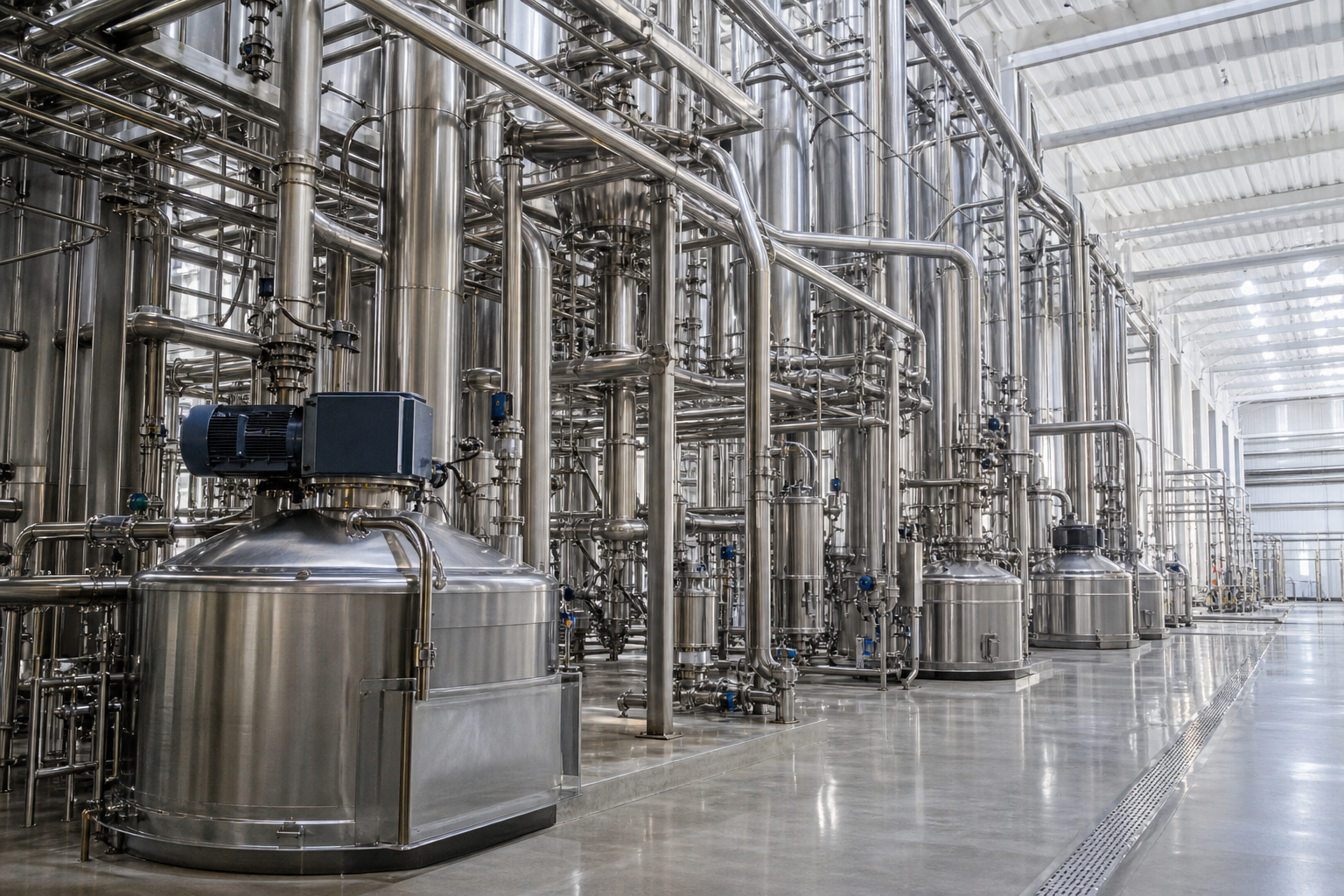
One set of the following equipment is typical for this duty:
- Ion-exchange purification ahead of concentration
- Multi-effect falling-film evaporator train with TVR energy integration
- Vacuum system and surface condenser; segregated condensate recovery to starch washing
- Fructose blending and finished-syrup tankage at 55±1% fructose
- Full-process DCS/intelligent control with closed-loop solids and temperature profiles
- SS304/SS316L food-grade construction; campaign CIP between productions
Performance & Outcome
Compiled from published industry project data, indicative: continuous operating rate > 98%, unit energy consumption down 20%+, unit water consumption down 30%+ (figures as reported in the published source), fructose content 55±1% meeting international beverage-grade specification. Specific steam rates are quoted per project solids profile.
A parallel deployment on a related wastewater stream is documented in Starch Syrup & Sweetener Evaporation Solutions.