Polyoxymethylene (POM) is one of the most separation-intensive engineering polymers to manufacture: the entire process chain – formaldehyde concentration, trioxane synthesis and purification, polymer recovery, powder drying, and formaldehyde-bearing wastewater treatment – is dominated by evaporation, distillation, crystallization, and drying duties that decide both product molecular weight and plant economics. A well-integrated POM plant treats these units as one heat-and-material-balance system, typically combining multi-effect or MVR evaporation for formaldehyde concentration, high-purity distillation for trioxane, closed drying for polymer powder, and solvent/monomer recovery loops that return value to the front end. Published external industry references describe integrated POM projects at the 60,000 TPA scale – vendor-reported experience rather than a statement of EvapCryst delivery record, and indicative – not a project guarantee – where this know-how-plus-equipment approach separates competitive plants from struggling ones.
The POM Process Chain and Where Separations Sit
POM is produced in two industrial variants, and both start from methanol via formaldehyde:
| Route | Monomer System | Stabilization | Characteristics |
|---|---|---|---|
| Homopolymer (POM-H) | High-purity formaldehyde | End-group esterification (e.g., acetic anhydride) | Higher crystallinity, stiffness, melting point ~175°C |
| Copolymer (POM-C) | Trioxane + 2-5% cyclic ether comonomer | Hydrolysis of unstable hemiacetal end groups | Better thermal-oxidative stability and alkali resistance; dominant global capacity |
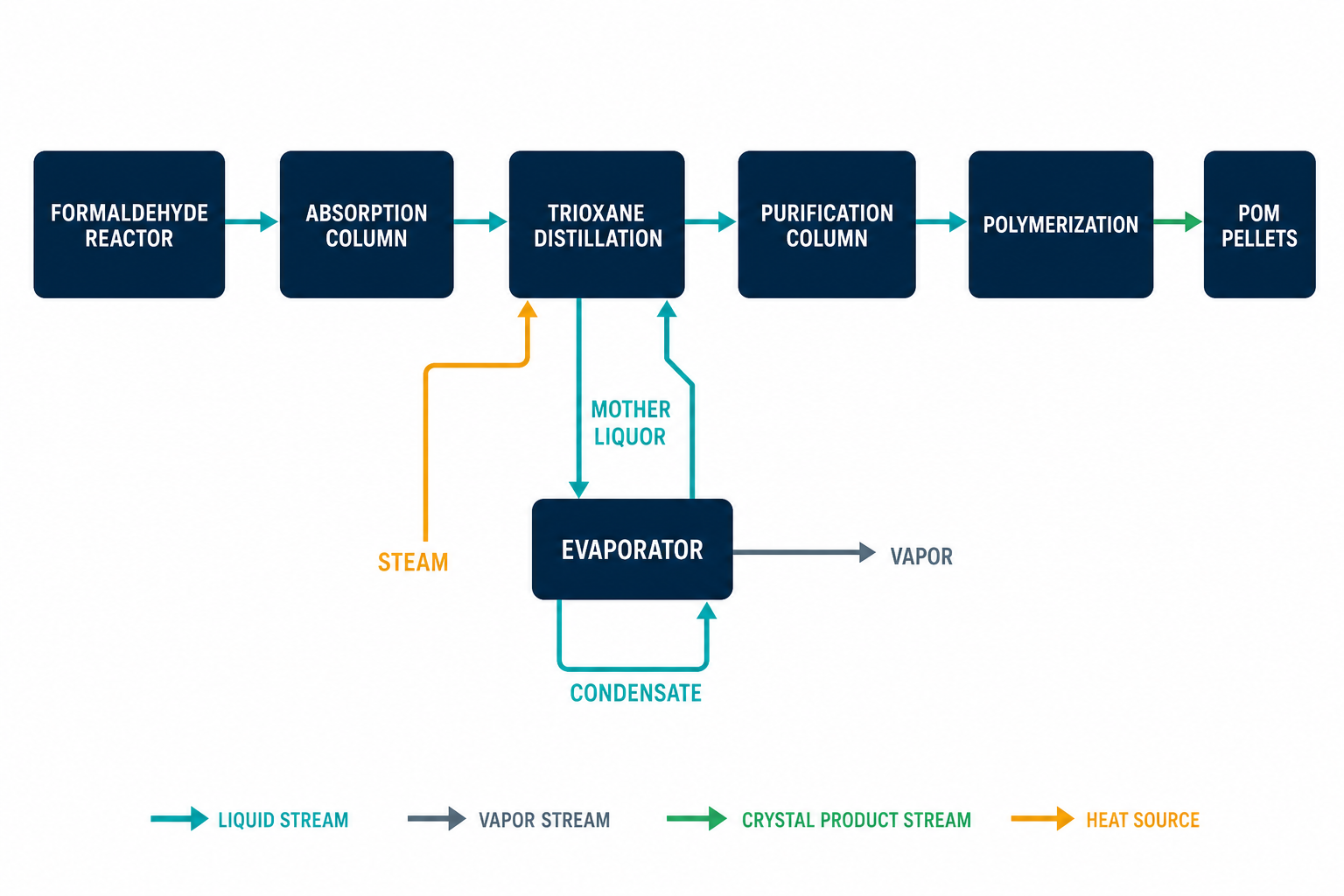
The downstream separation train for a copolymer route – the dominant configuration – typically runs as follows:
| Process module | Separation duty | Equipment candidates | Critical control point |
|---|---|---|---|
| Formalin concentration | Raise methanol-oxidation formalin from ~37-44% to typically 55-65% formaldehyde | Multi-effect or MVR evaporator plus rectification | Formaldehyde loss and polymerization fouling control |
| Trioxane synthesis | Cyclotrimerize formaldehyde in the presence of acid catalyst | Reaction-distillation loop | Water and formic acid management |
| Trioxane purification | Separate trioxane from unreacted formaldehyde, water, acid | Extraction plus high-reflux distillation columns | Polymerization-grade purity; impurities at ppm levels act as chain-transfer agents |
| Cationic polymerization | Recover monomer from polymer powder | Devolatilizer / decanter | Residual catalyst neutralization |
| Polymer finishing | End-group stabilization, additive incorporation, pelletizing | Extruder line | Melt residence time and temperature ceiling |
| Powder drying | Remove water/solvent before extrusion | Nitrogen-inerted fluid bed or conical dryer | Prevent acid-catalyzed depolymerization; dust explosion prevention |
| Off-gas and wastewater | Recover formaldehyde; treat COD | Water-scrubbing absorption towers, strippers | Formaldehyde recovery to the head of the process |
Indicative envelopes in the table are industry-general; configuration, materials, and operating ranges for each module depend on the actual feed, temperature, pressure, corrosion review, fouling behavior, utilities, and project capacity.
Why Trioxane Purity Sets the Ceiling on Product Quality
The single most underappreciated fact about POM manufacturing is that polymer molecular weight is decided upstream in the purification columns, not in the polymerization reactor. Water, methanol, formic acid, and other oxygenates carried into the monomer act as chain-transfer agents: every ppm of these species caps the chain length the growing polymer can reach. Commercial copolymer grades target number-average molecular weights in the range of roughly 20,000-100,000 g/mol depending on the application, and hitting the high end of that range demands monomer streams purified to ppm-level impurity content.
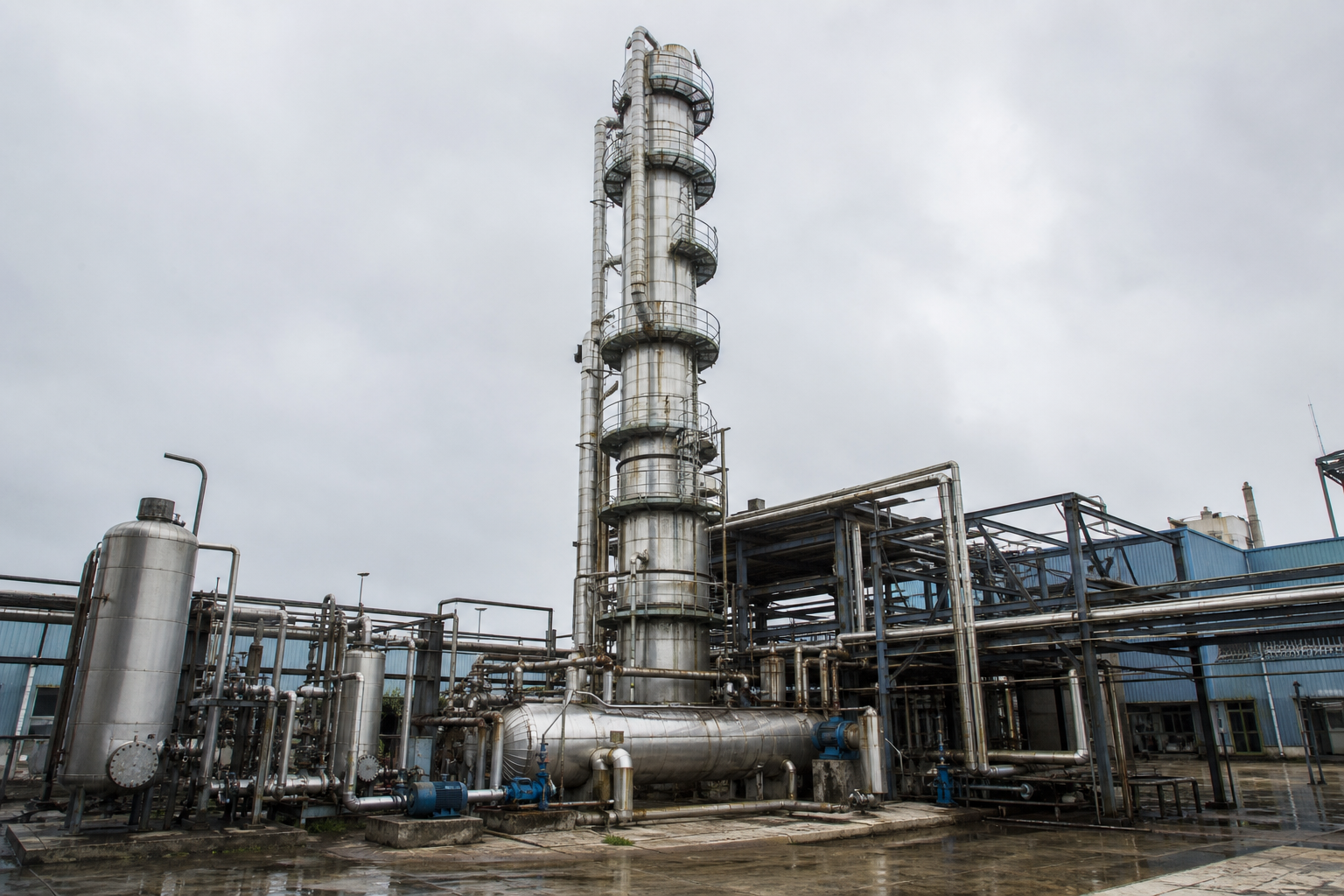
This is why serious POM integrators design the trioxane purification train – typically extraction to lift trioxane out of the aqueous reaction liquor, followed by multiple high-reflux distillation columns – as the technological heart of the plant. The formaldehyde-trioxane-water system is highly non-ideal, with formaldehyde oligomerization in the liquid phase shifting apparent volatilities; column design that ignores reaction-distillation coupling produces off-spec monomer at exactly the moments the plant runs at high throughput.
Formaldehyde Concentration: The Hidden Energy Consumer
Industrial formalin arrives from the methanol oxidation section at typically 37-44% formaldehyde. Trioxane synthesis wants a much drier feed – typically 55-65% formaldehyde – and every tonne of water that is not removed upstream must be handled by the synthesis loop’s recycle distillation anyway. Concentrating formaldehyde is not a simple evaporation duty: formaldehyde and water form a complex vapor-liquid equilibrium with oligomers (methylene glycol, paraformaldehyde species), the solution fouls surfaces if locally overconcentrated, and vented formaldehyde is both a product loss and an emissions problem.
Practical designs therefore combine:
- Forced-circulation or falling-film evaporation with tight temperature control to limit paraformaldehyde fouling – residence time matters as much as temperature.
- MVR or multi-effect arrangements to cut the steam intensity of the concentration duty, which is among the largest single energy consumers in the plant.
- Scrubbed vents with water or urea-based absorption returning recovered formaldehyde to the process instead of to the stack.
Polymer Powder Handling: The Degradation Risk Nobody Can Afford
POM’s Achilles’ heel is its depolymerization chemistry. The hemiacetal end groups of raw polymer unzip thermally – effectively a chain-end “unzipping” mechanism – and any residual acid catalyst dramatically accelerates it. Three engineering consequences follow:
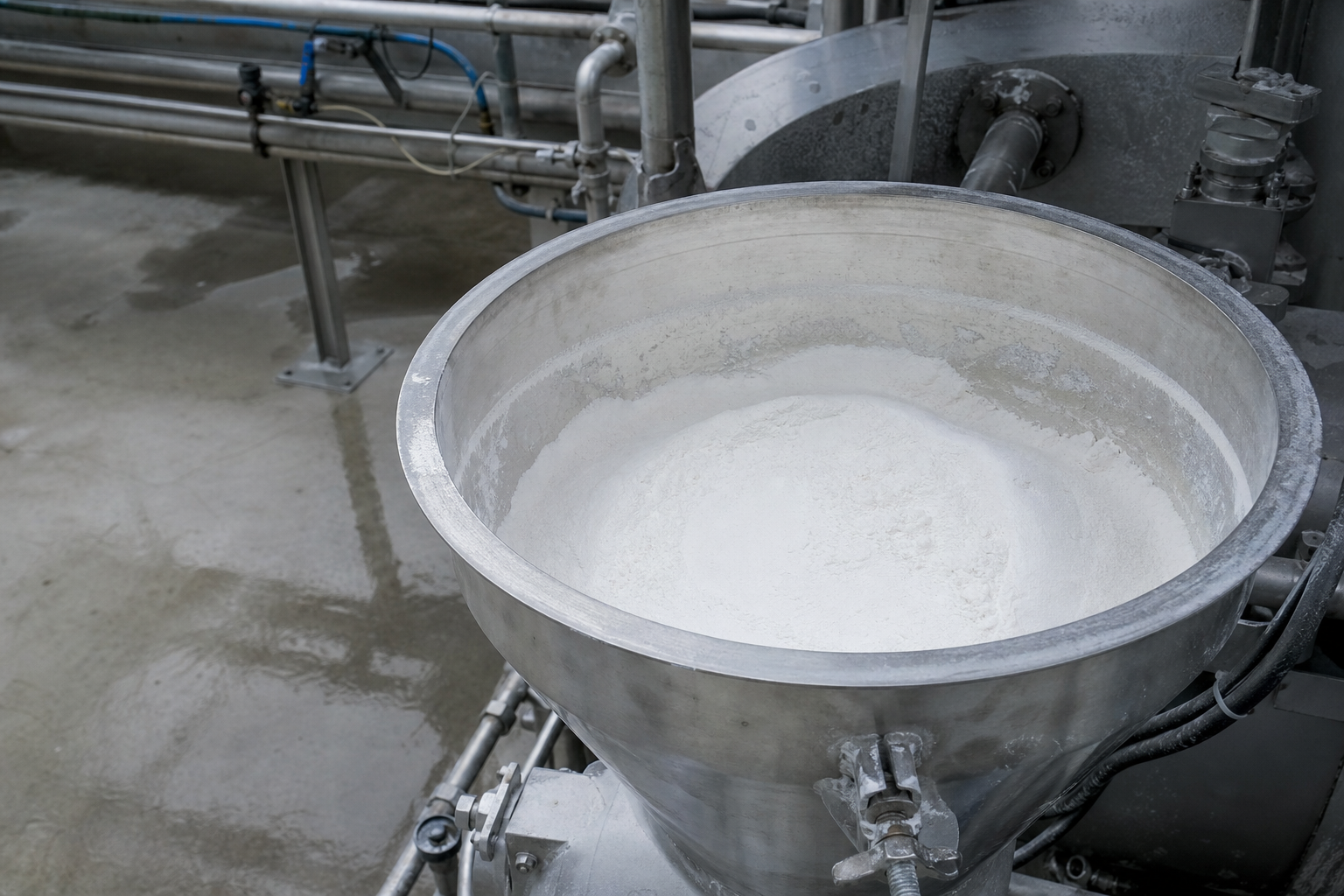
- Powder drying must be inert and moderate. Fresh copolymer powder leaving devolatilization carries water and traces of monomer and must be dried typically in the 80-120°C range under nitrogen. An open hot-air dryer invites both oxidative degradation and combustible dust hazards – fine POM powder dispersed in air is a deflagration risk requiring ATEX-rated equipment.
- End-group stabilization precedes melt processing. Copolymer routes hydrolyze the unstable ends in controlled conditions before or during finishing; homopolymer routes esterify them. Skipping or rushing this step shows up later as formaldehyde emission from pellets and plummeting melt stability.
- Melt residence time discipline in extrusion. POM melt temperatures are typically around 190-210°C with little margin before degradation accelerates; long residence times and dead spots in the pelletizing line convert good powder into yellowed, formaldehyde-releasing product.
Closing the Loops: Monomer, Solvent, and Water
A competitive POM plant recovers almost everything it buys:
- Unreacted formaldehyde and trioxane from the polymerization section are condensed and recycled – the recycle ratio is a primary determinant of variable cost.
- Extraction solvent (where liquid-liquid extraction is used in trioxane purification) is recovered by distillation at high rates; solvent losses directly inflate cash cost.
- Off-gas formaldehyde from tanks, dryers, and extruder vents is water-scrubbed; the rich absorbate returns to the formaldehyde concentration section.
- Wastewater containing formaldehyde and methanol is stripped before biological treatment, and in water-stressed sites the whole effluent is pushed toward zero liquid discharge, with the salt-bearing residue handled as a solid.
Scale and Integration: What 60,000 TPA Projects Teach
As external industry references show, integrated solution providers serving the POM industry report projects at scales up to at least 60,000 TPA of polymer – an indicative benchmark, not a project guarantee – combining licensed know-how with in-house engineered concentration, distillation, crystallization, drying, and material-handling equipment. At that scale the plant is less a collection of unit operations than a single recycle machine: monomer purity, energy integration, and loop recoveries interact so strongly that value engineering one section in isolation (for example, buying a cheap evaporator that tolerates higher formaldehyde losses) routinely degrades the economics of the whole asset. Buyers evaluating POM projects should therefore ask suppliers for the integrated heat and mass balance, loop recovery guarantees, and product-spec references – not just equipment datasheets.
Related capabilities on this site: MVR evaporation for energy-efficient formaldehyde concentration, solvent recovery and distillation for trioxane purification loops, inert drying and packing systems for polymer powder, and zero liquid discharge for formaldehyde-bearing effluents. See also our integrated solution overviews for vanillin production and dimethyl carbonate (DMC) – two other methanol-derivative value chains with similar separation intensity.
Commissioning and Operational Pitfalls
Integrated POM projects earn their reputation in the first year of operation, and the failure modes are well cataloged across the industry:
- Formaldehyde polymerization in dead legs and cold spots. Formaldehyde-bearing lines that stagnate form paraformaldehyde deposits that narrow and finally block piping – typically during winter startups and extended shutdowns. Steam tracing, continuous circulation loops, and rigorous drain-and-purge procedures at shutdown are the countermeasures; a blocked formaldehyde line discovered at restart can cost days of schedule.
- Distillation column fouling creep. The trioxane purification columns tolerate only so much heavy accumulation before reflux drums carry color and product grade slides. Plants schedule progressive cleaning aligned with catalyst changeouts rather than running to failure.
- Catalyst and stabilizer dosing discipline. Cationic polymerization catalysts and end-capping chemistry are metered at ppm-to-percent levels; calibration drift in these small flows directly moves molecular weight and melt flow index – two of the properties customers audit first.
- Powder transfer ignition prevention. POM powder pneumatic conveying is grounded, nitrogen-padded, and velocity-limited by design; retrofitting static grounding after an incident is far more expensive than specifying it.
- Start-up sequencing. The recycle loops (formaldehyde, trioxane, solvent) must be lined up before the polymerization section sees feed; commissioning plans that treat each unit in isolation discover, at the worst moment, that the monomer recovery compressor cannot follow a cold column.
Experienced integration suppliers address these points contractually – with guaranteed consumption figures, spare-part strategies for the high-wear items (pumps in chloride service, compressor seals, agitator mechanical seals), and commissioning teams that have started plants of the same configuration before. For a capital project at the 60,000 TPA scale, the difference between a smooth and a painful commissioning campaign is measured in months of lost production.
When This Route May Not Fit
This integrated route assumes a full-chain project. A buyer who needs one replacement evaporator or a single column revamp is not served by it, and honest scoping says so early. Plants without access to a licensed POM process package should not expect an equipment contractor to supply the missing polymerization know-how. Where methanol or formaldehyde supply is insecure or priced as an import, separation integration cannot rescue the economics that raw materials dominate. Sites with ample water and lenient discharge permits gain little from pushing effluent to zero liquid discharge, and the extra evaporation-crystallization capacity should be deleted rather than gold-plated. And sub-scale projects – far below the tonnage where recycle loops close efficiently – are usually better served by tolling arrangements than by a dedicated plant.
What Must Be Verified
Before this route is committed, verify the inputs that set the flowsheet. First, methanol and formaldehyde supply: source, price, and assay stability, since the concentration duty and synthesis loop are sized around them. Second, the product grade plan – target molecular weight and additive slate – because it fixes the monomer purity specification and therefore the purification train. Third, solvent selection and recovery guarantees for the extraction loop, where losses run straight into cash cost. Fourth, the safety envelope: ATEX classification for powder handling, nitrogen supply capacity for inerting, and formaldehyde emission limits. Fifth, the site utility picture – steam pressure levels, electricity price, cooling water – which decides how much MVR and multi-effect the energy integration can carry.
Frequently Asked Questions
What is the difference between POM homopolymer and copolymer production?
Homopolymer (POM-H) polymerizes high-purity formaldehyde and stabilizes the chain ends by esterification, giving higher crystallinity and stiffness. Copolymer (POM-C) polymerizes trioxane with a small share of a cyclic ether comonomer and stabilizes by hydrolyzing unstable end groups, giving better long-term thermal and chemical stability. Copolymer capacity dominates globally.
Why does trioxane purity matter so much in POM production?
Water, methanol, and formic acid in the monomer act as chain-transfer agents during cationic polymerization, capping molecular weight. Commercial grades span roughly 20,000-100,000 g/mol, and the upper grades are only reachable with monomer purified to ppm-level impurities – which is why the extraction-distillation purification train is considered the technological heart of a POM plant.
How is POM powder dried safely?
Fresh POM powder is dried typically at 80-120°C under nitrogen in closed equipment. Open hot-air drying is avoided because fine POM dust in air is a deflagration hazard and oxygen accelerates degradation; residual acid from polymerization would catalyze chain unzipping at elevated temperature, so catalyst neutralization precedes drying.
Where does the energy go in a POM plant?
The largest single consumers are formaldehyde concentration and the high-reflux distillation columns of trioxane purification, followed by devolatilization and drying. Multi-effect design and mechanical vapor recompression on the concentration duty are the standard levers; integrated projects at the 60,000 TPA scale justify MVR readily on the steam savings alone.
Can POM wastewater reach zero discharge?
Yes, in stages: formaldehyde and methanol are first stripped and recovered to the process, the remaining organics go to biological treatment, and the residual salt-bearing stream can be concentrated by evaporation-crystallization into a solid by-product. Sites in water-stressed regions increasingly specify this full ZLD configuration.
To scope an integrated POM separation project, share the monomer source and capacity target, the product grade plan, and the site utility analysis – enough for an initial process-direction assessment.