Coconut oil fractionation is a separation process that turns ordinary coconut oil into higher-value products: a hard fat fraction (stearin) for margarine, confectionery, and soap, and a liquid fraction (olein) for cooking oil — plus, when the olein is hydrolyzed and distilled, medium-chain triglyceride (MCT) oil for food, infant nutrition, and cosmetics. The separation itself is not chemical but physical: coconut oil is a natural blend of triglycerides with different melting points, and crystallization — driven by controlled cooling — is the tool that pulls them apart. The quality of a fractionation plant therefore lives or dies on its crystallizer: how precisely it cools, how well it nucleates and grows crystals, and how completely those crystals can be filtered from the liquid. This article walks through the process, the equipment choices, and the operating levers that decide fractionation profitability.
Why Coconut Oil Is Fractionated
Crude or refined coconut oil is a mixed triglyceride pool. Its fatty-acid profile is dominated by lauric acid (C12, roughly 45–52% of total fatty acids) and myristic acid (C14, roughly 16–21%), with smaller amounts of C8, C10, C16, and C18 chains. Because different triglyceride combinations melt at different temperatures, whole coconut oil sits in an inconvenient middle ground: not hard enough to function as a structured fat, and it clouds and solidifies in the bottle when ambient temperature drops — an undesirable trait for a frying and salad oil in temperate markets.
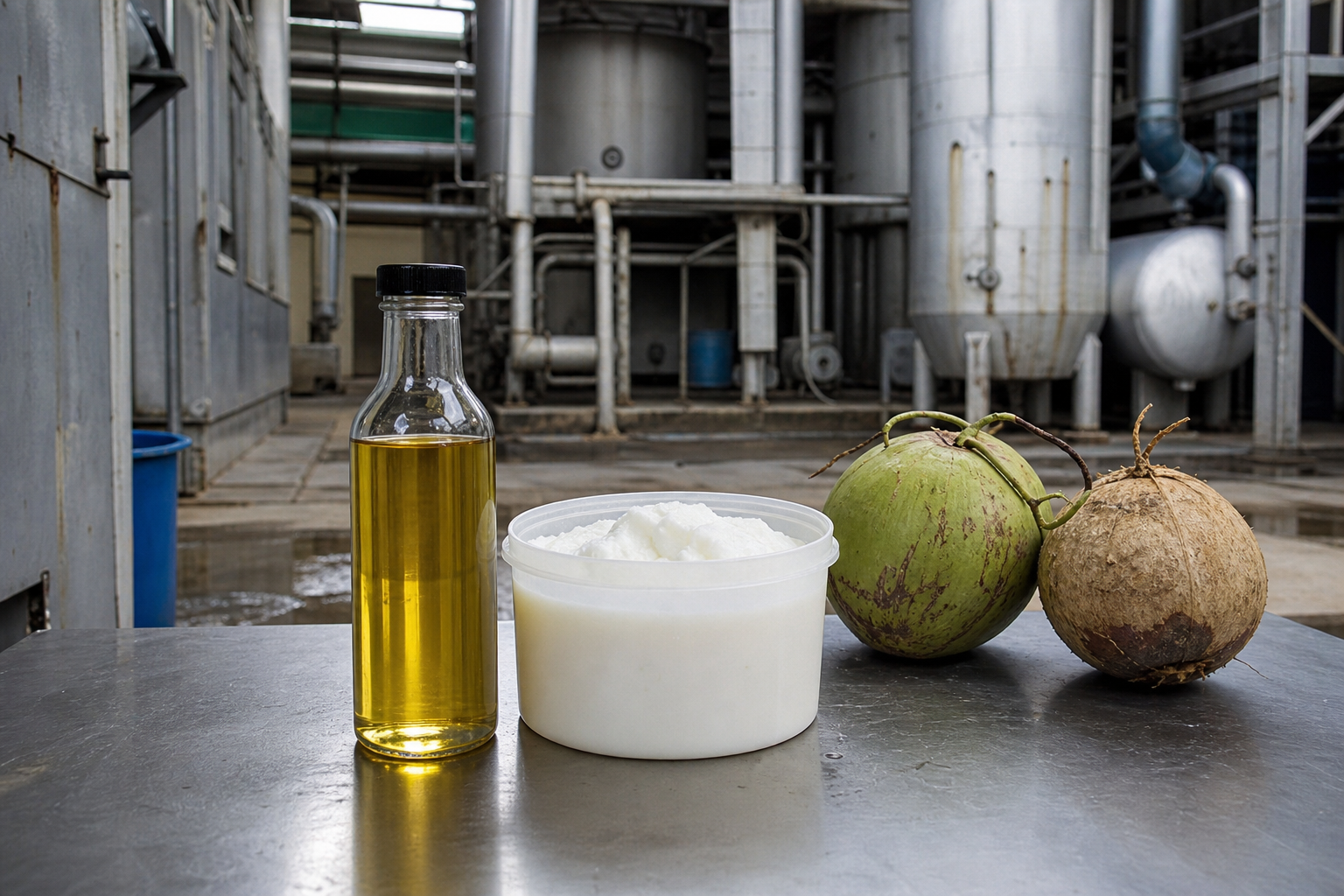
Fractionation splits this compromise into two commercial products:
- Coconut stearin — the crystallized high-melting fraction. It is a hard, white fat used in margarine and shortening blends, as a cocoa-butter-extending confectionery fat, in soap noodles, and increasingly as the feedstock for MCT and lauric-derivative chemistry.
- Coconut olein — the remaining liquid. It stays clear at room temperature, resists foaming in deep frying, and commands a premium as cooking oil; a second fractionation pass can raise its cold stability further for premium bottled grades.
Yields are roughly balanced: in typical industrial dry fractionation of coconut oil, stearin represents on the order of 30–40% of the feed and olein 60–70%, with the exact split adjusted by how hard the plant cools and how sharply it filters. Every percentage point of stearin purity or olein clarity is money, which is why the crystallization step receives so much engineering attention.
Dry Fractionation: The Standard Route
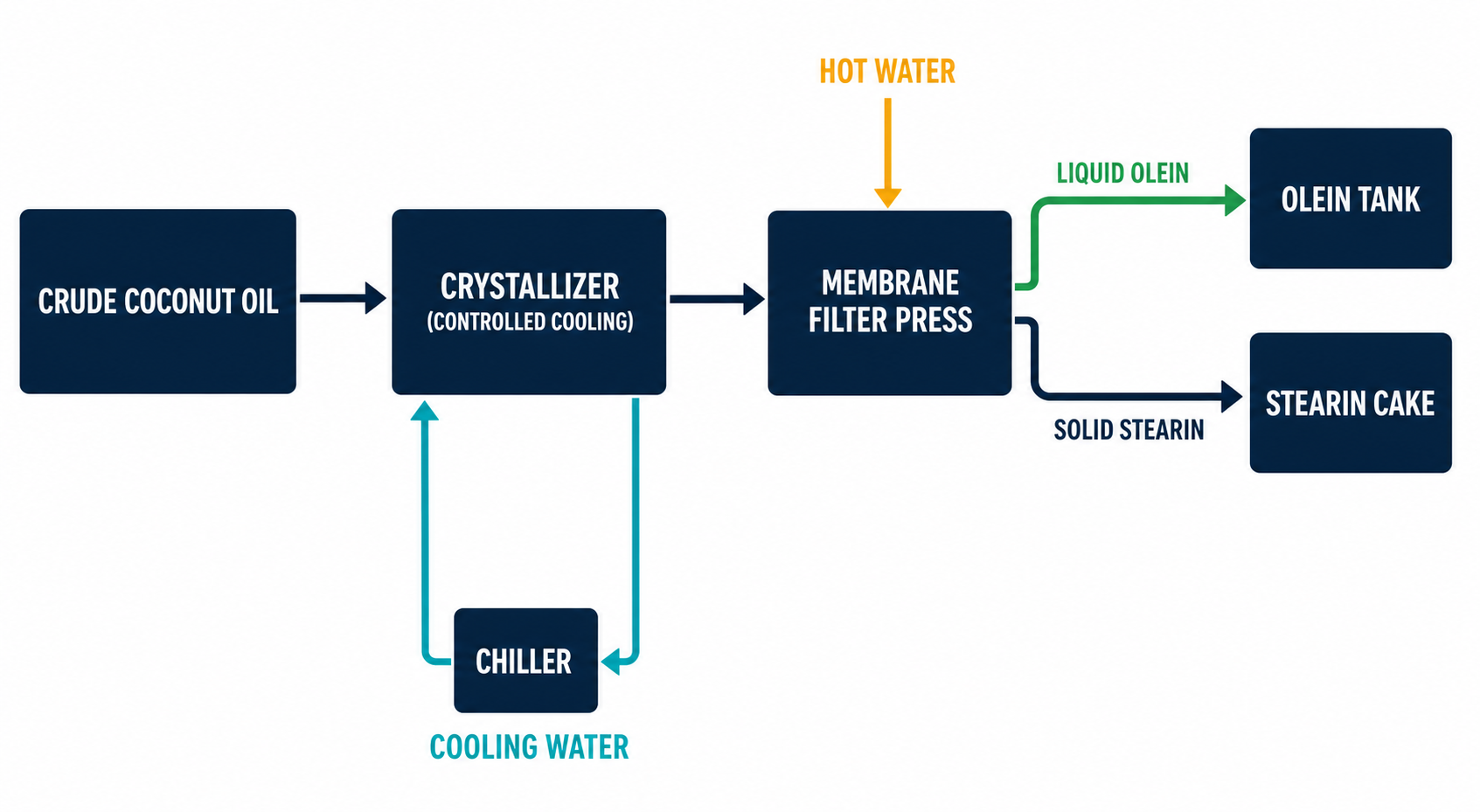
The industry-standard method is dry fractionation — no solvents, no additives, only cooling, crystallization, and separation. The process runs as a continuous loop of four stages.
Stage 1 — Heating and Conditioning
The feed oil is first heated to roughly 60–70°C, safely above its complete melting point, to erase the crystal memory of previous processing. This is a genuinely important step: residual crystal nuclei or polymorphic history from earlier cooling cause erratic crystallization behavior, so-called “memory effects,” that show up later as poor filterability. The oil may also be filtered or water-washed at this stage to remove gums, soaps, and particulates that would otherwise seed uncontrolled nucleation.
Stage 2 — Crystallization by Controlled Cooling
The melt enters a stirred, jacketed crystallizer and is cooled along a programmed curve. For coconut oil, the crystallization window of interest runs from roughly 40°C down to 15–25°C depending on the target product split. Cooling must be gentle in the nucleation zone: the driving force is supersaturation created by temperature difference, and if the oil is cooled faster than crystals can grow, the result is a population of tiny, fragile crystals that blind the filter press and trap olein in their mass. Industrial crystallizers therefore control the oil-to-cooling-medium temperature difference — commonly held to a few degrees — and reduce agitation speed as the slurry thickens.
Equipment is typically one of two forms:
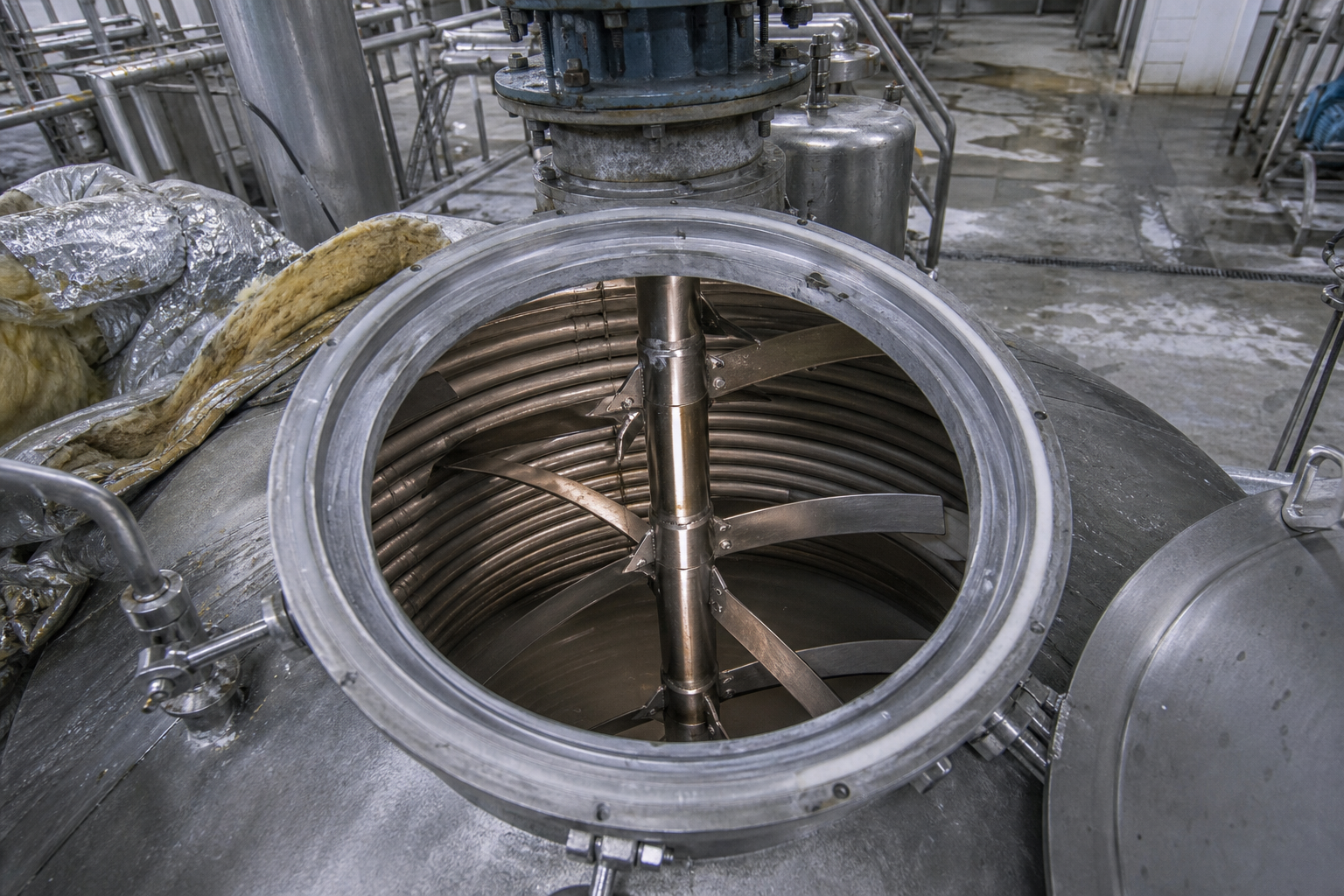
- Vertical or horizontal tank crystallizers with slow agitation, cooled by jackets, coils, or external scrapers — the traditional workhorse for edible-oil fractionation in the hundreds-of-tonnes-per-batch scale.
- Disc-and-cone or surface-scrubbed crystallizers, where oil flows across cooled discs; higher heat-transfer area per volume suits continuous or short-cycle plants.
Crystallizer design philosophy is the same across the industry: high cooling area, low temperature difference, gentle agitation, and long residence time — typically 6–12 hours for a full coconut-oil crystallization cycle, with the precise profile a closely guarded plant know-how item.
Stage 3 — Filtration and Separation
The crystal slurry is discharged to a separation device, and here the fractionation plant’s real productivity is decided. Three technologies dominate:
- Membrane filter presses — the modern default. The slurry is pumped into chambers and squeezed, often with membrane inflation and sometimes with a brief purge steam or hot-air blow, yielding stearin with residual oil down to the low single digits and clearly below what a plain plate-and-frame achieves.
- Rotary drum vacuum filters — continuous, simpler to operate, suited to high throughput, but with higher residual oil in the cake.
- Centrifugal decanters — used where a soft crystal habit or downstream process tolerance accepts a wetter stearin stream.
Stage 4 — Product Handling and the MCT Connection
Liquid olein passes directly to storage or bottle-filling lines. Solid stearin is melted for tank storage or kept in bagged block form. Where the plant feeds MCT production, the fractions proceed to splitting (hydrolysis or transesterification) and fractional distillation of the C8/C10 fatty acids, followed by re-esterification into the triglyceride MCT oil that food and personal-care formulators buy. The fractionation step ahead of this chain matters because it already concentrates the high- and low-melting triglyceride families, simplifying downstream separation.
The plant decomposes into standard process modules:
| Process module | Equipment candidates | Selection basis | Indicative envelope |
|---|---|---|---|
| Conditioning | Hot-water or steam-heated tanks; polishing filters | Crystal-memory erasure; contaminant control | ~60–70°C class |
| Crystallization | Jacketed tank crystallizers; disc-and-cone units | Cooling-curve discipline; crystal habit | ~6–12 h cycle class |
| Filtration | Membrane filter presses; rotary drum; decanters | Residual-oil target vs throughput | Low single-digit % residual class |
| Product handling | Melt storage; bagging lines; bottle filling | Stearin form and olein grade | Per product slate |
| Cooling infrastructure | Tiered tower water, chilled water, glycol or refrigerant | Peak batch heat load, not average | Per climate and utility |
Envelopes are industry-reported practice, indicative and not a project guarantee; configuration, materials, and operating ranges for each module depend on the actual feed, temperature, pressure, corrosion review, fouling behavior, utilities, and project capacity.
Typical Operating Parameters
| Parameter | Indicative envelope (industry-reported practice) | Engineering note |
|---|---|---|
| Feed conditioning temperature | ~60–70°C | Erases crystal memory; ensures fully molten feed |
| Crystallization window | ~40°C down to 15–25°C | End temperature sets the stearin/olein yield split |
| Cooling-medium ΔT | A few degrees only | Larger ΔT gives fine crystals that blind filters |
| Crystallization cycle time | ~6–12 hours | Long, gentle cycles win on filterability |
| Stearin share of feed | ~30–40% | Adjustable by final temperature and filtration sharpness |
| Residual oil in stearin (membrane press) | Low single-digit % | Directly controls olein yield |
| Lauric acid (C12) in feed | ~45–52% of fatty acids | Source-oil quality fixes the achievable fractions |
Cooling System Design: Where Crystallization Plants Are Won or Lost
The crystallizer is a heat-removal machine with a precision mandate, and the cooling system behind the jackets and coils determines whether it can deliver. Three design considerations recur across successful installations.
Refrigeration Versus Chilled Water
The final fractions of coconut-oil crystallization often demand oil temperatures below what a cooling tower can supply. Plants commonly use a tiered system: cooling tower water for the early, warm part of the curve; chilled water (typically 5–15°C) for the middle; and glycol or direct refrigerant circuits for the final approach to end temperature. Sizing the refrigeration plant for the peak heat load of a batch cycle — not the average — avoids the slow-finishing batches that quietly reduce annual capacity.
Temperature-Control Precision
Supersaturation is controlled by the oil temperature trajectory, so the cooling loop must actually follow the programmed curve, not just approximately. Modern plants use cascaded PID control on the crystallizer jacket, with the cooling-medium supply temperature itself regulated. Data logging of every batch’s temperature curve is standard practice, because when a fractionation plant drifts off-spec, the historical cooling curve is the first diagnostic.
Energy Recovery
Fractionation is thermally symmetric: the plant heats oil to 60–70°C, then extracts that heat during crystallization, then melts stearin for storage. Heat recovery between the warm discharge of one batch and the cold feed of the next — or between crystallizer cooling return and feed preheating — meaningfully reduces the combined boiler and refrigeration load. This is the same energy-discipline logic that applies to any evaporation and concentration plant: heat that leaves a process in a warm stream is a resource, not an exhaust.
Common Problems and Practical Countermeasures
Filter-Blinding Slurry
The classic failure: crystals too small or too fragile to form a permeable cake. The causes are almost always thermal or mechanical — cooling too fast, agitation too violent late in the cycle, or a feed with insufficient crystal-memory erasure. The countermeasures are the mirror images: slower cooling ramps, reduced agitator speed in the final hours, and disciplined 60–70°C feed conditioning.
Oily Stearin (High Residual Oil)
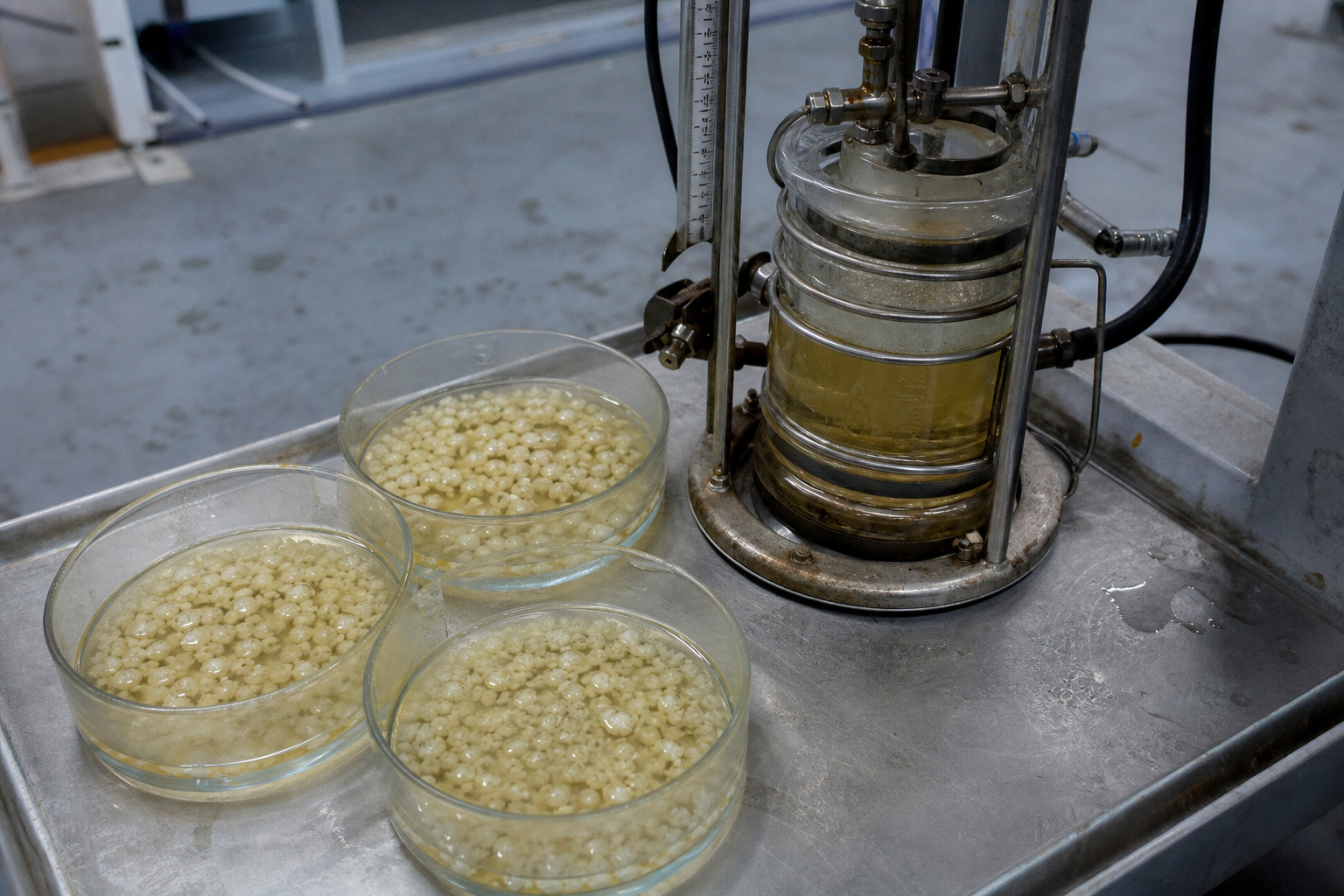
Stearin that carries too much entrained olein depresses its melting profile and its price. Beyond filtration technology choice, the lever is crystal habit — larger, more compact crystals filter drier. Some plants add a brief maturation hold near the end temperature to allow Ostwald ripening (small crystals dissolving and redepositing on larger ones), an essentially free purity gain.
Cloudy Olein in Cold Storage
Premium olein grades are judged by cold test — the hours a bottle stays clear at refrigerator or freezer temperature. Cloudiness means high-melting triglycerides leaked through the filter, pointing either at filtration bypass, an end temperature that was too warm for the claimed grade, or feed-oil quality drift. A second (re-fractionation) pass of the olein is the standard route to the clearest grades.
Variability of Source Oil
Coconut oil is an agricultural product; its triglyceride composition varies with origin and season. The crystallization program that works in January may over- or under-cool in July. Plants handle this with periodic differential-scanning-calorimetry checks of incoming oil and by keeping several cooling programs on the control system ready to deploy.
Where Fractionation Fits in a Separation-Technology Portfolio
Cooling crystallization of fats looks different from evaporation crystallization of salts, but the underlying engineering — supersaturation control, crystal growth management, and solid-liquid separation — is shared across industries. Related capability pages on this site cover the neighboring technologies:
- Food and fermentation solutions — the industry hub for edible-oil, food-ingredient, and fermentation-broth separation projects.
- Crystallization systems — crystallizer technologies spanning cooling and evaporative modes.
- Oslo-type crystallizers — growth-type designs where large, uniform crystals are the product target.
- Drying and packing systems — downstream handling of solid products after separation.
Conclusion
Coconut oil fractionation converts a commodity oil into two targeted products using nothing but heat, cold, time, and mechanical separation. The physics is settled and the equipment is proven; what separates an excellent plant from an average one is the discipline of the crystallization step — slow controlled cooling, gentle agitation, sharp filtration — and the cooling infrastructure that makes such discipline possible. Producers planning MCT-capable facilities should treat fractionation not as a commodity pre-step but as the foundation of their downstream product quality.
Validation Focus
Because this page cites no public third-party case data for coconut-oil duty, the route should be validated on the producer’s own oil. Start with differential-scanning-calorimetry characterization of incoming crude or refined oil across origins and seasons, since the cooling program must be re-derived when the triglyceride pool shifts. Develop the cooling curve at bench or pilot scale: a liter-scale programmed-cooling test with filterability measurement on the resulting slurry predicts full-scale crystal behavior better than any datasheet. Verify olein cold-test performance on pilot fractions against the target bottled grade. And before capital commitment, run the refrigeration peak-load calculation against the actual batch schedule – undersized final-stage cooling is the quiet capacity killer described above.
When This Route May Not Fit
Producers whose oil supply is irregular or off-specification cannot fractionate their way to quality: the feed fixes the achievable fractions, and no crystallizer repairs a bad oil. Plants below the tonnage where batch cycles fill the tanks pay for idle cooling capacity, and are better served by toll fractionation. Where the target product is ordinary cooking oil with no clarity premium, fractionation adds cost without a market reward. Specialty fats demanding melting profiles sharper than physical fractionation delivers belong to hydrogenation or interesterification routes instead. And a site without reliable chilled-water or refrigeration infrastructure should not commit to end temperatures it cannot hold: fractionation discipline is a cooling-plant property first and a vessel property second.
What Must Be Verified
Before this route is committed, verify the inputs that size it. First, the oil supply: origin mix, seasonal triglyceride variation, free fatty acid and gum levels, because these set the conditioning stage and the number of cooling programs the plant must carry. Second, the product slate in commercial terms – stearin melting profile and olein cold-test grade – since the end temperature and filtration sharpness follow from the specification, not the reverse. Third, the batch math: tank count against the 6-12 hour cycle, so that filtration and packaging never starve the crystallizers. Fourth, the utility reality at the site – cooling tower conditions in the local climate, chilled-water and refrigeration capacity – checked against peak, not average, duty. Fifth, the market price spread between fractionated and whole oil.
Frequently Asked Questions
What temperature is coconut oil fractionated at?
The oil is first conditioned at roughly 60–70°C to erase crystal memory, then cooled through a crystallization window from about 40°C down to a final temperature of 15–25°C, depending on the desired stearin/olein split and olein cold stability.
What are the two products of coconut oil fractionation?
Coconut stearin, the crystallized hard fraction (typically 30–40% of feed), used in margarine, confectionery, and soap; and coconut olein, the clear liquid fraction (typically 60–70%), sold as premium cooking oil and as feedstock for MCT oil production.
Does coconut oil fractionation use solvents?
No. Industrial coconut oil fractionation is almost universally dry fractionation — controlled cooling, crystallization, and mechanical filtration only. Solvent-based (wet) fractionation exists in the wider edible-oil industry but is not standard for coconut oil.
How long does a coconut oil crystallization cycle take?
Typically 6–12 hours per batch. The cycle is deliberately slow because rapid cooling produces fine, fragile crystals that blind filter presses and trap olein; longer gentle cycles improve filterability and stearin purity.
Why does fractionated coconut oil stay liquid in the refrigerator?
Because the high-melting triglycerides have been removed as stearin. The remaining olein is composed of lower-melting triglyceride species, so it stays clear at refrigerator temperatures — a property verified by cold-test specifications on premium grades.
To scope a fractionation plant for a specific refinery, share the oil source and characterization, the target stearin and olein specifications, and the site utility analysis – enough for an initial process-direction assessment.