Multi-effect evaporation (MEE) reuses the latent heat of evaporated water several times before releasing it: vapor boiled off in one effect becomes the heating steam of the next, so a single kilogram of live steam evaporates several kilograms of water across the train. A single-effect evaporator consumes roughly 1.1–1.2 tons of steam per ton of water evaporated; a triple-effect system typically consumes 0.33–0.4 tons per ton (about 0.3 with thermal vapor recompression), and each additional effect pushes the figure lower with diminishing returns. Designing a multi-effect system well means getting four things right: the number of effects, the feed arrangement, the temperature-difference distribution across effects, and the evaporator type in the final, most concentrated effect. This guide walks through the principle, the design variables, and the boundaries where MEE is the right choice — the technology deep-dive. For the system-side view — body selection, salt chemistry on the temperature ladder, materials, delivery and project specification — see our multi-effect evaporation systems page.
The Core Principle: Cascading Latent Heat
A multi-effect evaporator is a train of individual evaporator bodies—each with a heating chamber (calandria) and a vapor-liquid separation space—operated at successively lower pressures. Fresh steam heats the first effect only. The vapor generated there still carries its full latent heat; instead of condensing it to waste, the design sends it to the heating chamber of the second effect, whose liquor boils at a lower temperature because that effect runs at lower pressure. Second-effect vapor heats the third, and so on down the train, with only the last effect’s vapor reaching the condenser.
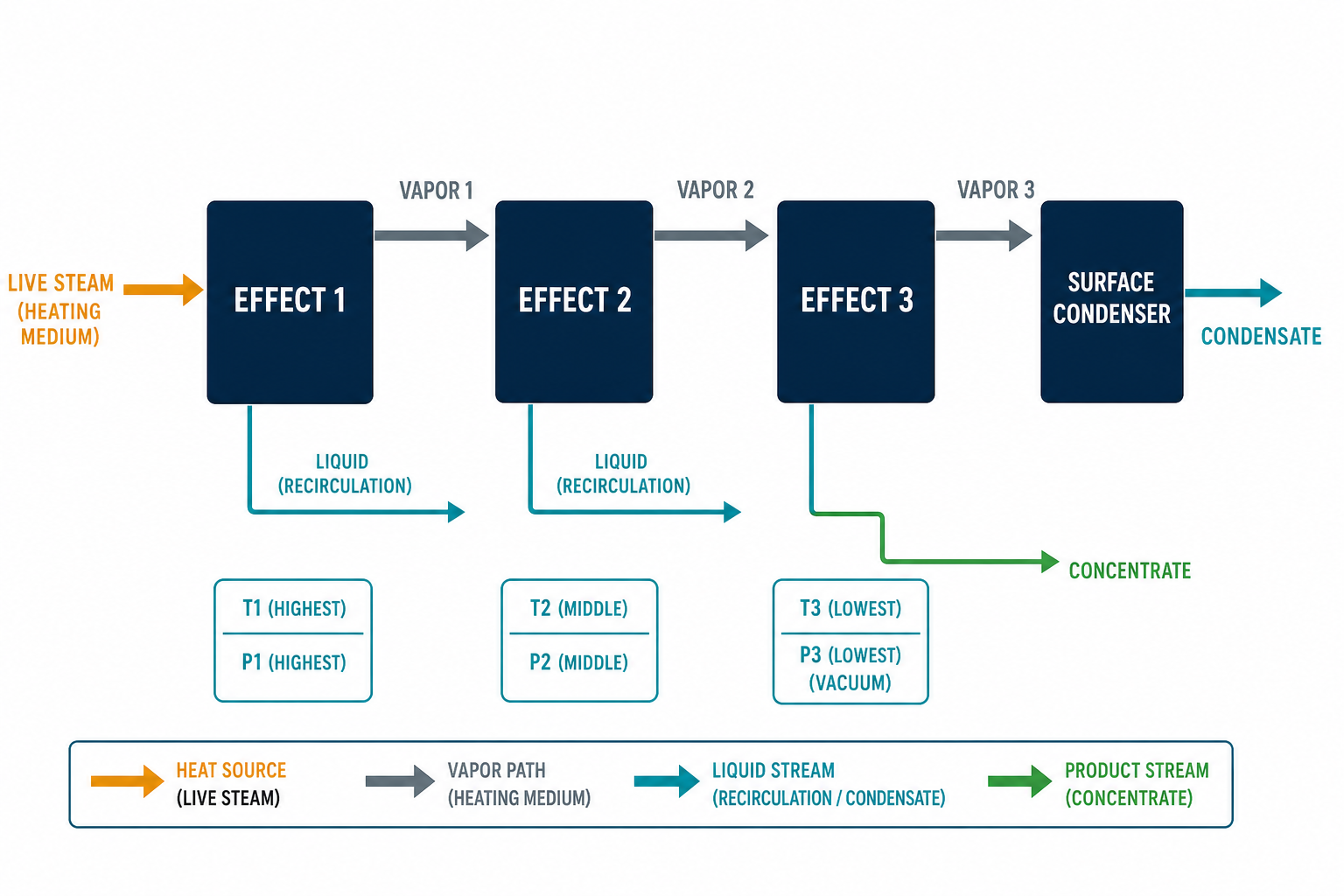
The driving mechanism is a chain of temperature differences. Each effect operates at a pressure and boiling point low enough that the previous effect’s vapor is still hot enough to boil it. The first effect runs near atmospheric or slightly above; the last effect runs under vacuum, its boiling point pulled down by the vacuum system. Steam therefore flows automatically from hot effect to cold effect without any compression machinery—the temperature gradient does all the work. A full treatment of the technology family, including hardware configurations, is on our multi-effect evaporation technology page.
System Anatomy
A complete MEE plant consists of the effect bodies (heating chamber plus separation space for each), inter-effect vapor and liquor piping, a condenser on the last effect, the vacuum system that establishes the low tail pressure, and a condensate collection system that recovers hot condensate from each effect’s heating chamber. Two details separate good designs from average ones: condensate flash recovery—letting high-pressure condensate flash back to steam for reuse in a lower-pressure effect recycles a few percent of energy for free—and non-condensable gas venting, because accumulated inerts blanket heat-transfer surfaces and silently degrade capacity.
Steam Economy and the Number of Effects
Steam economy—kilograms of water evaporated per kilogram of live steam—is the headline metric of MEE design. It improves with effect count, but each added effect returns less than the last: indicative figures are 1.1–1.2 t steam per t water for a single effect (economy ~0.85–0.9), ~0.5 for a double effect (~2), and 0.33–0.4 for a triple effect without TVR (~2.5–2.9, dropping to roughly 0.3 t/t with thermal recompression) — consistent with the configuration table, evaporation loads and best-fit duties maintained on our multi-effect evaporation systems page.
The upper limit on effect count is set by available temperature difference. The total driving force—first-effect steam temperature minus last-effect vacuum boiling point, minus the liquor’s boiling point rise—must be divided among the effects, and each effect needs a workable share, on the order of 5–10°C of effective temperature difference, to transfer heat without excessive area. As effects multiply, the per-effect difference shrinks; compensating means larger heat-transfer surfaces, and the added steel and complexity eventually cost more than the steam they save. This is why industrial designs settle at three to six effects, with triple-effect the most widely used configuration, and why high-BPR liquors tolerate fewer effects than clean fluids.
Feed Arrangements: Forward, Backward, Parallel
How liquor flows through the train is as consequential as the number of effects. Three arrangements dominate practice.

| Feed arrangement | Flow pattern | Best suited for |
|---|---|---|
| Forward feed | Liquor and steam travel the same direction, first effect to last | Heat-sensitive products: concentration rises as temperature falls, and liquor transfers between effects by pressure difference without pumps |
| Backward feed | Liquor enters the last (coldest) effect and is pumped forward against the steam flow | Viscous liquors whose viscosity climbs steeply with concentration—the most concentrated liquor meets the hottest effect, where low viscosity preserves heat transfer |
| Parallel feed | Liquor is split and fed to each effect individually | Duties where each effect produces a separate concentrate, or where feed staging suits the process |
Forward feeding is the simplest and most common default: it needs no inter-effect pumps and treats heat-sensitive products gently. Backward feeding spends pumping power to buy heat-transfer performance in the effects where it matters most. The correct choice follows from the liquor’s viscosity-concentration curve, heat sensitivity, and fouling tendency read together.
The Final Effect: Where Forced Circulation Earns Its Place
By the last effect, the liquor has reached its highest concentration—often supersaturated and ready to crystallize—which is precisely where falling-film and natural-circulation designs suffer fouling. The standard industrial answer is a forced-circulation final effect: a circulation pump pushes liquor through the heater at velocities high enough to suppress tube-wall scaling, and boiling is deferred to the separator where crystal growth is managed deliberately. This hybrid—multi-effect front end for steam economy, forced-circulation back end for fouling resistance—is the mainstream configuration for inorganic-salt wastewater concentration and crystallization, covering liquors such as sodium sulfate and sodium chloride (illustrative applications). The operating principle of the forced-circulation evaporator itself is covered in detail in our forced-circulation technology guide.
Design Checklist: The Details That Decide Performance
Beyond effect count and feed arrangement, four design points determine whether an MEE plant delivers its nameplate steam economy:
- Last-effect vacuum. The vacuum system fixes the tail boiling point and therefore the total temperature difference available to the whole train; vacuum leakage or non-condensable buildup erodes capacity from the cold end backward.
- Temperature-difference allocation. Distributing the total difference intelligently—more where heat transfer is easy, less where area is expensive—minimizes total surface for a given duty.
- Condensate flash recovery. Flashing condensate from each effect into the next lower-pressure effect’s steam supply recovers energy that would otherwise leave with hot water.
- Non-condensable venting. Continuous removal of inerts from the steam side of each calandria keeps heat-transfer coefficients at design values.
When Multi-Effect Is the Right Economic Choice
MEE’s economics shine in a specific corner of the map: large continuous water-removal duties at plants that already have cheap, abundant steam. The equipment investment is lower than an equivalent-efficiency MVR system—the technology trades a compressor for more vessels and piping—and for facilities with an existing boiler holding spare capacity, the incremental cost of MEE is modest. Documented comparisons (supplier-published MEE/MVR case studies and industry reference plants, external to EvapCryst) put MEE’s first cost roughly 30% below MVR for equivalent duty, while MVR answers with roughly 70% lower per-ton energy cost where electricity is reasonably priced—so the boundary runs along energy prices, capacity, and utilities.
The selection boundary, worked through with numbers in our MVR vs multi-effect comparison, divides cleanly: steam cheap and plentiful, capacity very large, liquor high-BPE, or batch operation favor multi-effect; electricity affordable, no boiler on site, or continuous mid-size duty favor MVR. MEE also tolerates both high and low boiling point rise, whereas MVR prefers low-BPR liquors—a physics constraint that can decide the question before economics even enter.
Combining MEE with Recompression
The technologies also stack. Adding thermal vapor recompression (TVR)—a steam ejector that recompresses part of the effect vapor with high-pressure motive steam—cuts a triple-effect train’s steam consumption from 0.33–0.4 to roughly 0.3 t/t without adding effect bodies. Plants facing rising steam costs or constrained boiler capacity can go further and reconstruct an existing MEE train into an MVR system, reusing shells and tubing while adding a compressor; documented retrofits cut operating cost by 40–70% (MEE-to-MVR conversion cases reported by evaporation suppliers, external industry references). Hybrid MVR + multi-effect designs use MVR for bulk evaporation and reserve effects for finishing and crystallization, combining the efficiency of recompression with the purity control of a multi-effect tail end.
Applications Across Industries
Multi-effect evaporation serves any duty with large water-removal requirements and available steam: high-volume industrial wastewater reduction, high-complexity wastewater treatment (illustrative application), sugar and starch concentration, black liquor in pulp and paper, salt production, and chemical liquor concentration. Wherever the liquor is difficult—high TDS, crystallizing, viscous—the design conversation quickly converges on a multi-effect front end with a forced-circulation crystallizing finish, sometimes closed with drying and packing for the recovered solids.
FAQ
How many effects should a multi-effect evaporator have?
Industrial designs settle at three to six effects, with triple-effect the most common. Each added effect improves steam economy with diminishing returns, and the total available temperature difference must give each effect a workable share—roughly 5–10°C—before heat-transfer area becomes uneconomical. High boiling point rise reduces the feasible effect count further.
What is steam economy in multi-effect evaporation?
Steam economy is the kilograms of water evaporated per kilogram of live steam consumed. A single effect delivers roughly 0.85–0.9, a double effect about 2, and a triple-effect train about 2.5–2.9 — corresponding to 0.33–0.4 tons of steam per ton of water evaporated without TVR, and roughly 0.3 t/t with thermal recompression.
When should I choose forward versus backward feed?
Forward feed suits heat-sensitive liquors—concentration rises as temperature falls—and needs no inter-effect pumps. Backward feed sends the most concentrated liquor to the hottest first effect, keeping viscosity low and heat transfer high, which suits liquors whose viscosity climbs steeply with concentration at the cost of pumping equipment.
Why is the last effect often forced circulation?
The final effect handles the highest concentration, where liquor is often supersaturated and most prone to scaling. Forced circulation maintains high tube velocity and defers boiling to the separator, suppressing tube-wall fouling and enabling controlled crystallization—making the multi-effect plus forced-circulation combination the mainstream configuration for salt-laden wastewater.
When is multi-effect better than MVR?
Multi-effect wins when steam is cheap and abundant (an existing boiler with spare capacity), capacity is very large, the liquor has high boiling point rise that penalizes mechanical recompression, or the duty is batch-oriented. MVR wins on per-ton energy cost wherever electricity is reasonably priced and steam is expensive or unavailable.