Rare earth metallurgy plants that treat their wastewater with reverse osmosis eventually face the same bottleneck: the RO unit recovers 65–75% of the water as clean permeate (typical published range) and concentrates the salts in the remaining 25–35% as a high-TDS reject stream that no membrane can treat further. Evaporation and crystallization is the terminal technology for that stream — it removes the water as reusable distillate, recovers ammonium sulfate or ammonium chloride as crystalline salt, and closes the site’s water balance toward zero liquid discharge. This page describes how such a system is configured for rare earth plants, how the train and materials are selected, and which operating details — ammonia in the condensate, calcium scaling, salt purity — decide whether it earns its keep.
Where High-Salt RO Concentrate Comes From in Rare Earth Plants
Chinese rare earth metallurgy runs on two distinct flowsheets, and both are salt generators. In the north, bastnaesite concentrate from Bayan Obo is decomposed by sulfuric acid roasting or acid leaching, then separated by solvent extraction. In the south, ion-adsorption ores are leached in place or in tanks with ammonium sulfate solutions, and the leachate is precipitated with ammonium bicarbonate or oxalic acid before extraction refining.
Every stage contributes dissolved salts: leaching residuals, extraction saponification and scrubbing liquors, precipitation mother liquors, and gas-scrubbing blowdown. The dominant salt is ammonium sulfate in sulfate circuits and ammonium chloride where chloride chemistry is used, with sodium sulfate, minor calcium and magnesium, and trace heavy metals — plus, for monazite-bearing feedstocks, naturally occurring radioactive nuclides that must be tracked through the water circuit.
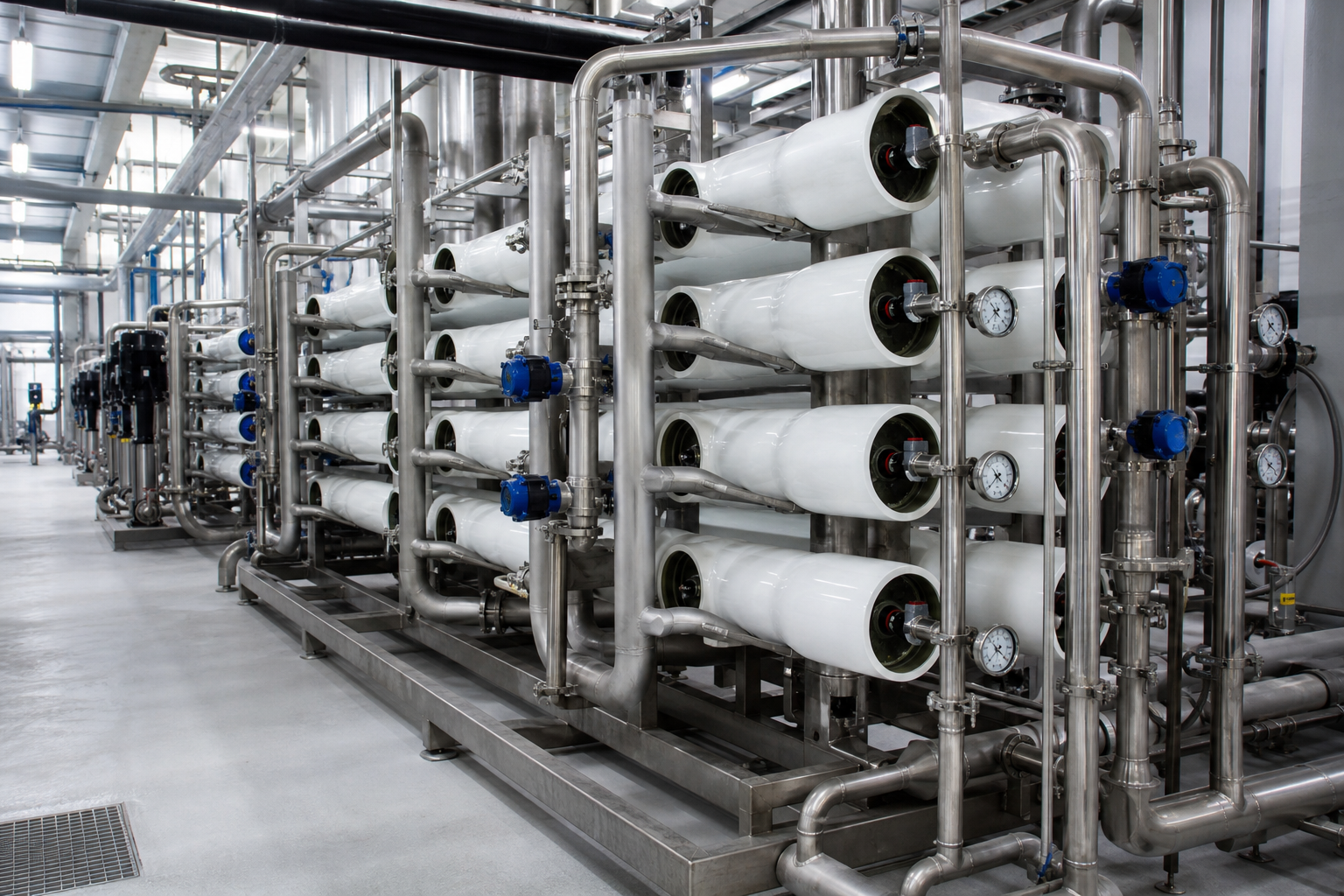
Biological treatment handles organics but cannot destroy these salts. Membrane systems — softening plus RO — recover most of the water volume, but the RO reject — an illustrative envelope of 20,000–80,000 mg/L TDS depending on upstream recovery — becomes steadily more concentrated and difficult. That reject is the feed for evaporation and crystallization.
Plant Configuration: From RO Reject to Dry Salt and Clean Distillate
A complete rare earth RO concentrate treatment island normally contains five sections working in series.
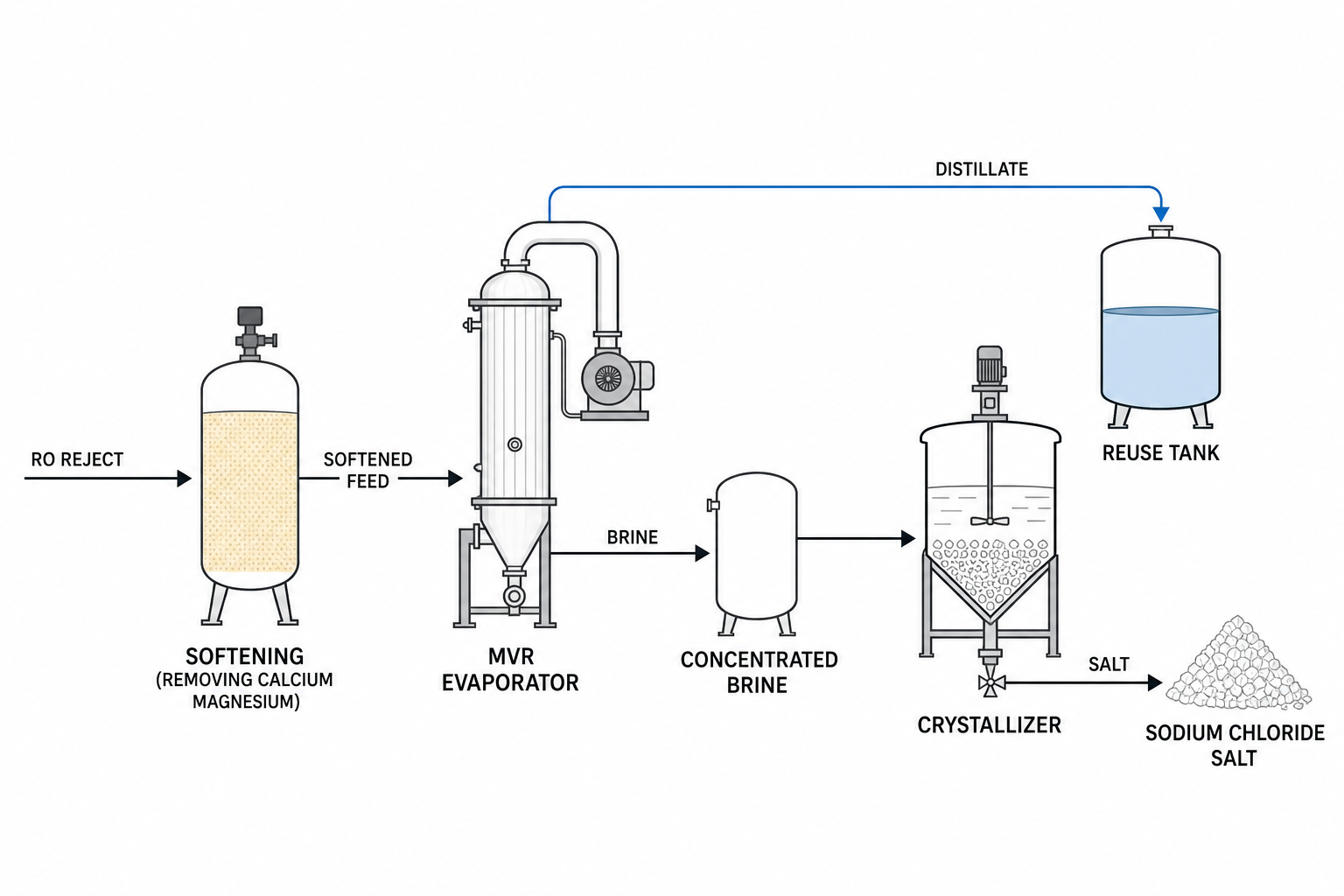
1. Feed conditioning. The RO reject is equalized, pH-adjusted, and polished for hardness: calcium and magnesium that passed RO at tolerable levels become scale formers at evaporator concentrations, so softening is placed ahead of the heat-transfer surface rather than behind it.
2. Concentration train. The softened liquor enters the evaporator — most commonly MVR forced circulation for this duty — and concentrates from feed strength toward the crystallization zone. MVR is the default because rare earth plants usually sit away from industrial steam corridors, and electrically driven evaporation avoids a new boiler investment.
3. Crystallization. The concentrated liquor discharges to a crystallizer operating at atmospheric or slight vacuum conditions, where ammonium sulfate (or ammonium chloride) nucleates and grows. Forced circulation crystallizers with external heating are the standard selection for these salts; where particle size matters for fertilizer resale, an Oslo-type growth-classified crystallizer can be substituted.
4. Solid-liquid separation and drying. A pusher or peeler centrifuge dewaters the crystal slurry, and a countercurrent-flow dryer — fluidized bed or rotary — brings the salt to free-flowing product moisture.
5. Condensate treatment and recycle. The evaporator distillate carries some ammonia, because ammoniacal liquor exerts a measurable ammonia vapor pressure at boiling temperature. Depending on the recycle specification, a small stripping column or pH-controlled polish restores the condensate to process-water quality for leaching, scrubbing, or washing.
| Process module | Equipment candidates | Selection basis | Indicative envelope |
|---|---|---|---|
| Feed conditioning | Equalization tank, softening polish, pH control | Ca/Mg become scale formers at evaporator strength | Run length set by hardness carryover |
| Concentration | MVR forced-circulation evaporator | Electric drive avoids a new boiler off the steam corridor | 20–40 kWh/t class (supplier-published); BPE growth as NH4 salts concentrate |
| Crystallization | FC crystallizer; Oslo where crystal size counts | Flat-solubility ammonium salts favor evaporative crystallization | Supersaturation control to avoid fines |
| Separation & drying | Centrifuge + fluidized bed / rotary dryer | Free-flowing product moisture for resale or disposal | Crystal washing vs chloride or Fe pickup |
| Condensate polish | Stripper or pH-polish, closed recycle | Ammonia vapor pressure follows the distillate | NAR tracking on Th/U where feedstock requires |
Configuration, materials, and operating ranges depend on the actual concentrate, corrosion review, scaling behavior, utilities, and project capacity.
Salt Selection: Ammonium Sulfate and Ammonium Chloride Behave Differently
The two candidate salts are both water-soluble nitrogen chemicals with crystallization behavior that shapes the design. Ammonium sulfate has a mild, nearly flat handbook solubility curve — about 75 g per 100 g water at 20°C rising only modestly with temperature — which means evaporative crystallization (removing water) is far more effective than cooling crystallization. Ammonium chloride dissolves to roughly 37 g per 100 g water at 20°C and also shows limited temperature sensitivity, again favoring evaporative crystallization. Neither salt offers the steep solubility slope that makes flash or cooling crystallization attractive, so the thermal duty — and therefore the energy price of the plant — is set by how much water must be boiled, reinforcing the case for MVR.
Evaporator Selection and Energy Economics
For the moderate boiling point elevation of ammonium salt liquors (typically a few degrees at feed, rising as the liquor approaches saturation), MVR delivers its best economics: the compressor lifts the vapor by a small temperature difference, and specific energy consumption settles in the range of 20–40 kWh per ton of water evaporated for this class of duty (supplier-published indicative range; not a project guarantee) — an order of magnitude cheaper than live steam evaporation in most electricity-versus-steam price environments. Multi-effect evaporation remains a valid alternative where waste steam or low-cost coal-fired steam exists on site; the selection is an energy-price calculation, not a technology contest.
Forced circulation is preferred over falling film for the final concentration and crystallization steps because ammonium salt liquors scale on hot surfaces as they approach saturation. Falling film can still serve for the initial pre-concentration stretch where scaling risk is low, improving overall heat-transfer economics — a hybrid arrangement many plants adopt.
Materials and Scaling Management
Ammonium sulfate liquor is mildly corrosive to carbon steel and accepts SS 316L as the standard wetted material; chloride-bearing circuits require the usual upgrade to duplex or higher-alloy steels in the hottest zones. Fluoride traces from roasting operations demand a specific review wherever titanium is considered. Scaling control is mostly a calcium story: sulfate hardness precipitates as gypsum on heat-transfer surfaces as concentration rises, countered by softening ahead of the evaporator, an allowance in the fouling factor, and scheduled CIP connections.
What to Do With the Recovered Salt
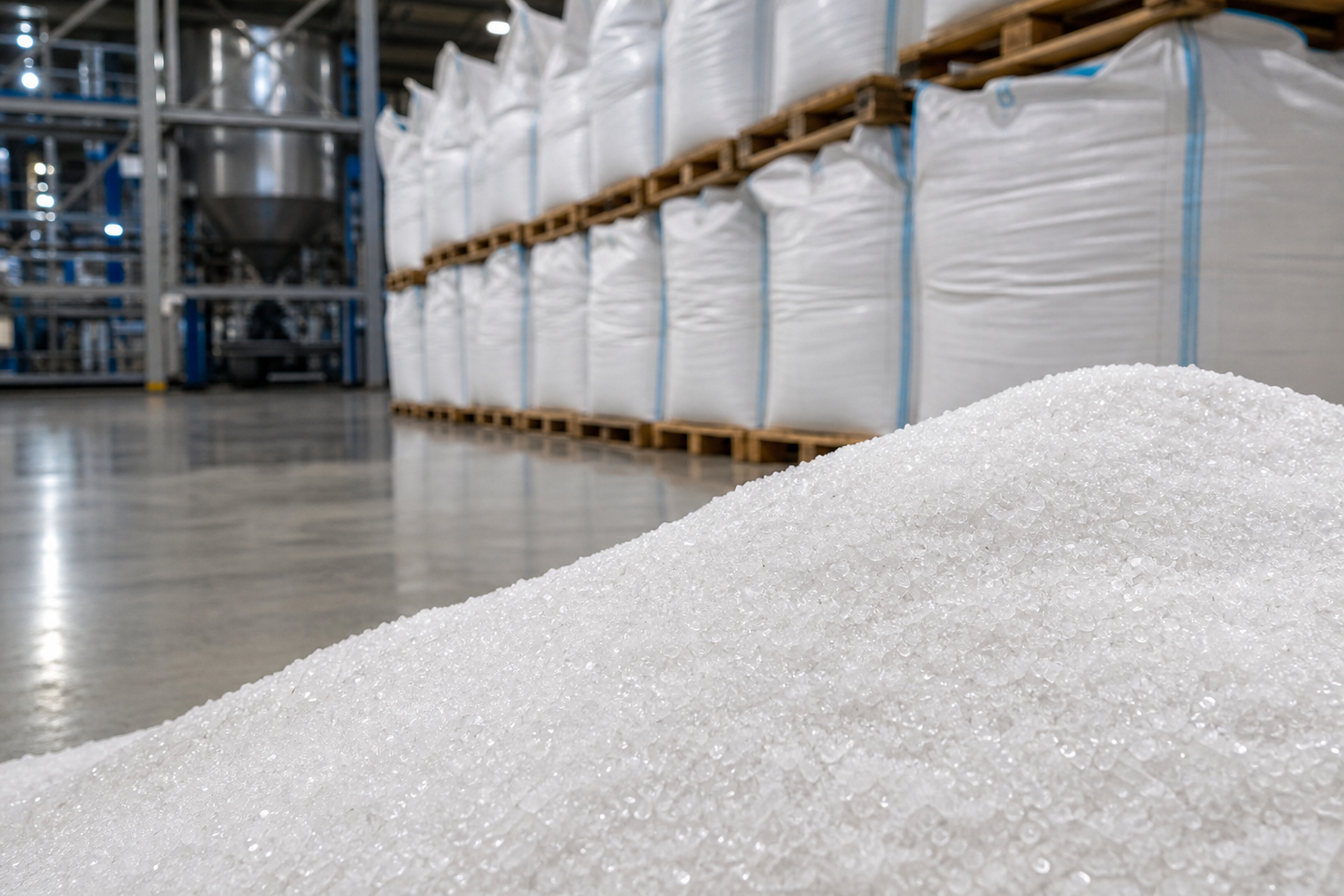
Crystalline ammonium sulfate recovered from rare earth wastewater can sell into the fertilizer market when purity and appearance specifications are met — requiring disciplined crystal washing on the centrifuge and control of iron and heavy-metal pickup. Mixed ammonium sulfate / sodium sulfate product needs fractional crystallization or a separate salt-separation stage to upgrade co-product value. Off-spec salt still disposes far cheaper as a dry solid than as brine, and the dry form is often a regulatory requirement in itself.
The water balance completes the resource story: distillate from the evaporator, after ammonia polishing, returns to leaching and washing duty, cutting fresh water withdrawal and wastewater discharge volumes simultaneously.
Instrumentation and Operating Discipline
A rare earth concentrate evaporator earns its availability through control loops, not exotic equipment. Density on the crystallizer discharge triggers slurry extraction to the centrifuge, keeping crystal residence time — and particle size — stable. Compressor anti-surge and inlet-temperature protection guard the MVR machine during load changes and CIP switchover. Condensate conductivity and ammonia analyzers close the water-quality loop, and a hardness analyzer on the softening outlet warns of the scaling that quietly shortens campaigns. Plants that instrument these five points run weeks between cleanings; plants that skip them clean by calendar.
Compliance Context: Why Plants Are Building These Systems Now
Rare earth separation capacity in China is concentrated in a small number of industrial parks, where basin-level discharge quotas have tightened and total-nitrogen limits have grown stricter. Zero liquid discharge — or near-ZLD with brine solidification — is now the default permit expectation for new and expanded capacity. RO-plus-evaporation is the most widely adopted route to meet it: membranes carry the cheap water-removal duty, and evaporation carries the final salt-crystallizing duty where membranes are physically excluded.
Related Pages
- Rare earth industry solutions — evaporation applications across rare earth metallurgy
- Zero liquid discharge solutions — the overall ZLD architecture this system completes
- MVR evaporation technology — the energy core of the concentration train
- Salt separation systems — fractional crystallization of mixed ammonium and sodium salts
- Aluminum electrolysis slag lithium recovery — a parallel metallurgical high-salt liquor evaporation application
When This Route May Not Fit
Evaporation on the RO reject does not fit every rare earth site. Where reject volume and TDS are both low, brine solidification or contracted disposal is cheaper than a crystallizer. Plants with cheap captive steam and expensive electricity may price multi-effect below MVR. Mixed ammonium-sodium sulfate streams with no fractional-crystallization step and no salt buyer convert the recovery leg into a disposal cost. And feedstocks carrying high natural radioactivity may push the salt into a regulated-waste channel where on-site recovery gains little.
What Must Be Verified
Four checks gate the design. The concentrate analysis itself: TDS, ammonium salt speciation, Ca/Mg hardness, heavy metals, and Th/U with the associated NAR obligations — softening depth and metallurgy both hang on it. The ammonia partition at boiling, which sets the condensate-polishing duty for the intended reuse. Salt marketability, tied to crystal washing and chloride and iron pickup against fertilizer specifications. And the site energy pair — electricity versus steam price — that settles MVR versus multi-effect before any equipment is specified.
FAQ
Why not just treat rare earth wastewater chemically instead of evaporating it?
Chemical precipitation and biological steps remove specific pollutants, but dissolved ammonium salts survive them. Evaporation is the only unit operation that physically separates dissolved salts from the water at high concentration, which is why it occupies the terminal position in rare earth ZLD flowsheets.
What TDS level should RO concentrate reach before evaporation?
RO concentrate from rare earth wastewater trains typically lands in the 20,000–80,000 mg/L range depending on membrane recovery and upstream salt load. Higher RO recovery shrinks the evaporator and its energy bill, so the two systems are optimized together, not separately.
Is the recovered ammonium sulfate sellable?
It can be, when crystal washing controls chloride and iron pickup and the crystal size meets fertilizer-market expectations. Mixed or off-spec salt still disposes cheaper and cleaner as a dry solid than as brine.
Why does the evaporator condensate need ammonia polishing?
Ammonium-bearing liquor exerts an ammonia vapor pressure at boiling temperature, so a fraction of ammonia reports to the distillate. A small stripper or pH-polishing stage restores the condensate to process-water quality for closed recycle.
MVR or multi-effect for a rare earth separation plant?
Most rare earth plants lack industrial steam infrastructure, making electrically driven MVR the lower-total-cost choice; specific consumption for this class of duty typically falls in the 20–40 kWh per evaporated ton band. Where cheap steam exists on site, multi-effect remains competitive and the choice becomes a site energy-price calculation.
To screen this route, share the RO-concentrate analysis (TDS, ammonium salt, hardness, metals), the reject flow, and the reuse or salt-outlet target — enough for an initial configuration screening.