Lithium recovered from aluminum smelter waste streams is no longer a laboratory curiosity: as lithium accumulates in the electrolyte of reduction cells during aluminum production, spent potlining and electrolyte slag have become a recognized secondary lithium resource. An evaporation-based desalination and concentration system sits at the center of the recovery flowsheet — after acid leaching and impurity removal, the lithium-bearing liquor must be concentrated several-fold before lithium carbonate precipitation, while sodium, potassium and other salts are separated as sellable byproducts. This solution page explains how the process works, how to select between MVR and multi-effect evaporation for these high-salt liquors, and which design details determine whether the plant runs stably for years or fouls and corrodes within months.
Why Lithium Builds Up in Aluminum Electrolysis Waste
Primary aluminum is produced by electrolyzing alumina dissolved in cryolite-based molten salts. The alumina feed, and to a lesser extent the fluoride salts, carries trace lithium that has no exit route in the closed cell: it accumulates continuously in the bath as lithium fluoride. Published industry data — an external industry reference from Chinese smelters using mid-to-low grade bauxite-derived alumina, not EvapCryst project data — shows lithium levels in the electrolyte building to roughly 1–2.7% (reported as Li+) over successive cell operations; indicative, not a project guarantee.
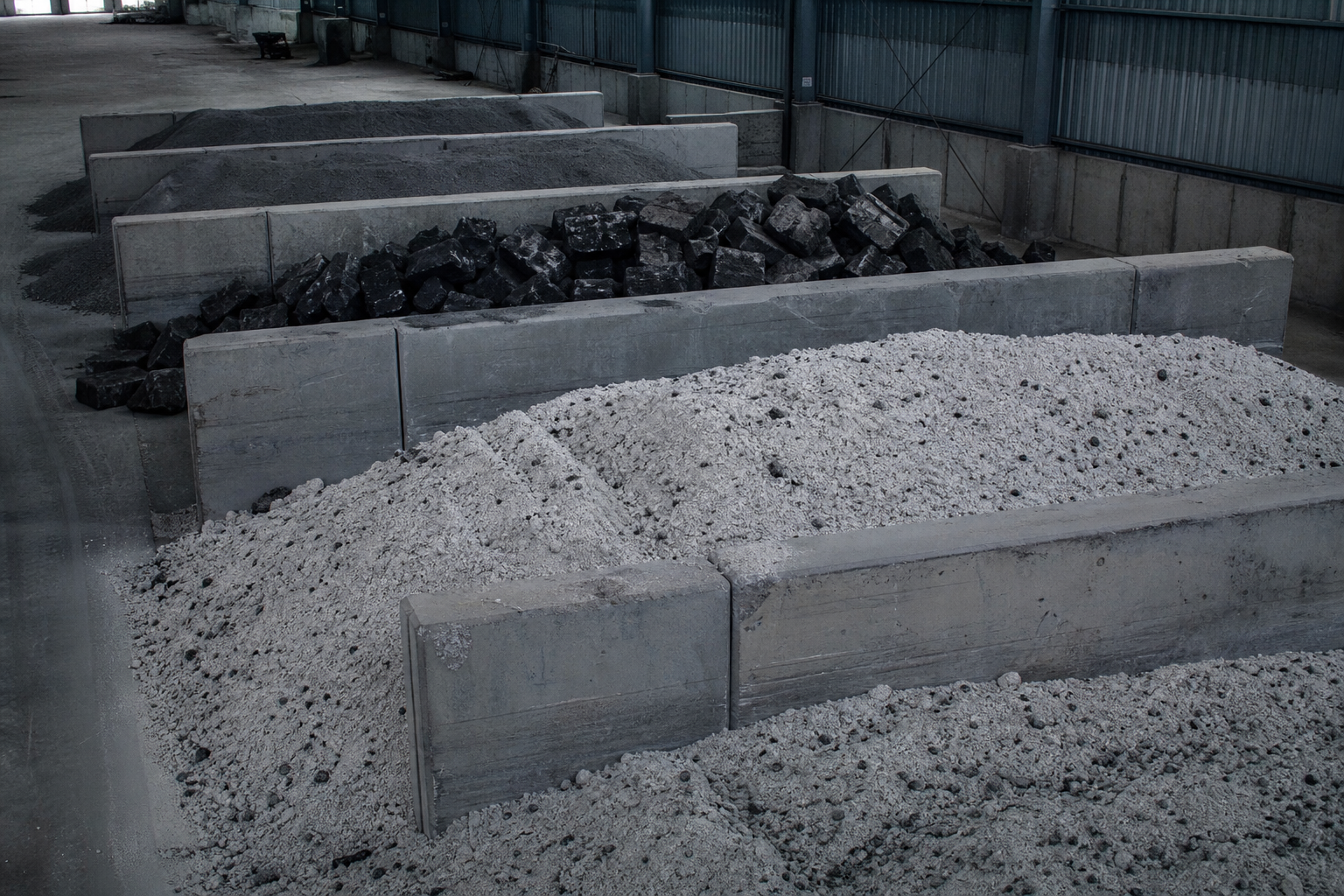
This accumulation is a double-edged problem. Excess lithium fluoride modifies bath chemistry and changes cell operating parameters, so smelters periodically drain electrolyte or replace bath material. The drained material — together with spent potlining (SPL) removed during cell relining, a hazardous waste stream containing fluorides, cyanides, carbon and refractory — carries lithium values that justify recovery rather than secure landfilling.
Recovery Flowsheet: From Hazardous Slag to Battery-Grade Lithium
The industrial route for lithium recovery from aluminum electrolysis slag and electrolyte follows a clear sequence. The material is first crushed and classified to remove carbon and refractory residue. The lithium-bearing fraction is leached with acid, producing a liquor that still contains calcium, magnesium and fluoride. Fluoride precipitation and hardness removal follow, because these impurities would otherwise scale heat transfer surfaces and contaminate the final product.
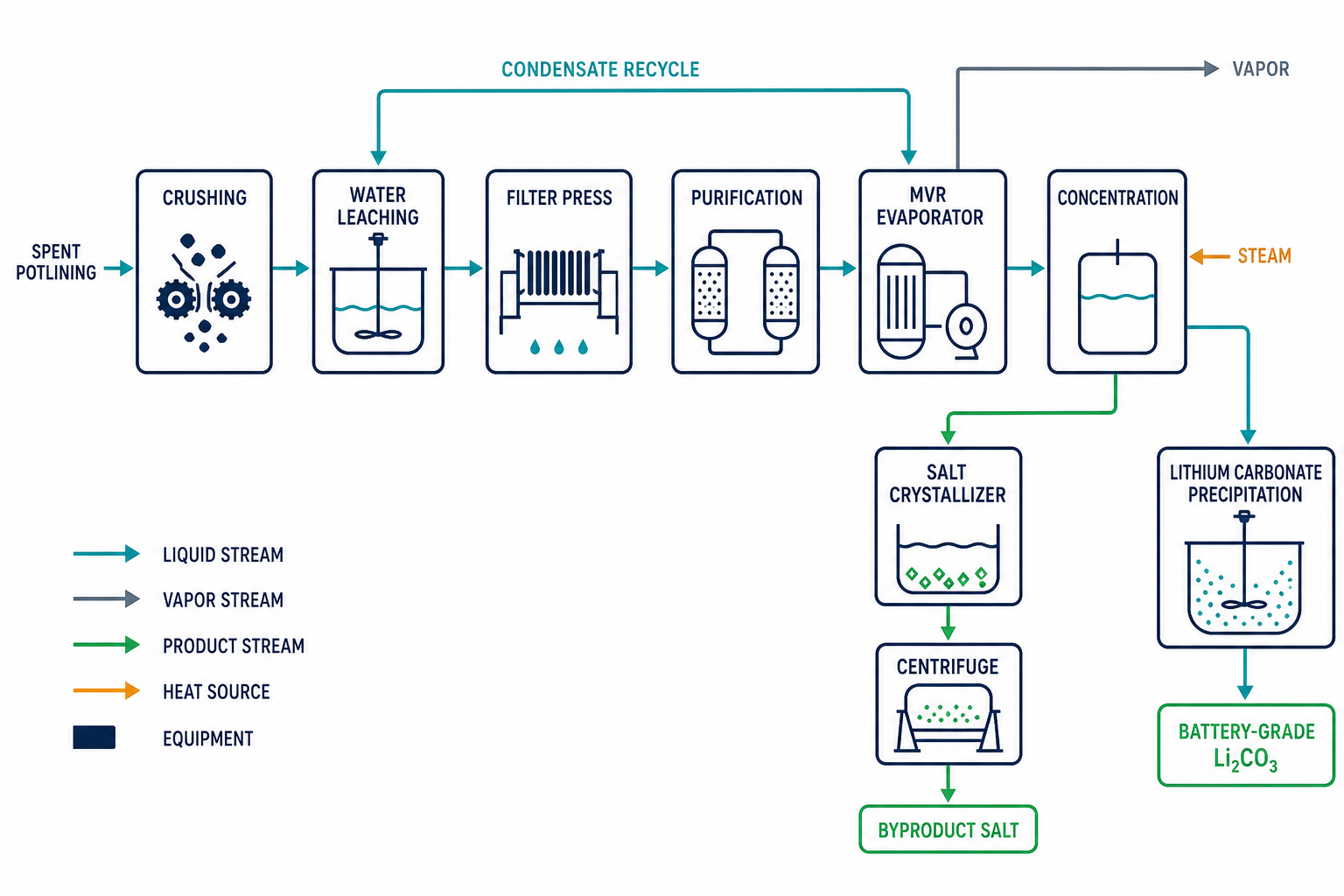
Only after this pretreatment does the liquor enter the evaporation stage, where lithium is concentrated to the level required for downstream precipitation — in published ore-based plant practice (external industry reference), lithium solution is reported to be concentrated by evaporation to the region of 90 g/L before the precipitation step. After concentration and polishing, sodium carbonate is dosed to precipitate crude lithium carbonate, which is then refined (typically via carbonation–decomposition of the bicarbonate) to battery grade.
The Real Engineering Challenge: Multi-Salt Evaporation, Not Simple Concentration
Project teams often underestimate one point: after impurity removal, the evaporator feed is never a clean lithium solution. Depending on the route, the cation profile includes lithium, sodium, potassium, and where the ore or slag chemistry dictates, rubidium and cesium; the dominant anion is either sulfate (sulfuric acid or sulfate roasting routes) or chloride (hydrochloric acid routes), with residual fluoride always a possibility. The evaporation step is therefore genuinely a mixed-salt concentration and salt-separation duty, not a simple concentration duty.
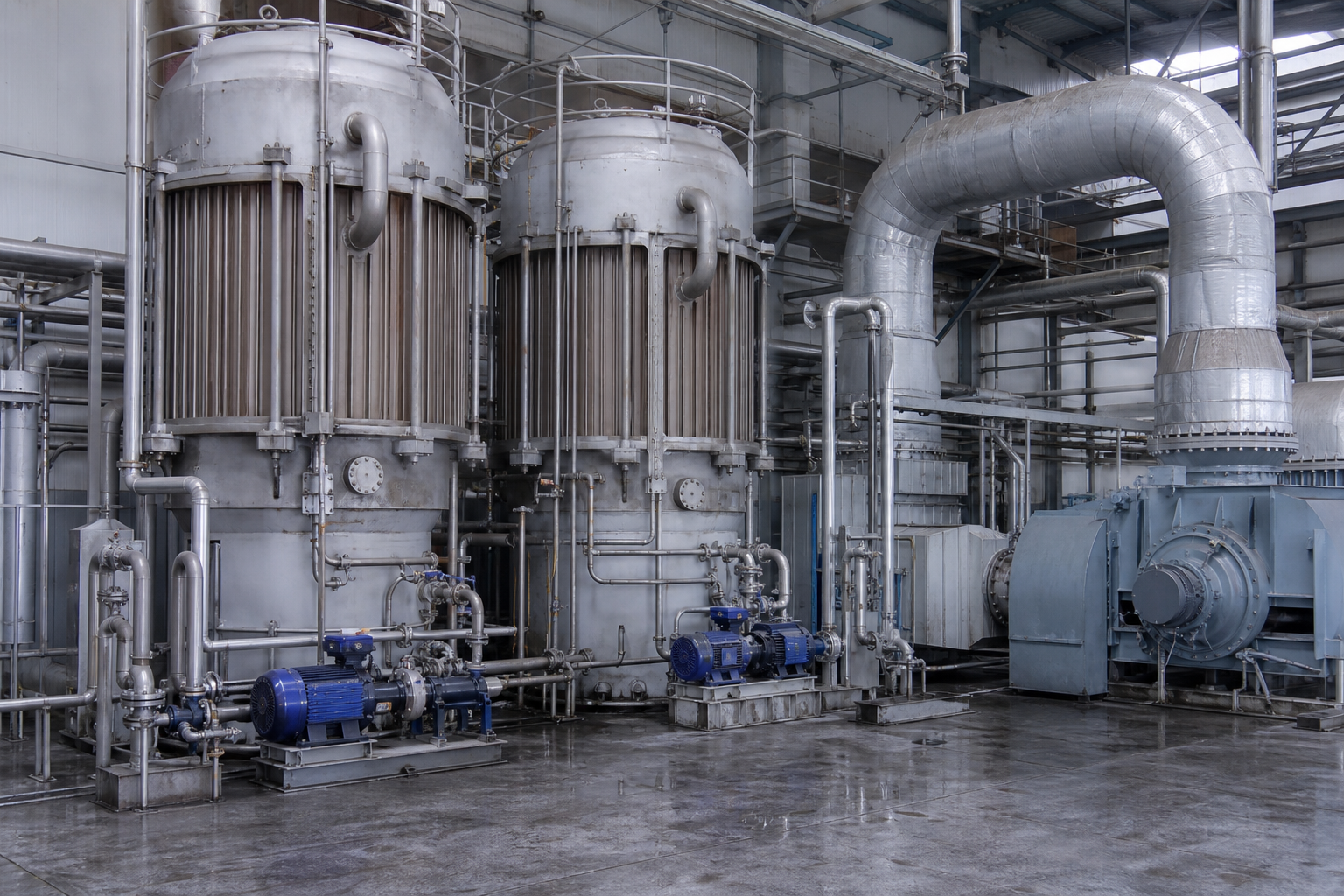
Practically, this means the plant is specified as one or more evaporation-concentration or evaporative crystallization trains, frequently supplemented by a chilling crystallization section. The sodium and potassium salts recovered from the mother liquor are separated and packaged as byproducts, improving the project economics. Salt handling, crystal washing and mother-liquor recycling deserve the same engineering attention as the evaporator itself.
MVR or Multi-Effect? Route Chemistry Decides
The acid route chosen upstream defines the evaporation technology choice downstream, mainly through boiling point elevation (BPE).
In sulfate-based systems, the initial boiling point elevation is modest, and from an energy-efficiency standpoint MVR evaporation is attractive: mechanical vapor recompression recycles the secondary vapor as heating medium, cutting live steam consumption dramatically. However, BPE rises as lithium and minor components concentrate, so the designer must define the endpoint of evaporation carefully and confirm the compressor duty at the final — not average — concentration.
In hydrochloric-acid-based aluminum electrolyte lithium recovery, the dissolved salts are mainly sodium chloride and lithium chloride. Vendor-published operating data from HCl-route plants — an external industry reference, not an EvapCryst delivery, indicative rather than a project guarantee — shows initial BPE of 7–8°C that climbs to 10–12°C or higher in operation, driven by lithium concentration and accumulating trace ions. At such BPE levels both MVR and multi-effect evaporation are technically defensible, and the decision becomes site-specific: where industrial steam is available at competitive cost, a triple-effect or other multi-effect evaporator is usually preferred; where steam is unavailable, an MVR system built with a compressor specified for high BPE is selected. Operating discipline also matters — lithium-rich liquor that has reached its target concentration must be discharged promptly to the precipitation section so that the overall salt BPE stays stable.
| Parameter | Sulfate Route (H2SO4 / sulfate roasting) | Chloride Route (HCl leaching) |
|---|---|---|
| Dominant salts | Lithium, sodium, potassium sulfates | Sodium chloride + lithium chloride |
| Boiling point elevation | Low at inlet, rising with concentration | 7–8°C initial, 10–12°C+ in operation |
| Preferred evaporator | MVR for energy efficiency (verify end-point BPE) | Multi-effect where steam exists; high-BPE MVR where it does not |
| Typical materials | SS 316L, titanium where fluoride is controlled | Duplex stainless steel; titanium used with caution (fluoride risk) |
| Forced circulation velocity | ≈2 m/s design target, VFD-controlled pump | ≈2 m/s design target, VFD-controlled pump |
Evaporator Type and Circulation Discipline
For these high-salt, scaling-prone liquors, forced circulation evaporators are the correct baseline. It is tempting to reduce CAPEX by specifying falling-film or natural-circulation units, but the mixed salts and trace impurities make tube-wall crystallization and fouling a certainty over a campaign. Two rules protect the heat transfer surface: maintain liquor velocity through the calandria at around 2 m/s, and drive the circulation pump through a variable-frequency drive so the actual velocity is adjustable as fouling resistance grows between cleanings.
For projects that later upgrade from marginal materials, a staged strategy works well: start with lower-cost metallurgy while feed quality is uncertain, keep the heat exchanger as a swappable module, and fabricate a titanium or duplex replacement for scheduled change-out once the water chemistry has stabilized. This caps early investment risk without locking the plant out of long-life materials.
Materials of Construction Under Chloride and Fluoride Attack
Sulfate-route liquors permit SS 316L, with titanium as an upgrade where corrosion margins must be wider. Chloride-route systems change the picture: duplex stainless steel is the workhorse selection, and titanium — normally the premium chloride material — must be assessed carefully because even small fluoride concentrations attack titanium passivity. Secondary vapor handling can stay in stainless steel, and mid-to-low temperature chloride streams allow non-metallic options such as PE or FRP for vent and drain piping. Where carbon steel is accepted for cost reasons on uncertain water quality, pH should be held neutral to slightly alkaline to manage corrosion rates.
Foam Control and Protecting the Compressor
Lithium recovery liquors, influenced by upstream processing residuals, foam measurably. The risk is rarely catastrophic foaming in the separator — it is liquid carry-over into the vapor path. In an MVR system, entrained droplets and foam reaching the compressor impeller cause erosion and imbalance, one of the most expensive failure modes in the plant.
The countermeasures are proven: specify composite-function demisters rather than a single wire-mesh pad, and where a single stage cannot fully eliminate the risk, install two stages in series. Commissioning should include a protocol of periodic condensate lithium analysis — rising lithium in the condensate is the early-warning signal of entrainment. Condensate should be kept in closed recycle, and lithium must never be allowed to escape into open circulating-water systems, both for product recovery economics and environmental compliance.
Discharge Control: Moving Lithium-Rich Liquor On Time
Concentrated lithium chloride solutions exhibit very high actual boiling points. The operating rule that follows from this is simple but frequently violated: once liquor reaches the lithium concentration setpoint, discharge it to the precipitation section immediately. Holding over-concentrated liquor in the system drives BPE upward, degrades heat transfer, accelerates corrosion and destabilizes the whole train. Front-end impurity removal (calcium, magnesium, fluoride) and back-end prompt discharge are the two levers that keep the evaporation system between cleanings for the full design campaign.
Byproduct Salt Recovery Completes the Economics
In ore-based lithium plants, the mother liquor after lithium precipitation is neutralized and processed by salt evaporation-crystallization separation (fractional salt crystallization) to recover potassium and sodium salts; crystallization mother liquor passes through flash and chilling crystallization and re-dissolution evaporation to yield sodium sulfate, and the chilled mother liquor returns upstream after fluoride removal. The same logic applies to aluminum electrolyte lithium recovery: every ton of separated and washed byproduct salt improves the project’s payback and reduces the residue stream that must be disposed. Designing the salt-separation section for product-grade output, not merely dewatering, is what separates an economic plant from a compliance plant.
System Scope Typically Supplied
| Process Module | Candidate Equipment Types | Selection Rationale | Indicative Operating Envelope |
|---|---|---|---|
| Pretreatment tie-in | Leach-liquor receiving tanks; polishing filters | Receives leached, impurity-removed liquor; Ca/Mg/F limits agreed at the interface | Set by upstream leach specification |
| Evaporation train | Forced-circulation evaporator, MVR or multi-effect heating | Concentrates lithium to the precipitation setpoint under scaling-prone mixed-salt duty | Velocity ≈2 m/s with VFD; endpoint BPE verified (chloride route 7–8°C rising to 10–12°C+, vendor-published) |
| Salt separation | Flash and chilling crystallizers; re-dissolution evaporation | Recovers Na/K salts and Na2SO4 at product grade | Mother-liquor recycle ratio per washing quality |
| Vapor system | MVR compressor or effect-to-effect cascade; composite demisters | Energy route set by BPE and steam availability; protects machine from entrainment | Condensate Li monitoring as early warning |
| Controls | Density-triggered discharge, anti-surge, CIP | Prompt discharge holds system BPE stable | Automated discharge on concentration setpoint |
Configuration, materials, and operating ranges depend on actual feed, temperature, pressure, corrosion review, fouling behavior, utilities, and project capacity.
Related Pages
- Forced Circulation Evaporation technology — the baseline evaporator type for high-salt lithium liquors
- Salt separation and fractional crystallization systems — byproduct salt recovery from mixed-salt mother liquors
- Concentration and crystallization solutions — integrated process design approach
- Battery materials industry solutions — evaporation systems across the battery-material chain
- Rare earth metallurgy high-salt RO concentrate evaporation — a parallel metallurgical extraction-liquor evaporation application
When This Route May Not Fit
Lithium recovery is not automatic for every smelter stream. Where the electrolyte lithium grade sits well below the published 1–2.7% range, or the drainable volumes are small, the recovery circuit cannot amortize its capital. Where spent potlining has not been detoxified and stabilized, hazardous-waste compliance — cyanide and fluoride destruction — rightly takes precedence over metal values. If the upstream leach route (sulfate versus chloride) is still undecided, no evaporator can be responsibly selected, because that chemistry sets BPE, materials, and energy route. And where no market exists for the sodium and potassium byproduct salts, the economics that carry the project thin out considerably.
What Must Be Verified
Validation focus: lithium grade and batch variation of the actual electrolyte or slag, because the published range is a reference, not a feed guarantee. A full liquor analysis after leach and impurity removal — Li, Na, K, Ca, Mg, F, and the dominant anion — is the entry ticket. Boiling point elevation must be measured across the concentration range, especially at endpoint for chloride routes. The fluoride residual dictates the corrosion review: it can disqualify titanium outright and narrow duplex selections. Confirm byproduct salt outlets and grades, and align the concentrated-liquor specification with the downstream lithium carbonate precipitation step before anything is fabricated.
FAQ
How much lithium does aluminum electrolyte actually contain?
At smelters using alumina from mid-to-low grade bauxite, lithium accumulates in the cell electrolyte to roughly 1–2.7% (as Li+) over operating campaigns, which is why drained bath and slag justify a dedicated recovery circuit.
Should I choose MVR or multi-effect evaporation for lithium recovery liquor?
For sulfate-route liquors with modest BPE, MVR is usually the energy-efficient choice. For chloride-route (HCl) systems where operating BPE reaches 10–12°C or higher, use multi-effect evaporation where industrial steam is available, and a high-BPE MVR compressor where it is not.
Why is forced circulation specified instead of falling film for these liquors?
After impurity removal the liquor is a multi-salt solution prone to wall crystallization. Falling-film and natural-circulation units save CAPEX but foul rapidly; forced circulation at around 2 m/s with a VFD-driven pump keeps the heat transfer surface cleanable over a full campaign.
Is titanium a safe material selection for chloride-route lithium evaporators?
Only after a fluoride review. Titanium performs well against chlorides but loses passivity in fluoride-bearing solutions, so duplex stainless steel is often the safer specification when fluoride traces remain after pretreatment.
What happens to the sodium and potassium in the liquor?
They are recovered as byproduct salts via fractional salt crystallization of the mother liquor — potassium and sodium salts by direct separation, sodium sulfate via flash plus chilling crystallization with re-dissolution, while the chilled mother liquor is fluoride-polished and returned to the process.
Evaluating lithium recovery from electrolyte or spent potlining? Send the material lithium grade, the leach route planned or in operation, the liquor analysis, and throughput targets — in exchange you will receive a first-pass screening of the evaporation route, salt-separation scope, and materials envelope your chemistry implies.