Project Parameters
| Parameter | Value |
|---|---|
| Process route | TVR + four-effect falling-film evaporation, forced-circulation crystallization |
| Industry | Battery materials / lithium chemical by-product recovery |
| Feed type & key components | Ammonium sulfate-bearing solution from battery-materials production (Anhui, East China) |
| Evaporation capacity | 10 t/h |
| Construction materials | SS316L wetted parts (indicative for ammonium sulfate service) |
Representative process configuration compiled from published industry project data. Indicative values, not a process guarantee.
Project Description
A battery-materials producer in Anhui province, East China, generates a steady ammonium sulfate stream as a by-product of its lithium chemical flowsheet. The salt has a genuine market — fertilizer and industrial grades — but only if it is recovered as a clean, crystalline, low-moisture solid; a dilute stream or a mixed mother liquor has negative value. The plant objective is to crystallize the ammonium sulfate on site into a sellable product while returning condensate to the process.
The reference configuration is a 10 t/h evaporation train driven by thermal vapor recompression (TVR) over four effects, with crystallization in forced-circulation service. The choice of TVR rather than MVR at this scale is a steam-economics decision: where the site operates a steam system with spare low-pressure capacity, a TVR system motivates the train with a modest steam draw instead of a large electric machine, and the four-effect arrangement divides the steam demand by roughly the number of effects. Comparable published configurations in the same product run the duty at 80 t/h with the same MVR/four-effect family of routes — the technology scales across the segment.
Process Technology
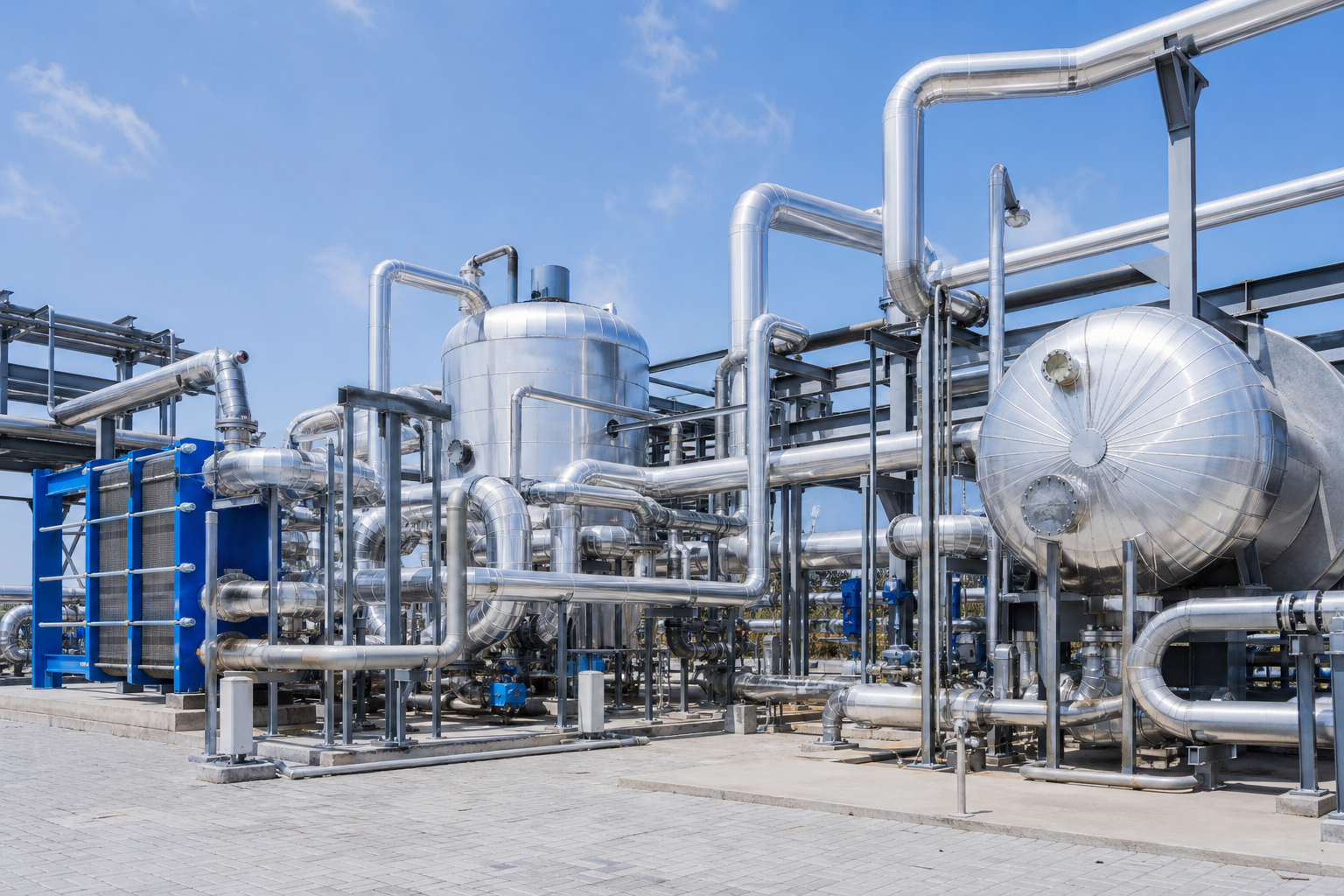
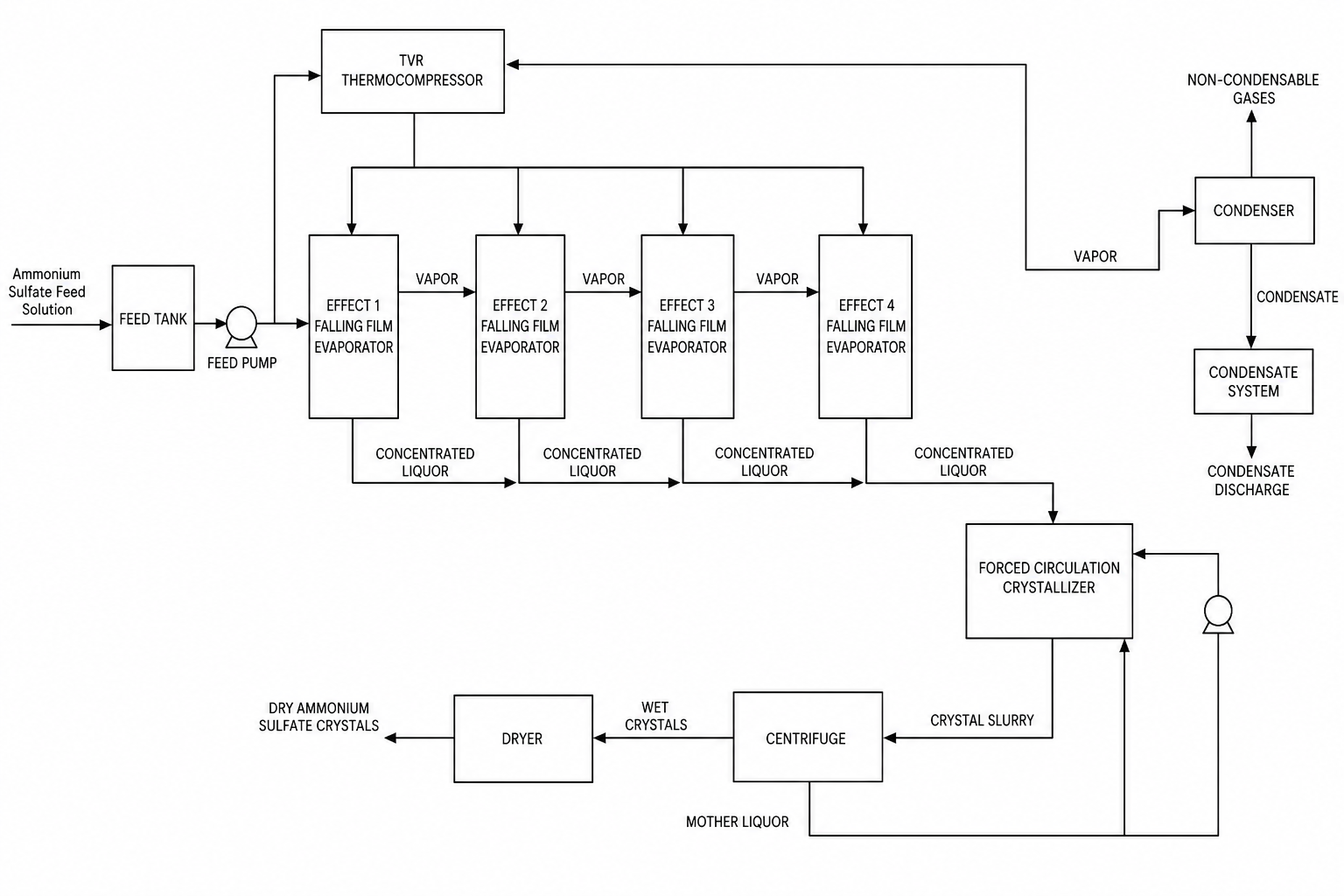
The ammonium sulfate solution is filtered and fed forward to the first effect. Four effects are arranged in series with successively lower temperature and pressure: live steam (compressed through the TVR ejector with recycled secondary vapor) drives the first effect, and each subsequent effect is heated by the vapor boiled off in the one before it. The TVR thermocompressor is the efficiency multiplier at the head of the train — it entrains part of the first-effect secondary vapor and recompresses the mixture with the live steam, so each tonne of boiler steam motivates materially more than one tonne of evaporation.
Falling-film service carries the concentration duty through the effects: the ammonium sulfate liquor wets the calandria surfaces as a thin film, evaporating at low temperature difference and short residence time. Ammonium sulfate solutions are foaming-prone and modestly corrosive to carbon steel; film evaporation with correct distribution and SS316L wetted parts handles both tendencies.
At the back end of the train the liquor, now near saturation, enters the forced-circulation crystallizer. Crystallizing ammonium sulfate scales aggressively on hot walls, so the crystallizer runs with pumped high velocity and suppressed wall superheat — supersaturation is generated in the bulk liquid and relieved on growing crystals rather than on the heat transfer surface. Crystal size is managed through classified withdrawal and slurry density control.
The crystal slurry is dewatered on a centrifuge, dried to specification moisture, and packed as fertilizer-grade or industrial-grade product. Mother liquor recycles to the effect feed with a purge to control impurity inventory, and condensate from the effects — hot, clean water from a four-effect train — is recovered for process reuse.
Equipment Configuration
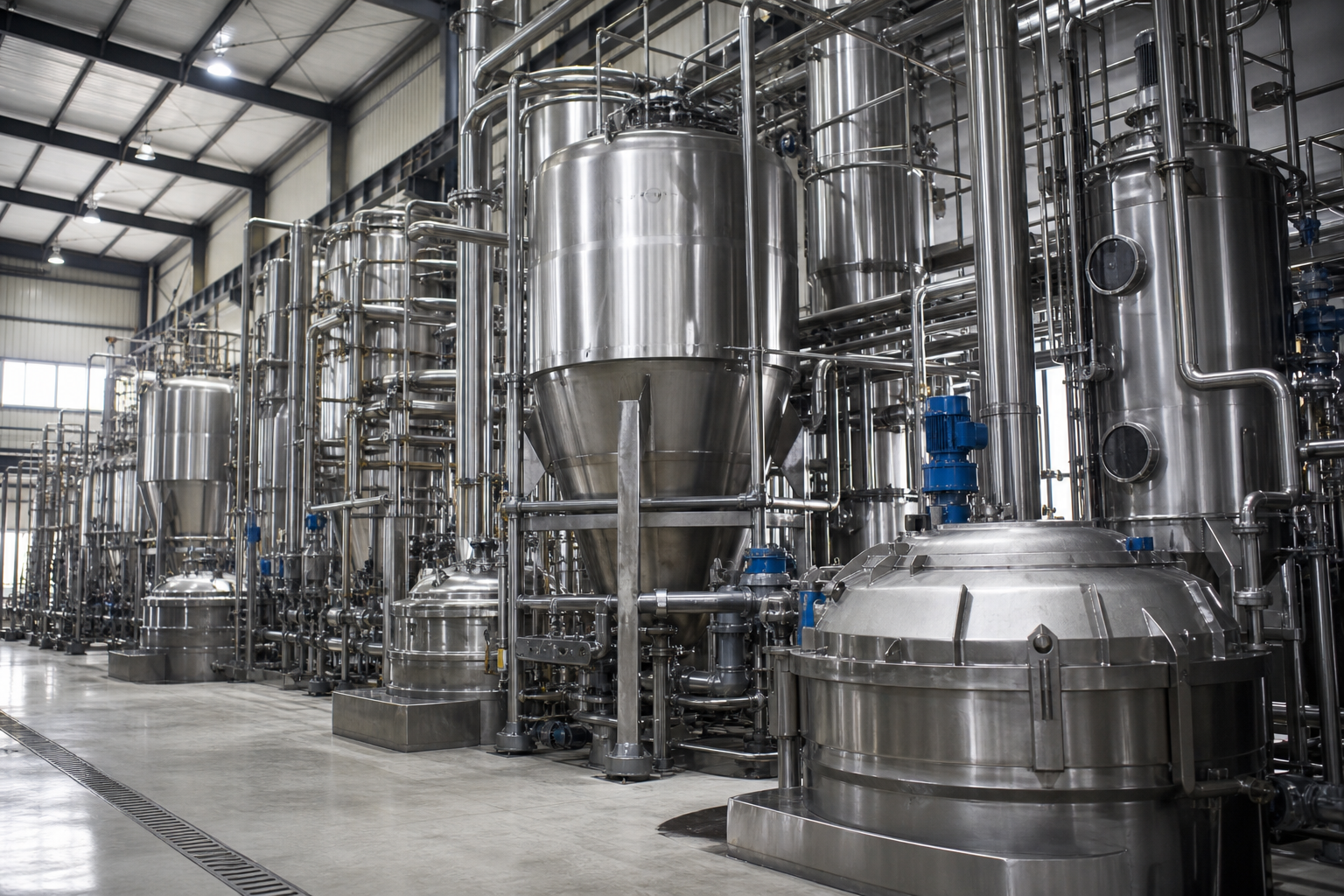
One set of the following equipment is typical for this duty:
- Feed tank and filtration for the ammonium sulfate solution
- Four-effect falling-film evaporation train with TVR thermocompressor on the first effect
- Forced-circulation crystallizer with classified crystal withdrawal
- Centrifuge, dryer and packing for a crystalline, low-moisture by-product salt
- Mother-liquor return with controlled purge; condensate collection and reuse pumping
- PLC control of effect temperatures, crystallizer slurry density and TVR steam draw
Performance & Outcome
Compiled from published industry project data, indicative: trains of this class convert an ammonium sulfate stream into a sellable crystalline product, run on a modest steam draw via TVR over four effects, and recover clean hot condensate. Steam per tonne of water and crystal size distribution are quoted per project.