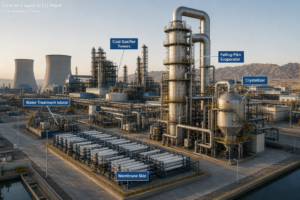
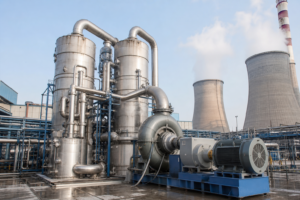
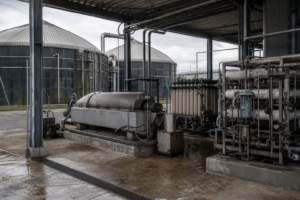
For rare earth smelting and separation wastewater – the streams that carry salt above 10%, pH below 1, COD in the tens of thousands and ammonia nitrogen in the thousands, all laced with recoverable rare earth ions – the workable route is an evaporation-membrane hybrid with stream segregation: each process stage’s wastewater is classified and pretreated for its own chemistry, MVR evaporation concentrates the liquor more than tenfold while recovering rare earths into a concentrate, and membrane polishing turns the condensate into reuse-grade water. The design premise: this wastewater family is too concentrated for membranes alone and too corrosive for standard evaporation equipment – the answer is to sort the streams, then let each unit operation do the fraction of the work its chemistry suits, in materials that survive the duty.
The Problem: “Four Highs, One Complexity”
Rare earth smelting and separation generate a wastewater family that supplier literature summarizes as four highs and one complexity: total salt content exceeding 10%, pH often below 1, COD and ammonia nitrogen at levels hundreds of times municipal sewage, rare earth ions at recoverable concentrations – all carried in a complex matrix of heavy metals, organic extractants and additives (WTEYA rare earth wastewater solution overview – an external industry reference, not an EvapCryst delivery). The streams differ by stage: beneficiation water is solids-laden but modest in salt; decomposition water is extreme in pH and carries NH4Cl or sulfate with dissolved rare earths; extraction and ion exchange water exceeds 100,000 mg/L salinity with extractant COD and high ammonia; refining water carries precipitation mother-liquor salts with residual precipitants.
Published process-performance claims for the hybrid route on this family: COD from 20,000-50,000 mg/L to below 50 (above 99.9% removal), ammonia nitrogen from 5,000-15,000 to below 15 mg/L (above 99.8%), total salinity from 80,000-120,000 to below 500 mg/L reuse standard (above 99.5%), rare earth ion recovery above 99.9% from a 500-2,000 mg/L feed, MVR steam savings above 80% versus traditional evaporation, and concentration factors above 10 – noted by the source as typical values that vary with influent quality (WTEYA – external industry reference; supplier-published typical values, not a project guarantee).
Illustrative Feed Envelope for Screening
The envelope below consolidates the published typical values with ranges used for screening rare earth smelting streams. It is an illustrative envelope built from public industry material and stated assumptions – not a customer dataset, and not a performance guarantee.
| Parameter | Illustrative range | Basis / note |
|---|---|---|
| Total salinity | 80,000-120,000 mg/L (extraction/IX streams >100,000) | Published typical influent |
| pH | Below 1 in decomposition streams | Drives materials selection |
| COD | 20,000-50,000 mg/L | Organic extractants and additives |
| Ammonia nitrogen | 5,000-15,000 mg/L | Saponification and wash chemistry |
| Rare earth ions | 500-2,000 mg/L | Recoverable resource, not just pollutant |
| Treatment objective | <500 mg/L reuse water; RE recovery >99.9%; “zero” discharge | Published targets |
Process Solution: Segregate, Recover, Then Polish
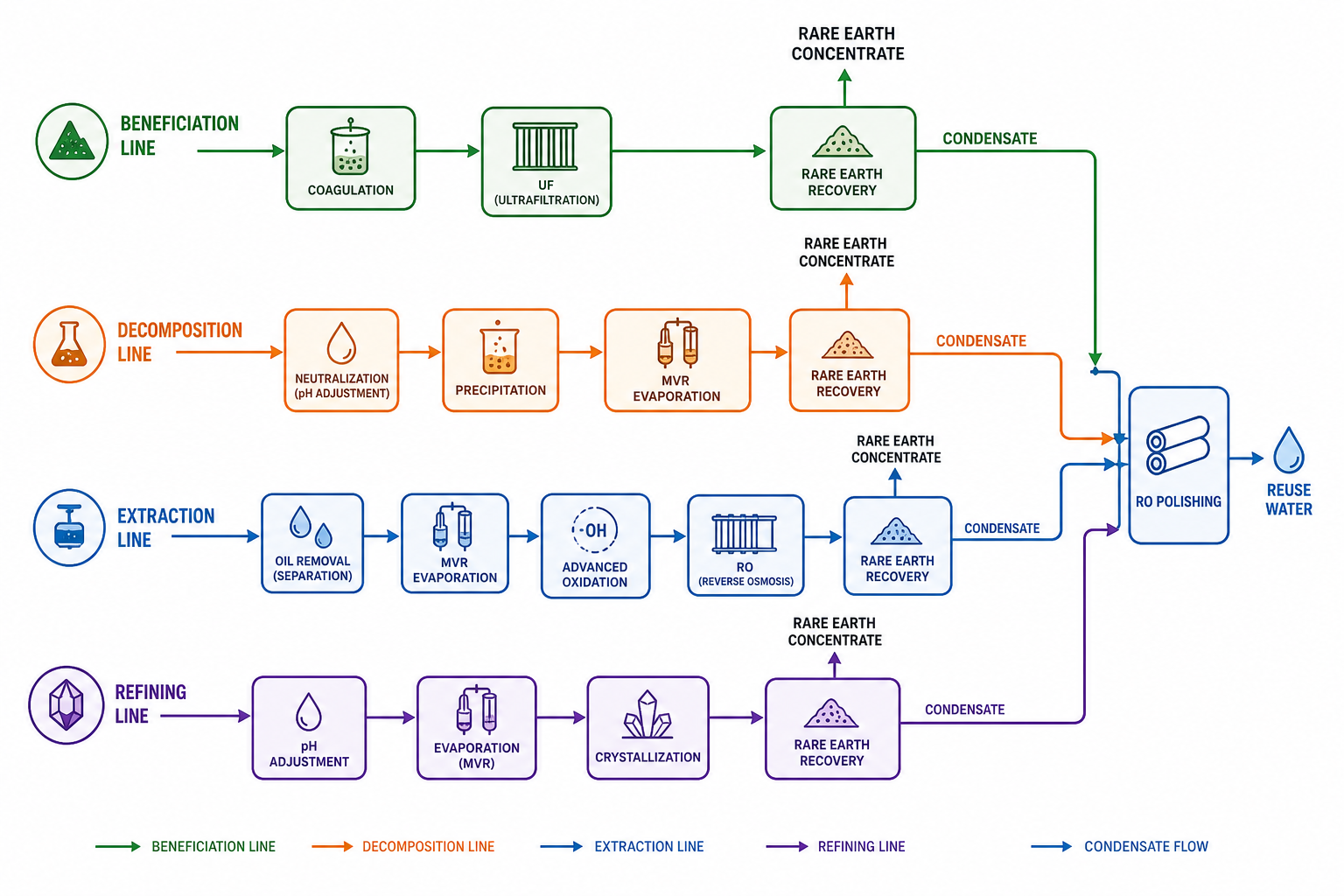
The architecture runs in four blocks, and the first is bookkeeping rather than chemistry. Stream segregation routes each stage’s wastewater to its own pretreatment: beneficiation water to coagulation-sedimentation and membrane filtration for direct reuse; decomposition water to neutralization and precipitation of its dissolved rare earths before evaporation; extraction and ion-exchange water to oil removal ahead of its evaporation duty; refining water to pH adjustment before concentration-crystallization. Blending the streams saves piping and destroys the flowsheet – the acid stream would consume the neutralization reagent of the neutral stream, and the extractant COD would foul every downstream surface.
Second, recovery ahead of volume reduction: where dissolved rare earths carry value, precipitation or concentration steps pull them out as a concentrate before the brine enters its final evaporation – the published claim of above 99.9% rare earth recovery with in-process intervention after extraction or separation, recovering value before it is contaminated downstream. Third, MVR evaporation as the volume engine: the pretreated, metal-depleted liquor enters mechanical vapor recompression evaporators that concentrate it more than tenfold – the energy claim is above 80% steam saving against traditional evaporation because the compressor recycles secondary vapor as the heat source. Crystallization closes the salt balance where the concentrate reaches saturation.
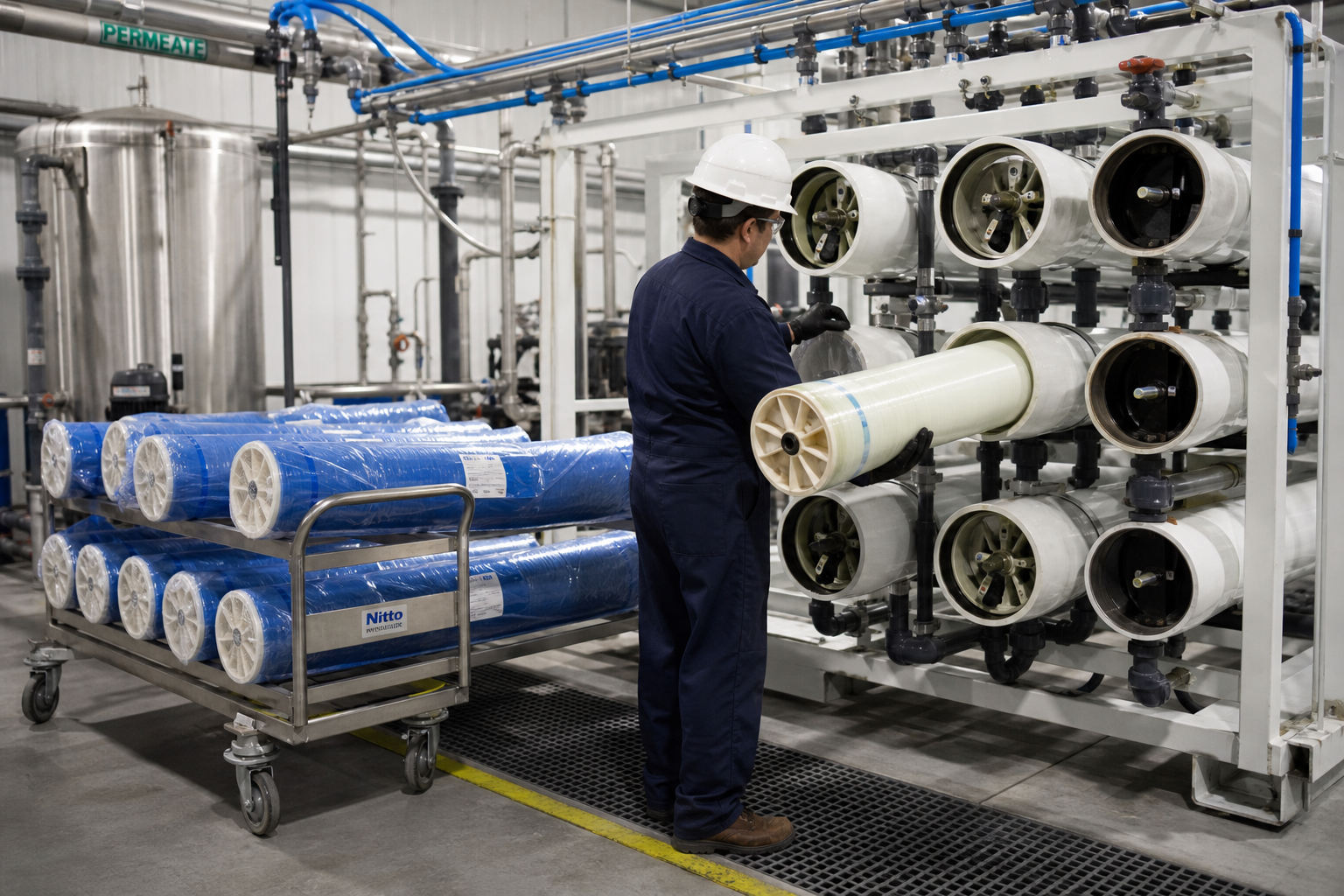
Fourth, condensate polishing by membrane: the evaporator condensate – clean of salt but carrying traces of volatile ammonia and organics – passes specialized reverse-osmosis polishing designed for high-salinity feeds’ condensate spectra, delivering water below the 500 mg/L reuse standard. The loop closes: salts and pollutants leave as solids or concentrate, water returns to the process.
Technical Features That Keep the Hybrid Alive at pH 1
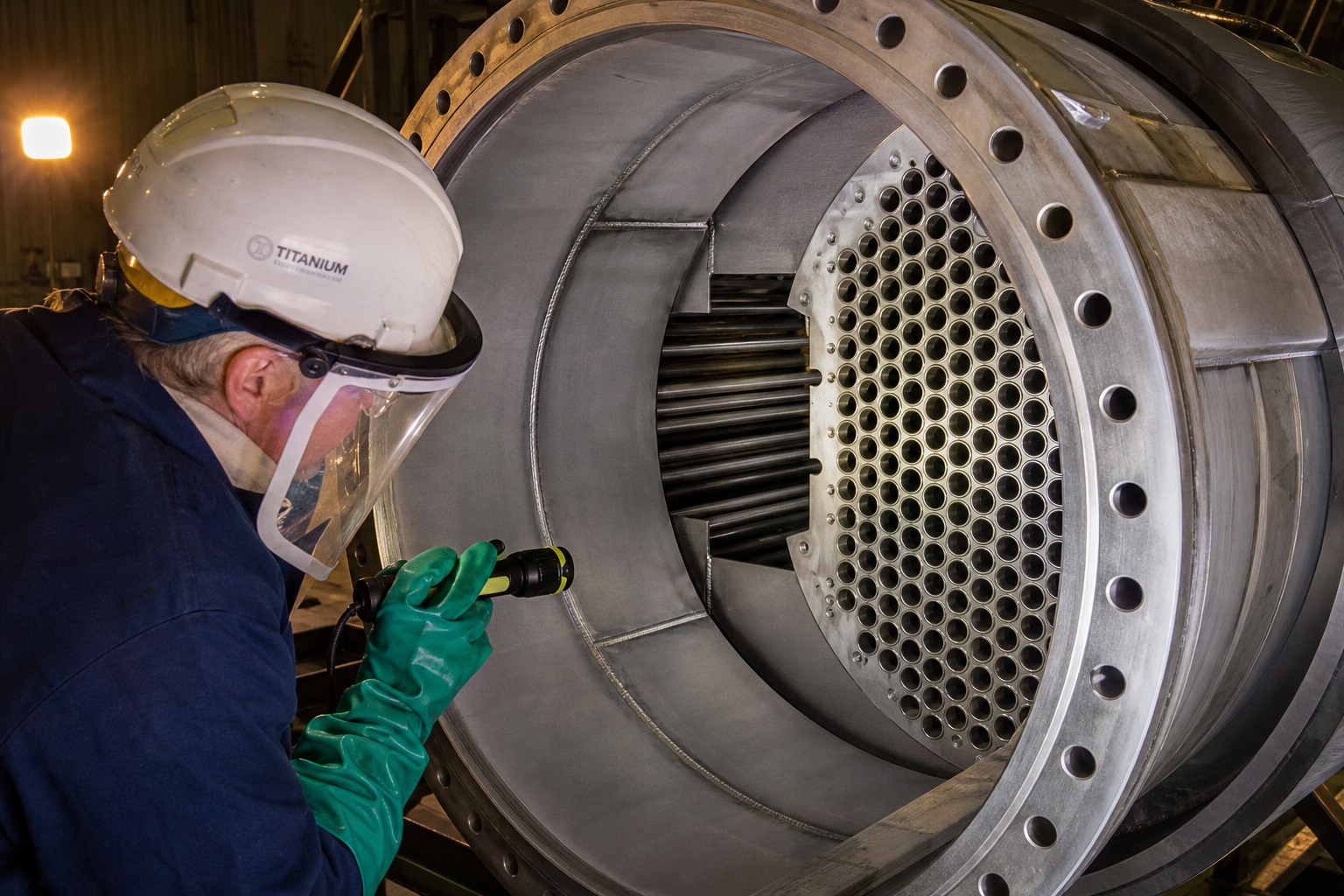
Three features carry the engineering weight. The first is materials of construction as a first-class design decision. A pH-below-1, chloride-rich, hot stream is not a carbon-steel duty; the published route calls out titanium and Hastelloy-class alloys for the wetted path, and the materials premium is a major line in the CAPEX that any honest comparison must carry. Cutting this corner is not an economy – it is a schedule for corrosion failure in the first year.
The second is the condensate-polishing membrane choice. The whole water-recovery promise rests on condensate that meets reuse standards, but evaporator condensate from ammonia- and organics-bearing liquor is not boiler water – the polishing RO train is what makes it one. Sizing that train for the volatile fraction, not the average, is the difference between a closed loop and a persistent excursion.
The third is the recovery-before-concentration sequence. Rare earth ions at 500-2,000 mg/L are simultaneously a pollutant and a product; recovering them as a concentrate before the final evaporation keeps them in a saleable form and prevents them from contaminating the salt product with radioactivity-bearing species – which in monazite- and bastnasite-derived streams matters for the salt’s disposal classification.
Process Modules
| Process module | Candidate equipment types | Selection rationale | Module duty |
|---|---|---|---|
| Stream segregation | Separate collection and balancing per stage | Four-high streams defeat any blended flowsheet | Deliver each stream to its own chemistry |
| Stage pretreatment | Neutralization, precipitation, oil removal, pH adjustment | Matches pretreatment to each stream’s failure mode | Protect recovery and evaporation |
| Rare earth recovery | Precipitation / concentration to RE concentrate | Value recovery before contamination | >99.9% RE into saleable concentrate |
| Volume reduction | MVR evaporation (falling-film + forced-circulation class) | >10x concentration; >80% steam saving claim | Split water from salt and pollutants |
| Salt handling | Crystallizer + solids finishing | Closes the salt balance at saturation | Dischargeable or co-processable solids |
| Condensate polishing | Specialized RO membrane train | Handles volatile NH3/organics traces | <500 mg/L reuse-grade water |
| Materials | Potential material considerations: titanium / Hastelloy-class wetted path | pH<1 hot chloride service | Survive the duty between service intervals |
Configuration, materials and operating envelopes above are potential considerations only; actual selections depend on feed composition, temperature, corrosion review, fouling behavior, utilities and project capacity.
Expected Performance and Limits
Published typical performance for the hybrid route: the influent-to-effluent table above – COD above 99.9% removal to below 50 mg/L, ammonia above 99.8% to below 15, salinity above 99.5% to below 500, rare earth recovery above 99.9% – with concentration factors above 10 and MVR steam savings above 80%, explicitly noted as typical values varying with influent quality (WTEYA – external industry reference; supplier-published typical values, not a project guarantee). Corroborating single-point data from the peer-reviewed literature: vacuum evaporation crystallization of 130 g/L NH4Cl rare earth separation liquor produced industry-grade crystal with condensate at about 12 mg/L NH4-N returned through RO to process water (Huang, Xiao and Yan, Desalination and Water Treatment 8 (2009) 109-117 – external peer-reviewed reference), which independently supports the condensate-quality premise of the hybrid’s polishing block. Limits worth respecting: the reuse-grade numbers are typical values from a supplier’s process family, not guarantees of any specific installation; the economics hinge on the rare earth recovery credit and the steam price the MVR displaces – a site with cheap steam may prefer multi-effect; and the radioactivity question (uranium/thorium daughters in some feedstocks) constrains salt disposal classification and must be answered before the flowsheet is frozen.
Industry References and Validation
The route is anchored on the WTEYA evaporation-membrane hybrid process family for rare earth smelting and separation wastewater: stream-by-stream classification of beneficiation, decomposition, extraction/ion-exchange and refining waters; MVR evaporation at concentration factors above 10 with titanium/Hastelloy-class materials; rare earth recovery above 99.9%; and condensate polished by specialized RO to below 500 mg/L reuse standard, with the published typical influent/effluent matrix and the explicit note that data varies with influent quality (WTEYA solution page – an external industry reference, not an EvapCryst delivery; supplier-published typical values, not a project guarantee). The ammonia and condensate chemistry is corroborated by the peer-reviewed three-band treatment study (Huang et al., DWT 8 (2009) – external peer-reviewed reference). For your own project, validation effort should concentrate on: a stream-by-stream characterization including the volatile COD and ammonia fractions; a corrosion and materials review for your specific acid and chloride profile; rare earth precipitation and recovery testing with a defined concentrate offtake; and condensate-quality projection against your reuse specification with the polishing train sized for excursions.
Frequently Asked Questions
Why not treat all the streams together in one train?
Because their chemistries fight. The pH-1 decomposition stream would consume reagent meant for neutral streams; extractant COD fouls every surface it meets; and each stage’s pollutants have a different economical resident process. Segregation costs piping and saves the flowsheet.
How can evaporation handle pH below 1?
With materials, not chemistry. Titanium and Hastelloy-class alloys in the wetted path survive hot acid chloride service that destroys standard steels – it is a CAPEX line, and skipping it is how these plants fail early.
Is the >99.9% rare earth recovery claim realistic?
It is a supplier-published typical value for the process family, and the direction is sound: precipitation or concentration upstream of final evaporation keeps the rare earths in a saleable concentrate instead of dispersing them into salt. Your number will depend on your ion speciation and the recovery chemistry chosen – test it, don’t assume it.
Why polish the condensate – isn’t evaporator distillate clean?
Clean of salt, yes; clean of volatiles, no. Ammonia and volatile organics ride the vapor in trace quantities, and reuse standards are strict. The polishing RO train is what converts condensate into process water – sizing it for the volatile fraction, not the average, is the design point.
What happens to the recovered salt?
It crystallizes at the concentration end and leaves as solids – ammonium chloride where the ammonia chemistry dominates, mixed salts otherwise. Its disposal or co-processing classification depends on its rare earth and radionuclide residuals, which is exactly why recovery happens upstream.
When This Route May Not Fit
If your dominant stream is dilute – beneficiation water at modest salinity – the full hybrid is overkill and a filtration-plus-reuse answer closes it. If rare earth prices crater, the recovery credit shrinks and the flowsheet must stand on compliance economics alone, which may favor simpler disposal routes. And if your feedstock carries high uranium/thorium, the radiological classification of every output stream may impose constraints that reshape the flowsheet – see our TENORM treatment article before committing.
What Must Be Verified Before Committing
Five items: a stream-by-stream inventory with salinity, pH, COD (volatile split), ammonia and rare earth ions; a materials and corrosion review against your acid-chloride profile at temperature; rare earth recovery tests fixing the concentrate grade and offtake; a condensate-quality projection with polishing sized for the ammonia and volatile organics fractions; and disposal or co-processing classification for the crystallized salts including their radionuclide residuals. These map directly onto the modules above and are the standard screening package we would run before any quote.