Project Parameters
| Parameter | Value |
|---|---|
| Process route | MVR forced-circulation evaporation + crystallization |
| Industry | Battery materials — manganese sulfate for NCM ternary and LMFP cathode precursors |
| Feed type & key components | Purified manganese sulfate production liquor (MnSO4 solution from ore processing / recycling chain) |
| Evaporation capacity | 50 t/h total (2 × 25 t/h trains) |
| Construction materials | SS316L wetted parts (indicative for purified MnSO4 service) |
Representative process configuration compiled from published industry project data. Indicative values, not a process guarantee.
Project Description
Manganese sulfate monohydrate (MnSO4·H2O) has moved from a fertilizer-adjacent commodity to a battery-materials feedstock: it is the manganese source for NCM ternary precursors and, with the rise of lithium manganese iron phosphate (LMFP), a directly strategic input. A producer in Guangxi, South China — positioned on the manganese ore and refining cluster there — operates purification and crystallization capacity that must hold battery-grade impurity limits (calcium, magnesium, sodium and heavy metals at controlled trace levels) while running at industrial scale.
The reference configuration is a 50 t/h evaporation and crystallization plant arranged as two 25 t/h MVR forced-circulation trains. The twin-train layout serves the same logic as in other battery-materials plants: maintenance and cleaning cycles on crystallizing manganese sulfate service rotate between trains without stopping the plant, and capacity tracks the stepwise growth of the regional cathode chain. Comparable published configurations run the same duty at 50 t/h single-train scale in the same region, confirming the route as segment standard.
Process Technology
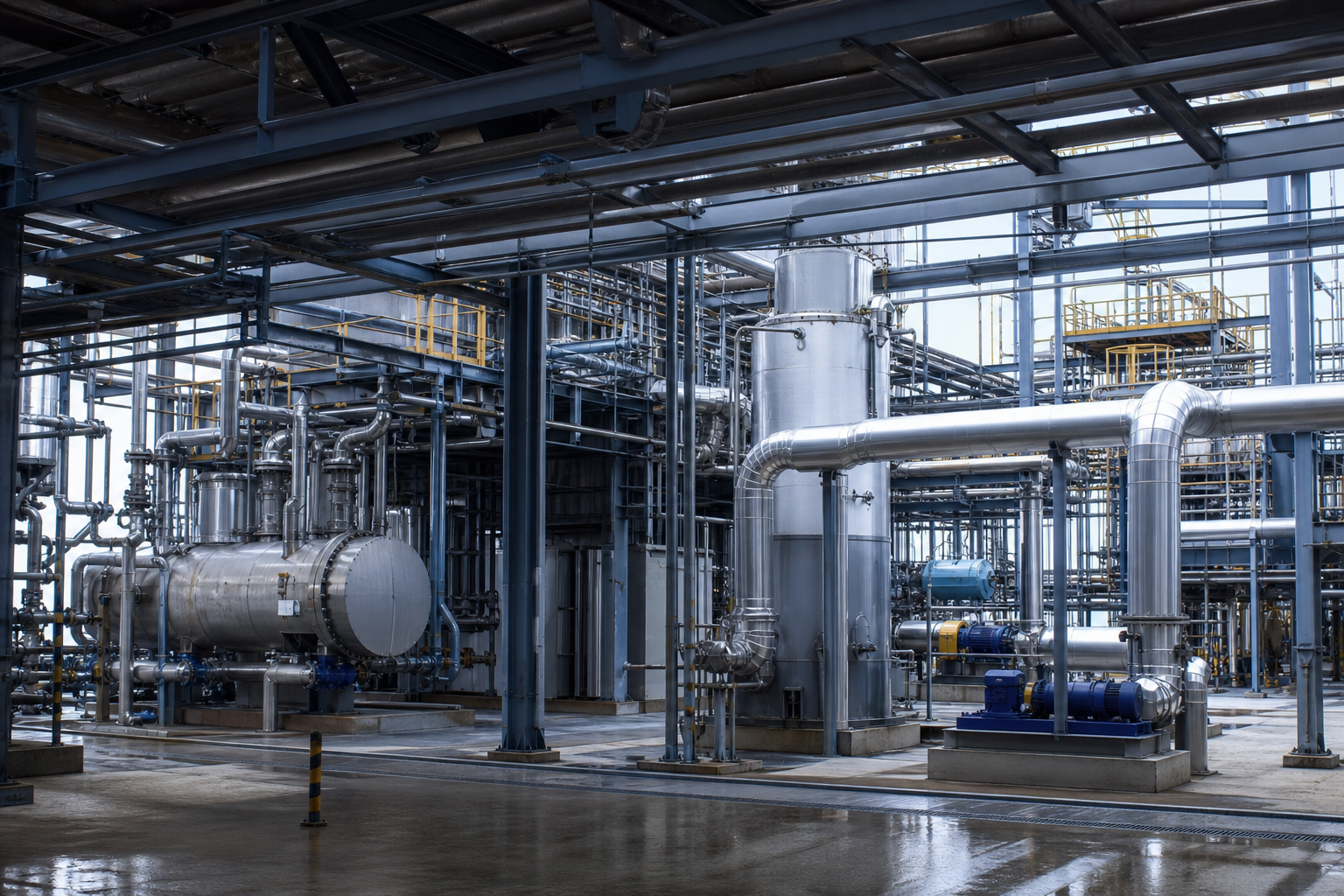
The feed is purified manganese sulfate liquor from the hydrometallurgical chain — ore leaching or recycling routes both end in a purification section that removes the divalent competitors (Ca, Mg) and heavy metals ahead of crystallization. What enters the evaporator is therefore a relatively clean, single-salt liquor, and the evaporation section is engineered for water removal at high efficiency rather than for separation chemistry.
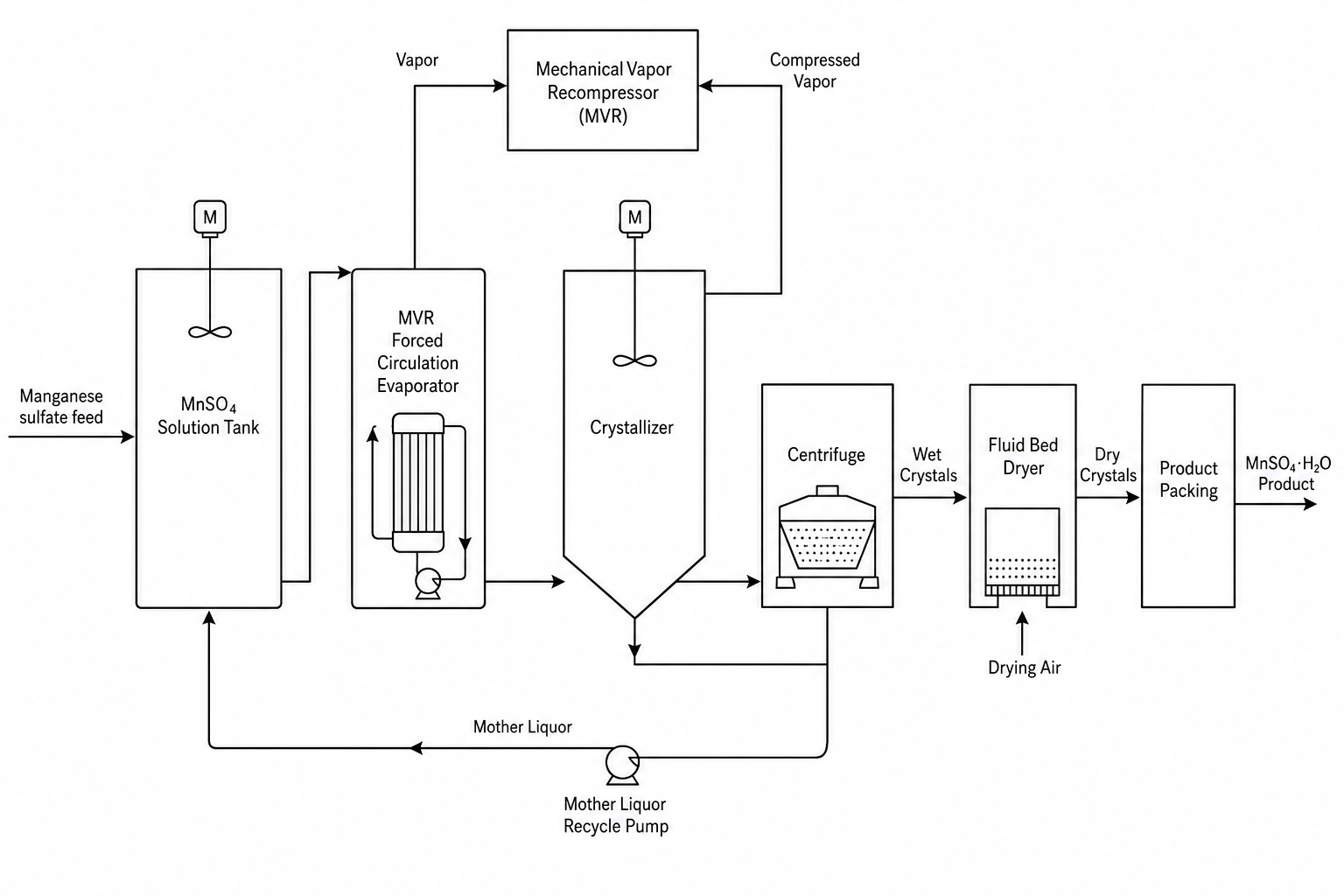
Each train concentrates the liquor in a forced-circulation evaporator under MVR drive. Forced circulation is the standard selection for crystallizing manganese sulfate: the salt has a steep solubility response and produces a dense crystal phase at saturation, so the evaporator body functions as the front half of the crystallizer — pumped high velocity around the heating element suppresses wall nucleation and scaling while supersaturation is generated in the bulk liquor. The mechanical vapor recompressor supplies the thermal drive electrically, lifting the boiled secondary vapor to heating duty and closing the loop; no steam boiler capacity is consumed by the crystallization plant.
Supersaturated liquor flashes into the crystallizer body where MnSO4·H2O crystals grow under controlled slurry density and classified withdrawal, building the coarse, free-flowing crystal that dries to specification moisture without caking. Crystal size control matters commercially: battery-grade buyers specify particle size distribution alongside chemistry, and both are set in this vessel.
The crystal slurry is dewatered on a centrifuge, dried in a fluid-bed or rotary dryer to monohydrate specification, and packed. Mother liquor — carrying the trace impurities that did not crystallize — returns to the evaporator feed under a controlled purge that holds the impurity inventory at steady state without draining product value. Condensate from the MVR train is recovered clean and hot for reuse in the plant’s washing and ore-processing duties.
Equipment Configuration
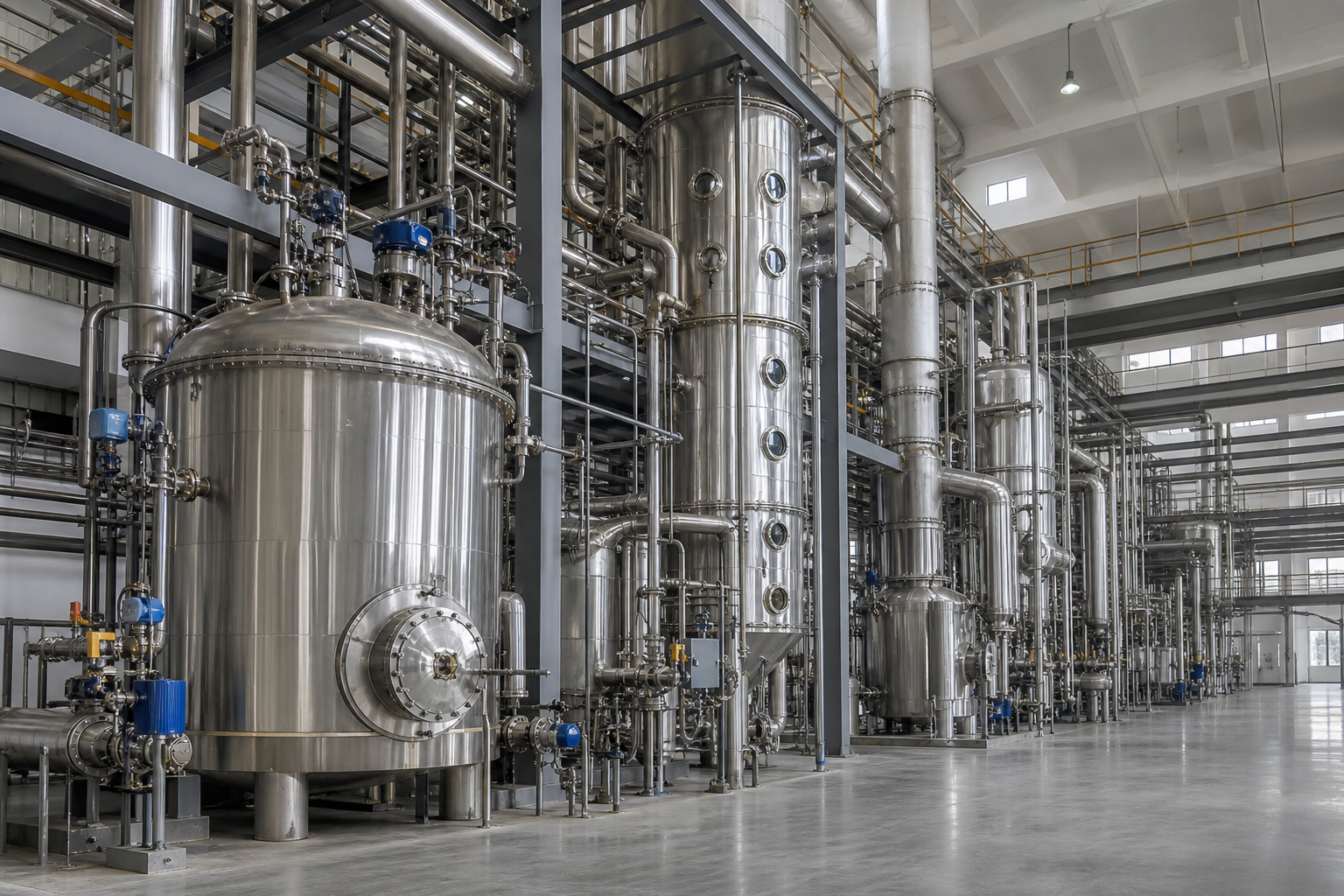
One set of the following equipment is typical per train (two trains for this duty):
- Purified MnSO4 feed tank and polishing filtration
- MVR forced-circulation evaporator with mechanical vapor recompressor
- Crystallizer with classified crystal withdrawal and slurry density control
- Centrifuge, fluid-bed dryer and battery-grade packing station
- Mother-liquor return with controlled purge; condensate recovery and reuse pumping
- PLC/DCS control of train density, compressor load, slurry inventory and wash sequences
Performance & Outcome
Compiled from published industry project data, indicative: trains of this class crystallize battery-grade manganese sulfate monohydrate at industrial scale on electrically driven MVR energy, with condensate recovered for plant reuse and crystal quality managed in the crystallizer rather than by post-treatment. Specific energy and particle size figures are quoted per project.