
EvapCryst logo

Food, Fermentation & Bioprocessing

From fermentation broth concentration (10–20% solids feed, 40–70% concentrate) to vacuum cooling crystallization at 50–65°C — engineered for thermal sensitivity (decomposition thresholds at 70–80°C), food-grade hygienic design (SS316L, Ra <0.8 µm, CIP/SIP), and MVR-driven steam economy of 15–25 kWh per tonne of water evaporated.

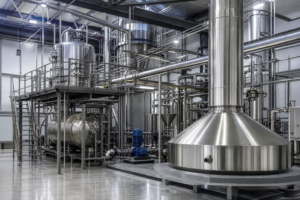
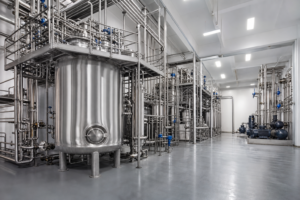
Food and fermentation plant for broth concentration and crystallization
Technology Driver

Why Thermal Sensitivity Drives Technology Choice

Most food and fermentation products decompose, discolor or lose activity above 70–80°C — well below the boiling point. This single property dictates low-temperature falling-film evaporation (ΔT 5–10°C, MVR at 60–75°C) and vacuum cooling crystallization (50–65°C, adiabatic flash).

PRODUCT 01Thermal Sensitive

Amino Acids (Lysine / Threonine / Tryptophan)

Decomposition and Maillard browning above ~70–80°C. Vacuum cooling crystallization at 50–65°C preserves purity (target >98.5%) and color (Y <10 Hazen).

  • Falling-film MVR concentration at ΔT 5–8°C, 65–75°C for the clarified broth
  • Cell-rich streams routed to forced-circulation instead
70–80°Cdecomposition & Maillard browning threshold — stay below it to hold purity >98.5% and color Y <10 Hazen
PRODUCT 02Color & Purity

Organic Acids (Citric / Lactic)

Citric acid solubility rises steeply with temperature, but color formation (measured as UV absorbance at 420 nm) accelerates above 75°C. Vacuum cooling crystallization at 40–55°C maintains food-grade clarity and avoids Maillard side reactions with residual sugars.

  • Solubility curve is the yield lever — cooling depth sets recovery
  • Low-temperature operation protects color spec
59% → 84%citric acid solubility from 10°C to 100°C — color formation (UV 420 nm) accelerates above 75°C, so crystallization runs at 40–55°C
PRODUCT 03Viscosity

Sugar Alcohols (Sorbitol / Xylitol / Erythritol)

Viscosity rises sharply above 60% solids — xylitol exceeds 200 cP at 60°C. Cooling crystallization with a programmed ramp and controlled seeding produces the target particle size distribution.

  • Cooling ramp 0.2–0.5°C/min, controlled seeding
  • High viscosity demands forced-circulation and low-ΔT service
>200 cPxylitol viscosity at 60°C above 60% solids — ramp 0.2–0.5°C/min with seeding targets D50 300–800 μm with Cv <35%
PRODUCT 04Volatile

Flavor & Aroma Compounds

Aroma degradation (ester / terpene loss) and cooked off-flavors accelerate above 60°C. Short-residence-time falling-film evaporation under vacuum preserves the organoleptic profile, and MVR recompression recovers vapor latent heat at low ΔT.

  • Operation at 50–65°C under vacuum
  • MVR recompression recovers latent heat at low ΔT
1–3 minfalling-film hold-up at 50–65°C under vacuum — ester/terpene loss and cooked off-flavors accelerate above 60°C
Process Route

Fermentation Broth Concentration & Crystallization

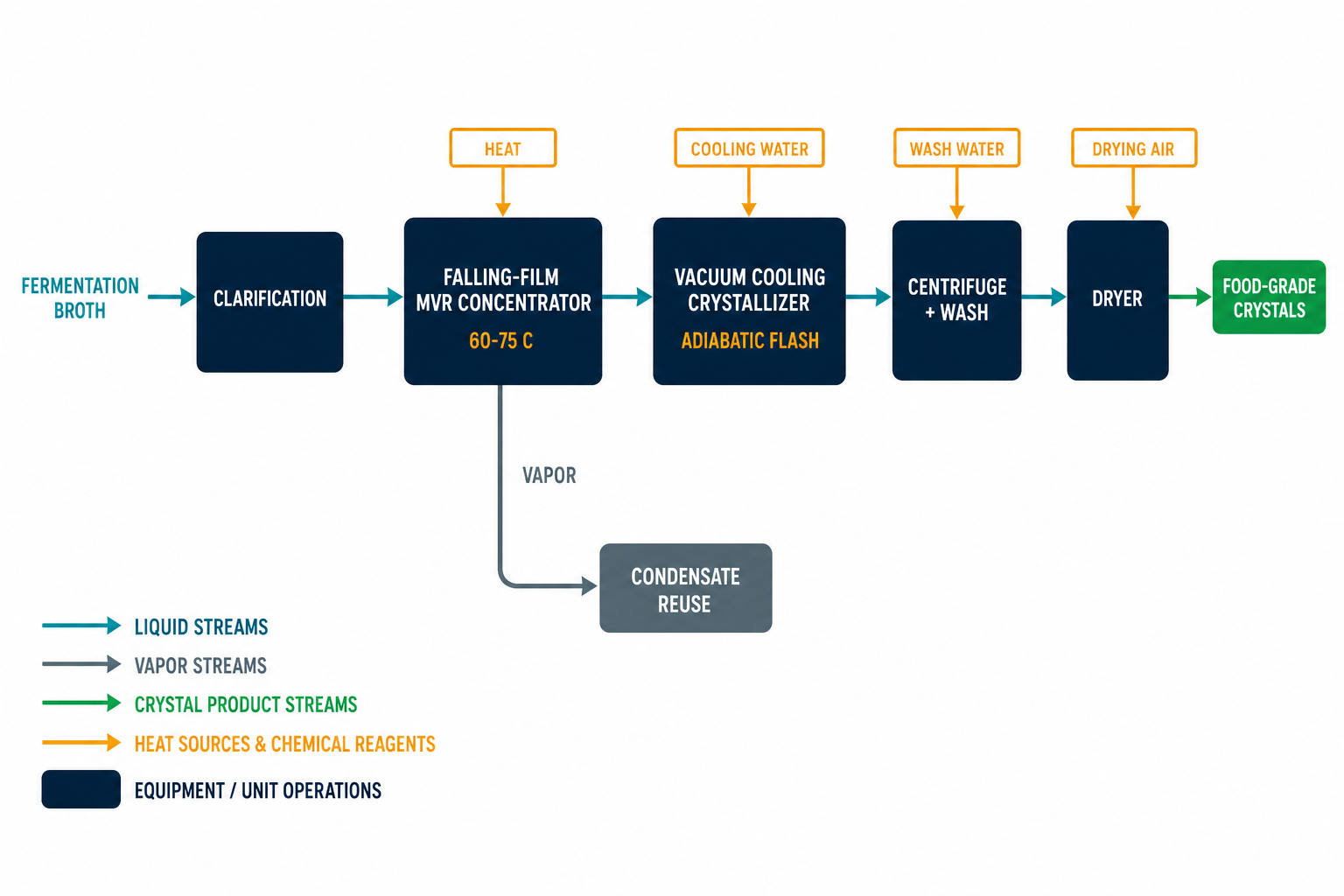
Indicative flowsheet for amino acid or organic acid recovery from fermentation broth.

Clarified fermentation broth (~10–20% solids) enters a falling-film MVR concentrator operating at low ΔT (5–8°C) and 60–75°C, then a vacuum cooling crystallizer (50–65°C, adiabatic flash). Crystals are dewatered on a centrifuge, washed with cold deionized water and dried on a fluid-bed or conical dryer. Cell-rich broth goes through forced-circulation instead of falling film to manage viscosity (>50 cP) and fouling.

Simplified indicative process flow diagram — final configuration depends on feed characterization and crystallization trials.

Concentration

Concentration of Fermentation Broth

Broth concentration is the largest energy consumer on a fermentation plant. Evaporator choice balances heat sensitivity, viscosity and energy economics.

ROUTE 01Low-Viscosity Service

Falling Film Evaporation

The default for low-viscosity clarified broth — high heat-transfer coefficient, short residence time and low ΔT protect thermally sensitive streams.

  • Short residence time (1–3 min) and low ΔT (5–10°C)
  • Best suited to thermally sensitive streams
3,000–6,000 W/m²·Kheat-transfer coefficient — applies to low-viscosity clarified broth (<30 cP)
ROUTE 02Viscosity

Forced-Circulation

For cell-rich or high-viscosity broth. High tube velocity suppresses fouling on the heat-transfer surface, and suppressed boiling (no boiling in tubes) prevents protein denaturation on hot tube walls.

  • Selected when broth is cell-rich or fouling-prone
  • Often paired downstream of falling film as viscosity rises
2–3 m/stube velocity — for cell-rich or high-viscosity broth (>50 cP), suppressing fouling with no boiling in tubes
ROUTE 03Energy

MVR Integration

Mechanical vapor recompression reuses the vapor latent heat, cutting steam demand by 80–90% vs. single-effect evaporation.

  • Standard on new fermentation broth concentrators above ~2 t/h evaporation
  • Payback typically 2–4 years vs. multi-effect
15–25 kWh/tper tonne of water evaporated — steam demand cut 80–90% vs. single-effect
ROUTE 04Sanitary

Hygienic Design

SS316L product contact, CIP/SIP integration, sanitary fittings, full drainability and material traceability are standard deliverables on food-grade systems.

  • Sanitary fittings and full drainability
  • Material traceability with every system
Ra < 0.8 μmbaseline product-contact surface finish for food-grade service
Crystallization

Crystallization of Bio-Products

Crystal quality — color, PSD, purity — defines the product value. Vacuum cooling and cooling crystallization are the dominant routes for thermal-sensitive bio-products.

ROUTE 01No HT Surface

Vacuum Cooling Crystallization

Adiabatic flash cooling under vacuum — no heat-transfer surface in the crystallizer, so scaling risk is minimized. Standard for lysine, MSG and citric acid.

  • Cooling rate 0.3–1.0°C/min, controlled by vapor extraction rate
  • Eliminates localized incrustation on cooling surfaces
50–65°C · 80–150 mbaroperating band (abs.) — adiabatic flash, standard for lysine, MSG and citric acid
ROUTE 02Surface Cooling

Cooling Crystallization

Surface cooling via jacket or heat exchanger (cooling water or chilled glycol). Used when solubility rises steeply with temperature and the product is moderately thermally stable — xylitol and erythritol.

  • Cooling rate 0.2–0.5°C/min to stay inside the metastable zone
  • Chilled glycol where cooling water cannot reach the target temperature
0.2–0.5°C/mincooling rate — held inside the metastable zone for moderately thermally stable sugar alcohols
ROUTE 03Scale-Dependent

Batch vs. Continuous

Batch dominates smaller-scale pharma-style intermediates; continuous wins at production scale for lysine, MSG and citric acid where PSD consistency matters.

  • Batch — flexibility and small campaigns
  • Continuous — PSD consistency at scale
DTB / Oslocontinuous configurations — chosen at production scale where PSD consistency matters
ROUTE 04PSD Control

Seeding & Cooling Profile

Controlled seeding and programmed cooling profiles keep the operation inside the metastable zone — avoiding spontaneous nucleation and bimodal PSD.

  • Seed loading and size set the nucleation baseline
  • Programmed profile follows the solubility curve
Metastable zoneoperating window — controlled seeding + programmed cooling avoid spontaneous nucleation and bimodal PSD
Sanitary Standards

Sanitary & Compliance Standards

Food and bioprocessing customers verify hygienic design to international standards. These are the baseline specifications EvapCryst works to.

Material
SS316L / 304

Product-contact construction with full material traceability

Surface Finish
Ra < 0.8 μm

Baseline for product contact; Ra < 0.4 μm for high-purity or aseptic duty

Cleaning
CIP / SIP

Integrated clean-in-place / steam-in-place with full drainability

Compliance
FDA / EHEDG

Hygienic design principles, sanitary fittings

FDA and EHEDG considerations apply to hygienic design principles. Process validation and food-safety certifications remain the responsibility of the producer. Material traceability and mill test reports are provided with every food-grade system.

Product Reference

Typical Products & Indicative Routes

ProductThermal SensitivityCrystallization BehaviorTypical Route
LysineC₆H₁₄N₂O₂HighVacuum cooling, controlled seedingVacuum Cooling
MSG (Monosodium Glutamate)C₅H₈NNaO₄HighVacuum cooling, narrow PSDVacuum Cooling
Citric AcidC₆H₈O₇Moderate-HighVacuum cooling or coolingVacuum Cooling / Cooling
Xylitol / Sorbitol / ErythritolC₅H₁₂O₅ · C₆H₁₄O₆ · C₄H₁₀O₄ModerateViscous, slow growthCooling Crystallization
Mushroom / Yeast ExtractHighConcentration only (no crystal)Falling Film MVR

Routes are preliminary screening only. Final configuration requires solubility data, crystallization trials and project-specific engineering evaluation.

Frequently Asked Questions

Why is vacuum cooling crystallization used for lysine and MSG instead of regular cooling?+

Both amino acids are thermally sensitive (decomposition, browning above 75°C) and surface cooling risks localized incrustation at the heat-transfer surface. Vacuum cooling at 50–65°C and 80–150 mbar abs removes heat adiabatically by flashing vapor under vacuum, eliminating the heat-transfer surface in the crystallizer itself and enabling uniform low-temperature operation at 0.3–1.0°C/min cooling rate.

When is forced-circulation preferred over falling film for fermentation broth?+

Forced-circulation (FC) is preferred when the broth is cell-rich, has viscosity above ~50 cP, or is fouling-prone. Falling-film (FF) is preferred for low-viscosity clarified broth (<30 cP) where short residence time and low ΔT protect thermal-sensitive components. Many plants run both in series — FF for the initial 10–30% concentration, FC for the final 30–55% concentration where viscosity rises sharply.

What surface finish is required for food-grade evaporators?+

The baseline specification is Ra < 0.8 μm for product contact surfaces. For high-purity or aseptic applications, Ra < 0.4 μm may be specified. Surface finish verification, CIP/SIP integration, sanitary fittings and full material traceability are standard deliverables.

How does MVR apply to thermal-sensitive streams?+

MVR compresses the vapor to recover its latent heat at a slightly higher temperature (ΔT 5–10°C), enabling low-temperature operation at 60–75°C. Combined with falling-film evaporators (residence 1–3 min), MVR delivers both energy efficiency (15–25 kWh per tonne water vs. 0.25–0.40 t steam per tonne water for multi-effect) and the gentle thermal treatment thermal-sensitive products require.

Discuss Your Food or Fermentation Project

Send us your product specification, broth composition and throughput. Within 2 business days you will receive a feasibility assessment and indicative sanitary-grade route.

Request a Proposal

Send your feed characterization (TDS, COD, main salts, viscosity), throughput and product targets — we respond with a preliminary process route within two business days.