Tryptophan fermentation broth demands more downstream work than most amino acids: the fermentation liquor is dilute (an illustrative published feed envelope of 2.8–3 g/100 mL), rich in impurities, and carries ammonium ions that must be stripped and recovered before crystallization. The published solution family for this duty — external industry references, not EvapCryst project records — is a combined train of sterilization and acidification, ceramic membrane filtration, chromatographic purification, deamination with ammonia recovery, then multi-effect or MVR evaporation crystallization, two-stage centrifugation, and fluidized bed drying. This page explains why each purification stage exists, how the evaporator is sized for such a dilute feed, and how the recovered ammonia and condensate are recycled.
Why Tryptophan Is the Hardest Amino Acid Finishing Duty
Tryptophan is an essential amino acid used in medicine, food, and animal feed. Industrial production runs direct fermentation with mutagenesis-bred strains, and the raw broth contains bacteria, residual sugars, pigments, colloids, and other by-products — the same impurity families as threonine work, with two added complications:
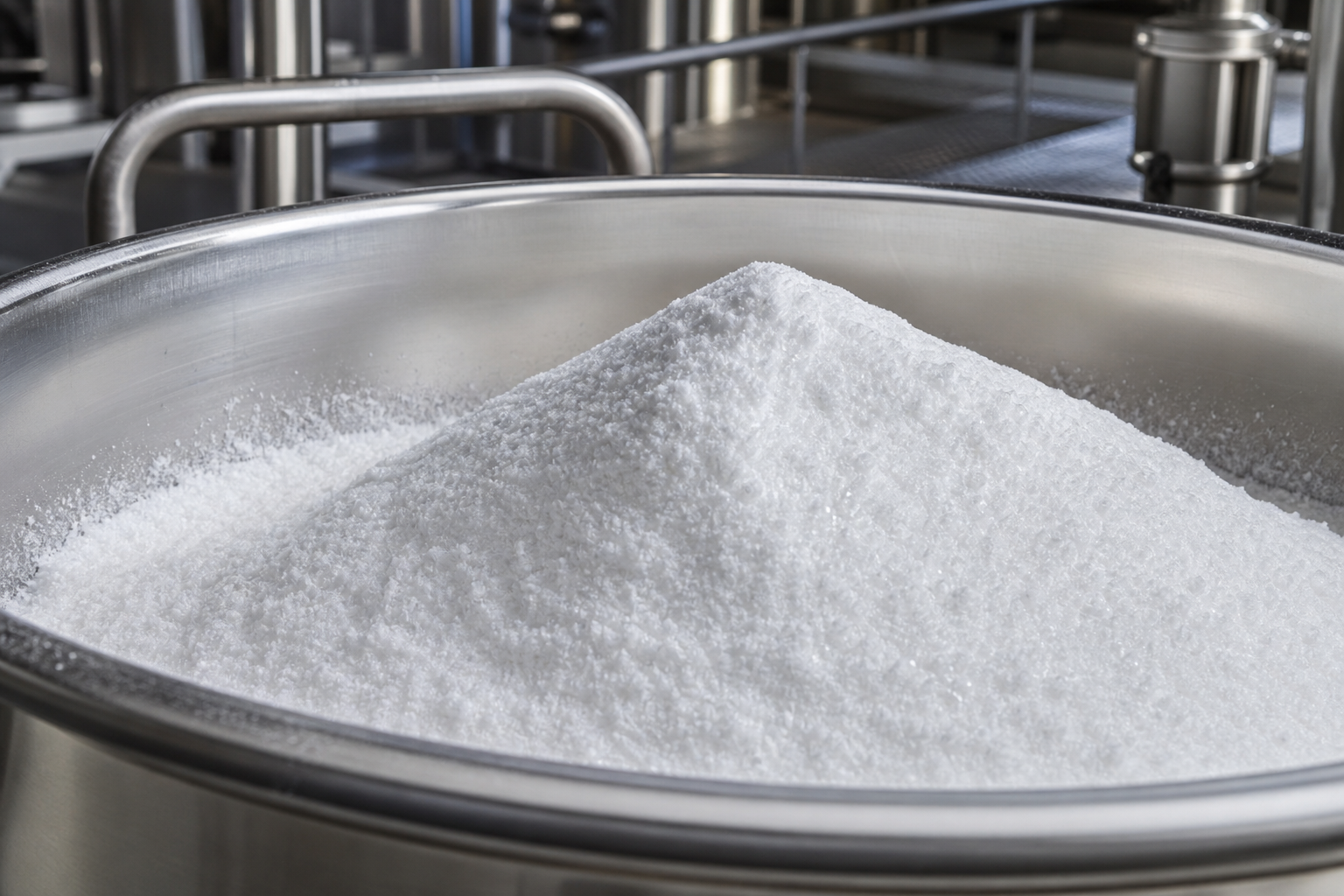
- Very dilute product liquor: published references feed the evaporator at an illustrative 2.8–3 g/100 mL tryptophan envelope, roughly a quarter of the concentration typical for threonine dialysate. More water must be evaporated per tonne of product, making specific energy consumption and vapor recovery economically decisive.
- Ammonium load: the liquor carries ammonia ions that would contaminate the crystal and corrode equipment if carried into the crystallizer.
These two factors explain why the reference process adds chromatography and a dedicated deamination step before evaporation — a combination that distinguishes tryptophan plants from simpler lysine or threonine trains.
The Process Chain, Stage by Stage
| Process module | Equipment candidates | Selection basis | Indicative envelope (published) |
|---|---|---|---|
| Fermentation (context) | Directed-mutagenesis strains; three-stage culture expansion (slope, seed, final) | Sets the impurity load every downstream module must handle | Air intake above 25 m, sterilized by total and membrane filtration |
| Sterilization & acidification | Plate or spiral heat exchangers; pH dosing | Protect the liquor; set the resin-preferred ionic form | 65–75 °C; pH 3.8–4.2 |
| Ceramic membrane filtration | Ceramic micro/ultrafiltration modules with dialysis-water recovery | Remove cells and colloids before resin; recover tryptophan from concentrate | Retentate sold as bacterial protein feed |
| Chromatography | Adsorption resin columns | Selective uptake from an impurity-rich dialysate | Regeneration cycles set by feed clarity |
| Deamination | Stripping column with condenser | Remove volatile ammonium before the crystallizer | Ammonia water condensed and recycled |
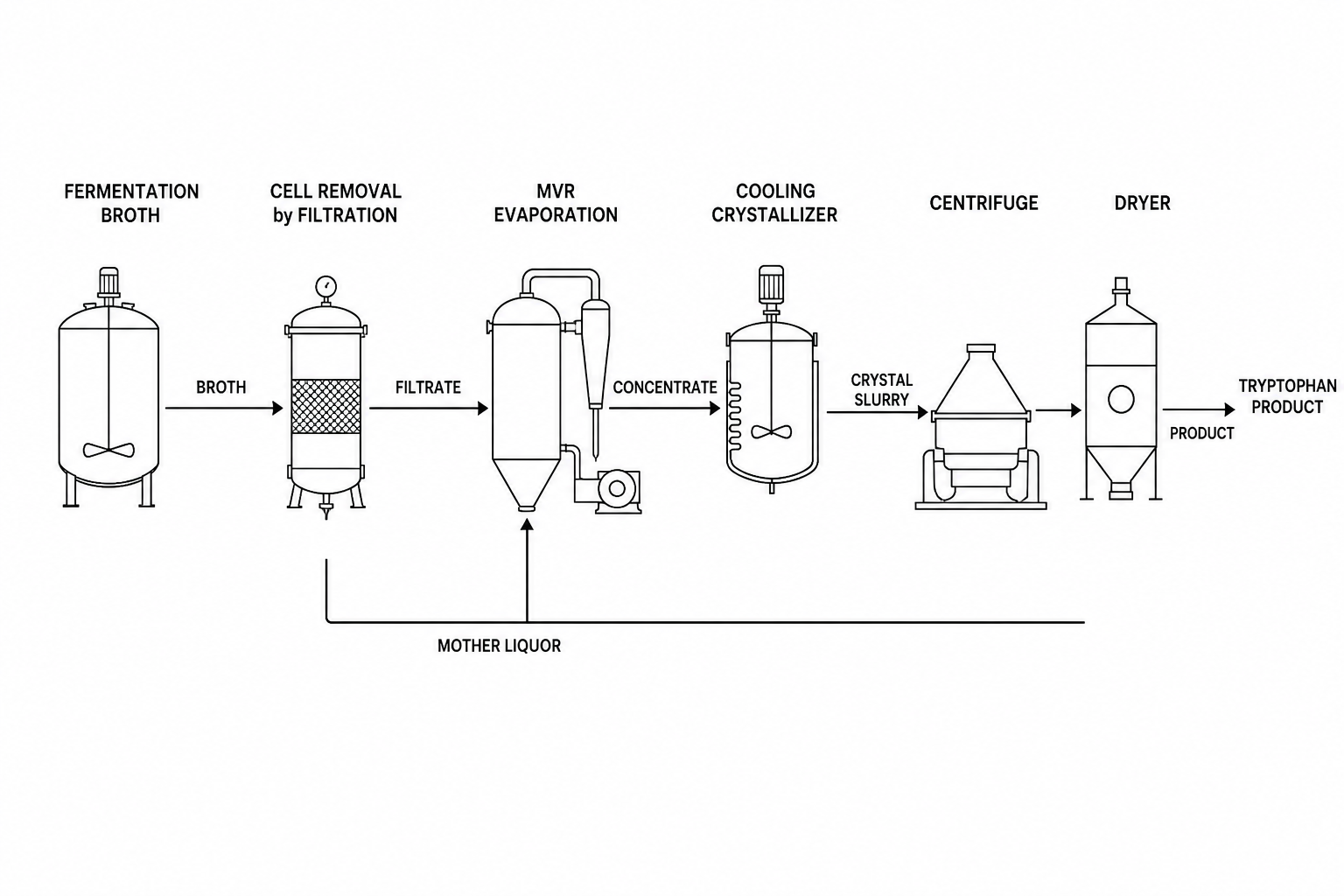
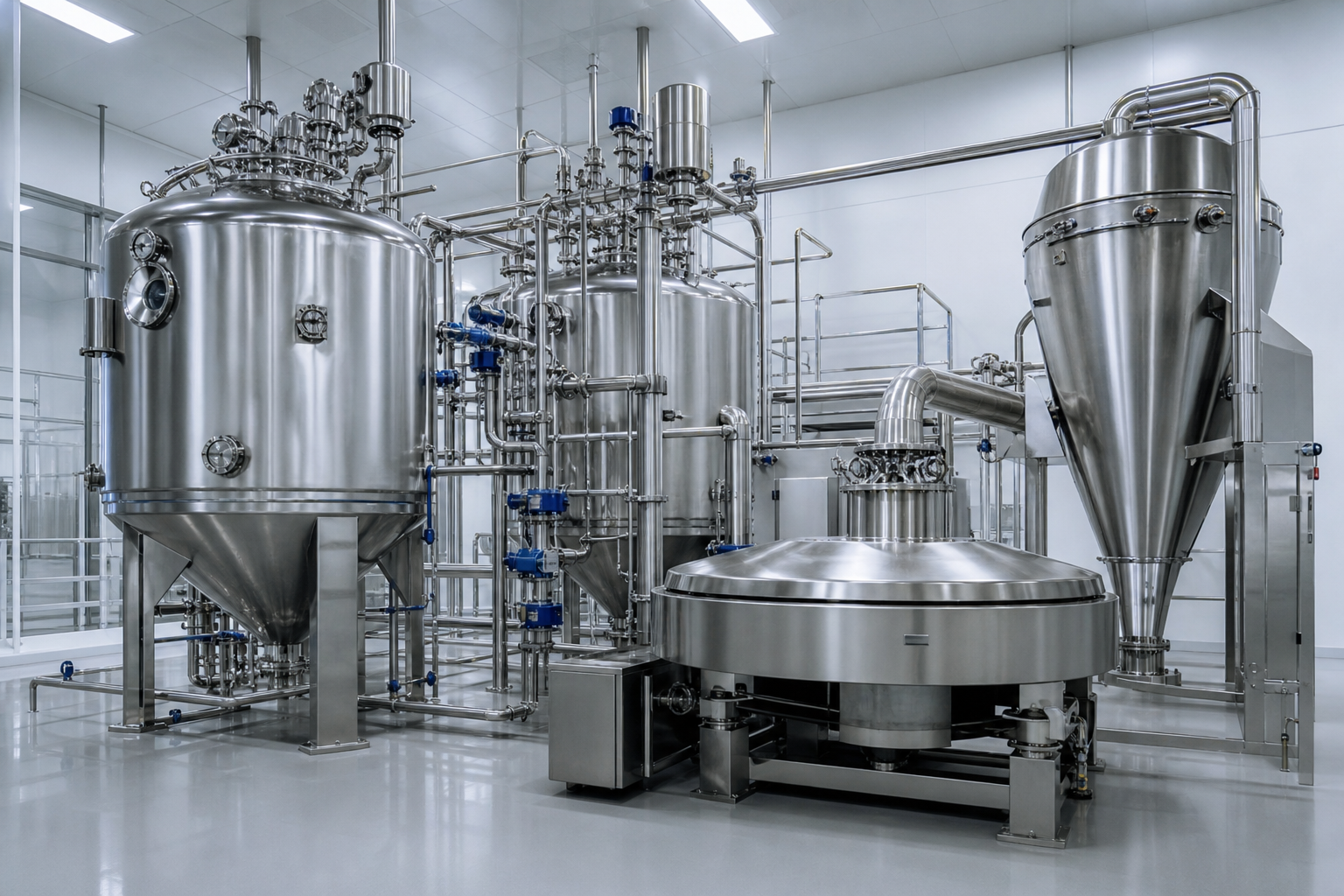
| Evaporation crystallization | Multi-effect or MVR forced-circulation crystallizer | Dilute feed: water load dominates plant economics | Feed 2.8–3 g/100 mL; discharge slurry 58–60% solids |
| Centrifugal separation | Two-stage pusher centrifuge | Low crystal moisture; mother liquor to storage | Per slurry rate |
| Fluidized bed drying | Fluidized bed dryer; vibrating screen | Uniform particle product | Multi-stage screening |
Configuration, materials, and operating ranges depend on the actual broth, impurity profile, corrosion review, heat sensitivity, utilities, and project capacity.
Sterilization and Acidification Set Up the Purification Train
Before purification, the broth is heated to 65–75 °C and acidified to pH 3.8–4.2. Acidification is not incidental: it puts tryptophan in the ionic form the resin prefers, suppresses microbial activity during column residence, and reduces the solubility drift that would complicate crystallization control.
Ceramic Membrane Filtration: Clean Liquor First
As with other amino acid broths, the first solid-liquid split is a ceramic membrane stage. The broth is concentrated and filtered; dialysis water washes tryptophan back out of the concentrate so filtration losses stay low. Molecules larger than the membrane cut-off — whole cells, debris, and colloids — form a bacterial protein stream that is blended into mother liquor and sold as a protein feed ingredient. Only the clear dialysate advances to chromatography.
Membrane cleanliness upstream is what makes chromatography economical: resins foul quickly on whole cells and colloids, and ceramic protection first extends cycles between regeneration and cuts chemical consumption per tonne.
Chromatographic Purification and Deamination
The dialysate enters chromatographic purification where tryptophan is adsorbed while impurities pass through and are washed out with clear water; the adsorbed tryptophan is displaced from the resin to yield purified liquor. This step is what allows feed- and pharma-grade purity from a broth carrying pigments, residual sugars, and related amino acids.
The purified liquor then passes a deamination system: ammonia ions are evaporated off and condensed as ammonia water, recycled to the front of the process. The closed loop has two paybacks — it removes the main volatile contaminant before the crystallizer and recovers a reagent-grade aqueous ammonia stream the fermentation and neutralization sections can consume.
Evaporation and Crystallization of a Dilute Feed
After refining, the liquor enters the multi-effect evaporation crystallizer at 2.8–3 g/100 mL and concentrates until the discharge slurry reaches 58–60% solids for the centrifuges. Because the feed is so dilute, water evaporated per tonne of tryptophan is several times threonine service, and the energy system choice dominates operating cost.
Multi-effect evaporation is the published baseline in reference plants, splitting the evaporation duty across effects so each kilogram of live steam evaporates several kilograms of water. For new projects, MVR evaporation is the main alternative: by mechanically compressing and recycling secondary vapor, MVR systems typically consume 20–35 kWh of electricity per tonne of evaporated water and reduce steam consumption by up to 95% (supplier-published indicative ranges, not a project guarantee) — a compelling profile when most of the plant’s energy bill is literally boiling water off a dilute amino acid liquor. Design details, compressor selection, and temperature-lift limits are covered in our MVR technology overview and in the companion page on MVR working principle and system design.
Because tryptophan is heat sensitive and commands purity specifications, crystallizer design favors controlled evaporation with growth-type vessels rather than flash concentration. The fundamentals of sizing and selecting crystallizers are summarized in our crystallization technology guide.
Separation, Drying, and Utility Recovery
The 58–60% slurry feeds a two-stage pusher centrifuge where mother liquor is collected and recycled to storage while the crystal cake advances to the second drum stage under greater centrifugal force, leaving very low water content. Crystals pass a vibrating screen into a fluidized bed dryer, and multi-stage screening delivers uniform particle tryptophan.
Two utility loops close the balance: evaporated condensate is reused for fermentation blending and steam condensate recycled by the power plant. Combined with ammonia-water recovery, a well-run plant exports little dissolved load to effluent — the remaining stream is the mother-liquor purge feeding the protein co-product.
Common Design Mistakes in Tryptophan Finishing
Four failure patterns recur in dilute amino acid finishing projects:
- Sizing the evaporator on nominal product capacity instead of water load. At 2.8–3 g/100 mL feed concentration, the evaporator must remove more than thirty tonnes of water per tonne of crude tryptophan before the first crystal appears. Plants that inherit a threonine-sized evaporator run out of vapor capacity immediately.
- Skip-level purification. Sending membrane dialysate straight to crystallization without chromatography saves capital but pushes pigments and related impurities into the crystal, where they are far harder to remove. The chromatography step exists precisely because these impurities co-crystallize.
- Ignoring the ammonia balance. If deamination is undersized, ammonium carries into the crystallizer, contaminating product and shifting the pH window in which tryptophan crystallizes cleanly. A correctly sized deamination loop turns the same ammonia into a recoverable input instead of a contaminant.
- Overheating the product. Tryptophan darkens under prolonged heat. Long-residence, high-temperature concentration trains degrade color and purity; the fix is short-residence evaporation under negative pressure, where gentle boiling temperatures protect the molecule.
When This Route May Not Fit
This purification-plus-evaporation train earns its complexity only on genuine fermentation feeds. Chemical-synthesis tryptophan routes need none of it. Small producers whose broth volumes cannot amortize the fixed capital of chromatography and deamination are better served buying finished tryptophan or toll-processing. Plants whose liquor is already concentrated and clean — closer to a threonine profile — do not need the chromatography module. And where the crystal is an intermediate rather than a specification product, the growth-type crystallizer and two-stage centrifuge are over-investment.
What Must Be Verified
Verification starts with the broth: a full impurity analysis — ammonium, residual sugars, pigments, related amino acids — across fermentation batches, since that envelope sizes the chromatography and deamination modules. Second, resin screening and regeneration-cycle testing on the real dialysate. Third, the ammonia balance across stripping and recycle, so the recovered ammonia water has a consumer. Fourth, evaporation behavior of the purified liquor: boiling point elevation, foaming, and color drift under heat, ideally confirmed in a pilot concentration run. Fifth, the product specification itself — feed versus pharma grade sets the polishing duty.
Frequently Asked Questions
Why does tryptophan need chromatography when threonine does not?
Tryptophan fermentation produces a more dilute liquor with impurity profiles (pigments, residual sugars, related amino acids) that membrane filtration alone cannot reduce to product specification. Chromatographic purification adsorbs tryptophan selectively, washes impurities out with clean water, and displaces a purified liquor for crystallization.
What happens to the ammonia removed during deamination?
Ammonia ions are evaporated from the dialysate and condensed as ammonia water in a condenser, then recycled for reuse in the process. This both protects crystal purity and recovers a usable aqueous ammonia stream instead of creating a pollutant.
How dilute is the feed to the tryptophan evaporator?
Reference plants report an evaporator feed of 2.8–3 g/100 mL after purification — much lower than the 12–13 g/100 mL typical for threonine. The discharge slurry still reaches a 58–60% solid-liquid ratio before centrifugation.
Is MVR evaporation worthwhile for such a dilute feed?
Because almost all the energy in tryptophan finishing goes to evaporating water from a dilute liquor, vapor recompression directly attacks the largest operating cost. MVR systems typically use 20–35 kWh per tonne of evaporated water with minimal live steam after start-up, so the economics are usually more favorable here than in already-concentrated duties — subject to site electricity price and boiling point rise checks.
What co-products does a tryptophan plant generate?
The ceramic membrane retentate is sold as bacterial protein for animal feed, recovered ammonia returns as ammonia water, and evaporator condensate is reused for fermentation broth blending. The main purge is mother liquor, which is blended into the protein feed stream.
How does tryptophan crystallization differ from threonine crystallization?
The discharge specification is similar — both crystallize to a 58–60% solid-liquid ratio before centrifugation — but tryptophan arrives at the evaporator roughly four times more dilute, after chromatographic purification and deamination rather than membrane filtration alone. The evaporator and energy system therefore carry proportionally more of the plant’s capital and operating cost in tryptophan service.
To screen this route, share the broth analysis (ammonium, sugars, pigments), the product grade target, and the throughput — enough for an initial train-configuration assessment.