
Project Parameters
| Parameter | Value |
|---|---|
| Process route | MVR evaporation + crystallization |
| Industry | Dye and dye intermediate manufacturing (East China) |
| Feed type & key components | Ammonium sulfate-laden wastewater from dye production; salt brine with organic color traces |
| Evaporation capacity | 40 t/h |
| Construction materials | SS316L wetted parts (indicative for sulfate service) |
Representative process configuration compiled from published industry project data. Indicative values, not a process guarantee.
Project Description
Dye chemistry runs on unit processes that leave salt in the water — neutralizations, aminations, sulfonations — and the salt that dominates dye plant effluent is ammonium sulfate. At a dye manufacturing site in East China, the region where Chinese dyestuff capacity concentrates, this brine arrives at 40 t/h: too saline for biological treatment, too constant to truck away, and — the saving grace — carrying a salt that trades as fertilizer. The reference configuration is the MVR evaporation crystallizer built around that arithmetic: evaporate the water, crystallize the ammonium sulfate, return the condensate.
Organic contamination is the engineering complication. Dye wastewater carries color bodies and organics that would stain the salt product and foul heat transfer surfaces, so the flowsheet pairs pretreatment for organics control with crystallization that refines the salt as it grows. A comparable published configuration runs a 32 t/h centrifugal vapor compressor on ammonium sulfate wastewater service, confirming the segment’s scale range around this duty.
Process Technology
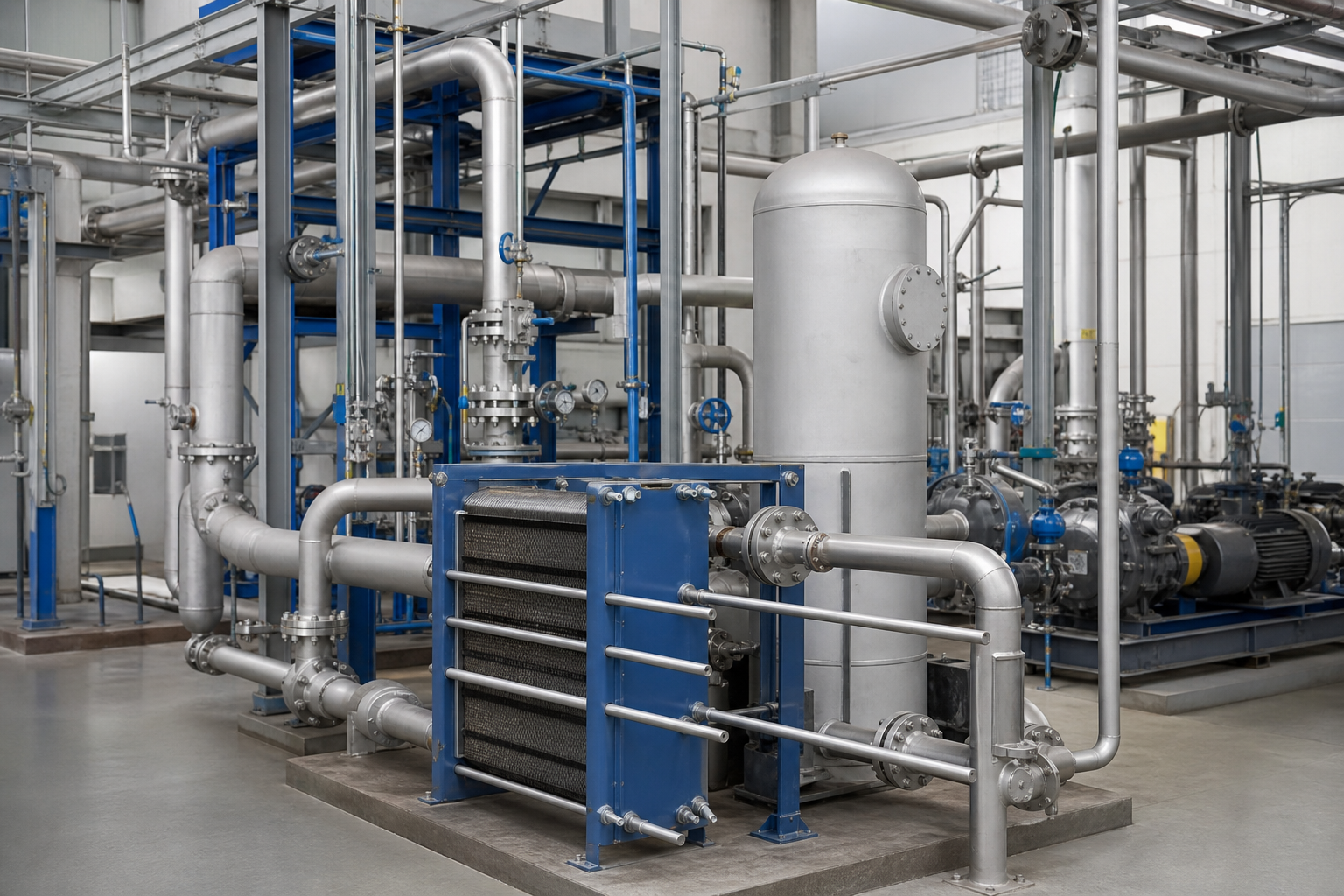
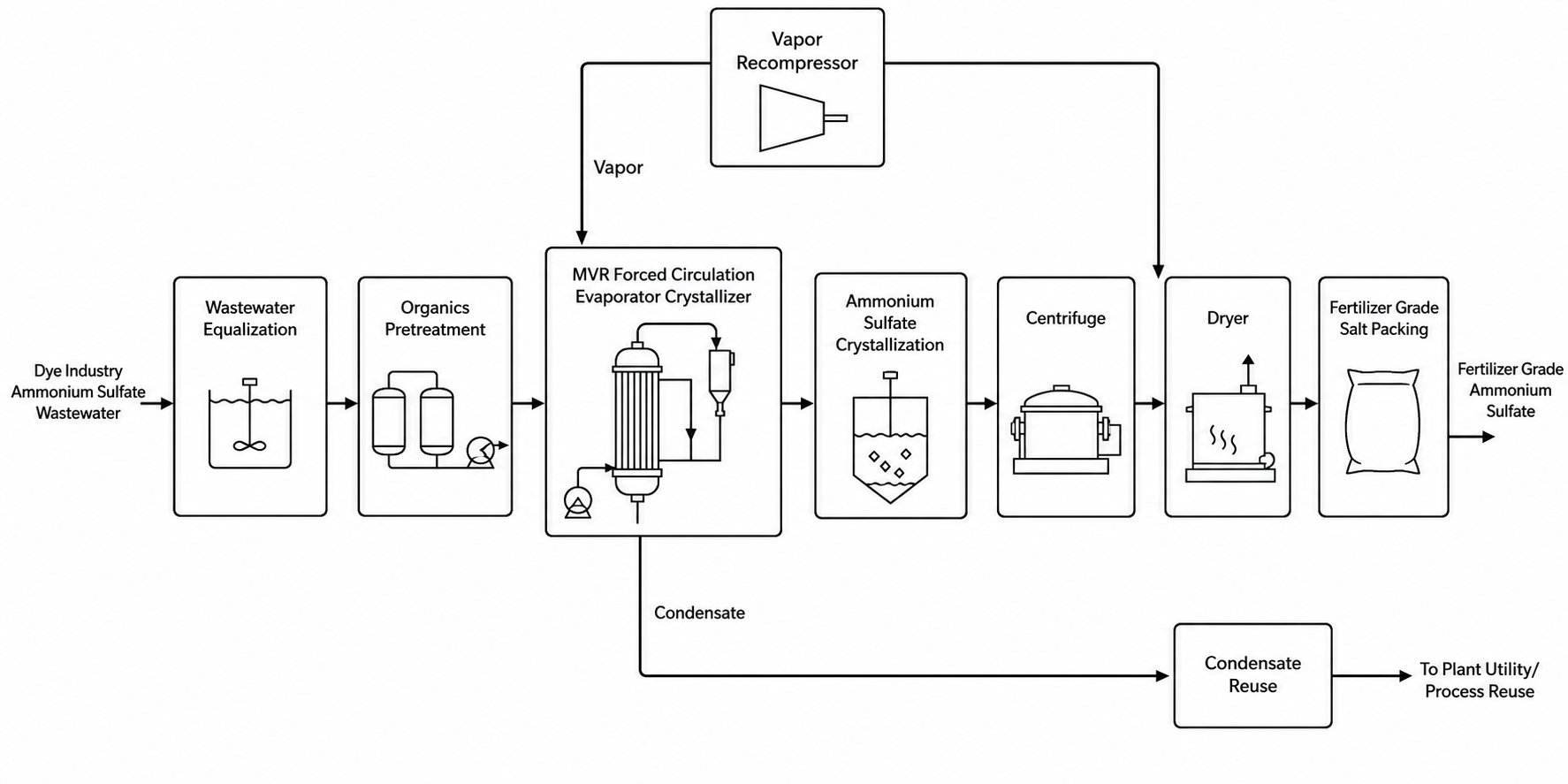
The wastewater is equalized and pretreated: suspended color and organics are reduced by adsorption or chemical conditioning so the brine entering the evaporator carries salt rather than pigment — the salt product’s color specification is written by the customer, and the condensate’s COD is written by the discharge permit, and the pretreatment section is where both are decided.
Concentration and crystallization run on MVR. The mechanical vapor recompressor recycles secondary vapor as the heating medium; the evaporator-crystallizer works in forced circulation, the honest regime for a salt brine with organic traces — pumped velocity keeps the exchanger surface in service between cleanings, and supersaturation relieves on growing crystals. Ammonium sulfate crystals grow under controlled slurry density, each crystal layer burying the trace organics away from the product surface as it grows.
Centrifuging dewaters the crystal slurry; drying finishes the ammonium sulfate to fertilizer-grade handling moisture, and the regional fertilizer market absorbs the output within trucking distance of the plant. Mother liquor recycles with a purge that carries the organics out of the loop before they concentrate. Condensate — forty tonnes of water per hour — is recovered for process reuse, shrinking the plant’s fresh water demand by the same measure.
Equipment Configuration
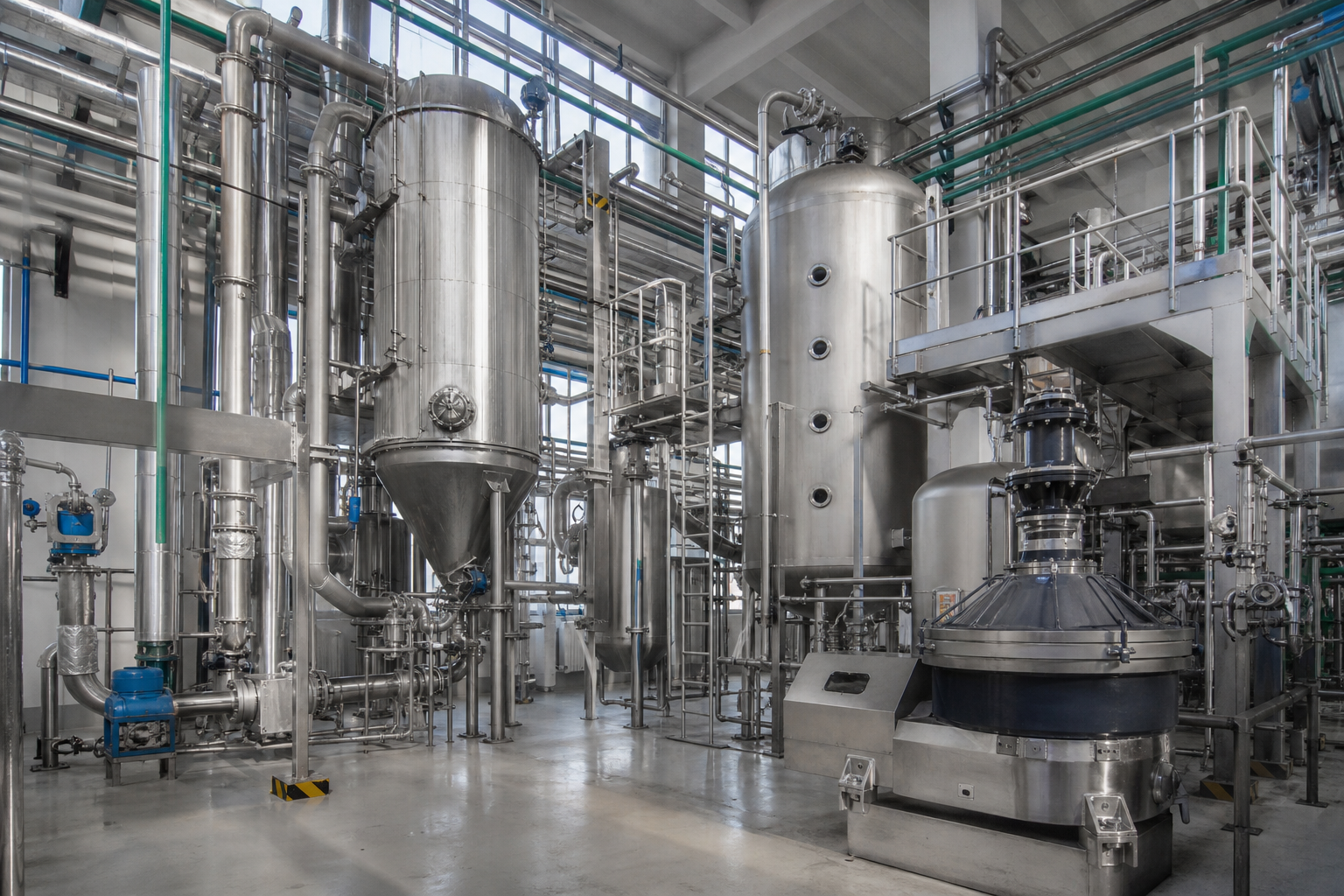
One set of the following equipment is typical for this duty:
- Equalization with organics pretreatment (adsorption / chemical conditioning)
- MVR forced-circulation evaporator-crystallizer with centrifugal recompressor
- Crystallization section with slurry density control
- Centrifuge and dryer for fertilizer-grade ammonium sulfate
- Mother-liquor recycle with organic purge management
- Condensate recovery for process reuse and permit-compliant monitoring; PLC control of the whole train
Performance & Outcome
Compiled from published industry project data, indicative: trains of this class convert dye plant ammonium sulfate brine into fertilizer-grade product on electrically driven MVR energy, with condensate recovered as process water. Salt color specification and per-tonne energy are quoted per project wastewater chemistry, and the condensate quality per permit.


