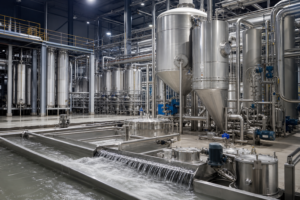
MAP (monoammonium phosphate, NH₄H₂PO₄) is one of the largest-volume phosphate fertilizer products in the world, and evaporation–crystallization is the separation step that turns a phosphoric acid–ammonia reaction liquor into a free-flowing, marketable crystal. In a representative integrated plant, neutralization of wet-process phosphoric acid with ammonia produces a hot MAP solution; water must then be removed until the liquor is saturated, and the dissolved MAP must be crystallized, dewatered, and dried to specification. The energy cost of that water removal dominates the cash cost of crystalline MAP, which is exactly why the evaporator–crystallizer train — not the reactor — usually decides the economics of a MAP unit. This article explains where MAP evaporation and crystallization fits in the flowsheet, which equipment configurations suit which feed conditions, and how modern MVR-based designs cut the steam demand of crystalline MAP production.
Where MAP Sits in the Phosphate Fertilizer Landscape
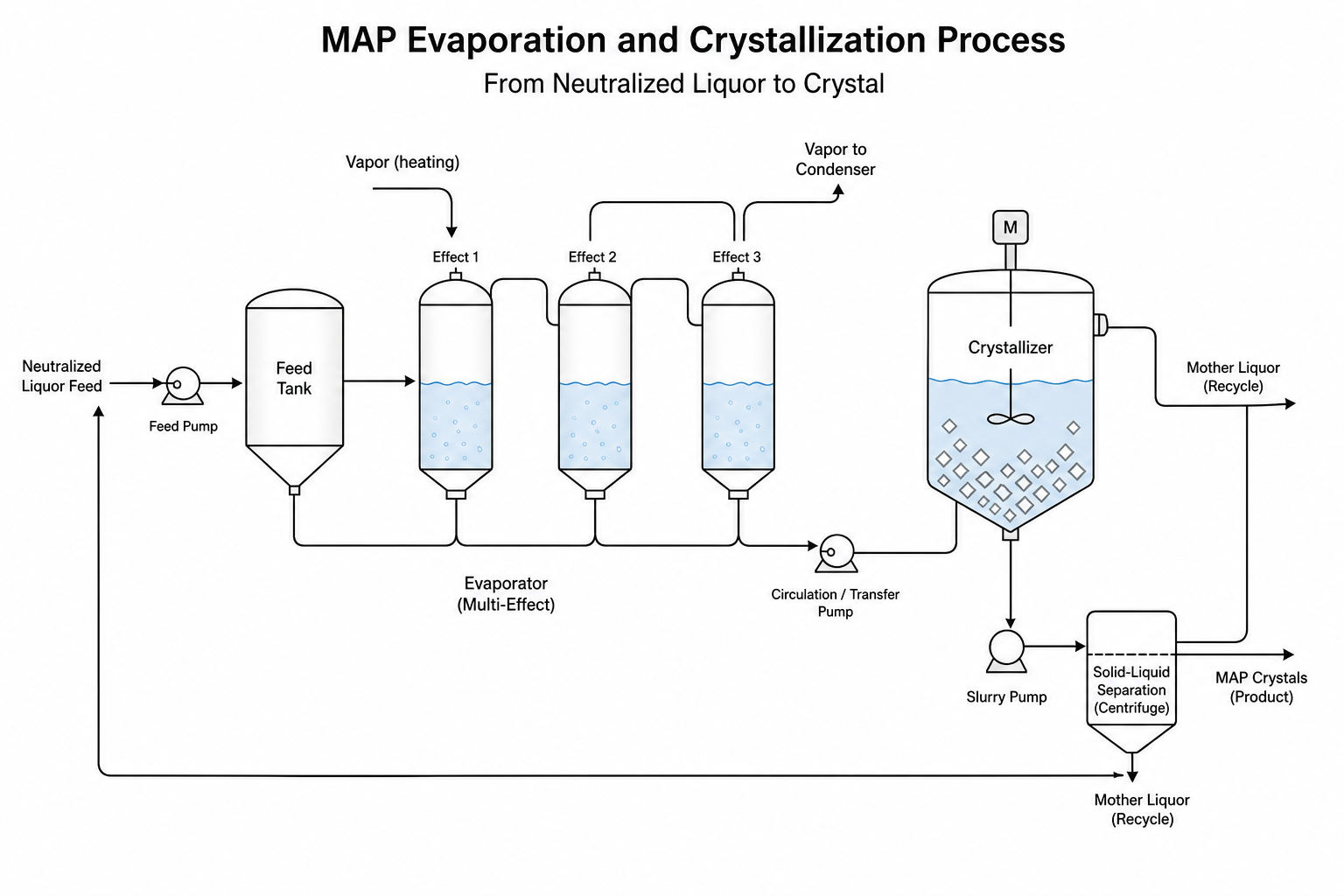
MAP is produced in two fundamentally different product forms, and the difference determines whether an evaporation–crystallization system is required at all. Granular MAP is made by reacting wet-process or merchant-grade phosphoric acid with ammonia in a granulator or pipe reactor, where the reaction heat and a dryer remove water directly — no dedicated crystallizer is needed. Crystalline MAP, by contrast, is produced by neutralizing purified or wet-process acid in solution, concentrating the liquor in an evaporator, and crystallizing the dissolved salt in a controlled-temperature crystallizer.
Crystalline MAP commands a price premium over granular product in several markets because the same chemical, when grown as a clean crystal, serves higher-value applications: technical-grade fertilizer for fertigation and water-soluble blends, drip-irrigation-grade nutrients that must dissolve completely without residue, and the feedstock side of fire-retardant and specialty phosphate chemistry. For these outlets, impurity control — iron, aluminum, magnesium, and sulfate carried in by wet-process acid — is as important as water content, and both are set by the evaporation and crystallization conditions.
The implication for plant design is that a crystalline MAP line is really a hydrometallurgical-style purification train: neutralizer, evaporator concentrator, crystallizer, centrifuge or filter, and dryer, with mother-liquor management closing the loop. Each unit is standard evaporation–crystallization engineering, which is why MAP projects can borrow heavily from forced-circulation crystallizer practice developed for ammonium sulfate, sodium sulfate, and other fertilizer salts.
The Process: From Neutralized Liquor to Crystal
Step 1 — Neutralization and Feed Preparation
Phosphoric acid (typically 40–54% P₂O₅ for wet-process acid, or higher for purified acid) is reacted with gaseous or liquid ammonia in an agitated neutralizer. The reaction is strongly exothermic, and the exit liquor temperature commonly reaches 90–110°C without external heating. Control here is a matter of chemistry, not evaporation: the N:P ratio must be held close to the 1:1 stoichiometry of NH₄H₂PO₄. If the liquor drifts alkaline, monoammonium phosphate converts to diammonium phosphate (DAP); if it stays too acidic, corrosion rates on downstream 316L stainless steel climb sharply. Most operators trim the pH so the product remains safely on the MAP side, because crystalline DAP is a different product with a different market.
Step 2 — Concentration by Evaporation
An illustrative neutralized MAP liquor envelope is 25–45% water depending on the acid strength used, and it must be concentrated to near saturation before crystals can be produced at an economic rate. Two evaporation duties are common:
- Pre-concentration of dilute liquor, where falling-film evaporation is efficient: MAP liquor is not particularly scale-prone at moderate concentration, viscosity is manageable, and the large heat-transfer coefficient of falling-film tubes keeps the area requirement down.
- Final concentration / crystallization at the saturation point, where forced-circulation evaporators or directly coupled forced-circulation crystallizers take over, because boiling at high dissolved-solids content with some suspended crystal growth must be handled without tube fouling.
Liquor-strength figures above are an illustrative envelope from published phosphate-practice ranges and stated design assumptions, not a customer or project dataset; acid strength varies by source and sets the evaporation duty. The target solids content is set by MAP solubility data. Published MAP solubility in water rises from roughly 290 g/kg of solution at 25°C to roughly 630 g/kg of solution near 100°C, so hot concentrated liquor can hold substantially more salt than the crystallizer discharge — this temperature dependence is the thermodynamic lever the whole process exploits. Operating pressure therefore matters: evaporating under vacuum lowers the boiling temperature, which protects the liquor from unnecessary foaming and lets the crystallizer operate in a useful supersaturation window.
Step 3 — Crystallization
MAP crystallizes well. The crystal habit is prismatic, growth kinetics are fast relative to nucleation, and the compound does not form hydrates or hard scale under normal control, which is why a straightforward forced-circulation (FC) crystallizer handles the duty in most plants. The supersaturation is generated by evaporation: liquor circulates through an external heat exchanger and flashes at the vapor-liquid interface in the crystallizer body, depositing the excess dissolved MAP onto suspended crystals.
Where larger, more uniform crystals are the target — for example, product destined for blending with other crystalline water-soluble fertilizers, where dust and caking are commercial defects — an Oslo (growth-type) crystallizer or a draft-tube-baffle (DTB) crystallizer with fines destruction can be justified. These designs physically separate crystal growth from nucleation and give a tighter crystal size distribution; the trade-off is higher cost and a larger footprint than a basic FC loop.
Step 4 — Dewatering, Drying, and Mother-Liquor Recycling
Crystal slurry is withdrawn continuously and dewatered on a pusher centrifuge, peeler centrifuge, or, at smaller scale, a basket centrifuge. Surface moisture after centrifugation is typically reduced to a few percent, and a final fluid-bed or rotary dryer brings the product to the market moisture specification. Crystalline MAP is hygroscopic enough that cooling before bagging and lined storage matter in humid climates.
The mother liquor — the liquid that leaves the centrifuge with the crystals — carries the impurities rejected by the growing crystal. It is returned to the evaporator, not dumped, because it still holds most of the P₂O₅ value. Impurities (Fe, Al, Mg, and potassium from the wet-process acid) build up in this loop until the crystal purity suffers, at which point a small mother-liquor purge is taken and either sold into lower-grade product, sent to the granular MAP train, or in zero-discharge plants treated in a small end-of-pipe crystallizer. Managing that purge stream well is one of the quiet differentiators between a clean MAP plant and a troubled one.
Key Process Parameters at a Glance

| Parameter | Indicative Range / Characteristic | Why It Matters |
|---|---|---|
| N:P molar ratio in neutralizer | ~1.0 (MAP side of neutral, slightly acidic) | Prevents DAP formation; controls corrosion |
| Neutralizer exit temperature | ~90–110°C from reaction heat | Free heat input to the evaporation step |
| MAP solubility exploited | ~290 g/kg of solution at 25°C → ~630 g/kg of solution near 100°C | Temperature window that drives crystallization yield |
| Evaporation duty split | Falling-film pre-concentration → forced-circulation finish | Matches heat-transfer behavior to liquor viscosity |
| Crystallizer type | FC standard; DTB/Oslo for coarse uniform crystal | Sets crystal size distribution and dust behavior |
| Crystal dewatering | Centrifuge to low single-digit surface moisture | Minimizes dryer fuel; protects product flowability |
| Mother liquor | Recycled with small purge | Impurity control + P₂O₅ recovery |
| Module | Candidate Equipment Types | Selection Rationale | Indicative Operating Envelope |
|---|---|---|---|
| Neutralizer | Agitated reactor with ammonia sparging | Holds N:P ratio on the MAP side | Exit near 90–110°C from reaction heat |
| Pre-concentration | Falling-film evaporator | Efficient on moderate-viscosity dilute liquor | Vacuum boiling to near saturation |
| Final concentration / crystallization | FC crystallizer; DTB or Oslo for coarse product | Evaporative supersaturation without tube fouling | Within the published solubility window |
| Dewatering | Pusher, peeler, or basket centrifuge | Low single-digit surface moisture protects the dryer | Continuous slurry withdrawal |
| Drying and cooling | Fluid-bed or rotary dryer plus cooler | Meets moisture spec; limits caking in humid storage | Hygroscopic product handled lined |
| Mother-liquor management | Recycle loop with small purge | Impurity control with P2O5 recovery | Routine Fe/Al/Mg/SO4 monitoring |
Configuration, materials, and operating ranges depend on the actual acid and liquor, corrosion review, foaming behavior, site utilities, and project capacity.
Why MVR Changes the Economics of MAP Crystallization

Evaporating one kilogram of water consumes roughly one kilogram of live steam in a single-effect system. A MAP line that must remove several hundred kilograms of water per tonne of product therefore carries a steam bill that moves directly with fuel prices. Mechanical vapor recompression (MVR) attacks this number by recompressing the vapor boiled off in the crystallizer and reusing it as heating steam in the same effect — the process heat is recycled instead of condensed and discarded.
The practical result, in industry-published figures for this duty, is that an MVR forced-circulation crystallizer consumes on the order of 20–40 kWh of electricity per tonne of evaporated water instead of the equivalent steam energy, with the exact figure depending on the compression ratio and heat exchanger approach temperatures. For MAP, where the temperature lift across the compressor is modest (the liquor boils under vacuum at a comparatively low temperature and the required temperature rise is small), MVR is technically well matched: the compression duty per tonne of vapor is among the lowest of any crystallization duty, because the process does not demand high operating temperatures.
Three engineering points deserve attention in an MVR MAP project:
- Foaming. MAP liquors from wet-process acid contain surfactant-like organic impurities and can foam under vigorous boiling. Demister and anti-entrainment design at the vapor outlet — and foam-control chemistry where needed — protect the compressor from liquor carry-over.
- Corrosion. The liquor is acidic by design. The evaporator, crystallizer, and vapor path are normally 316L stainless as a minimum, with higher alloys or rubber-lined sections where chloride from the acid is significant.
- Turndown. Fertilizer demand is seasonal; an MVR train that turndowns gracefully (variable-frequency compressor, multiple circulation loops) avoids the off-spec and fouling problems of running forced-circulation equipment far below design rates.
Common Problems and How Design Prevents Them

Caking in Storage
Crystalline MAP with residual surface moisture cakes in bags and silos. The remedy is disciplined: dry to specification, cool the crystal before packaging, and control the fines fraction — dust created by over-drying or by mechanical attrition in pneumatic transfer reabsorbs moisture first. Crystallizer selection that produces rounded, coarse crystal (DTB or Oslo) helps more than any anti-caking agent.
Crystal Purity Versus Feed Acid Quality
Wet-process acid brings iron, aluminum, magnesium, and fluoride chemistry into the liquor. Growing MAP crystals incorporate some of these impurities, so the market grade achievable (fertilizer vs. technical) is capped by acid quality — evaporation and crystallization polish the product but cannot create purity that the feed does not contain. Plants targeting technical-grade crystalline MAP either start from purified acid or add a deferrization step ahead of neutralization.
Corrosion-Fatigue in Hot Acidic Vapor Service
Vapor-phase zones where acidic condensate forms — particularly at the top dome of the crystallizer and in the demister region — are the classic corrosion locations of a MAP unit. Thermal insulation of the vapor ducting to keep acidic vapor above its dew point, plus drain design that never lets condensate pool, extends vessel life substantially.
Variable Acid Supply
Plants fed by merchant acid of fluctuating quality see the impurity load arrive as slow drift rather than step change. The mother-liquor loop acts as a buffer, which is an advantage — but it also means impurity problems surface weeks after the feed changes. Routine mother-liquor analysis (Fe, Al, Mg, SO₄) is the cheapest early-warning instrument a MAP operator can buy.
Related Evaporation and Crystallization Applications
MAP technology does not stand alone. The same neutralize–concentrate–crystallize architecture appears across the phosphate and fertilizer salt family, and design know-how transfers directly:
- Chemical and agrochemical solutions — the industry hub for fertilizer, pesticide, and fine-chemical evaporation projects.
- Forced-circulation crystallizers — the workhorse configuration for MAP and similar high-volume fertilizer salts.
- DTB crystallizers — where coarse, uniform crystal for water-soluble fertilizer markets is the target.
- MVR evaporation systems — the energy-recovery core of a modern MAP crystallization train.
Conclusion
Crystalline MAP production is a concentration-and-crystallization business wrapped around a simple acid–base reaction. The plant that wins on cost is the one whose evaporator configuration matches its liquor, whose crystallizer produces crystal the market pays a premium for, whose mother-liquor loop is managed with respect, and whose energy system — increasingly an MVR compressor instead of a steam main — recycles the latent heat it would otherwise condense and throw away. The technology is mature, the thermodynamics are well mapped, and the engineering levers are known; the differentiator is disciplined application of them.
When This Route May Not Fit
Crystalline MAP evaporation–crystallization only pays where the product earns the crystal premium. If the market is granular MAP for bulk blending, a granulator route with reaction-heat drying removes the water with no evaporator or crystallizer at all. Feed acid quality caps the achievable grade: wet-process acid with heavy iron, aluminum, or fluoride loads cannot be polished into technical-grade crystal, and pretending otherwise wastes purification capital. Sites with cheap waste heat or surplus steam may find MVR unnecessary. Seasonal, low-utilization plants struggle to amortize compressor capital, and markets without water-soluble fertilizer demand have no outlet for the crystal premium that funds this route. Corrosion-averse budgets should also note that acidic vapor service punishes under-specified materials on every hot surface.
What Must Be Verified
No project dataset is cited on this page; parameters are published chemistry and stated design practice, and a MAP project should verify its basis before equipment is fixed. The acid supply needs analysis and a drift history: P2O5 strength, Fe/Al/Mg, sulfate, fluoride, and chloride, because impurities cap product grade and set materials. The target product specification — fertigation, water-soluble, or technical — must be matched honestly against that acid quality. On the process side: solubility confirmation on the actual liquor, neutralization control basis for N:P, foaming tendency under vacuum, and a purge strategy that holds impurity steady state. Site items: steam or power economics for the MVR decision, seasonal capacity profile, and humidity conditions for storage and bagging design. Each item prices a risk that otherwise surfaces as off-spec crystal months into operation.
Frequently Asked Questions
Does MAP production always need a crystallizer?
No. Granular MAP made in a granulator or pipe reactor uses reaction heat and a dryer for water removal and needs no crystallizer. Dedicated evaporation–crystallization is required for crystalline MAP — the water-soluble, drip-irrigation, and technical grades sold as clean crystal.
Which crystallizer type is standard for MAP?
A forced-circulation (FC) crystallizer is the standard choice because MAP crystallizes readily without scale or hydrate problems. DTB or Oslo growth-type crystallizers are specified where the product must be coarse and uniform for premium water-soluble fertilizer markets.
How much energy does MAP evaporation save with MVR?
An MVR forced-circulation system, per industry-published figures, consumes on the order of 20–40 kWh of electricity per tonne of evaporated water in place of roughly a tonne of live steam per tonne of water in single-effect evaporation. MAP is well suited to MVR because the required compressor temperature lift is modest.
What impurities limit crystalline MAP quality?
Iron, aluminum, magnesium, and sulfate from wet-process phosphoric acid are the usual limiters; fluoride chemistry also plays a role. They accumulate in the recycled mother liquor and partially incorporate into the crystal, so feed-acid quality — plus purge management — caps the achievable product grade.
Why is MAP liquor kept slightly acidic rather than neutral?
Holding the N:P ratio on the acidic side of MAP stoichiometry prevents conversion to diammonium phosphate (DAP), which is a different commercial product, and suppresses corrosion of the 316L stainless steel typically used in the evaporator and crystallizer train.
For a first-pass screening of a crystalline MAP project, send the acid analysis, target product grade, and capacity; in return you receive an indicative neutralization–evaporation–crystallization architecture with an MVR energy view, before any detailed engineering.