Project Parameters
| Parameter | Value |
|---|---|
| Process route | Combined train: MVR + multi-effect; plate/tubular falling film, plate rising film, plate/tubular forced circulation; evaporation, crystallization & salt–Glauber (NaCl–Na2SO4) separation |
| Industry | Battery-grade cobalt chemicals, 12,000 tpa plant (Tianjin, North China) |
| Feed type & key components | Process liquors bearing sodium chloride, ammonium chloride, ammonium sulfate and sodium sulfate |
| Evaporation capacity | 150.7 t/h |
| Construction materials | SS316L wetted parts (indicative; ammonium and chloride service assessment per zone) |
Representative process configuration compiled from published industry project data. Indicative values, not a process guarantee.
Project Description
A 12,000 tonne-per-year battery-grade cobalt chemicals plant in Tianjin runs a hydrometallurgical flowsheet whose waste-liquor chemistry is unusually crowded: four salts share the process water — sodium chloride and ammonium chloride from the chloride processing steps, ammonium sulfate from sulfate processing, and sodium sulfate carried between them. A single mixed salt from that water is a disposal liability in a region with strict salt management; separated, each fraction is a tradable or recyclable product. The evaporation plant is therefore not an end-of-pipe treatment unit but a salt refinery whose four product streams feed back into the cobalt chain.
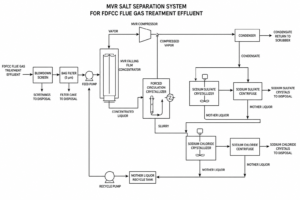
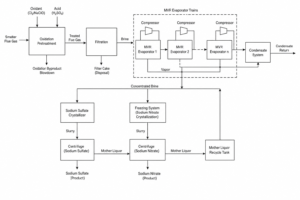
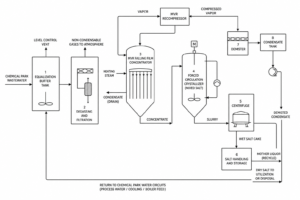
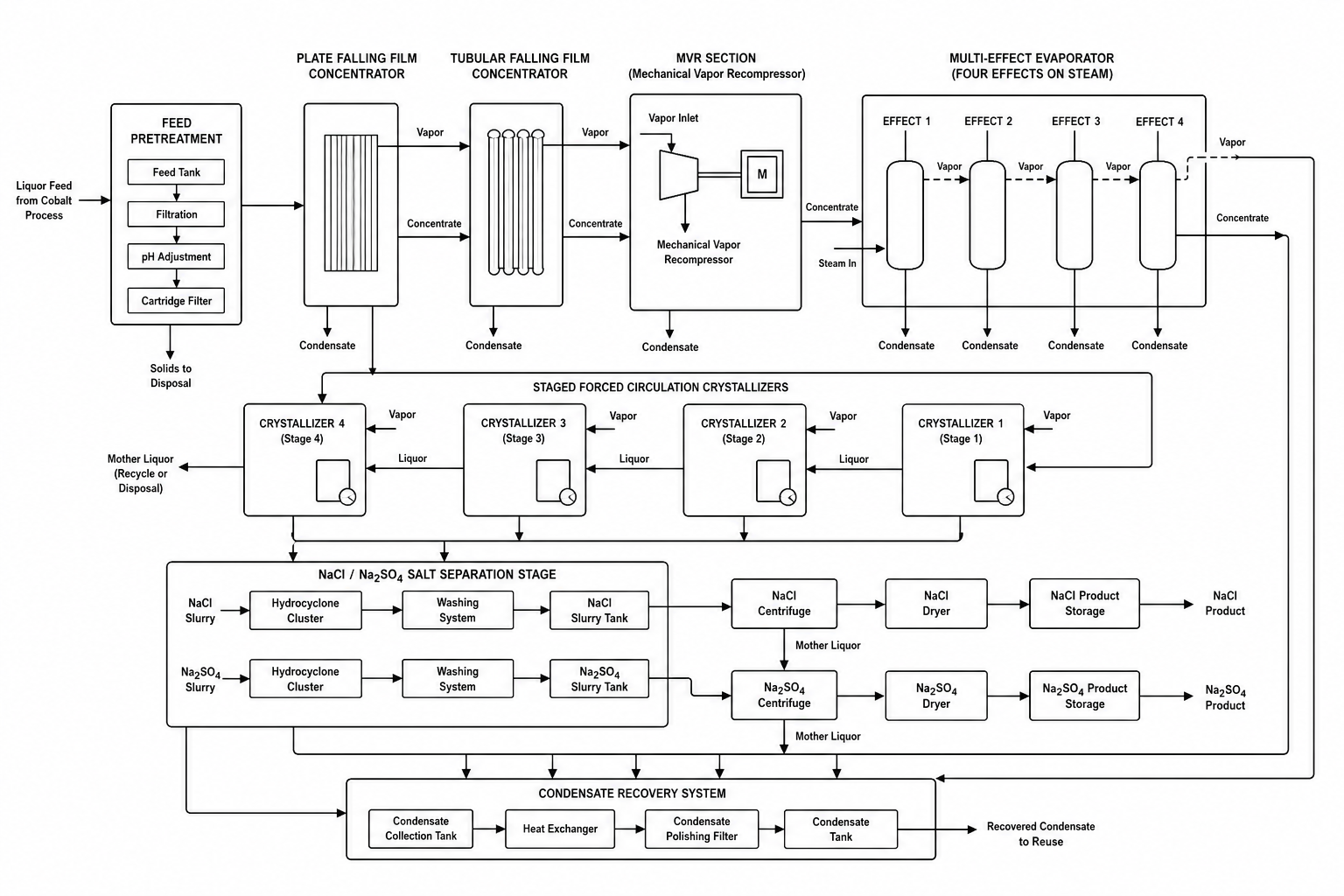
The reference configuration is a 150.7 t/h combined train — the published equipment scope spans MVR and multi-effect evaporation with plate and tubular falling-film bodies, plate rising-film bodies, and plate and tubular forced-circulation service, closing with salt–Glauber separation (NaCl–Na2SO4). No single evaporator type could carry this duty: the four salts crystallize at different points of the concentration path, and each stage of the train is the body type matched to its window — which is exactly why the published configuration reads like a catalog. Scale is the second headline: at 150.7 t/h this is among the large evaporation trains in the battery-materials salt-recovery class, comparable in scale thinking to the 82 t/h ternary-precursor trains published for the NCM chain.
Process Technology
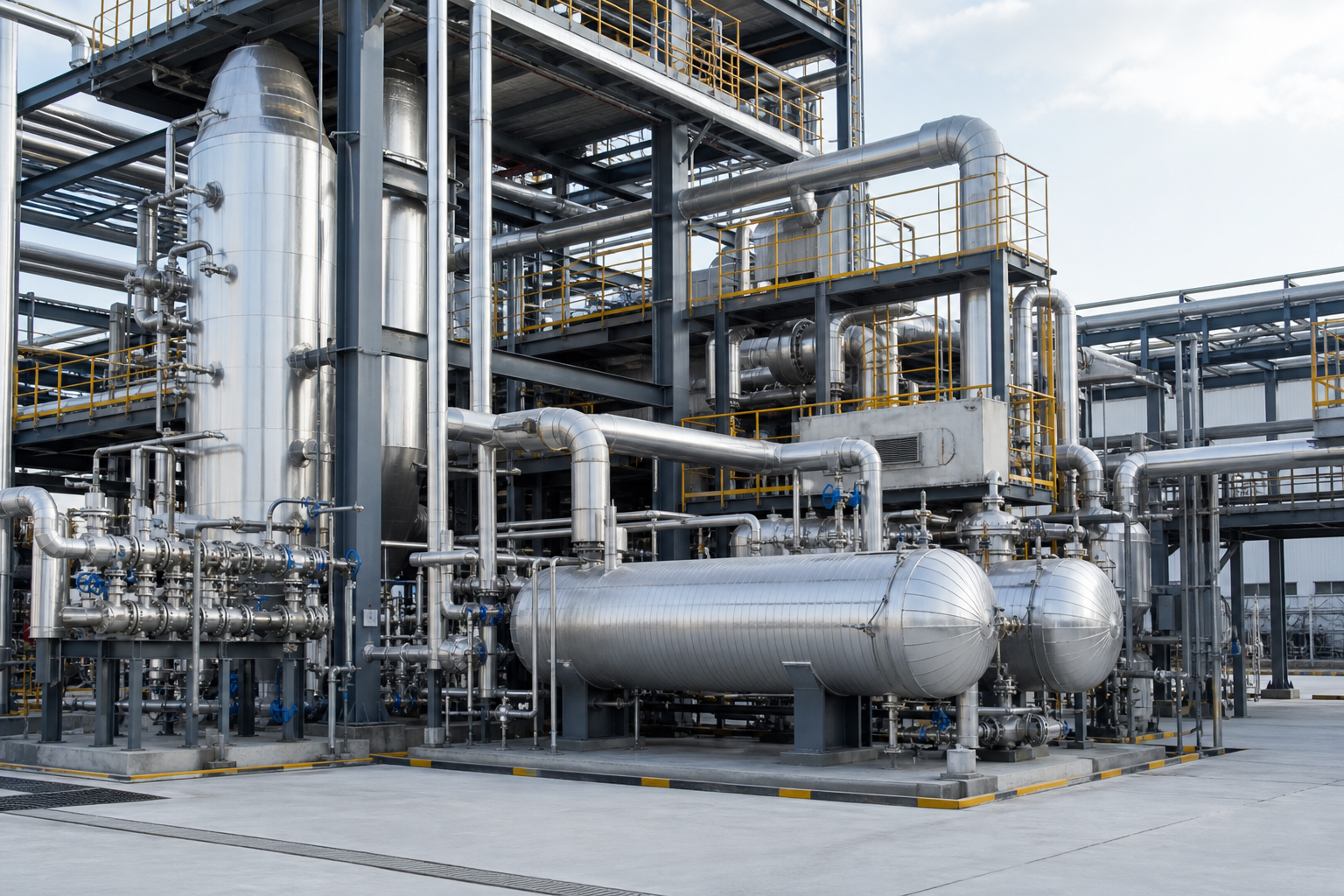
The train opens with concentration of the combined liquors. Falling-film bodies — plate and tubular — carry the early concentration window where the liquors are clear and pumpable; plate bodies deliver compact heat transfer where plot space is tight, tubular where fouling service or maintenance access argues for conventional geometry. Rising-film plate service appears where the liquor’s behavior favors natural-circulation wetting at higher velocity through the concentration middle game.
MVR and multi-effect evaporation share the energy duty in a deliberate split. MVR sections run on electrical power with recompressed secondary vapor — the efficient choice where the duty is steady and power is available; multi-effect sections run on live steam where the site’s steam system and the temperature sensitivity of a particular salt fraction favor staged thermal economy. Mixing the two drive types in one train lets each salt circuit take the energy economics that suits it, rather than forcing one drive philosophy onto four crystallization chemistries.
Crystallization is staged per salt. Forced-circulation bodies — plate and tubular — manage the crystallizing zones, where every one of these four salts is a scaling fluid on superheated walls. The separation sequence exploits solubility differences: fractional crystallization withdraws the salts in turn as the liquor concentrates and cools, and the closing salt–Glauber separation splits sodium chloride from sodium sulfate into individual products. Ammonium salts are handled with thermal regimes that avoid ammonia slip to the condensate. Each salt leaves its crystallizer through centrifuge and drying to bagged product or recycle to the cobalt plant.
Mother liquors recycle within salt circuits with controlled purges holding cobalt, calcium and organics at steady state; condensate from the effects returns to the hydrometallurgical plant as process water.
Equipment Configuration
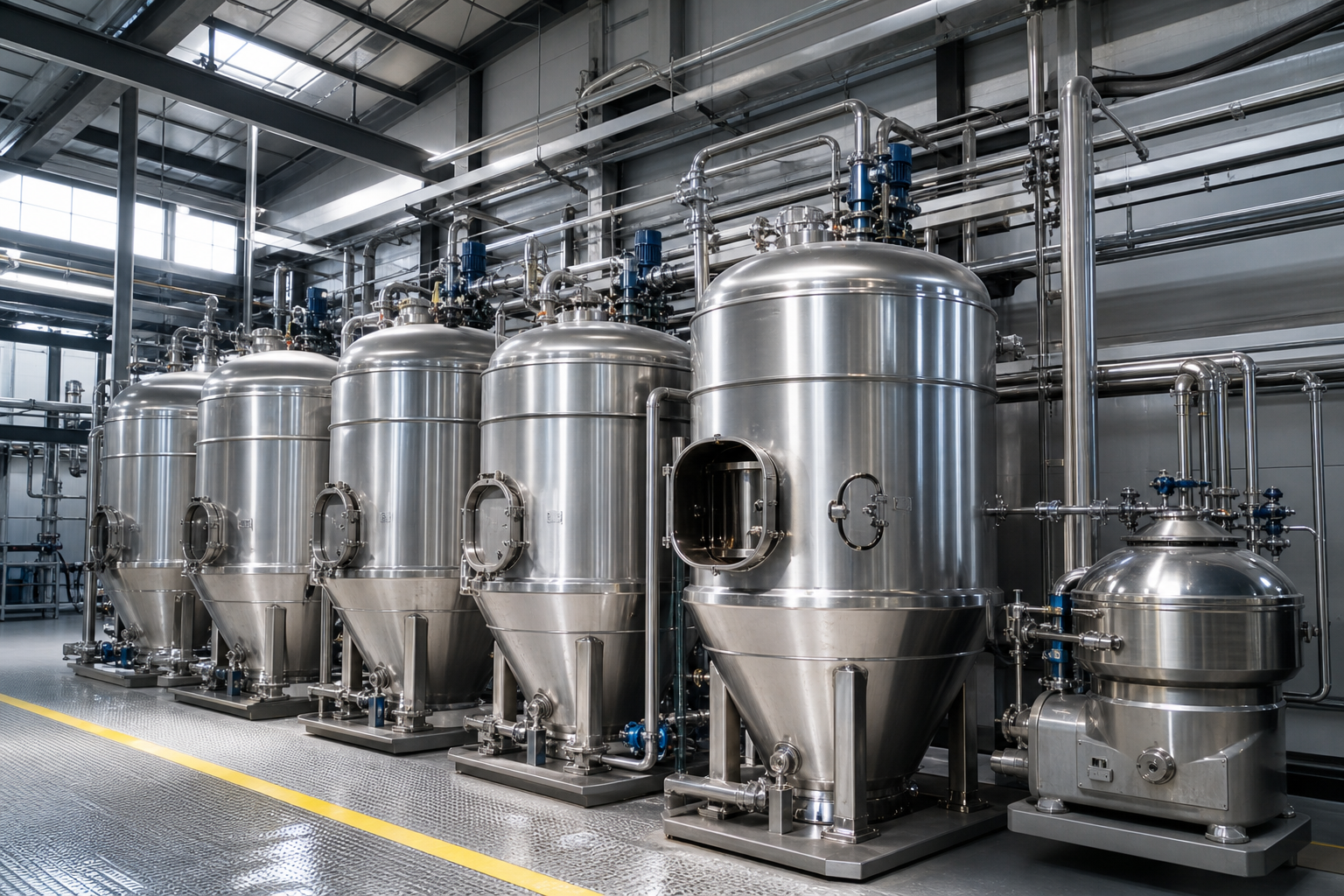
One set of the following equipment is typical for this duty:
- Liquor equalization and filtration across the four-salt process streams
- Plate and tubular falling-film concentrators; plate rising-film evaporation bodies
- MVR sections with mechanical vapor recompressors + multi-effect sections on site steam
- Plate and tubular forced-circulation crystallizers staged per salt
- Salt–Glauber (NaCl–Na2SO4) separation stage; centrifuges and dryers per salt product
- Mother-liquor returns with cobalt/impurity purge control; condensate reuse; DCS coordination of the combined train
SS316L is the indicative reference; ammonium chloride and sulfate zones are assessed per project for duplex upgrades where chloride stress corrosion governs.
Performance & Outcome
Compiled from published industry project data, indicative: combined trains of this class separate a four-salt liquor into individual chloride, ammonium and sulfate product streams at the 150 t/h scale, mixing MVR and multi-effect energy economics per circuit and returning condensate as process water. Salt purities and per-circuit energy figures are quoted per project.
The underlying design logic is summarized in Salt Separation Technology Overview.