Salt separation (fractional crystallization) is the process that turns a mixed-salt wastewater stream into individual, sellable salt products—industrial-grade sodium chloride, sodium sulfate, potassium chloride—by exploiting how differently each salt’s solubility responds to temperature and concentration. Plants in coal chemical, flue gas desulfurization, and chemical manufacturing generate large volumes of NaCl-Na2SO4 mixed brine that conventional precipitation and filtration cannot split; simple evaporation only reduces the volume and leaves a mixed waste salt with almost no resale value that must be disposed of at hazardous-waste cost. Separated salts, by contrast, re-enter commerce: chlor-alkali feedstock, fertilizer, detergent-grade sodium sulfate. The choice among thermal, freeze, and nanofiltration-based separation routes—and how they are staged with MVR evaporation—determines whether a brine stream is a disposal liability or a product line. This article is the engineering deep-dive on that choice; the salt separation capability page presents the same technology at system level for selection-stage readers.
Why Mixed Salt Is a Problem Worth Solving
Dissolved salts cannot be separated by the ordinary physical treatment toolbox. Precipitation, filtration, and sedimentation act on suspended solids; dissolved NaCl and Na2SO4 pass through untouched. The economic consequences of stopping at volume reduction are severe:
- Mixed salt has minimal resource value. A blend of sodium chloride and sodium sulfate meets no product standard, so it cannot be sold into any application that specifies either salt.
- Disposal is paid, repeatedly. Mixed salts from industrial wastewater are commonly classified as general or hazardous solid waste depending on the contaminant matrix, and every ton trucked offsite is a pure cost.
- Regulatory pressure is tightening. ZLD mandates in India, China, and water-stressed regions push plants toward full solidification of brine—making the “what do we do with the salt” question unavoidable.
Salt separation answers the question by producing single-salt streams that meet industrial specifications.
The Physical Basis: Solubility-Temperature Behavior
Each salt has a characteristic solubility curve, and the differences between those curves are the entire basis of separation:
- Sodium chloride is nearly indifferent to temperature. Its solubility changes little between warm and cold conditions, so cooling a saturated NaCl solution crystallizes almost nothing. Concentrating NaCl requires removing water—evaporation crystallization is the only effective route.
- Potassium chloride responds strongly to temperature. Cooling a hot saturated solution crystallizes KCl in quantity—the classical route to fertilizer-grade potash.
- Sodium sulfate combines both behaviors with a twist. Its solubility swings with temperature, and below roughly 32 °C it crystallizes as the decahydrate (Glauber’s salt, mirabilite) with distinctly low solubility—cold conditions can precipitate it almost completely while NaCl stays dissolved.
Three-Salt Quick Reference
| Salt | Solubility vs temperature | Effective crystallization route | Typical product market |
|---|---|---|---|
| NaCl | Flat curve—weak temperature dependence | Evaporation crystallization | Chlor-alkali feed, salt recovery, de-icing |
| KCl | Steep curve—strong temperature dependence | Cooling crystallization | Potash fertilizer |
| Na2SO4 | Steep curve + hydrate behavior (decahydrate below ~32 °C) | Evaporation or cooling crystallization, depending on temperature and hydrate design | Detergents, paper, glass, chemical feedstock |
Engineers use phase diagrams to plan which salt reaches supersaturation first along the planned concentration and cooling path. The crystallization order is not fixed by chemistry alone—feed composition, evaporation rate, cooling trajectory, impurity distribution, and mother liquor management all shift it, which is why each brine deserves its own process design rather than a copied flowsheet.
The Fractional Crystallization Train: Five Steps
A separation-by-staging plant follows a recurring sequence:
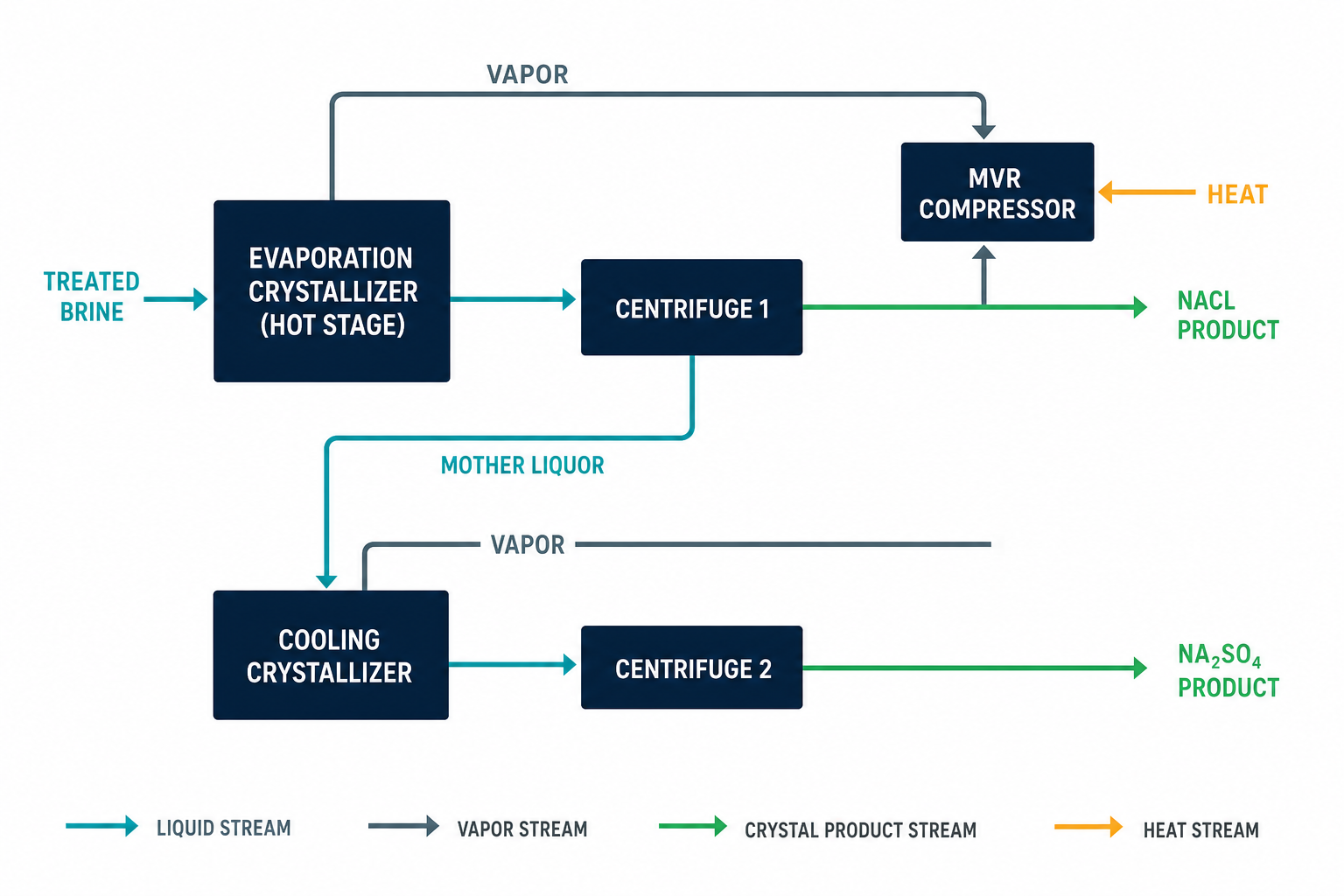
- Mixed salt feed enters from brine wells, salt lakes, or industrial wastewater collection.
- Evaporation concentration (MVR or multi-effect) drives the liquor toward saturation; the least soluble component—commonly NaCl in chloride-rich brine—reaches saturation first and crystallizes out.
- Crystal separation by thickening, filtration, or centrifuge removes the first salt as a solid product stream.
- Mother liquor transfer under controlled temperature—the liquor must not be shocked thermally or compositionally between stages—feeds a cooling or vacuum flash crystallizer where the next salt (KCl or Na2SO4) precipitates as coarse, high-purity crystals.
- Final recovery and recycle: centrifuged crystals are washed and dried; mother liquor returns to the front of the train.
Evaporation (removing water) and separation (selective crystallization) are distinct steps in this logic—one dehydrates, the other sorts. A well-designed train recovers up to about 90% of the water as reusable condensate along the way.
Route 1: Thermal Salt Splitting (Variable-Temperature Evaporation)
The thermal route separates NaCl from Na2SO4 purely with temperature: evaporation and crystallization at high temperature (typically 80–90 °C) crystallize anhydrous sodium sulfate, while cooling to the 40–50 °C range shifts the system so sodium chloride crystallizes instead.
Strengths: the flowsheet is simple, uses standard evaporation equipment, and requires no refrigeration or membranes.
Weaknesses: because the two salts’ solubility curves shift over a modest temperature span, process control is demanding. In practice both salts rarely reach first-grade product quality simultaneously—plants usually obtain one on-spec product and one lower-grade stream. Mother liquor circulation is large, and each spec violation propagates through the recycle.
Route 2: Evaporation plus Freeze Crystallization
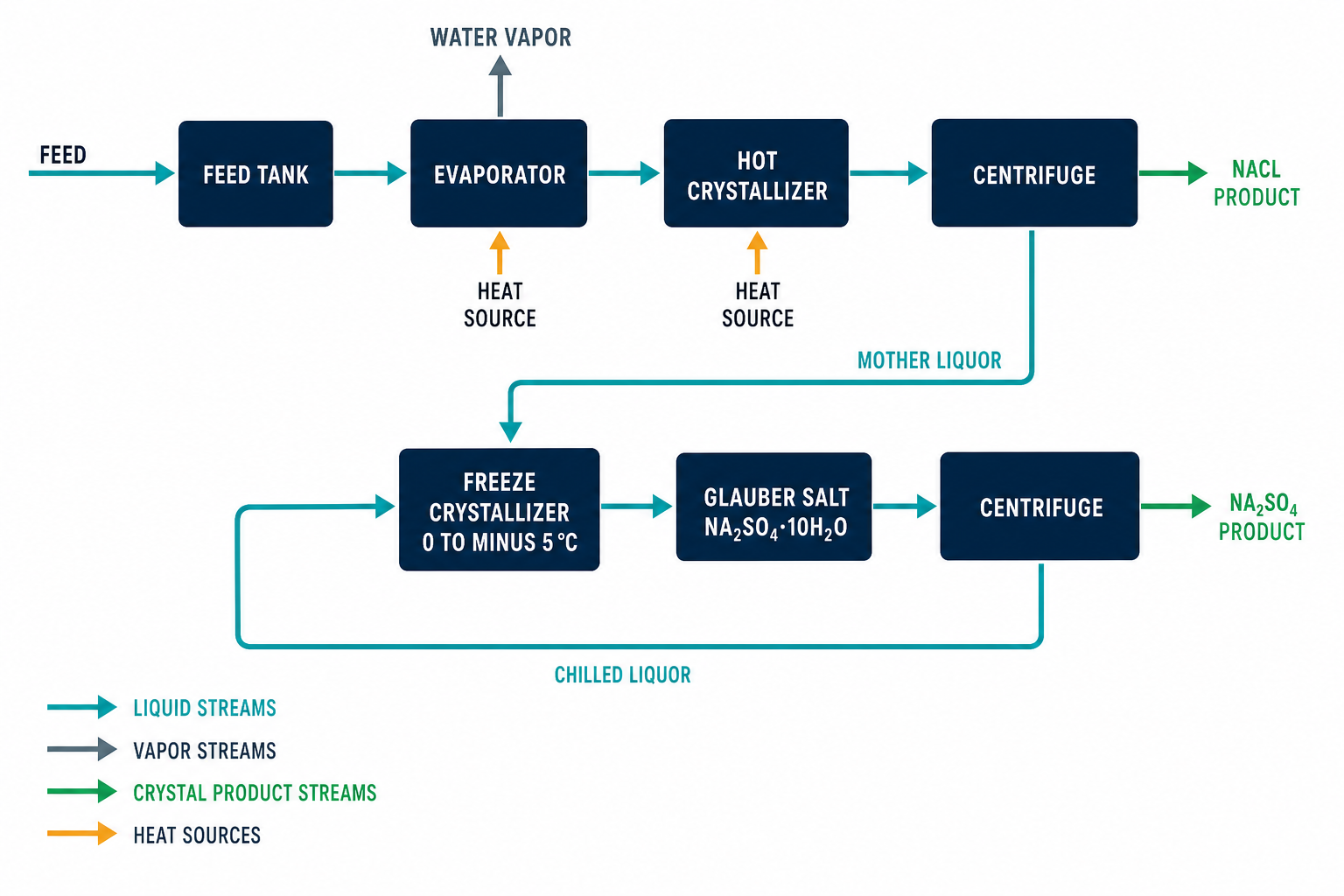
Freeze separation exploits the extreme behavior of Glauber’s salt in the cold: at around −5 °C, the co-saturation point of the two salts shows sodium sulfate at only about 0.71% while sodium chloride remains near 25%—a mass ratio of roughly 35:1 in favor of NaCl in the mother liquor (published phase-equilibrium data). Chilling the liquor therefore crystallizes sodium sulfate decahydrate nearly quantitatively and leaves NaCl in solution; evaporating that chilled mother liquor at high temperature then yields solid sodium chloride.
Strengths: the route tolerates a wide range of feed ratios with large operating flexibility, handles high-hardness and high-silica systems better than membranes, and requires moderate investment and operating cost. Reported field practice often treats it as the most broadly applicable salt-sulfate separation route.
Weaknesses: freeze temperature control is sensitive—poorly managed chilling destabilizes the mother liquor composition—and impurity ions and COD accumulate in the mother liquor, which can degrade sodium chloride product quality unless purge and polishing are managed.
Route 3: Nanofiltration plus Separate Evaporation
Nanofiltration membranes separate by valence: monovalent ions (Na+, Cl−, with some K+ and nitrate) pass into the permeate while divalent ions (SO42−) are retained in the concentrate, and most organic matter follows the divalent side. Each stream then goes to its own evaporation-crystallization train: the monovalent side yields relatively pure NaCl; the divalent side (with advanced oxidation as needed for organics) yields anhydrous sodium sulfate.
Strengths: the split is the most complete of the three routes, product quality is stable because NF permeate quality is stable against feed swings, external mother liquor purge is minimal, and overall salt recovery—the fraction of incoming salt sold as product—is the highest.
Weaknesses: equipment investment is higher, nanofiltration membrane life is short compared with process equipment, and operating cost reflects membrane replacement. The route suits brines with relatively high NaCl content and relatively low COD and hardness.
Comparing the Three Salt-Sulfate Separation Routes
| Criterion | Thermal (variable-T evaporation) | Evaporation + freeze crystallization | Nanofiltration + separate evaporation |
|---|---|---|---|
| Separation principle | Na2SO4 crystallizes at 80-90 °C, NaCl at 40-50 °C | Na2SO4·10H2O crystallizes near −5 °C; NaCl stays dissolved (35:1 ratio at co-saturation) | Membrane splits by valence; each side evaporated separately |
| Product quality | Both salts on-spec simultaneously is difficult | Good Na2SO4 yield; NaCl quality sensitive to impurity buildup in mother liquor | Best; stable quality against feed swings |
| Feed flexibility | Limited by solubility window | Wide—commonly regarded as a broadly applicable route | Best water stability, but needs low COD/hardness, high NaCl share |
| Investment / OPEX | Simplest equipment | Moderate | Highest; short membrane life |
| External purge | Large mother liquor recycle | Moderate | Minimal—highest salt recovery |
Choosing the Route by Salt Ratio
Feed composition drives flowsheet sequencing as much as chemistry does:
- High sodium sulfate, low sodium chloride: evaporate first to crystallize sodium sulfate; chill the mother liquor to crystallize Glauber’s salt; re-dissolve and evaporate it to anhydrous Na2SO4; finally evaporate the remaining liquor to NaCl, with the tail mother liquor yielding a small mixed-salt purge.
- Low sodium sulfate, high sodium chloride: concentrate first; freeze-crystallize mirabilite; re-dissolve and evaporate it to sodium sulfate; then evaporate the chilled mother liquor to sodium chloride.
- Potassium-sodium split, sodium-rich: evaporation crystallizes NaCl first; cooling the mother liquor then crystallizes KCl.
- Potassium-sodium split, potassium-rich: evaporation crystallizes KCl first, further cooling or flash evaporation recovers more KCl, and the end mother liquor is evaporated to NaCl with the recycle closed on the cooling/flash stages.
Both sodium routes deliver sulfate and chloride products that meet industrial standards, with impurities exiting through the end-cut mother liquor.
Engineering a High-Purity NaCl Recovery: Reference Case
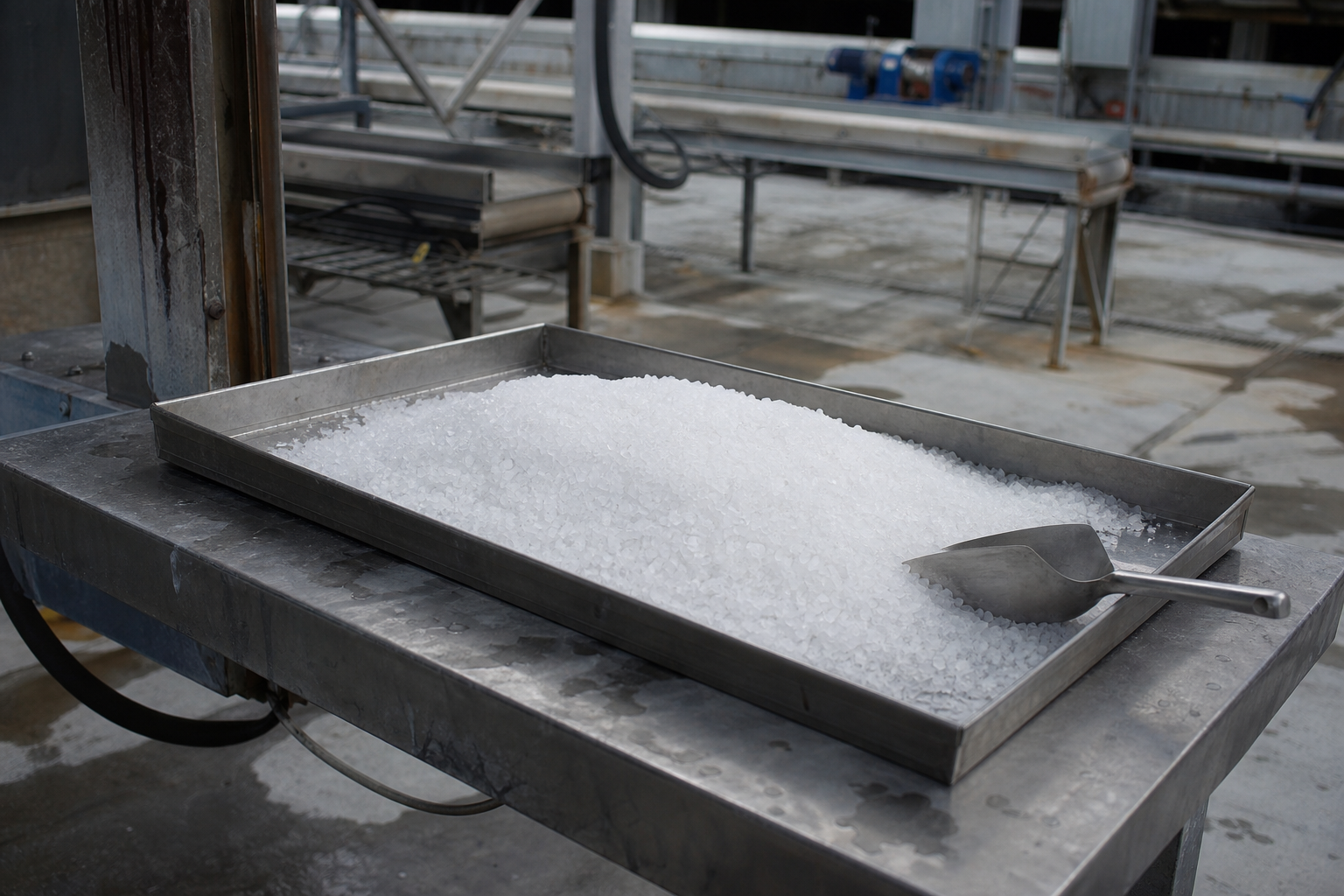
An externally reported project frame for recovered salt production illustrates the magnitudes involved: an evaporation capacity of 100 t/h treating wastewater at roughly 26% NaCl, processed through three MVR stages—concentration, evaporation crystallization, and drying—to industrial-grade sodium chloride with moisture at or below 5%, alongside full liquid recovery with no discharge.
The crystallization section carries the quality burden:
- A forced-circulation crystallizer maintains high velocity over the heat exchange surface, sweeping nascent NaCl crystals off the tubes while giving them time to grow.
- Precise control of supersaturation, temperature, and circulation rate—combined with seed crystal management—directs nucleation toward large, regular, high-purity crystals rather than fine, impurity-trapping solids. The configuration is described on the forced-circulation crystallizer page.
- Downstream, a thickener raises underflow solids content, a centrifuge dewaters the crystal slurry, and a vibrating fluidized-bed dryer with clean hot air delivers the dry white product—see drying and packing systems.
- Most mother liquor returns to the crystallizer; a small side stream is periodically purged and further concentrated to a minor mixed-salt solid, keeping trace impurities from accumulating while protecting main-product purity.
Pretreatment: The Foundation of Product Purity
Every separation chemistry above assumes a clean feed. Sulfate and fluoride—key scaling and impurity factors—must be removed before the evaporation train, both to keep heat transfer surfaces clean and to keep the contaminant load out of the crystal lattice. Suspended solids, organics, and heavy metals in the raw brine are knocked out in a pretreatment section designed around the feed water report.
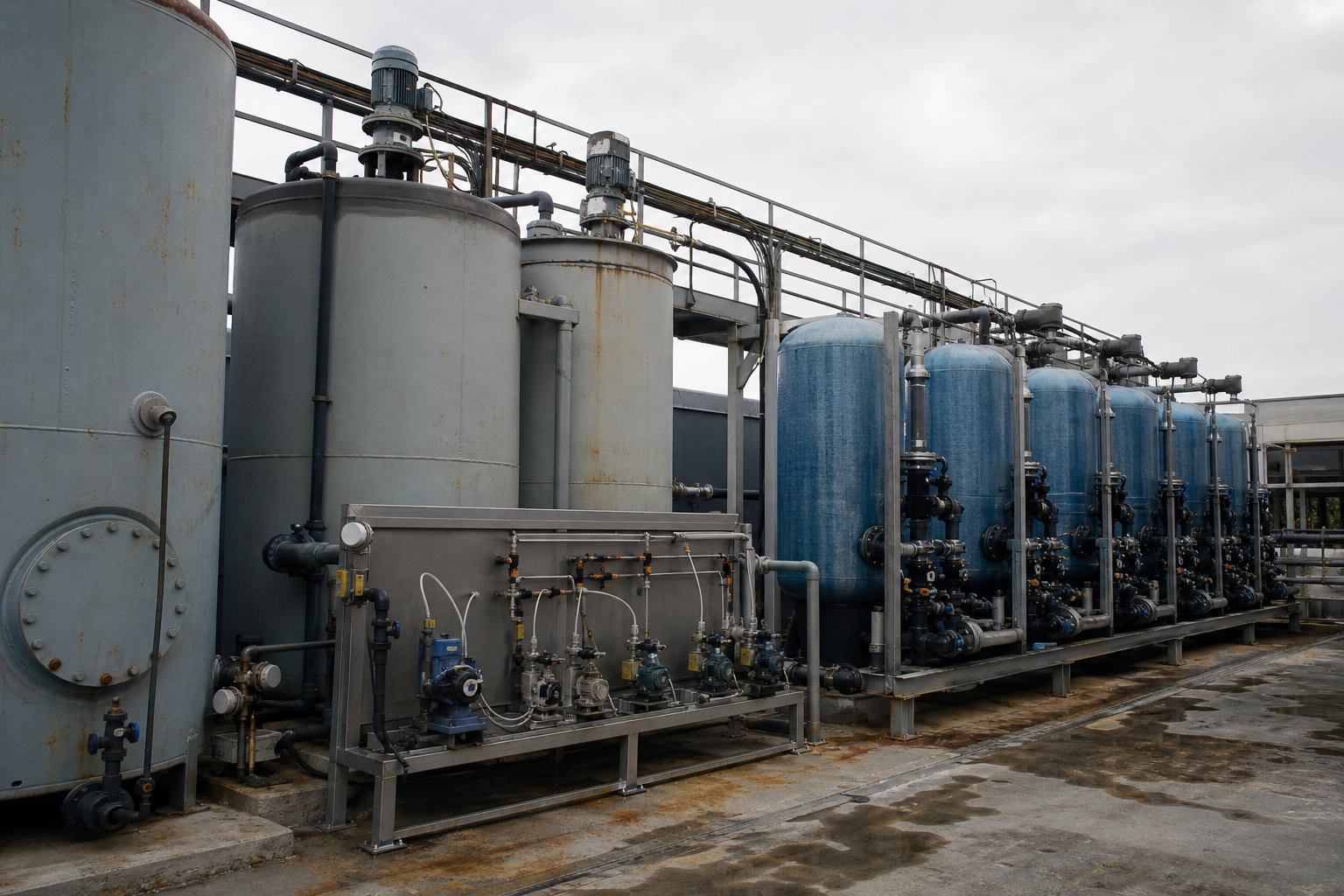
Skipping or undersizing pretreatment shows up later as scaling campaigns (see the fouling and scaling guide) and as off-spec salt.
The Closed Loop: Five Unit Blocks
A complete salt-separation ZLD plant organizes into five blocks:
- Water conditioning: removal of suspended solids, organics, and scale-formers to protect heat surfaces and product purity.
- Staged evaporation concentration: MVR or multi-effect concentration toward saturation.
- Fractional salt crystallization: the high/low-temperature or freeze-staged crystallizers that produce single salts.
- Condensate recovery: high-purity distillate returned to production.
- Mother liquor recycle: the small residual flows returned to the front of the train, with a controlled purge for impurity removal.
MVR is the standard energy engine for such trains: recompressing secondary steam instead of venting its latent heat cuts energy use by roughly 60% versus conventional multi-effect evaporation (supplier-published indicative), directly reducing unit salt production cost. On high-value brines, salt sales can offset operating cost entirely—the economics are examined on the MVR technology page and the overall plant architecture in the ZLD system overview.
Where Salt Separation Pays: Industry Applications
- Coal chemical and mining wastewater: large NaCl-Na2SO4 brines requiring ZLD with salt recovery as the economic offset.
- Flue gas desulfurization wastewater: chloride-sulfate separation ahead of compliant solidification.
- Chlor-alkali brine purification: high-purity NaCl re-dissolved as ion-membrane electrolysis feed.
- Potash production: sylvinite and carnallite hot-leach circuits separating KCl fertilizer from NaCl.
- Salt lake and well brine refining: fractional crystallization upgrading mixed crude salts to specification products.
Configuration examples across these duties are collected under salt separation and resource recovery systems, and the coal chemical application detail on the coal chemical industry page.
Frequently Asked Questions
Why can’t mixed salt from wastewater be sold?
Because product standards are written for single salts. A NaCl-Na2SO4 mixture fits no chlor-alkali, detergent, or fertilizer specification, so its resource recovery rate is close to zero and plants pay for disposal. Separating the salts into individual on-spec products is what converts the waste stream into salable material.
What is fractional crystallization in brine treatment?
It is the staged crystallization of a mixed brine in which concentration and temperature are controlled so that one salt at a time reaches supersaturation and crystallizes. NaCl—with its temperature-flat solubility—is crystallized by evaporation; KCl and Na2SO4—with steep solubility curves—are crystallized by cooling. Mother liquor moves between stages under controlled conditions.
How does freeze crystallization separate sodium sulfate from sodium chloride?
Below roughly 32 °C, sodium sulfate crystallizes as the decahydrate (Glauber’s salt) with very low solubility. Near −5 °C the co-saturation point holds only about 0.71% Na2SO4 while NaCl stays near 25%—a 35:1 ratio. Chilling therefore precipitates nearly pure sodium sulfate hydrate, and evaporating the chilled mother liquor recovers solid NaCl.
When is nanofiltration the better salt separation route?
NF suits brines with relatively high NaCl content and relatively low COD and hardness. It gives the most complete sulfur-chloride split, the most stable product quality against feed swings, minimal external purge and the highest salt recovery—offset by higher investment and shorter membrane life. For high-hardness or high-silica feeds, evaporation plus freeze crystallization is usually more robust.
How much energy does MVR save in salt separation duty?
MVR evaporation-crystallization typically uses about 60% less energy than conventional multi-effect evaporation (supplier-published indicative) by recompressing secondary steam as the heating medium. On large trains this reduction in unit production cost is what makes salt sales able to offset operating cost.
What pretreatment does a salt separation plant need?
Removal of suspended solids, organics, and heavy metals plus the key scaling factors—sulfate where it is not the product, and fluoride. Pretreatment protects the heat transfer surfaces from scaling and keeps impurities out of the crystal lattice; it is the precondition for both stable operation and product purity.