Project Parameters
| Parameter | Value |
|---|---|
| Process route | Five-effect falling-film evaporation, eight concentration stages |
| Industry | Fruit juice concentrate (Lingbao, Henan — apple juice region, Central China) |
| Feed type & key components | Clarified apple juice: sugars, acids, heat-sensitive aroma and color fractions |
| Evaporation capacity | 50 t/h |
| Construction materials | SS316L wetted parts (food-grade finish) |
Representative process configuration compiled from published industry project data. Indicative values, not a process guarantee.
Project Description
China&rsqu;s apple juice concentrate industry sits on the northwest arc of the country&rsqu;s apple belt, and Lingbao in Henan is one of its established production centers. Apple juice concentrate (AJC) is an export commodity sold on Brix, color and clarity — and all three of those quality axes are set in the evaporator. The published project for this duty is a 50 t/h five-effect train at a juice concentrate producer in Lingbao: mid-scale for the industry, with the eight-stage concentration path that characterizes the modern AJC evaporator.
Apple juice concentration is a study in gentle water removal. The sugars concentrate readily, but the aroma fraction is volatile and the color darkens measurably with thermal exposure — a pale concentrate grades and prices higher. The train therefore runs under vacuum at low temperature difference, in thin films, with the concentration path split into eight small steps rather than a few large ones, so the juice never sits in a big temperature jump.
Process Technology
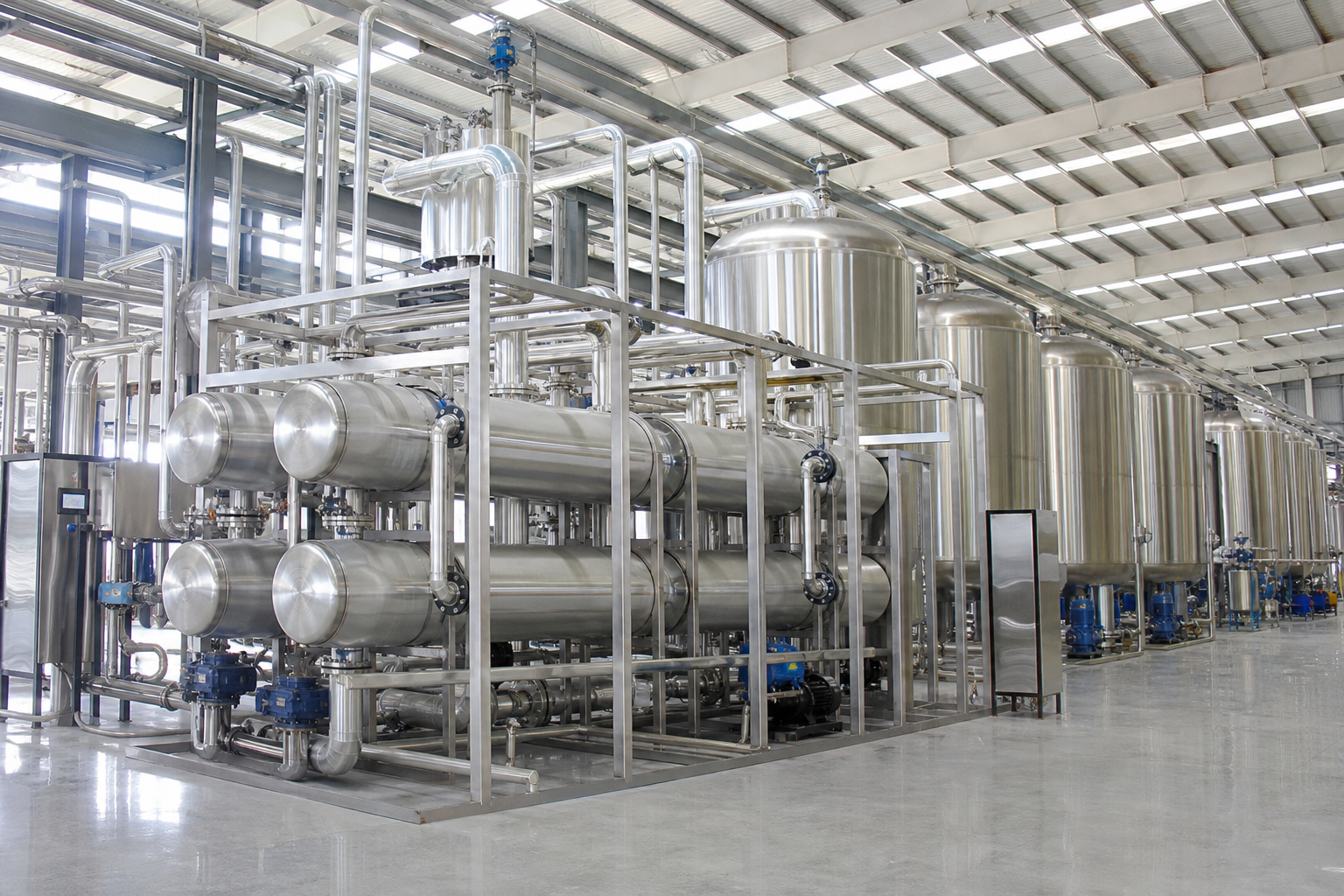
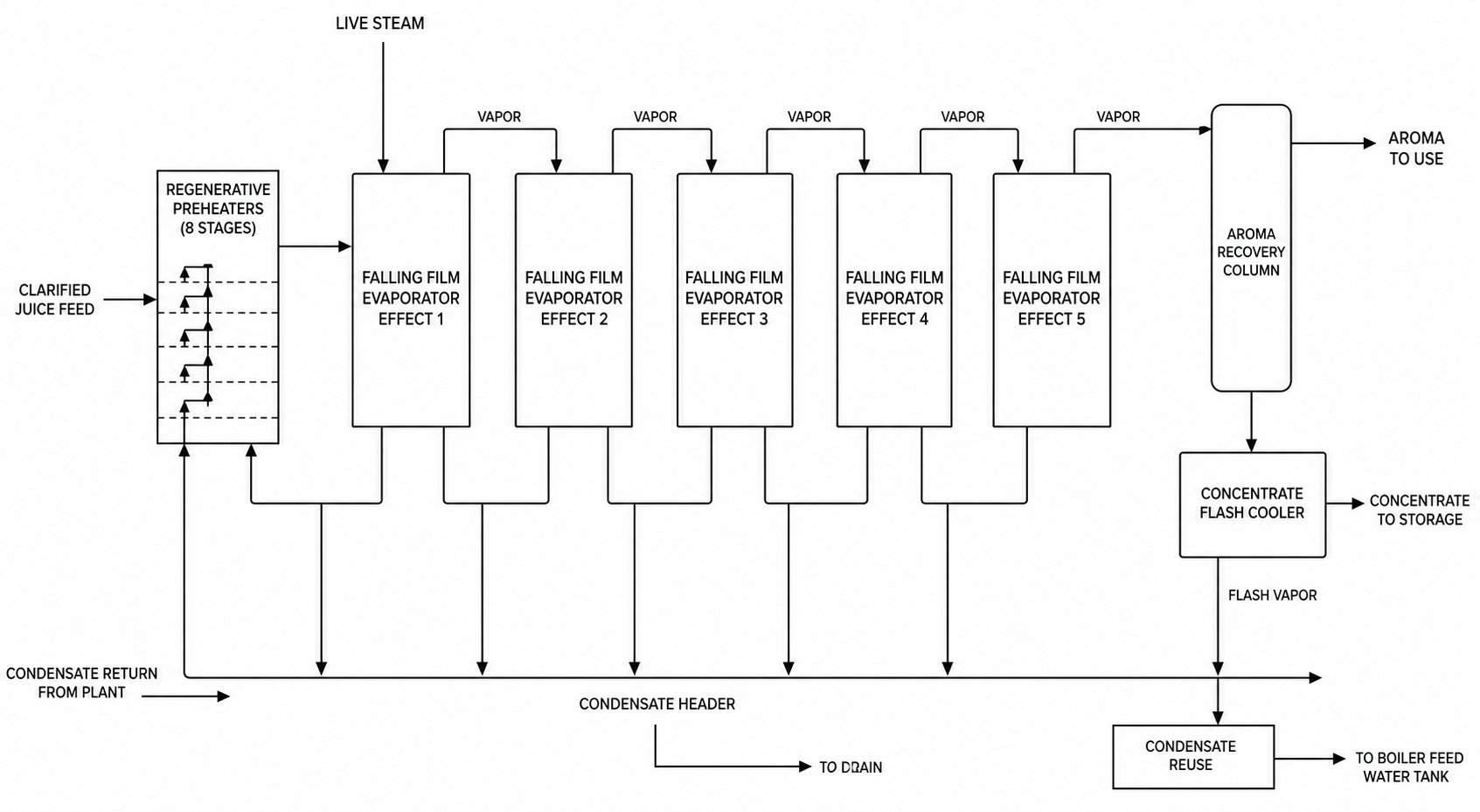
Clarified apple juice from upstream pressing, enzyming and filtration is preheated regeneratively — recovering heat from outgoing condensate and concentrate — and enters the first effect of the five-effect train. Each effect operates at successively lower temperature and pressure; each boils on the vapor of the one before, so the steam demand is divided across the train. Eight concentration stages distributed across the five effects give the operator a fine-grained concentration ladder: juice steps up in small Brix increments, stage by stage, from roughly single-strength toward the 70 Brix-class concentrate that ships.
Falling-film bodies carry the duty. Apple juice in the early stages is a thin, foaming-prone liquid that wets and evaporates cleanly; through the middle stages viscosity climbs with sugar concentration, and the film distribution system — the precision component of any falling-film juice evaporator — keeps the tubes uniformly wetted to the final concentration. Vacuum on the later effects holds boiling temperatures low precisely where the juice is most sugar-heavy and most heat-vulnerable.
Aroma recovery is integrated at the head of the train: volatile esters driven off in the first effect are condensed in an aroma recovery column and re-blended into the concentrate or sold as essence. Finished concentrate is flash-cooled and routed to cold storage or aseptic filling. Condensate from the effects — the great majority of the feed, in a juice plant — is recovered hot and clean, and reused for fruit washing and CIP.
Equipment Configuration
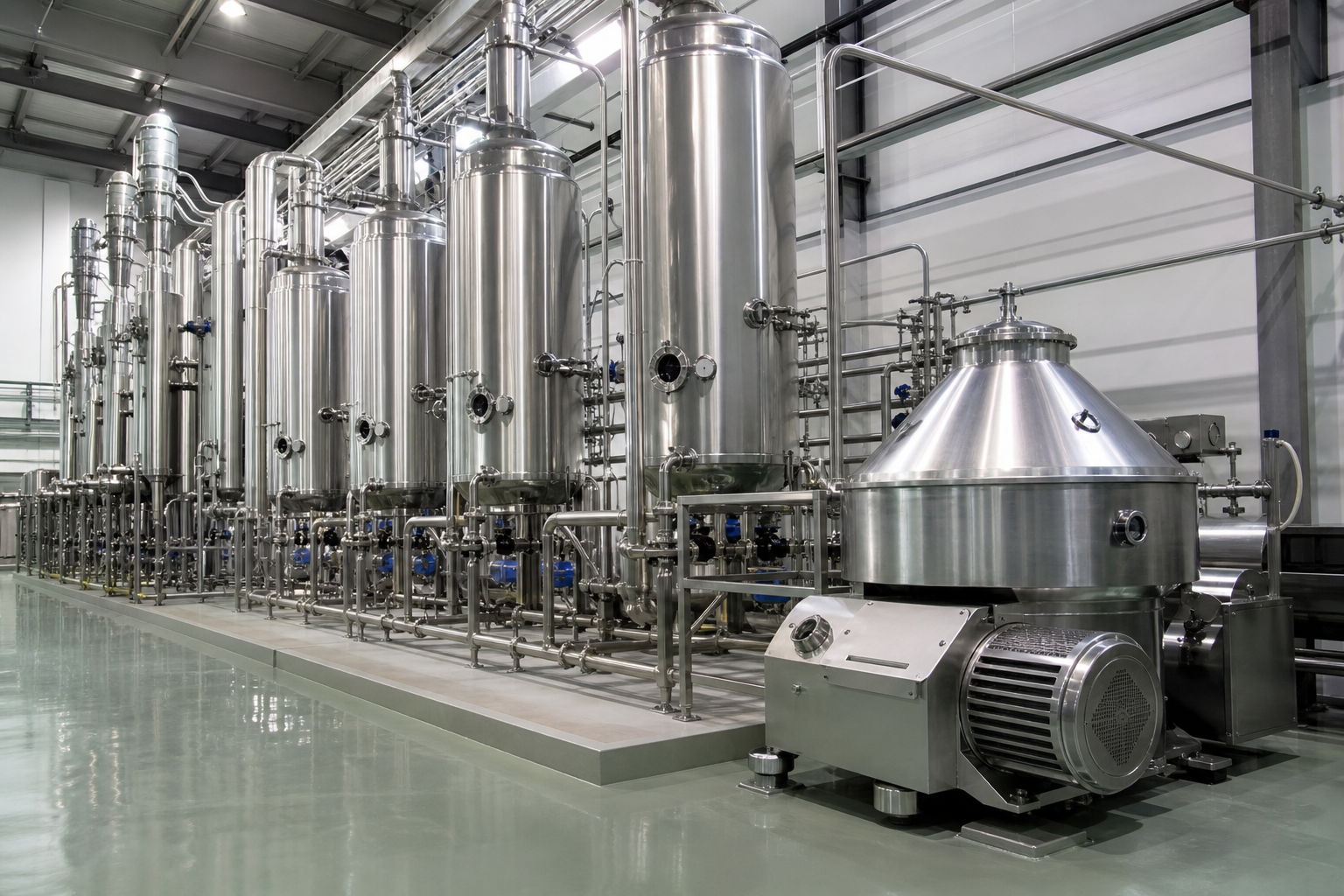
One set of the following equipment is typical for this duty:
- Clarified juice feed with regenerative preheating against condensate/concentrate
- Five-effect falling-film train with eight concentration stages, vacuum system
- Aroma recovery column on first-effect vapor with essence handling
- Concentrate flash cooling, cold storage and aseptic filling interface
- Condensate collection and reuse for washing/CIP; food-grade CIP system
- PLC control of stage temperatures, vacuum and concentrate Brix
SS316L with food-grade surface finish is the reference construction for all product-contact surfaces.
Performance & Outcome
Compiled from published industry project data, indicative: trains of this class concentrate apple juice at 50 t/h on five-effect steam economy with an eight-stage gentle concentration path, aroma recovery and pale-color operation. Steam per tonne of water and final Brix are quoted per project.
The underlying design logic is summarized in Food and Beverage Evaporation Solutions.