Project Parameters
| Parameter | Value |
|---|---|
| Process route | MVR evaporation + Na2SO4–NaNO3 separation + freezing stage |
| Industry | Non-ferrous smelting / flue gas treatment (hydrometallurgy) |
| Feed type & key components | Flue gas treatment wastewater: Na2SO4 15–20%, NaNO3 1–3%, NaNO2 <0.5%, Na2SO3 <0.5%, trace chloride; 100 t/d at 5 t/h design feed |
| Evaporation capacity | 4 t/h + 0.5 t/h MVR duties, with 1 t/h freezing system |
| Construction materials | TA2 titanium wetted parts |
Representative process configuration compiled from published industry project data. Indicative values, not a process guarantee.
Project Description
A smelting site in East China operates a flue gas cleaning system whose wash liquor accumulates a characteristic salt load: sodium sulfate dominant at 15 to 20 percent, sodium nitrate at 1 to 3 percent from NOx capture, sodium nitrite and sulfite as minor species, and a trace of chloride. The brine cycles under a zero discharge requirement, and its two main salts have different markets — sulfate toward the industrial sodium sulfate standard, nitrate toward the industrial nitrate standard — so separation, not concentration, is the duty.
The reference configuration is a 4 t/h + 0.5 t/h two-train MVR system with a 1 t/h freezing stage, in TA2 titanium. The split duties exist because the two salts want different process environments: evaporation to reach the sulfate window, a smaller polishing duty, and cold crystallization to finish the nitrate side of the separation.
Process Technology
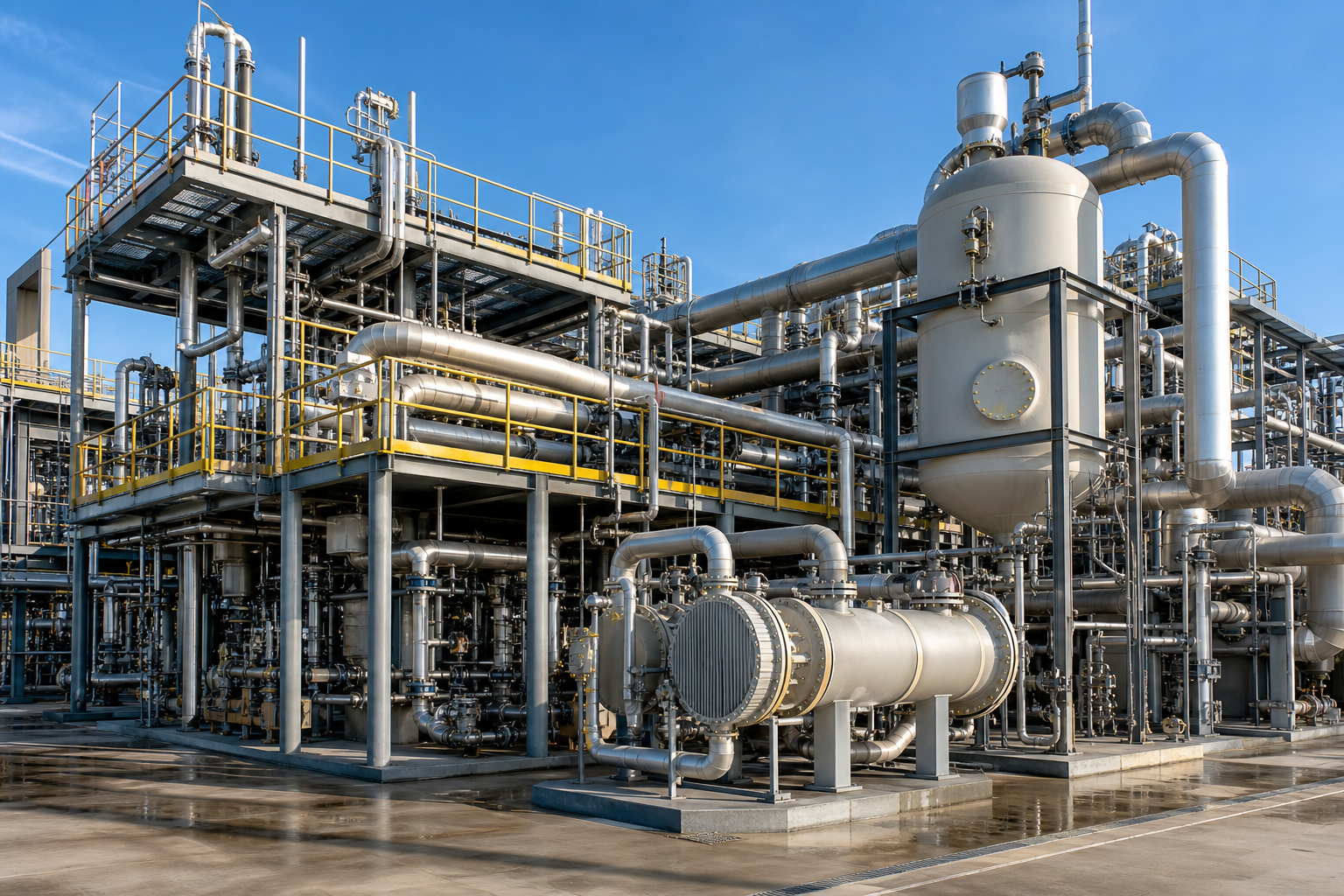
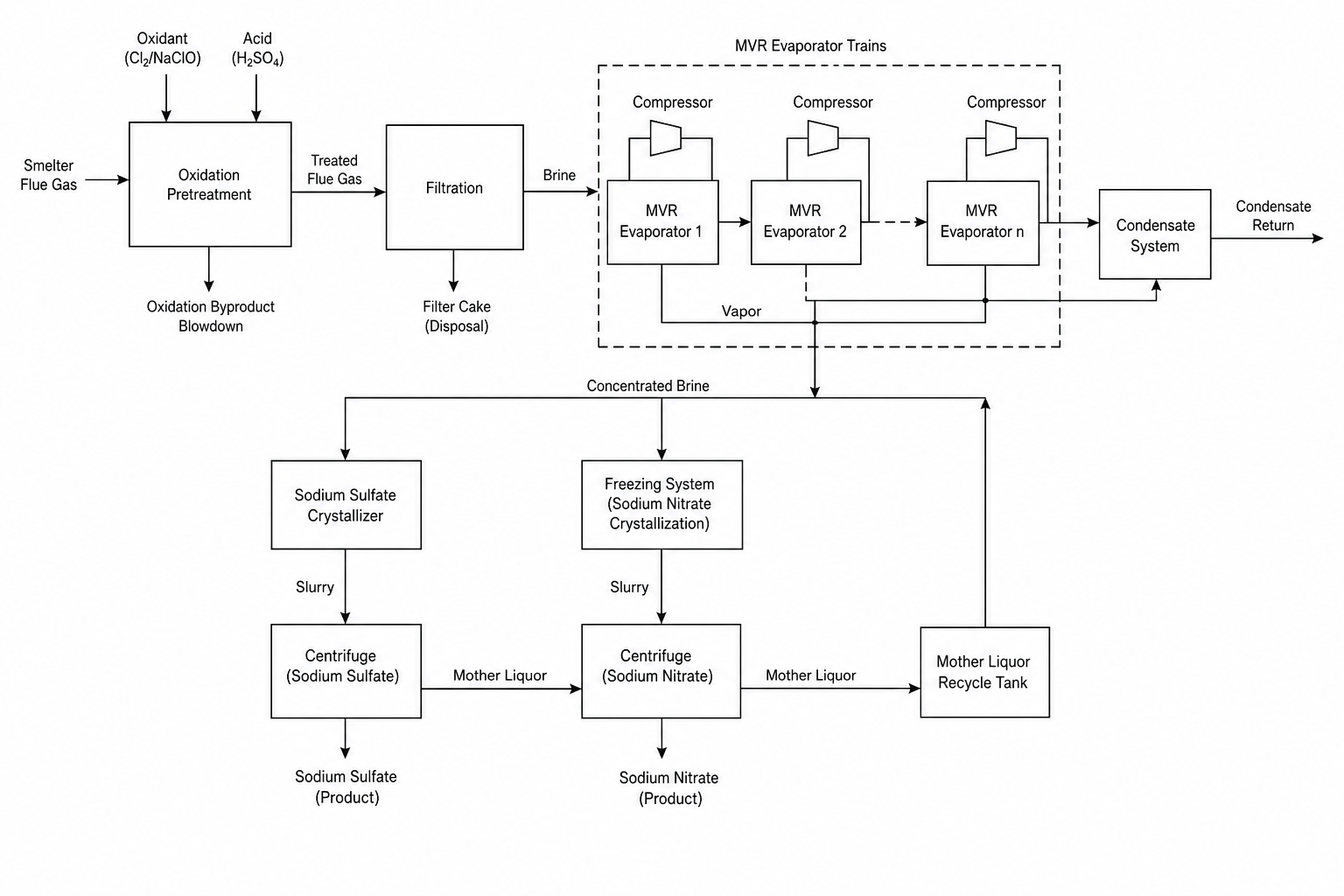
The feed is conditioned first: the sulfite and nitrite species are oxidized so that the sulfur and nitrogen inventories arrive at crystallization in their stable forms, and solids are filtered out. The brine then enters the 4 t/h MVR train, which concentrates on recompressed secondary vapor through the sodium sulfate crystallization window.
Sodium sulfate, at its dominant concentration with its strong temperature-dependent solubility, crystallizes through the combined effect of water removal and temperature control; the sulfate slurry is centrifuged and washed, delivering in the reference class an anhydrous product above 98 percent purity meeting the GB/T 6009-2014 class-II first-grade standard. The nitrate-bearing mother liquor, now relatively enriched, passes through the 0.5 t/h section and the 1 t/h freezing system, where cooling crystallization drives sodium nitrate out of solution to its own product standard — in the reference class above 98 percent against the industrial sodium nitrate standard.
Mother liquors recycle under purge control so the trace chloride never accumulates to corrosive or product-degrading levels; condensate returns to the flue gas system. Treatment cost in the reference class runs around 110 RMB per ton of water — the cost of a two-salt separation with oxidation pretreatment on a feed whose valuable fraction is the minority salt.
The oxidation step at the front of the train looks minor on the flowsheet and is not. Sodium sulfite and sodium nitrite, if carried into crystallization unconverted, contaminate both salt products with unstable species — salts that discolor, cake and complicate the product analysis. Oxidizing the sulfur and nitrogen to their stable sulfate and nitrate forms before evaporation means the crystallizers work on a fixed chemistry instead of a shifting one, and the product certificates stay valid through storage. It also protects the freezing stage, where sulfite carry-over would upset the nitrate crystallization window the stage exists to exploit.
Equipment Configuration
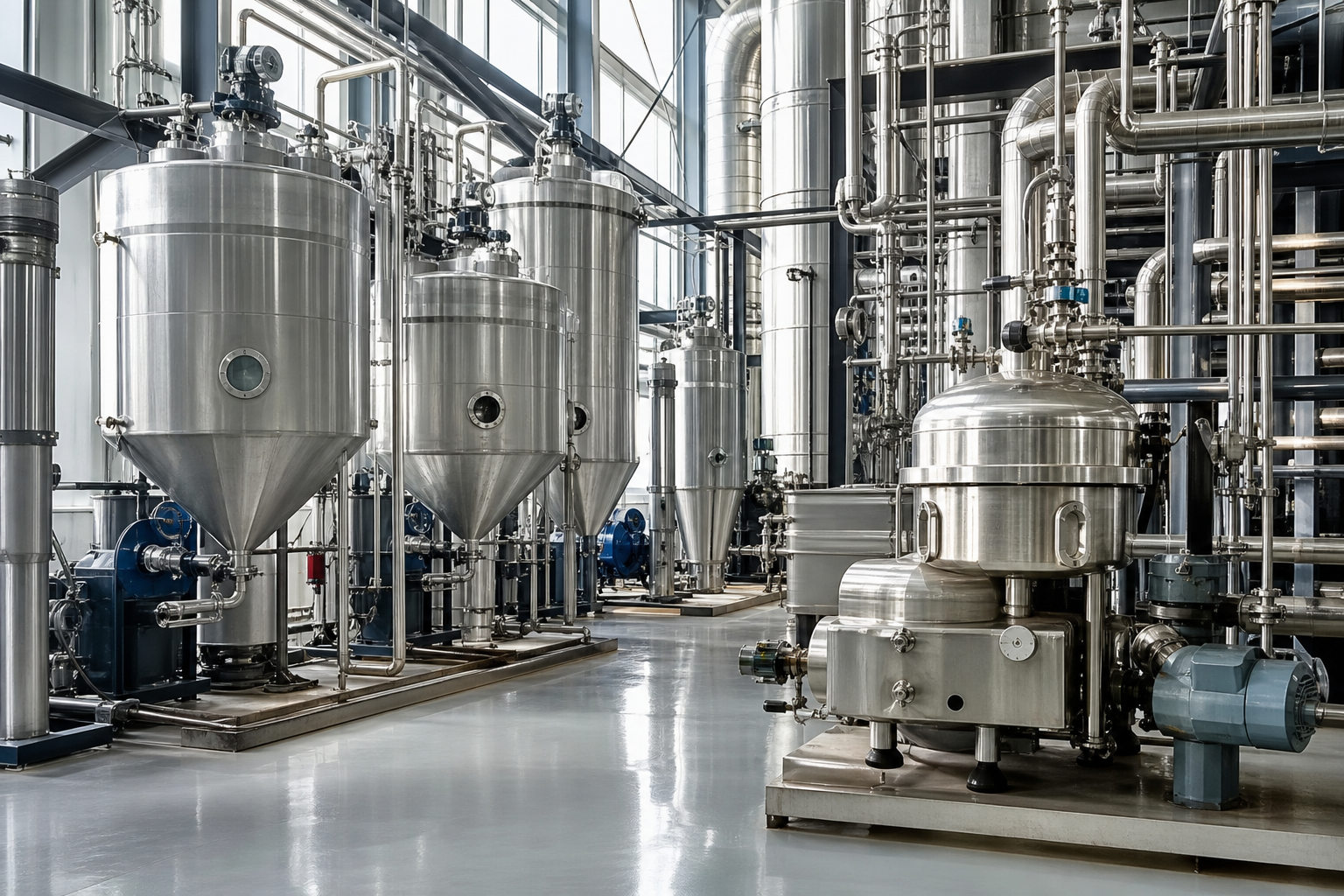
One set of the following equipment is typical for this duty:
- Feed conditioning with sulfite / nitrite oxidation and solids filtration
- MVR evaporator trains (4 t/h + 0.5 t/h) with mechanical vapor recompressor, TA2 wetted parts
- Sodium sulfate crystallization section with centrifuge and washing
- Freezing system (1 t/h) for sodium nitrate cold crystallization with its own dewatering
- Mother-liquor recycle and purge control for trace chloride management
- Condensate return to the flue gas circuit; PLC control of stage densities and the freezing profile
Performance & Outcome
Compiled from published industry project data, indicative: systems of this class separate flue gas treatment brine into anhydrous sodium sulfate above 98 percent (GB/T 6009-2014 class-II first grade) and sodium nitrate above 98 percent to its industrial standard, at treatment costs around 110 RMB per ton of water in the reference class. Salt grades depend on the sulfate-to-nitrate ratio of the actual feed and are validated per project.