
Project Parameters
| Parameter | Value |
|---|---|
| Process route | Double-effect falling-film evaporation under vacuum |
| Industry | Chlor-alkali and general chemicals — caustic soda concentration |
| Working medium | Sodium hydroxide solution |
| Concentration duty | 32% NaOH → 50% NaOH |
| Design feed / discharge | 4,360 kg/h feed / 2,760 kg/h product |
| Heat source | 160 °C saturated steam |
| Design pressure / temperature | 10 barg / 180 °C |
| Construction materials | Nickel heating tubes; carbon steel shells |
Representative process configuration compiled from published industry project data. Indicative values, not a process guarantee.
Project Description
Caustic soda leaves the chlor-alkali cell at about 32% and the market buys it at 50% — and between those two numbers sits one of the most demanding routine duties in the chemical industry. The published design configuration behind this case covers it with a double-effect falling-film evaporator: 4,360 kg/h of 32% NaOH in, 2,760 kg/h of 50% NaOH out, evaporating roughly 1.6 tonnes of water per hour on 160 °C saturated steam, designed for 10 barg and 180 °C service.
What sets caustic concentration apart from every other duty in this catalog is corrosion mechanics. Hot concentrated sodium hydroxide attacks standard austenitic stainless steel — caustic stress corrosion cracking and general dissolution both accelerate with concentration and temperature — which is why the published design specifies nickel for the internal heating tubes and carbon steel for the external structure: nickel tolerates the liquor, carbon steel carries the mechanical load, and the material bill is spent only where the liquor actually touches.
Process Technology
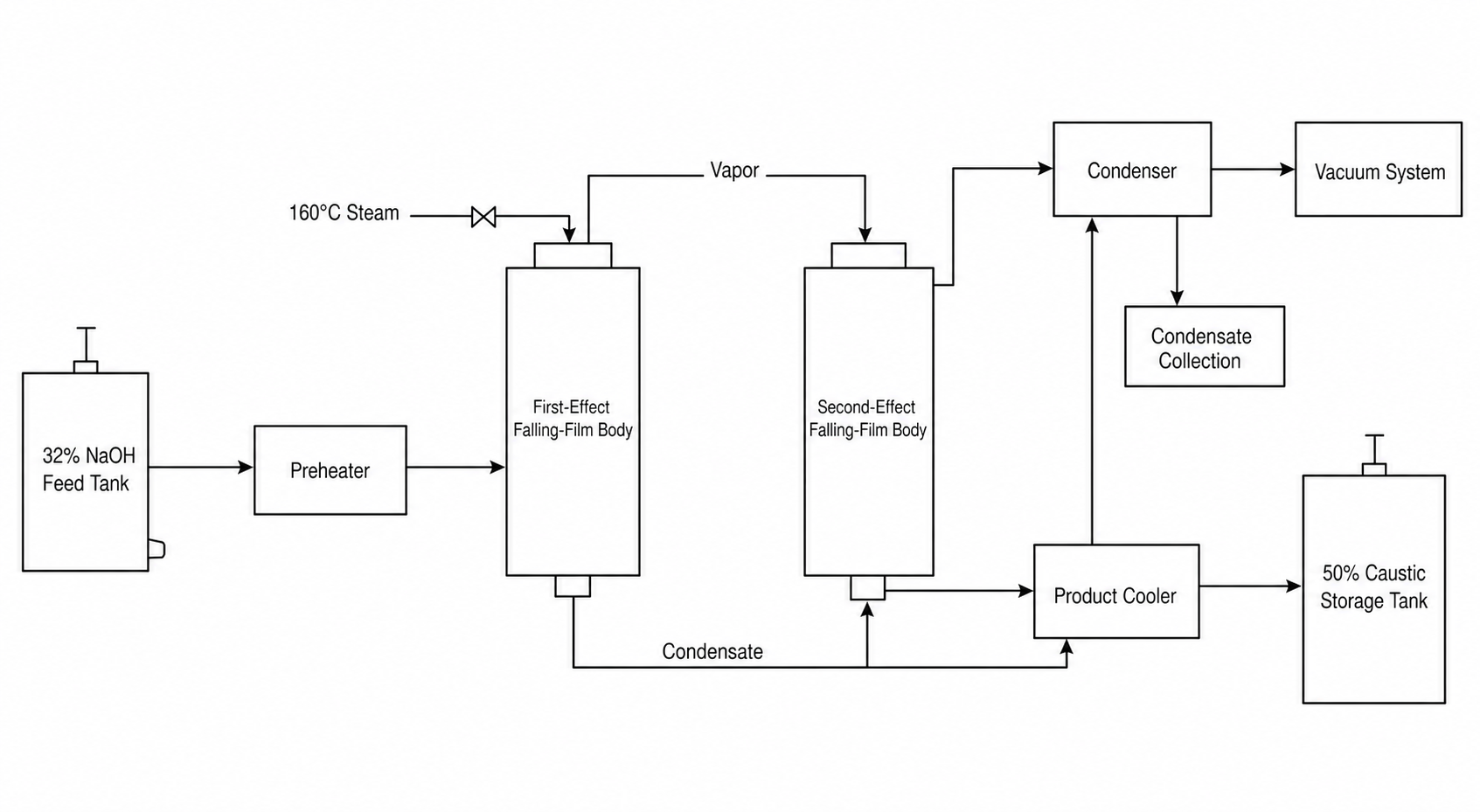
The 32% feed preheats against product and condensate — energy discipline starts before the first effect — and enters the first-effect calandria, where 160 °C saturated steam raises the liquor to its first boiling stage under the train’s pressure profile. Falling-film geometry serves caustic well: the liquor descends the nickel tubes as a thin film with high heat-transfer coefficients at modest temperature difference, which matters when the heating surface itself is an expensive alloy and every square meter is capitalized cost.
First-effect vapor becomes the second-effect heat source: the liquor from the first effect transfers to the second body, which boils at lower temperature and pressure on its predecessor’s vapor, concentrating to the final 50% specification. Second-effect vapor condenses against the condenser under the vacuum system’s pull — vacuum operation holds the liquor temperatures down through the chain, easing the corrosion burden that rises steeply with temperature, and the evaporation temperature can be selected against the client’s steam and cooling-water conditions per the published proposal.
The 50% product leaves the second effect, gives up its sensible heat to the incoming feed, and moves to cooled storage — 50% caustic freezes near ambient temperature, so product handling is part of the plant, not an afterthought. Condensate from both effects collects as clean hot water; on a chlor-alkali site it is a valuable brine-plant stream.
The published design accounts for the balance of the machine class: the injection hot-vapor pump (thermocompressor) as an energy-saving option, self-control or manual control modes per client preference, and continuous feed with continuous discharge as the operating regime. Design pressure of 10 barg and design temperature of 180 °C frame the mechanical envelope for the steam side of the system.
Equipment Configuration
One set of the following equipment is typical for this duty:
- Preheater recovering product and condensate heat
- Double-effect falling-film evaporator bodies — nickel tubes, carbon steel shells
- Condenser and vacuum system on the second effect
- Product cooling and 50% caustic storage forwarding
- Automated control system with continuous feed / continuous discharge
- Optional thermocompressor (injection hot-vapor pump) for further steam economy
Performance & Outcome
Compiled from published industry project data, indicative: double-effect trains of this class concentrate 32% NaOH to 50% at 4,360/2,760 kg/h feed/product rates on 160 °C saturated steam, with nickel-tube corrosion allowance and vacuum-side temperature selection. Steam rate and materials scope are quoted per project.


