Project Parameters
| Parameter | Value |
|---|---|
| Process route | Multi-effect evaporation: steeping-water concentration + syrup evaporation trains across the wet-milling complex |
| Industry | Corn wet milling — starch and sweeteners |
| Plant capacity | 300 TPD corn starch; 100 TPD glucose line; 120 TPD fructose line |
| Feed types | Corn steeping water; glucose syrup; fructose syrup |
| Region | Indonesia (Southeast Asia) |
Representative process configuration compiled from published industry project data. Indicative values, not a process guarantee.
Project Description
An integrated corn wet-milling complex does three things with the same kernel: it steeps it, mills the starch out, and — when the complex runs the full sweetener scheme — converts part of that starch through saccharification and isomerization into glucose and fructose syrups. The published project behind this configuration is such a complex in Indonesia: 300 tonnes per day of corn starch, a 100 TPD glucose line and a 120 TPD fructose line, with evaporation duty spread across every stage.
Two evaporation personalities coexist in this kind of plant. Steeping-water concentration is the heavy, fouling, protein-and-mineral-laden duty — the steep liquor becomes corn steep liquor, a saleable feed and fermentation ingredient, but only if the concentration train tolerates what the steeping process dissolves. Syrup evaporation is the gentle, food-precise duty: glucose and fructose liquors concentrated to market or downstream brix under low thermal exposure. One complex, two evaporation cultures; the published scope covers both.
Process Technology
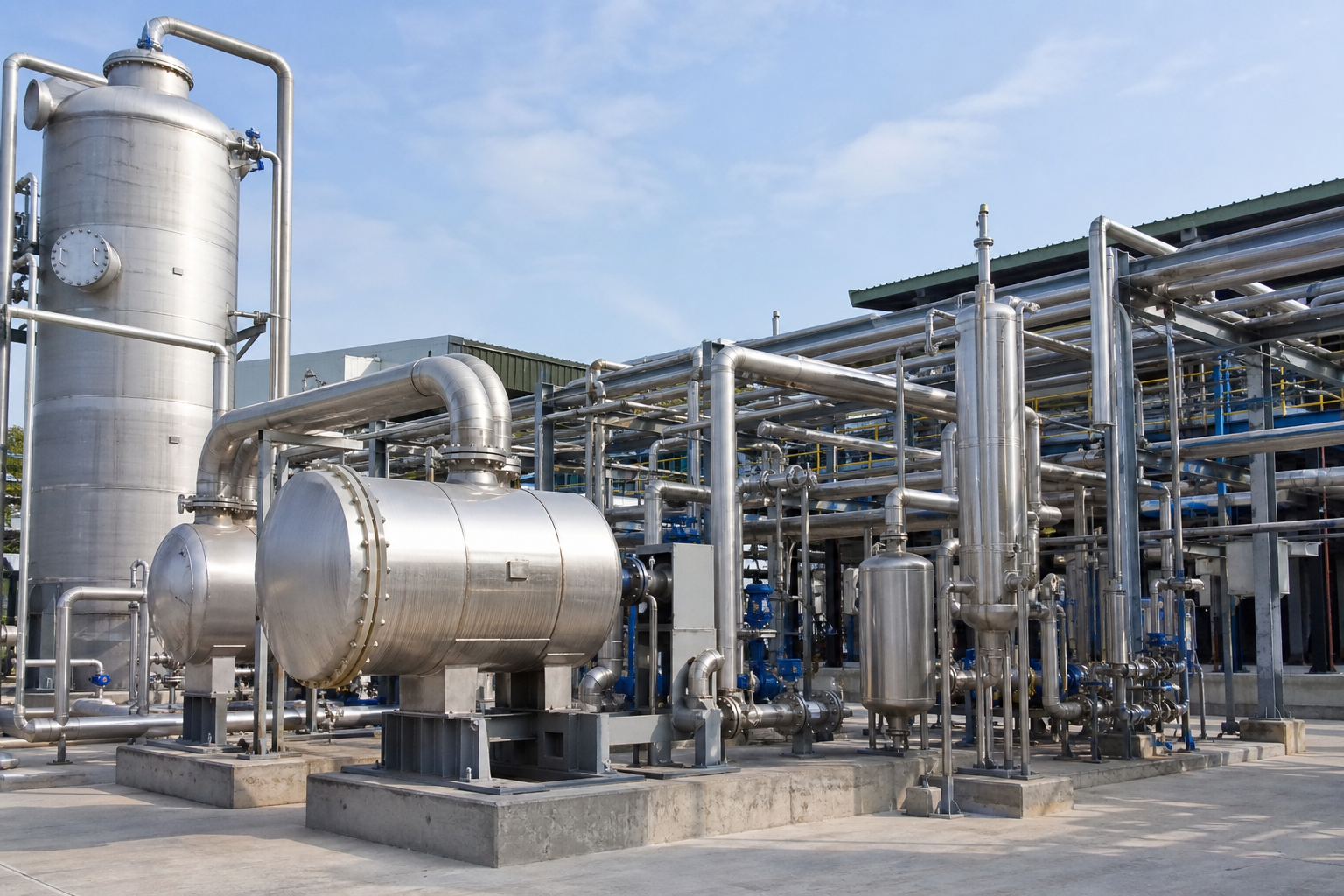
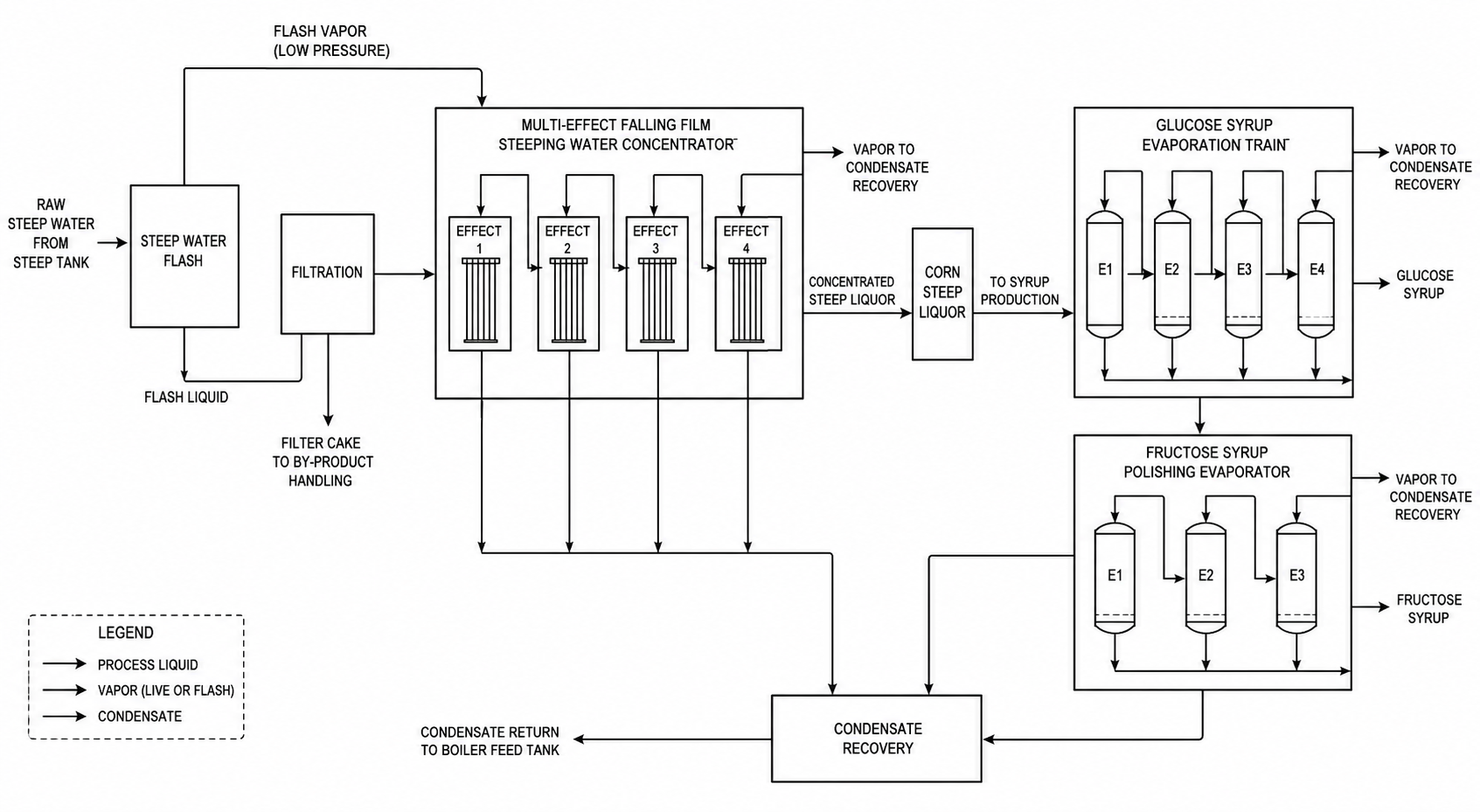
Steeping water from the steep battery is flashed free of SO2 traces and filtered, then concentrated in a multi-effect falling-film train. The steep liquor’s proteins, sugars and minerals raise boiling point and viscosity together, so the train runs under vacuum at low temperature difference with generous distributor capacity and planned CIP — the standard engineering for a duty that will foul if it is allowed to dwell. The product, concentrated corn steep liquor, ships as a feed ingredient and fermentation nutrient.
The glucose-side syrup train concentrates refined saccharified liquor toward the glucose line’s product brix or toward the isomerization feed. Falling-film evaporation at low temperature lift protects the syrup’s color; multi-effect heat economy matches the steam picture of a wet mill, where the boiler house also serves starch drying. Condensate from the clean effects returns to the steep and washing circuits — a wet mill is one of the most water-hungry food plants, and every clean tonne of condensate is steep make-up water it does not have to draw.
On the fructose side, the train concentrates the isomerized high-fructose syrup to product specification. Fructose syrup is the most color-sensitive liquor in the complex: the evaporation runs at the lowest practical temperature difference, with residence time minimized in both the heater and the separator, and the final density is controlled inline against the filling or storage specification.
Across all trains the engineering signature is the same: multi-effect heat integration sized to the complex’s steam balance, vacuum operation in the food window, segregated condensate by cleanliness class, and CIP between grades. The published scope describes the evaporation blocks engineered inside the wider starch-sweetener complex — one supplier’s engineering across steeping, glucose and fructose duties.
Equipment Configuration
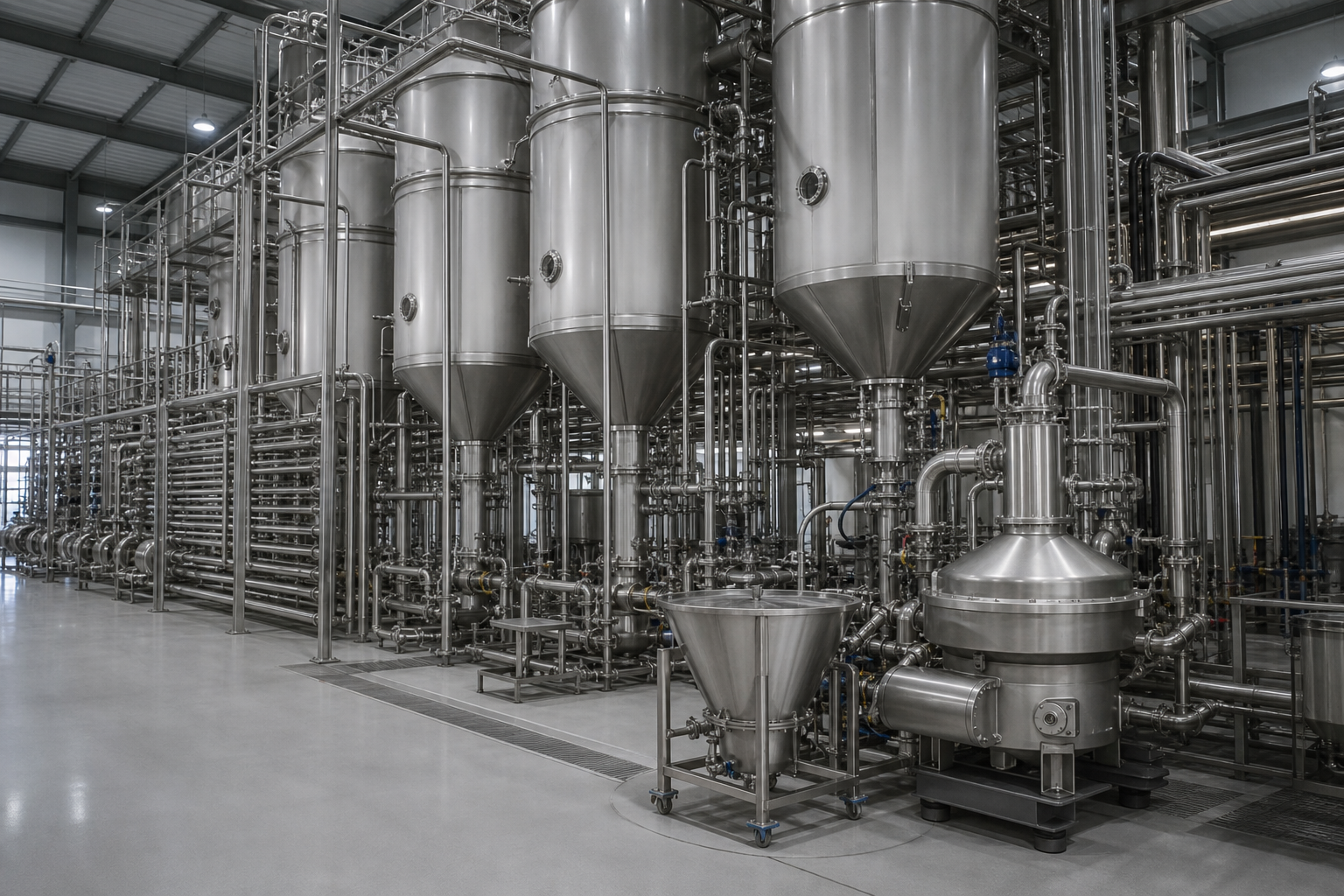
One set of the following equipment is typical for this duty:
- Steep-water flash degassing and filtration ahead of the CSL train
- Multi-effect falling-film steeping-water concentrator for corn steep liquor
- Glucose syrup multi-effect falling-film evaporation train
- Fructose syrup polishing evaporator at low temperature difference
- Surface condensers, vacuum system and segregated condensate headers
- Inline density control on syrup discharge; CIP systems for food-grade changeovers
Performance & Outcome
Compiled from published industry project data, indicative: evaporation blocks of this class serve wet-milling complexes in the 300 TPD starch range with glucose and fructose lines attached, concentrating steep water to CSL product and syrups to specification brix on multi-effect steam economy. Per-train evaporation duties are quoted per project balance.