Project Parameters
| Parameter | Value |
|---|---|
| Process route | MVR triple-effect evaporation — forced falling-film |
| Industry | Inorganic chemicals / rare earth processing by-products |
| Feed type & key components | Calcium chloride wastewater (CaCl2-rich liquor) |
| Evaporation capacity | 81 t/h water removal |
| Construction materials | SS316L / duplex on chloride service (indicative) |
Representative process configuration compiled from published industry project data. Indicative values, not a process guarantee.
Project Description
An industrial site in Baotou, Inner Mongolia — in the heart of the region’s rare earth and steelmaking cluster — discharges a calcium chloride wastewater generated by the neutralization and conversion chemistry of its processing circuits. Calcium chloride liquors are the awkward guest of industrial brines: extremely corrosive to ordinary stainless steels, thick with a boiling point elevation that climbs as concentration rises, and hygroscopic as a product, yet genuinely valuable as feedstock for calcium chloride flake and solution products used in de-icing, dust control and construction. The site’s program is a large 81 t/h concentration train that turns the wastewater into the feed liquor for calcium chloride recovery.
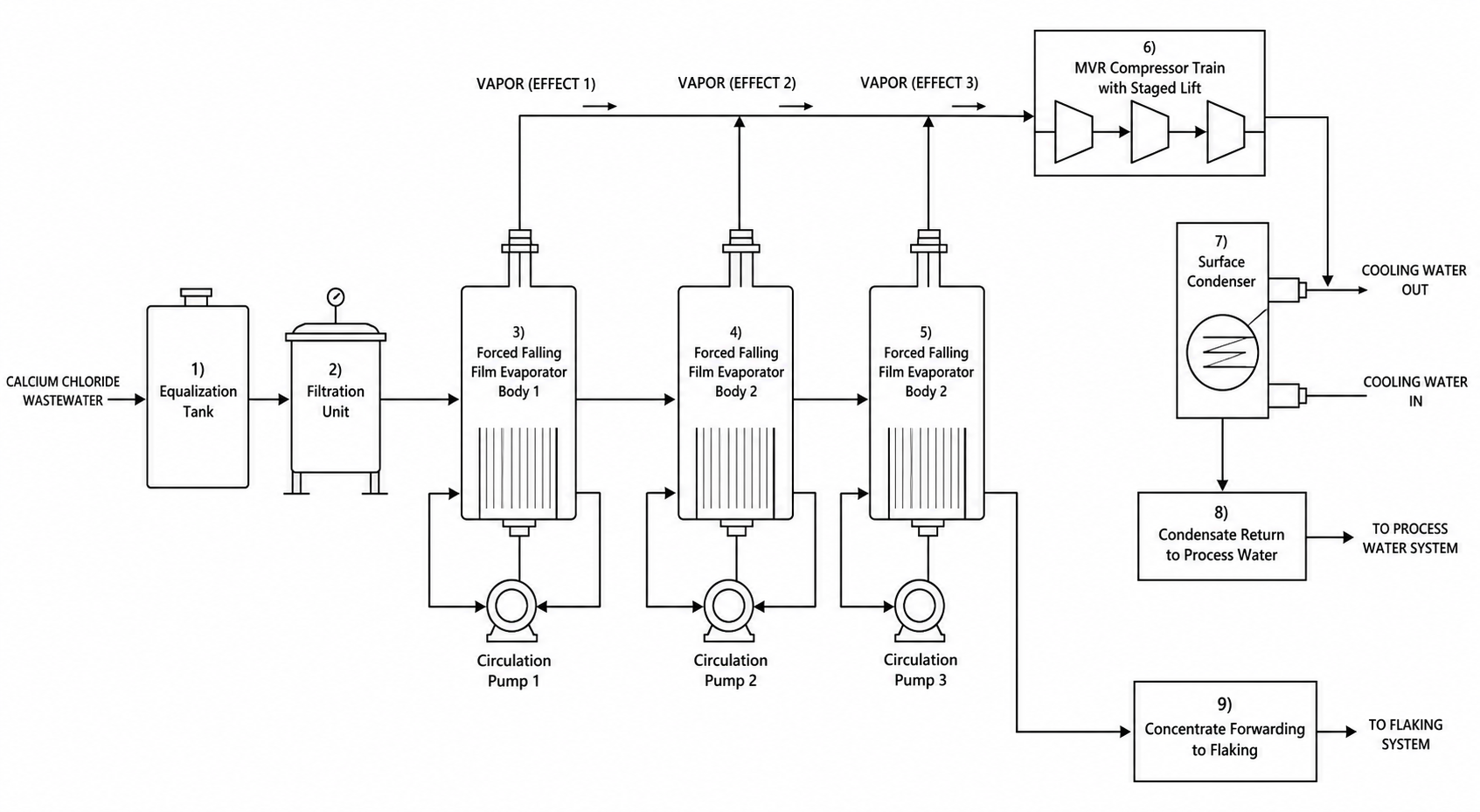
The reference configuration is an MVR triple-effect forced falling-film evaporation train. The choice couples two ideas: triple-effect staging under MVR service holds the energy cost down across a large single duty, and forced falling-film bodies are the answer to calcium chloride’s specific difficulties — high viscosity and a boiling point elevation that punish naive designs.
Process Technology
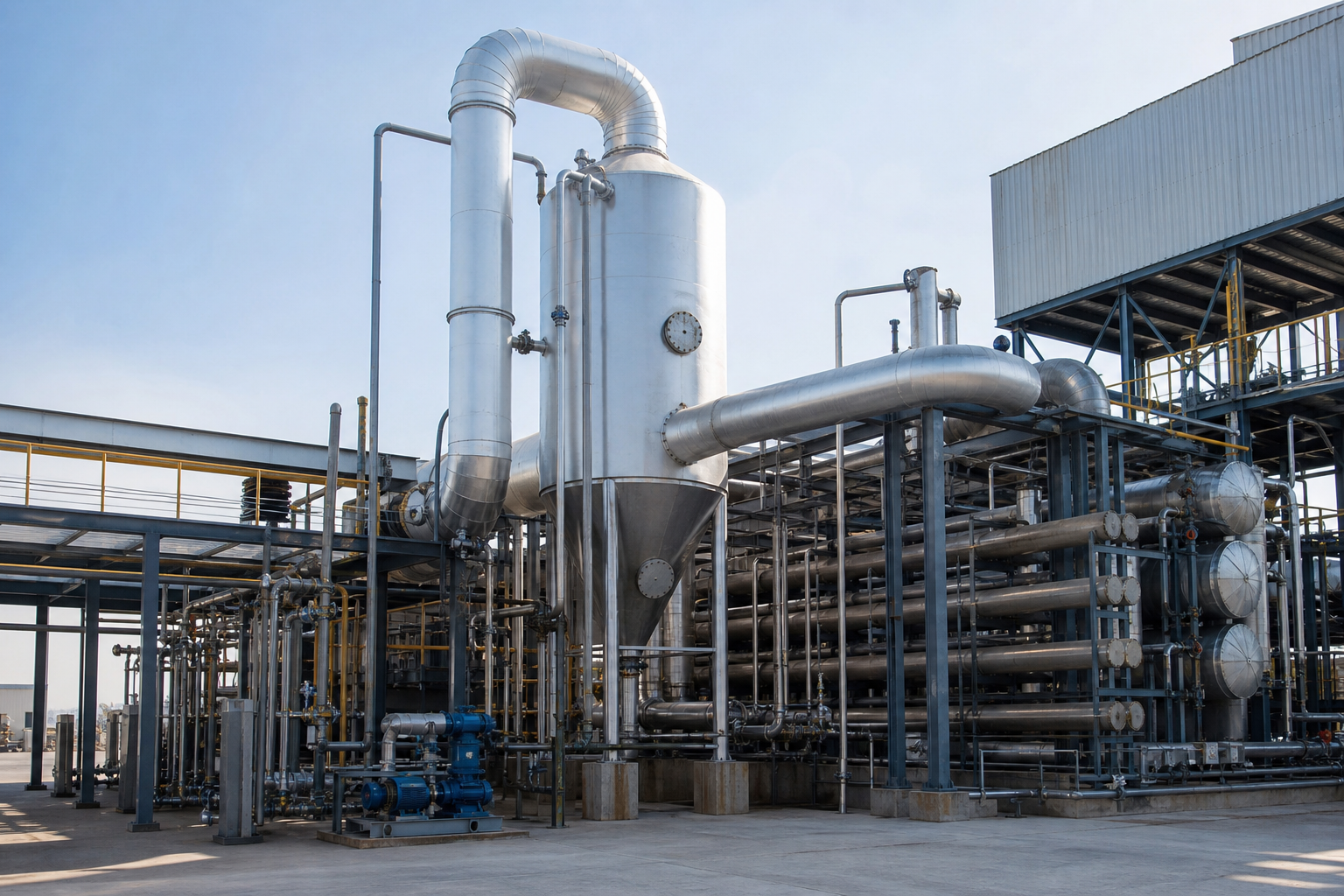
The wastewater is equalized and filtered — calcium liquors carry suspended hydroxide and carbonate fines that must not reach the heat transfer surfaces — and preheated against outgoing streams before entering the first effect. The three effects operate in a descending temperature ladder under vacuum, the whole cascade driven by the MVR compressor rather than by large live-steam draws.
In each effect the liquor is pumped over the distributor and filmed down the tubes under forced circulation control. The forced film matters through the middle of the concentration range where calcium chloride viscosity climbs: gravity filming alone would slow and thicken, degrading heat transfer exactly where the duty is hardest, while the forced pattern sustains velocity and wall shear. The boiling point elevation of concentrated CaCl2 — tens of degrees at commercial strengths — is paid for in compressor lift and effect temperature allocation, which is why the MVR staging is engineered as a set rather than a single body: distributing the lift across three effects keeps each compressor stage in an efficient operating band.
Concentrate leaves the third effect at the strength the downstream recovery route requires — feed to flaking and solid calcium chloride production, or sale-strength solution for offtake. Condensate from the surface condenser is recovered and returned to the site’s process water circuit; on the water-scarce Inner Mongolia steppe, 80 t/h class condensate recovery is a utility stream the plant counts in the project’s favor alongside the product.
Equipment Configuration
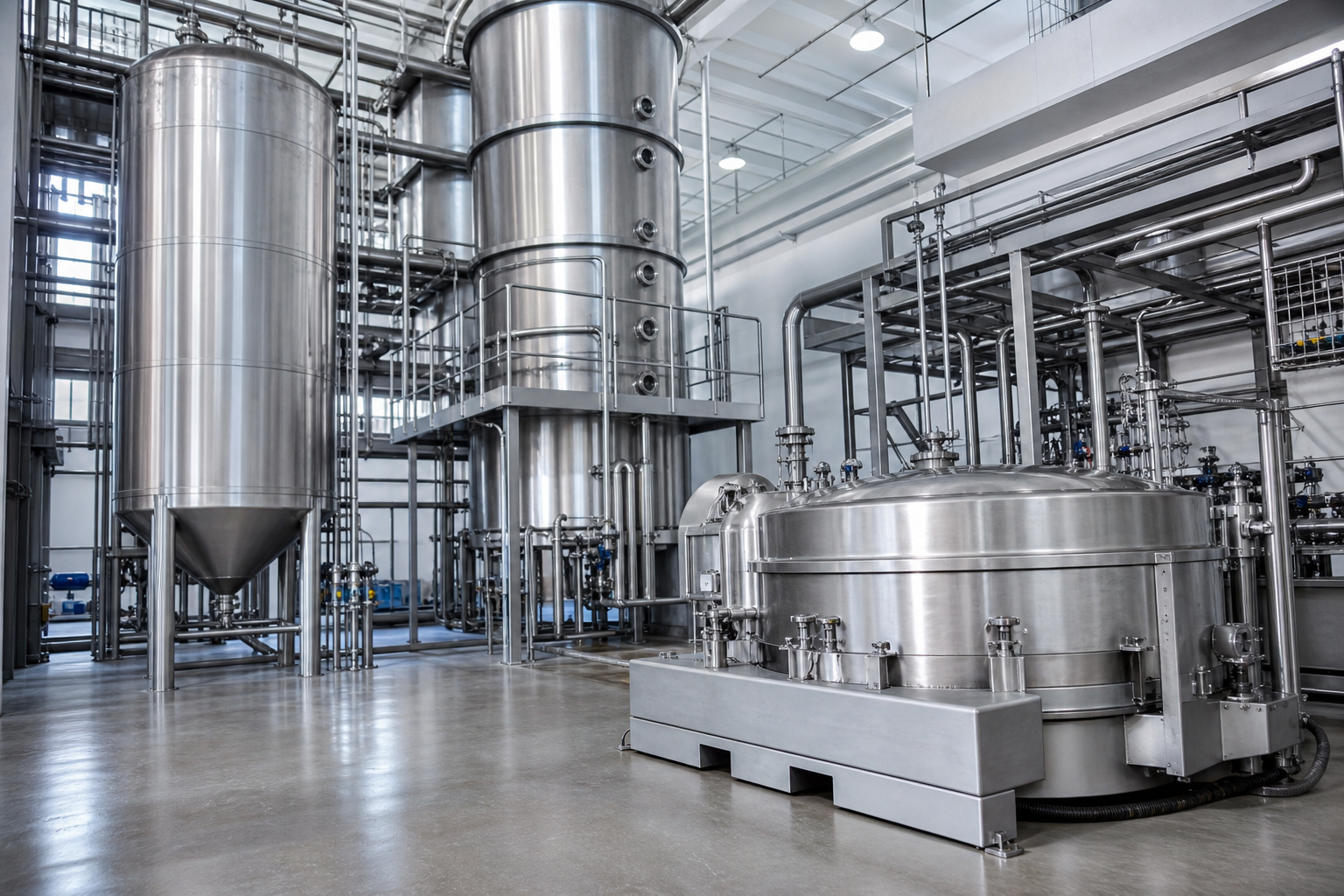
One train of this class comprises:
- Equalization and filtration for hydroxide and carbonate fines control
- Triple-effect forced falling-film bodies with circulation pumps, distributors and demisters
- MVR compressor train with anti-surge and variable-frequency control across the staged lift
- Concentrate forwarding to flaking or solution offtake with density control
- Surface condenser, condensate tank and return to process water circuits
- Section-wise temperature and density control with CIP between campaigns
SS316L with duplex upgrades is the indicative metallurgy; hot, concentrated calcium chloride is among the more demanding chloride services and material selection is confirmed per section against the concentration profile.
Performance & Outcome
Compiled from published industry project data, indicative: MVR triple-effect trains of this class concentrate calcium chloride wastewater at capacities around 80 t/h water removal to recovery feed strength, with condensate returned to process water circuits and the calcium chloride values retained as product feed. Steam and power figures, final concentration and material guarantees depend on feed strength and product route and are quoted per project.