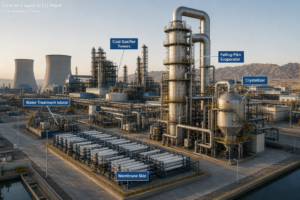
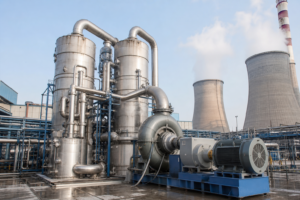
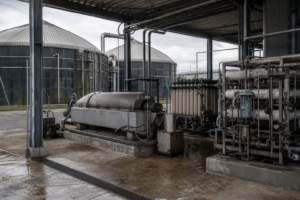
Concentrating calcium chloride is a battle against boiling point elevation and viscosity: a CaCl2 liquor that behaves politely at 35% turns progressively harder to evaporate as it climbs toward 68–70%, where flake production requires it to end up. The industrial answer – documented in published vendor cases such as a hybrid system reported for an Algeria installation – is a staged configuration: MVR or multi-effect evaporation up to roughly 35–50%, double-effect forced circulation for the mid-range to about 55–60%, and a dedicated single-effect falling film finisher — supplied with higher-pressure steam — for the final push to 68% and beyond. One correctly dimensioned hybrid train takes a 35% by-product liquor to either approximately 55% for spherical products or ≥68% for flakes, with markedly lower steam consumption than any single-technology design.
Where Calcium Chloride Liquors Come From
Most merchant calcium chloride begins as a by-product stream. In chlor-alkali and chemical parks, waste hydrochloric acid is neutralized with limestone, then filtered and clarified to yield a clean solution near 35% CaCl2. Soda-ash production and other chloride-bearing neutralizations generate similar liquors. That 35% intermediate is the feedstock for every downstream product form, which is why the evaporation train — not the reaction step — usually sets the plant’s capacity, energy bill and product slate.
The commercial outputs from that single intermediate are wide:
- Commercial flake, typically 74–77% CaCl2 (dihydrate-based commercial assay) for deicing, dust control and oilfield fluids, produced by concentrating to 68–70%, cooling and flaking, then finishing in a fluidized bed.
- 94% anhydrous granules for drying, gas treatment and industrial processes, produced via spray granulation and fluidized-bed drying fed with ~50% liquor.
- Spherical dihydrate and anhydrous grades for water treatment and specialty markets, seeded from liquor concentrated to around 55%.
Scope note: this page covers the concentration-band technology selection for CaCl2 liquor; the CaCl2 granulation and soda ash integration page covers product-form granulation routes and integrated by-product plants in detail.
Why CaCl2 Concentration Punishes Naive Designs
Three physical realities dominate the flowsheet.
- Boiling point elevation (BPE). Calcium chloride solutions boil well above water at equal pressure, and the elevation grows sharply with concentration. Every degree of BPE must be paid for either as higher steam pressure or as reduced effective temperature difference in a multi-effect train.
- Viscosity climb. Above roughly 55–60%, liquor viscosity rises steeply, degrading heat-transfer coefficients and making film formation on tubes progressively harder.
- Scaling and corrosion. The chloride medium is corrosive to common steels, and localized supersaturation at heat-transfer surfaces invites scale that plugs tubes and forces cleaning outages.
Choosing the Right Technology for Each Concentration Band
Because the difficulty rises band by band, the economics do too. The table below summarizes the process strategy that experienced suppliers apply.
| Concentration Range | Recommended Process | Typical Product Outcome |
|---|---|---|
| <5% → ~35% | MVR evaporator — efficient electrically driven concentration while BPE is still modest | 35% intermediate liquor feeding the multi-effect stage |
| ~35% → ~50% | Multi-effect evaporation (MEE) | ~50% liquor — ideal feed for spray granulation and fluidized-bed drying to 94% anhydrous granules |
| ~50% → 68–70% | MEE plus a single-effect finisher on higher-pressure, higher-temperature steam | 68–70% liquor, cooled and flaked, then fluidized-bed dried to commercial flake assay (typically 74–77% CaCl2) |
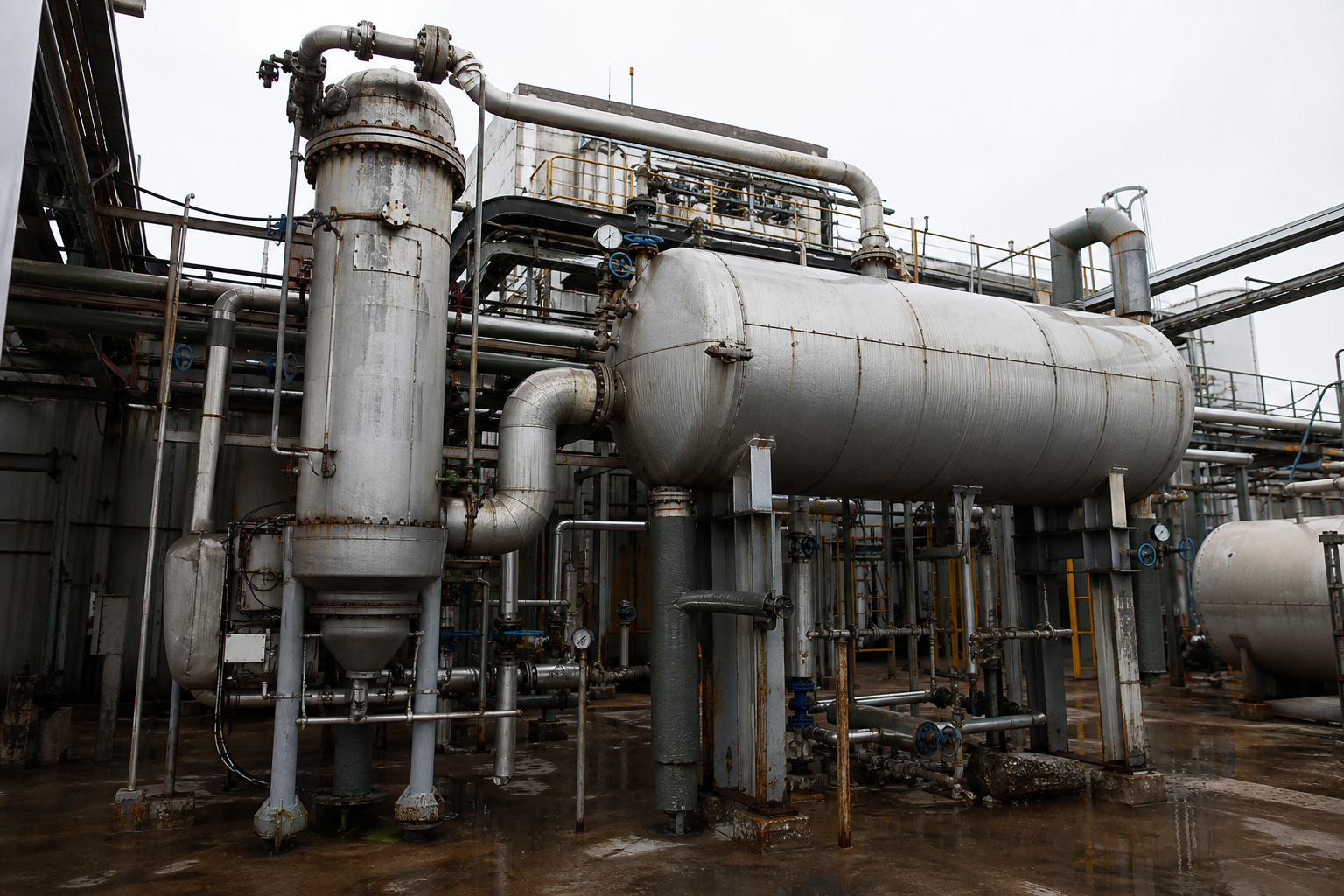
Why MVR Stops Making Sense Above ~35%
Mechanical vapor recompression is the energy-saving default while solution concentration — and therefore BPE — stays moderate. As concentration climbs past roughly 35%, the compressor must lift vapor across a much wider temperature difference. That can demand multiple compressors in series, driving up both capital and power draw until the operating-cost advantage over steam-driven multi-effect evaporation disappears. The disciplined engineering answer is to let MVR do the low-BPE work and hand the liquor to a steam system for the high-BPE finish, rather than forcing one technology across the whole range.
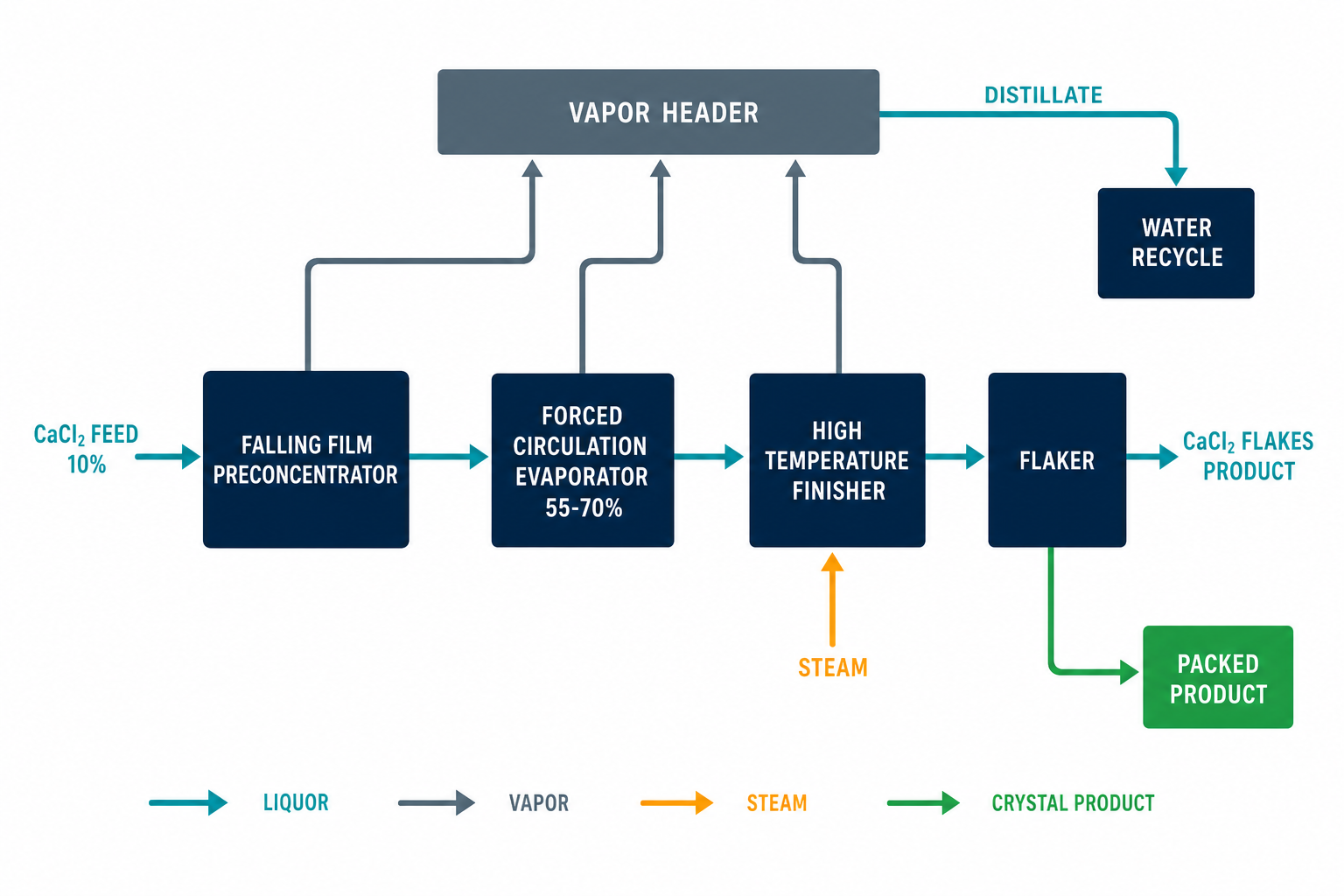
Inside the Hybrid Train: Forced Circulation Plus Falling Film Finisher
The reference hybrid configuration — an external industry reference from a published Algeria project case processing 35% feed to 55% or ≥68% products, supplier-reported and indicative – not a project guarantee — pairs two evaporator types in sequence.
Double-Effect Forced Circulation for Bulk Concentration
The front section uses double-effect forced circulation equipped with high-flow, low-head axial pumps. Circulating the liquor through the heat-exchange tubes at high velocity keeps the tube wall wetted and scouring action high, which suppresses scale formation and extends cleaning intervals substantially. In this section the liquor is concentrated to approximately 55% for spherical-product duties, or beyond 60% when flake production is the target. Forced circulation tolerates the rising viscosity and the solids that can appear in marginal feeds far better than film-type units at these concentrations.
Single-Effect Falling Film Finisher for the Final Push
Pushing from ~60% straight to 68% inside a forced-circulation body would push viscosity and supersaturation into the zone where scaling and tube blockage become routine. Instead, the hybrid route transfers the liquor to a single-effect falling film concentrator as the final stage. The falling film geometry handles the high-viscosity, high-concentration liquor gently and efficiently, with short residence time and low product temperature rise, delivering stable 68% output without the fouling spiral. This stage draws on higher-pressure steam so that an adequate temperature difference is available despite the large BPE.
The full train decomposes into standard process modules:
| Process module | Equipment candidates | Selection basis | Indicative envelope |
|---|---|---|---|
| Feed reception & clarification | Settling; polishing filters | Suspended solids and Mg/sulfate traces set scaling propensity | Per neutralization survey |
| Pre-concentration | MVR evaporator | Low-BPE band; electric drive | Below ~5% to ~35% band |
| Bulk concentration | Double-effect forced circulation, axial pumps | Viscosity and solids tolerance | ~35% to 55–60% |
| Final finishing | Single-effect falling film on higher-pressure steam | High-BPE band needs temperature difference | To 68–70% |
| Solids finishing | Flakers; spray granulation; fluidized beds | Product slate fixes the route | Per product specification |
Configuration, materials, and operating ranges for each module depend on the actual feed, temperature, pressure, corrosion review, fouling behavior, utilities, and project capacity.
Product-Linked Downstream Operations
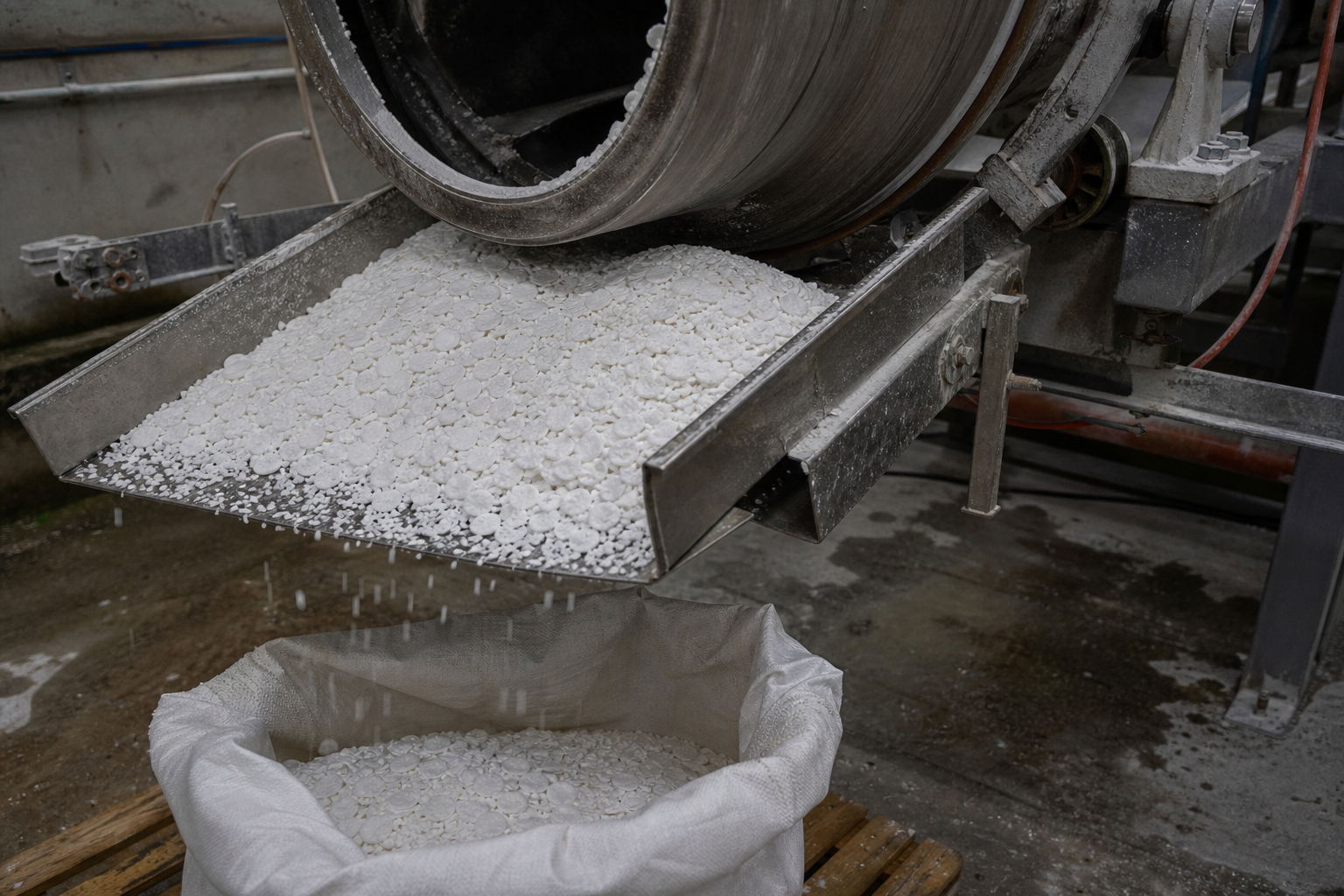
The evaporator train only earns its keep when the downstream solids systems run at specification. For flake lines, the 68–70% liquor is fed to flaking machines whose rolls cool the melt into coherent flakes, and a fluidized bed then adjusts final moisture toward the commercial flake assay — typically 74–77% CaCl2 (pure dihydrate is 75.5% CaCl2 by stoichiometry, so commercial specs straddle it with a small anhydrous fraction). For granule lines, ~50% liquor feeds spray granulation or fluidized-bed granulators; designs with a secondary fluidized bed improve particle rounding, reduce dust and recycle fines efficiently, tightening the size distribution of the 94% anhydrous product. Packaging for a hygroscopic product demands dry-air or sealed handling from the cooler to the bag.
Materials, Energy and Operability
Chloride concentration and temperature together dictate metallurgy. Lower-concentration, lower-temperature zones can run on suitable stainless grades, while the hotter, more concentrated stages justify higher alloys selected against chloride stress-corrosion behavior at the actual operating temperature. The economics of the plant live in steam consumption: multi-effect reuse means each tonne of live steam evaporates several tonnes of water across the train, and heat recovery from condensate and product streams preheats incoming liquor. Operationally, the design targets are long cleaning intervals, stable vacuum control, and turn-down that follows the by-product supply — because in most plants the CaCl2 feed arrives at whatever rate the upstream acid neutralization happens to run.
Steam System Design and Heat Integration
A hybrid train only delivers its promised steam economy when the vapor and condensate circuits are engineered as deliberately as the evaporator bodies themselves. Live steam is admitted solely to the first effect of the multi-effect section and to the finisher, where the higher pressure required by the final concentration band is available. Secondary vapor cascades effect to effect at progressively lower temperature, and the condensate from each body — hot and clean — preheats incoming 35% liquor in plate exchangers before it enters the first effect. Vacuum on the final condensing stage is sized for the non-condensables the liquor releases, because air leakage or undersized vacuum capacity shows up directly as lost temperature difference and reduced throughput. Plants that respect these details evaporate several tonnes of water per tonne of live steam across the train – an industry-reported benchmark for well-integrated multi-effect service; plants that neglect them pay for it every operating hour.
Planning a Project: From Water Chemistry to Commissioning
A reliable calcium chloride plant starts with an honest feed characterization — not just the CaCl2 assay but suspended solids, magnesium and sulfate traces, and the acidity profile of the neutralization step, all of which influence scaling propensity and materials selection. The next decisions are the product slate (flakes, granules or both, which fixes the target concentrations), the steam pressure actually available on site, and the water balance for condensate reuse. Equipment is then specified band by band: circulation pumps sized for tube velocity rather than simply for head, metallurgy matched to each temperature-and-concentration zone, and finishing equipment — flakers, granulators, fluidized beds — selected for the moisture and shape specification the market demands. Pre-shipment assembly and trial runs of critical assemblies before delivery materially shorten site commissioning, a discipline that separates plants that ramp up in weeks from those that struggle for quarters.
When This Route May Not Fit
This route is mis-specified without the right energy context. The finisher demands genuinely high-pressure steam: a site whose boiler cannot supply it, and whose electricity is cheap, has no economical path to 68–70% liquor and should not start one. Small or intermittent by-product acid streams rarely justify a hybrid train, because the feed arrives at whatever rate the neutralization step runs and the evaporator sits idle between batches. Where the goal is disposal rather than merchant product – concentrating brine only to cut hauling volume – simpler single-effect equipment or outsourced treatment is usually cheaper. And specialty grades demanding very low heavy-metal content or food-grade purity need a purification step upstream of evaporation that this train does not provide.
What Must Be Verified
Before this route is committed, verify four inputs against the actual stream. First, an honest feed characterization: CaCl2 assay, suspended solids, magnesium and sulfate traces, and the acidity profile of the neutralization step, because these set both scaling propensity and metallurgy. Second, the site energy picture – available steam pressure and temperature, electricity price, and annual utilization – which fixes where the MVR band ends and whether the finisher is viable. Third, the product slate in commercial terms: flakes, granules or both decide target concentrations and the downstream machines. Fourth, scaling behavior at temperature on the candidate surfaces, ideally from a pilot or supplier test, together with vacuum and cooling-water capacity for the non-condensables the liquor releases.
FAQ
Can an MVR evaporator concentrate calcium chloride to 68%?
Not economically. Above roughly 35% concentration, boiling point elevation rises so steeply that the compressor must deliver an impractically large temperature lift, often requiring multiple machines in series. MVR is best applied below ~35%, with steam-driven multi-effect evaporation taking over for higher concentrations.
Why combine forced circulation with a falling film finisher?
Forced circulation excels at bulk evaporation of scaling-prone liquor between about 35% and 55–60%, thanks to high tube velocities. Taking the same body to 68% risks scaling and plugging from high viscosity and supersaturation; a single-effect falling film finisher handles that final band gently and reliably.
What concentrations do flake and granule products require?
Flake production typically concentrates liquor to 68–70% before cooling, flaking and fluidized-bed finishing to the commercial flake assay (typically 74–77% CaCl2). Anhydrous granule lines work from ~50% liquor through spray granulation and fluidized-bed drying to roughly 94% CaCl2.
Is waste hydrochloric acid a viable feedstock?
Yes. Neutralizing by-product hydrochloric acid with limestone, followed by filtration and clarification, yields a clean ~35% calcium chloride solution — the standard intermediate for flake, spherical and anhydrous product lines. This route turns a disposal liability into merchant product.
How is scaling controlled in the evaporator?
High-velocity forced circulation keeps tube surfaces scoured, effect sequencing and temperature differences are chosen to avoid local supersaturation, and the finishing stage is isolated in a falling film body that operates with short residence time. Together these measures extend cleaning cycles and stabilize capacity between outages.
EvapCryst delivers complete calcium chloride concentration plants — from MVR pre-concentration through forced-circulation evaporation to the falling film finisher, plus drying and packing systems for flake and granule products. Compare the technology split in our MVR evaporation overview and the companion article on CaCl2 concentration and granulation solutions. To screen a specific project, share the feed assay, the available steam pressure, and the target product slate – enough for an initial process-direction assessment.