Project Parameters
| Parameter | Value |
|---|---|
| Process route | Double-effect evaporation + salt separation, ZLD, with waste-heat recovery integration |
| Industry | Specialty chemicals — precipitated silica (white carbon black) production |
| Feed type & key components | Silica production wastewater; sodium sulfate / sodium carbonate salts, suspended silica fines |
| Throughput | 1,200 t/d wastewater treated |
| Evaporation capacity | 50 t/h (double-effect + evaporation-condensation section; ~200,000 Nm³/h waste-heat recovery integrated) |
| Construction materials | 2205 duplex stainless steel evaporator construction |
| Recovered product | Crystalline salt meeting first-class industrial salt standard |
| Region | East China (Shandong) |
Representative process configuration compiled from published industry project data. Indicative values, not a process guarantee.
Project Description
Precipitated silica — white carbon black, the reinforcing filler of tires and rubber — is made by acidifying sodium silicate, and the process water it leaves behind is a classic ZLD candidate: saline, silica-laden, and produced in volumes no plant in a water-receiving region may discharge. The published project behind this configuration treats 1,200 tonnes per day of silica wastewater in East China with a 50 t/h double-effect evaporation and salt-separation plant, published as a demonstration project for resource recovery in the silica industry.
The published economics are the story’s heart. The plant’s operating cost is quoted at roughly RMB 12 per tonne of water — a figure achieved not by cheap equipment but by heat integration: the design couples the double-effect evaporation train to a waste-heat recovery circuit of roughly 200,000 Nm³/h, harvesting low-grade heat from the production site to drive a substantial share of the duty, with an evaporation-condensation section polishing the balance. And the salt it recovers meets first-class industrial salt standard — the ZLD residue is a product, not a liability.
Process Technology
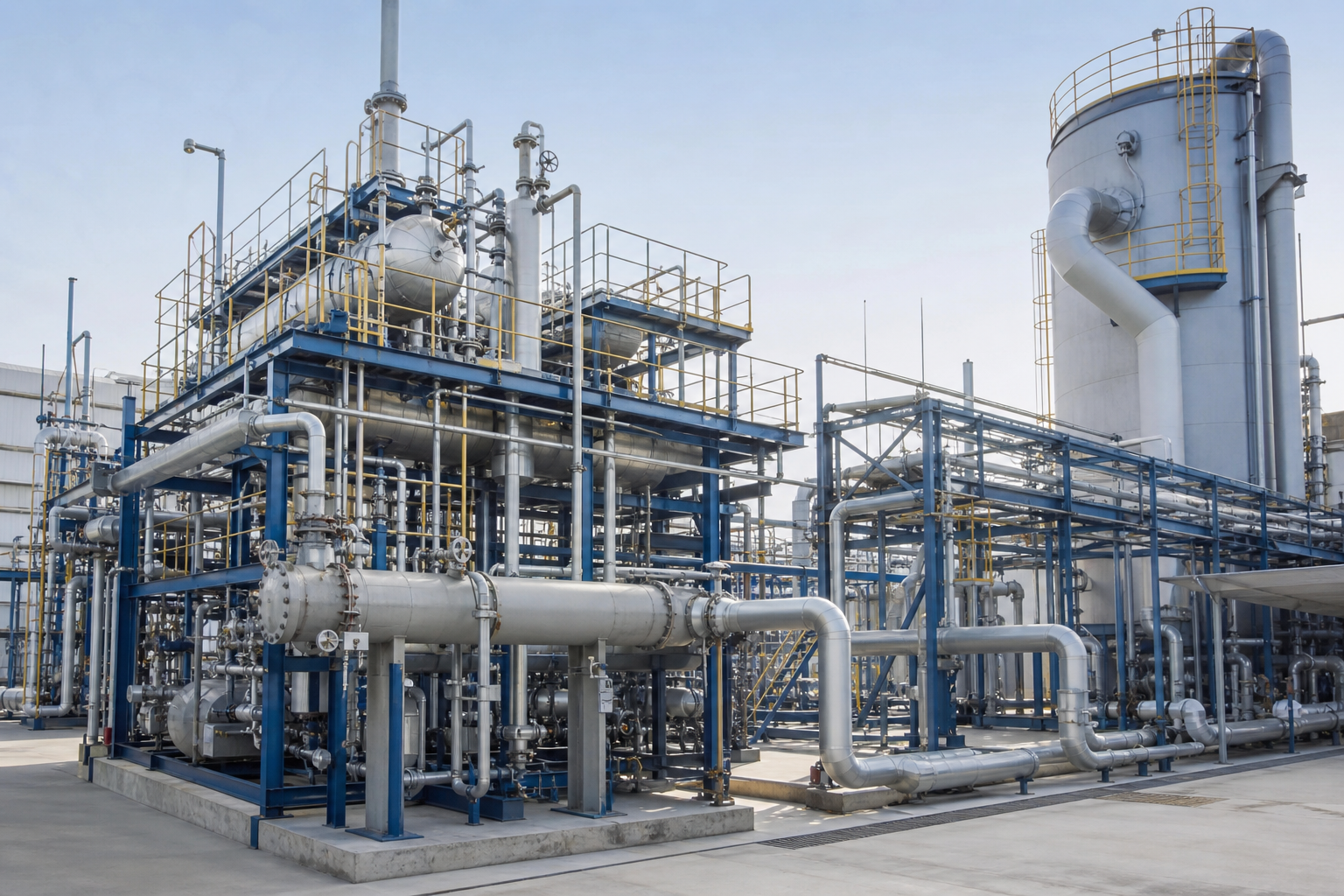
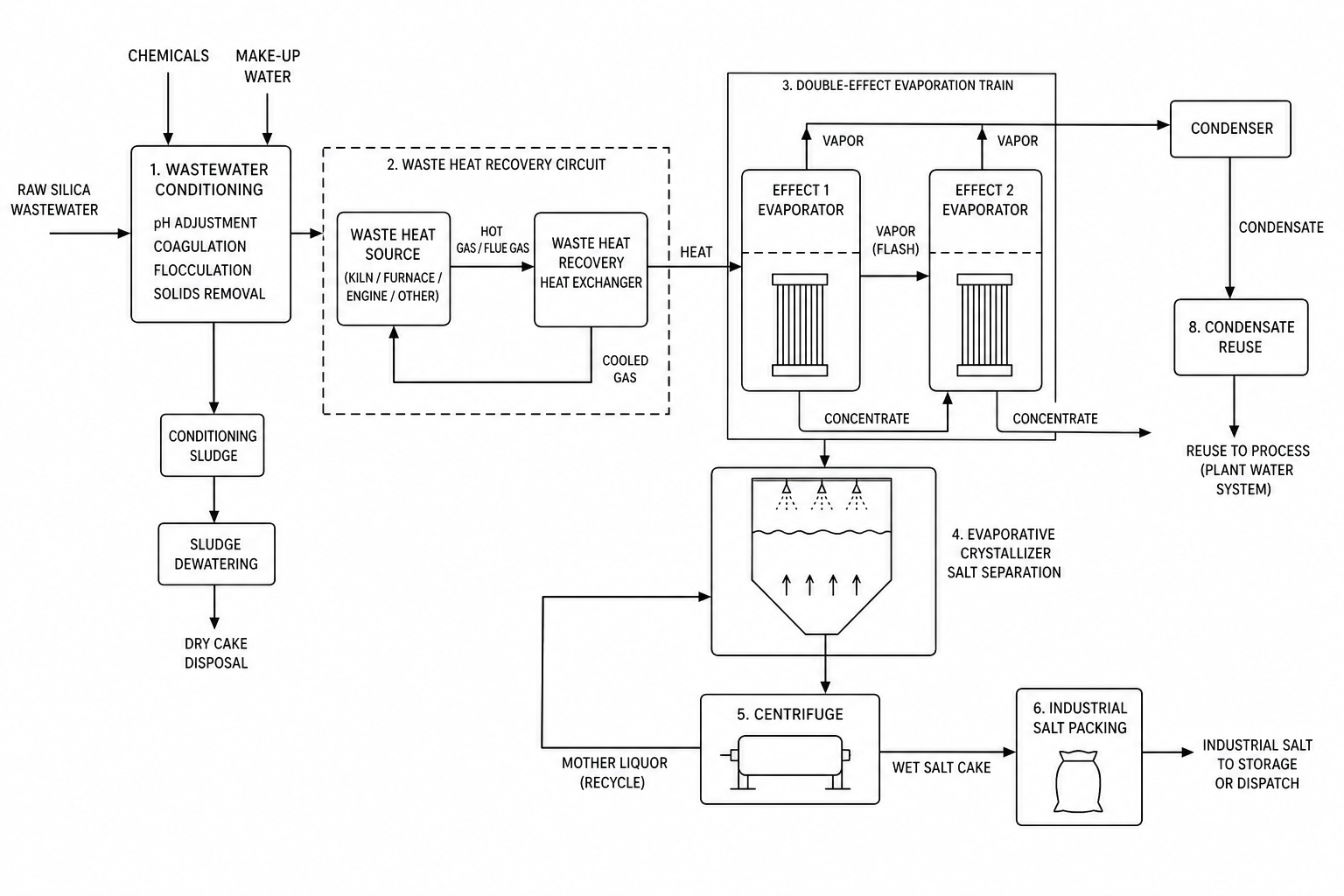
Silica wastewater challenges evaporation in a specific way: dissolved and colloidal silica. Silica polymerizes and scales on heat-transfer surfaces at concentrations conventional evaporators never see, so the feed handling — solids removal, pH management, and in many designs silica preconditioning — decides whether the plant survives its first quarter. The published configuration guards the double-effect train with proper feed conditioning ahead of the first effect.
The double-effect train itself is the robust heart of the design: two effects staged in pressure, live steam (and recovered waste heat) driving the first, first-effect vapor driving the second, surface condensation closing the chain. Double effect trades steam economy for simplicity and capital discipline — the right selection where the heat is nearly free, as it is here with 200,000 Nm³/h of site waste heat integrated into the duty. Salt separation rides on the train’s finisher: as the liquor approaches sodium-salt saturation, evaporative crystallization grows the salt crop that the published record says reaches first-class industrial salt purity and whiteness.
The 2205 duplex stainless construction is the corrosion answer. Chloride-bearing saline brines at evaporation temperature put stress-corrosion cracking on the table for standard austenitics; 2205’s duplex structure carries the chloride resistance and the strength that ZLD brine service demands, and the published configuration specifies it for the evaporator bodies.
The zero-discharge boundary closes with the condensate: clean evaporator condensate returns to the silica plant’s process and washing circuits, the salt leaves as packaged industrial product, and the residual mother liquor recycles with a controlled purge to the front of the train. Water in, water recovered, salt out — the arithmetic of a demonstration ZLD.
Equipment Configuration
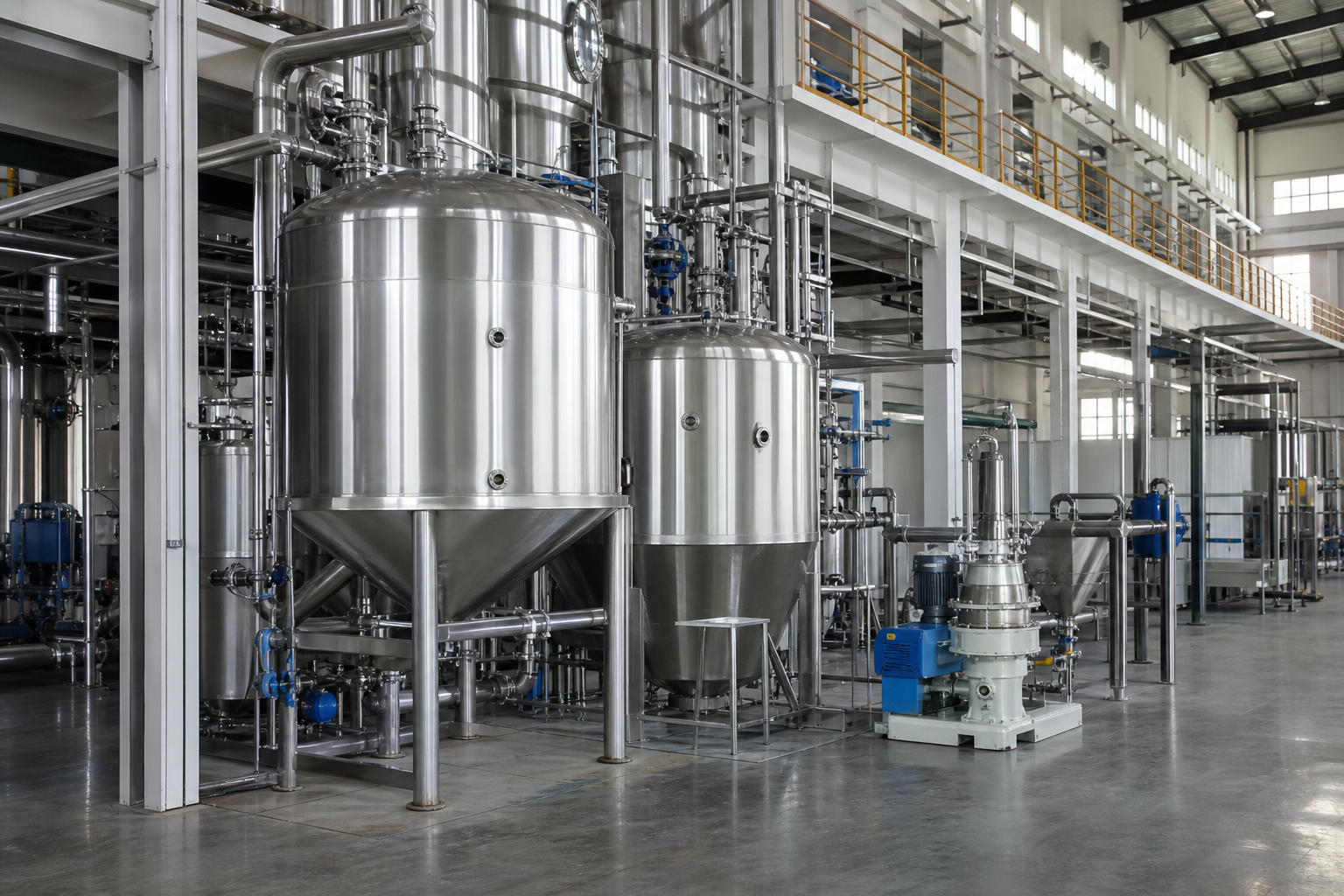
One set of the following equipment is typical for this duty:
- Wastewater equalization with silica-solids removal and feed conditioning
- Waste-heat recovery circuit (~200,000 Nm³/h class) feeding the evaporation duty
- Double-effect evaporation train in 2205 duplex stainless steel
- Evaporative crystallizer / salt-separation section on the finisher
- Evaporation-condensation polishing section
- Centrifuge and salt handling producing first-class industrial salt
- Condensate return to silica-plant process water; mother-liquor recycle with purge
Performance & Outcome
Compiled from published industry project data (this configuration’s published record includes operating cost and product quality): 1,200 t/d silica wastewater treated at a published operating cost of roughly RMB 12 per tonne; crystalline salt recovered at first-class industrial salt standard (purity and whiteness); condensate returned to plant reuse; the project is published as a demonstration plant for resource-recovery ZLD in the silica industry.
Simplified PFD
The simplified process flow diagram above shows wastewater conditioning, the waste-heat recovery circuit, the double-effect train in duplex steel, salt separation and condensate reuse.