For wastewater above roughly 10,000 mg/L of total dissolved solids (TDS), the evaporator decision is essentially settled by physics: biological and membrane chains stop working reliably in this range, and thermal separation becomes the backstop technology that concentrates the brine into solid salt plus reusable condensate regardless of salt concentration. What remains to be decided is the route — multiple-effect evaporation (MEE) if cheap steam is available, mechanical vapor recompression (MVR) if electricity is the economical energy source, heat-pump evaporation for low-temperature duties — and a set of feed-water red lines (hardness, silica, chlorides) plus materials of construction that determine whether the machine survives its first year. This guide walks through the failure mechanisms of conventional treatment, compares the four evaporation routes, sets out MVR’s operating limits and pretreatment options, and ends with a selection checklist and recovery figures reported in external industry references.
What Counts as High-Salinity Wastewater
The working definition used across the industry is TDS above 10,000 mg/L — one percent dissolved solids by mass. Around that threshold, three related but distinct indicators matter and are often confused:
- TDS (total dissolved solids) — the total mass of dissolved species, the primary yardstick for evaporator sizing and discharge compliance.
- Salinity — the chloride-dominated salt fraction; it drives corrosion spec and crystal phase behavior more than total mass does.
- Brine (concentrate) — the concentrated reject stream itself. A brine problem can exist at moderate TDS if upstream recovery steps (RO, softening) have already squeezed the water out.
The industrial sources are consistent across regions: chemical and petrochemical production, pharmaceutical and fine-chemical synthesis, power-plant cooling-tower blowdown, mining and mineral processing, food and beverage plants, textile dyeing, and landfill leachate. Each stream carries its own organic load, hardness, and specific salt chemistry — which is why the same evaporator platform is configured differently for each.
Why Conventional Treatment Fails Above One Percent Salt
Every mainstream non-thermal technology has a documented failure mode in high-salinity service:
- Biological treatment — salt concentrations at this level are toxic to the bacterial cultures in activated sludge and anaerobic systems; the biology simply inhibits and the COD removal collapses.
- Chemical precipitation — works on selected ions, but generates large volumes of wet sludge whose dewatering and disposal cost frequently exceeds the treatment value.
- Reverse osmosis — membranes have a practical feed-TDS ceiling; pushed beyond it, flux falls and scaling climbs. Worse, RO does not destroy salt: it produces a smaller, more concentrated brine that still needs a final solution.
- Electrolysis and membrane processes generally — organics cannot be electrolyzed away, membranes foul and blind, and the concentrate streams accumulate without an outlet.
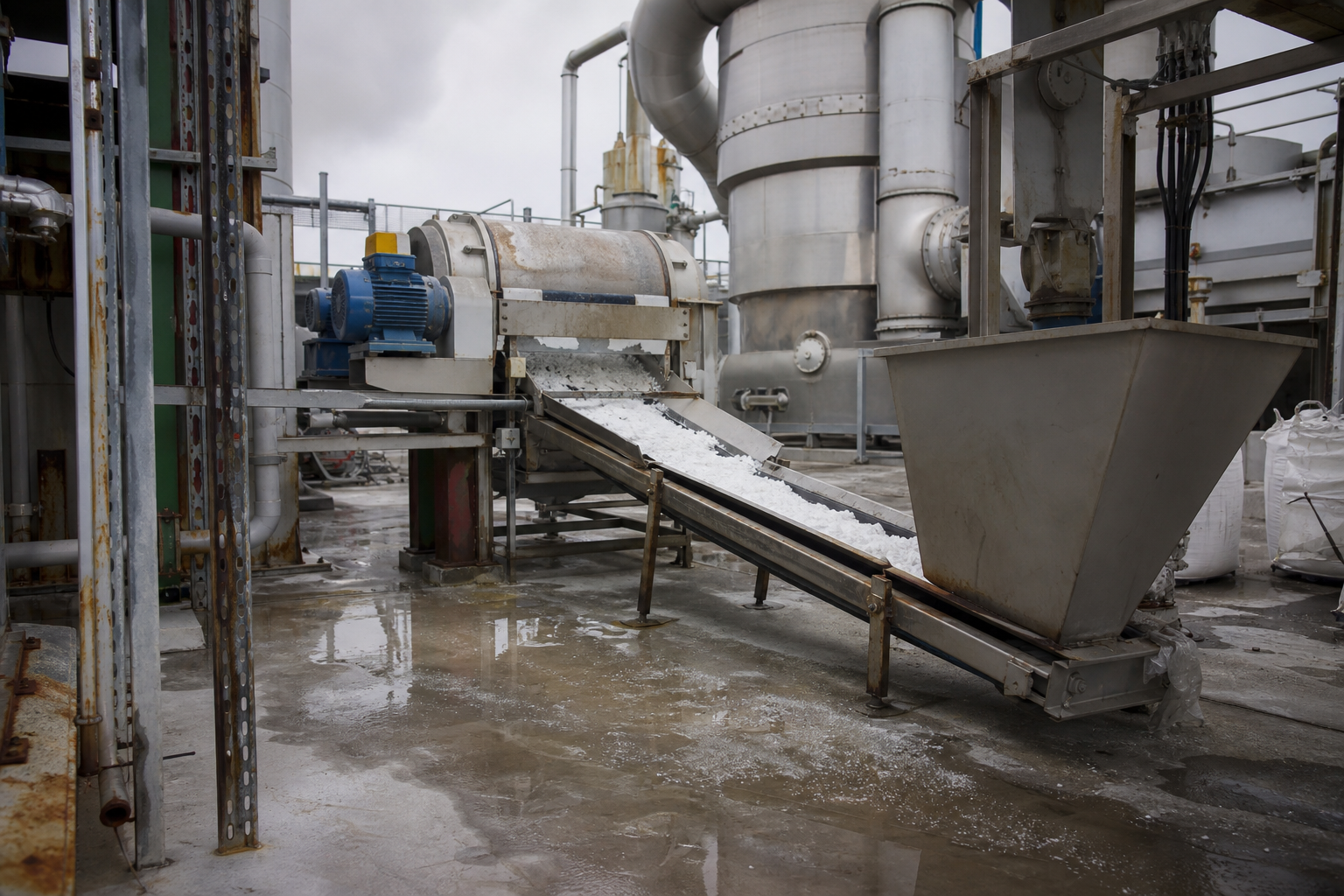
Thermal separation escapes these limits because it does not depend on the chemistry of the water: evaporation delivers a clean condensate stream and a solid or near-solid salt product, at any feed concentration. That is why evaporation sits at the back end of every zero-liquid-discharge train.
Comparing the Four Evaporation Routes
Four thermal routes cover virtually all high-salinity duties. They differ in energy source, efficiency, and the site conditions that favor them:
| Route | Energy driver | Characteristics | Best fit |
|---|---|---|---|
| Multiple-effect evaporation (MEE) | Live steam | 3–5 effects recover heat sequentially; mature, tolerant, steam-hungry | Sites with cheap or waste steam |
| MVR (mechanical vapor recompression) | Electricity | Highest energy efficiency; steam needed only for start-up | Stable power, continuous large-scale duty, no steam source |
| Heat-pump evaporation | Electricity | Low operating temperature; gentle on heat-sensitive components, limits scaling | Low-temperature concentration duties |
| TVR (thermal vapor recompression) | Motive steam, ejector | No moving parts; one TVR saves steam roughly equal to adding one effect | Steam-rich sites wanting a low-maintenance efficiency step |
The energy structure of the site is usually the deciding axis: where steam is cheap, MEE (optionally with TVR) wins on capital; where electricity is the economical carrier, MVR wins on operating cost. The deeper comparison of steam economy, COP, and payback between these routes is covered in the energy efficiency and steam economy optimization guide.
MVR for Saline Water: Working Principle and Hard Limits
MVR evaporates water and then recompresses the resulting vapor with a centrifugal compressor so it can serve as the heating medium again — an electrically driven heat pump with a very large effective output. Two compressor facts set the engineering envelope:
- A centrifugal vapor compressor delivers a temperature rise of about 20°C per stage; centrifugal fans and blowers manage only about 9°C (typical vendor-published figures). Compressor selection is therefore the difference between a working and a marginal system.
- Because the available temperature lift is finite, the boiling point elevation (BPE) of the liquor must stay below roughly 15°C for MVR to remain energy-efficient. Highly concentrated solutions with large BPE erode the compressor’s useful ΔT.
Feed water has equally firm red lines (typical supplier screening guidelines; site-specific limits are set by pilot testing on the actual liquor):
| Parameter | Limit | Consequence if exceeded |
|---|---|---|
| Calcium + magnesium (hardness) | < 100 mg/L | Rapid scaling on heat-transfer surfaces |
| Silica / silicates | < 30 mg/L | Hard, difficult-to-clean silica scale |
| Cyanides | None permitted | Safety hazard — toxic gas release risk |
Against multi-effect evaporation, MVR’s operating profile is distinctive: it needs steam only to start, then runs on electricity alone through the campaign; residence time is short, which shortens batch cycles; and the investment concentrates in the centrifugal compressor, whose service life is on the order of twenty years. Equipment suppliers publish indicative figures — more than 90% cooling-water saving, roughly 80% labor reduction, and around 60% smaller footprint versus equivalent steam-driven plants; these are supplier-reported comparisons, not project guarantees — and the advantage grows largest at sites with no steam source at all. The technology’s broader application map is on the MVR evaporation page.
Materials: Chlorides Decide the Metallurgy
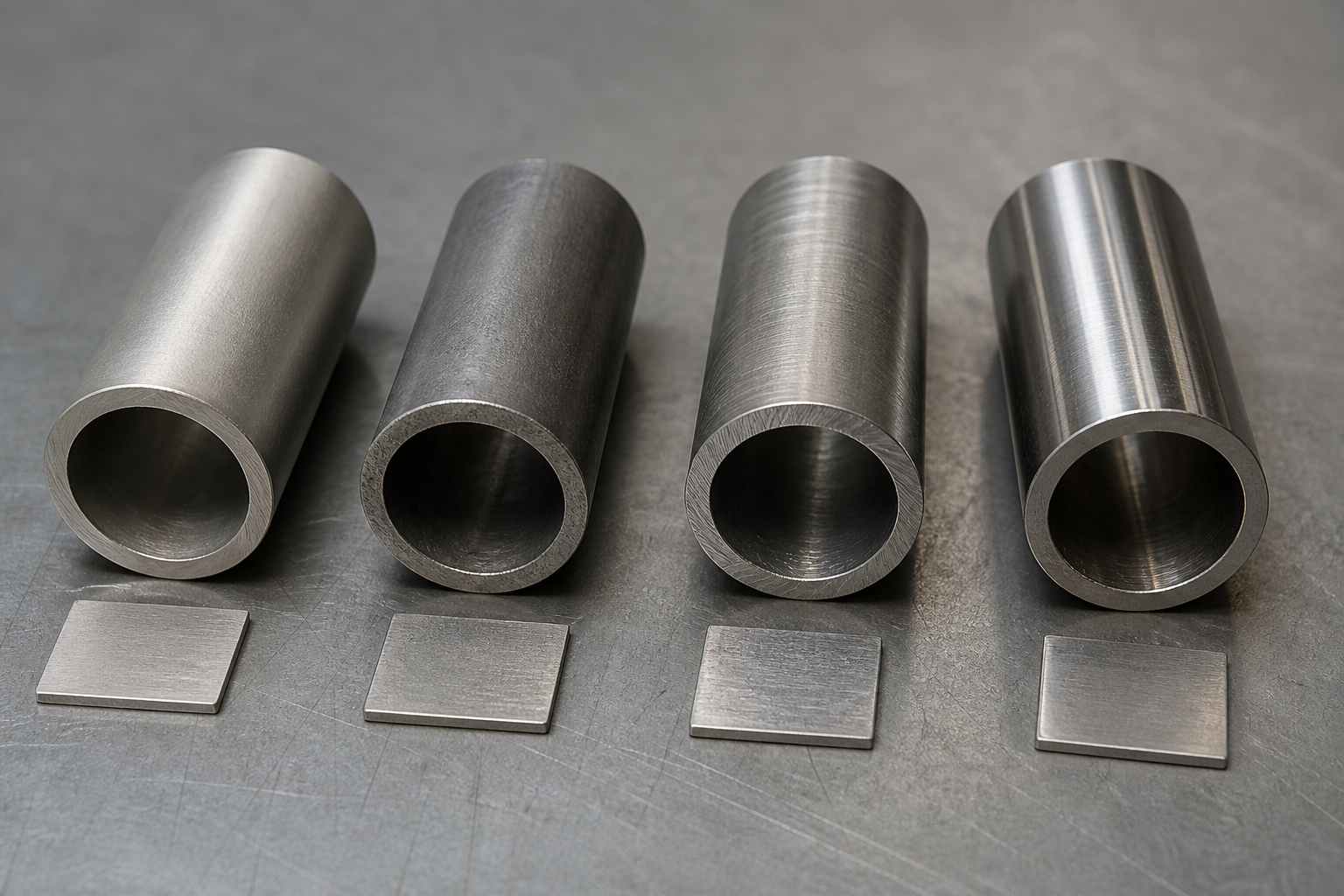
Salt chemistry dictates the pressure-vessel and heat-exchanger materials. For high-chloride streams (sodium chloride, and the chloride salts of ammonium, magnesium, and calcium), titanium is the reliable choice for wetted parts. Where the chloride content is moderate and the sodium chloride evaporation temperature is held at or below about 80°C, duplex stainless steel 2205 can serve, though with higher risk; titanium remains the conservative answer. Sulfate, carbonate, and nitrate systems are far gentler and allow standard austenitic grades. The full material-selection logic — wetted versus non-wetted zoning, cost tiers, and corrosion mechanisms — is laid out in construction materials and corrosion protection.
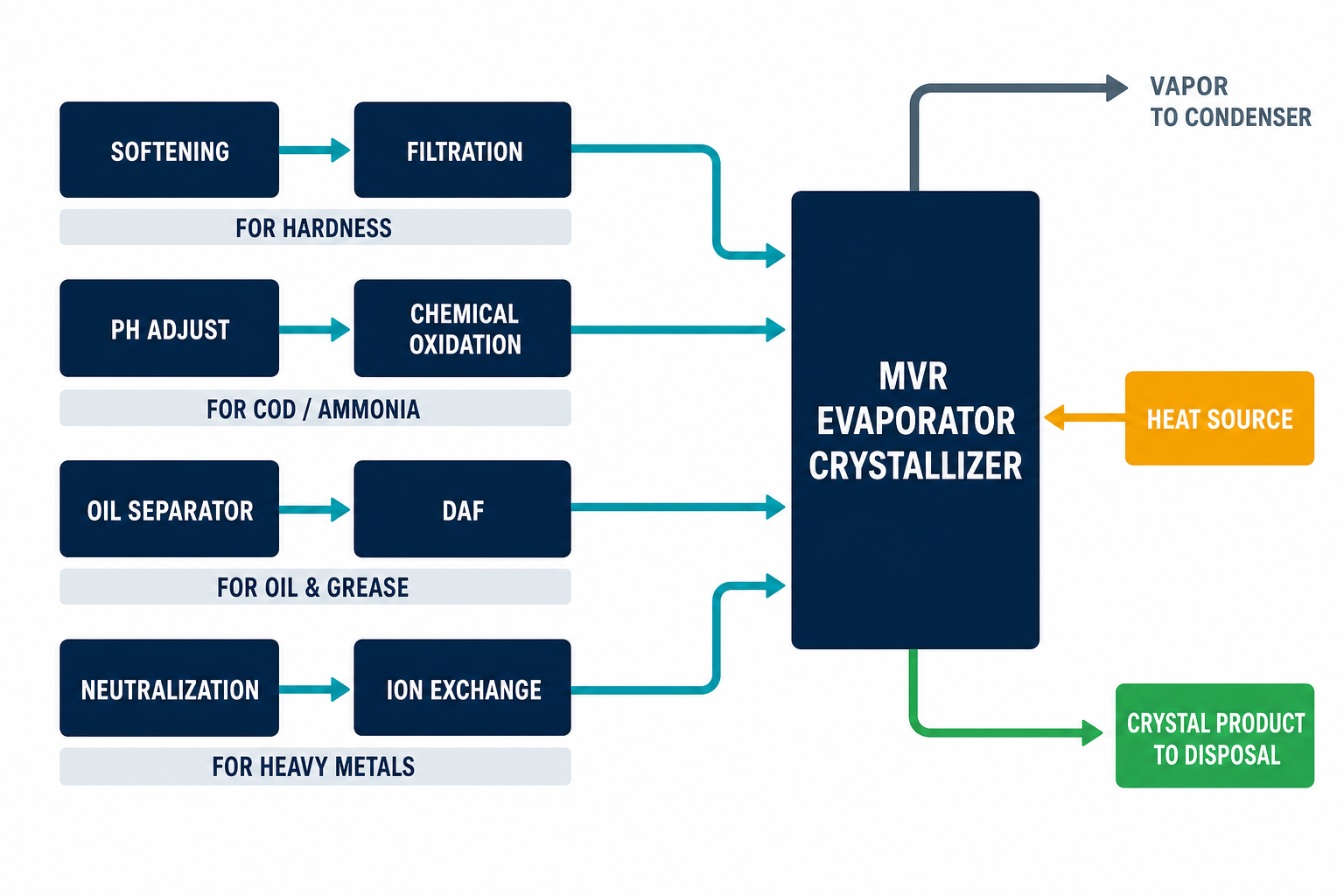
Pretreatment: Four Routes That Protect the Evaporator
High-salinity streams usually carry organics that would contaminate the salt product or foul the evaporator. Four pretreatment routes are in industrial use ahead of MVR:
| Pretreatment route | Target | Notes |
|---|---|---|
| High-temperature wet oxidation (500–600°C) + MVR | COD destruction | For heavily organics-loaded streams |
| Solvent extraction + MVR | Recovery of DMAC/DMF and similar solvents | Turns a waste problem into product recovery |
| Activated carbon adsorption + regeneration furnace + MVR | COD down to ~2,000–3,000 mg/L (supplier-reported) | Required to obtain white (usable) salt instead of contaminated mixed salt |
| Sulfuric acid conversion to by-product | Specific salt chemistries | Route-dependent; converts the pollutant into a saleable stream |
The choice among them is a function of the organic speciation, the value of any recoverable component, and the salt quality the plant wants to exit with.
Salt Separation by Temperature
Where the brine carries both sodium sulfate and sodium chloride, fractional crystallization separates them without chemicals, purely by temperature control: sodium sulfate is precipitated preferentially in the hot section at around 85°C (its solubility falls as temperature rises), sodium chloride drops out in the cooling section at reported operating points from roughly 45 to 65°C depending on the train configuration (its solubility is only weakly temperature-dependent), and the residual mixed salt is concentrated at the end of the train. Externally reported projects in Inner Mongolia have demonstrated this split-salt sequence on coal-chemical brines at scale. The separation equipment and crystallizer selection are detailed on the salt separation technology page.
ZLD or MLD: Setting the Target Before Buying Hardware
The discharge target sizes the plant. Zero liquid discharge (ZLD) means no liquid leaves the site: the evaporator-crystallizer delivers reusable water and solid salt as the only two products. Minimal liquid discharge (MLD) is the pragmatic tier — reducing effluent volume by 95% or more, which approaches zero discharge without paying the full crystallization cost of the last increment. Specifying MLD where it satisfies the permit, and reserving full ZLD for streams where regulation or water scarcity demands it, is one of the highest-leverage decisions in the whole project.
A Selection Checklist That Prevents Expensive Mistakes
Six inputs, collected before any quotation is meaningful:
- Complete water analysis — flow rate, salt species and concentrations, organics and oils. The salt speciation (not just TDS) selects the materials and the crystallizer.
- Site energy structure — cheap steam points to MEE; cheap or stable electricity points to MVR or heat-pump evaporation.
- Discharge target — MLD, ZLD, or salt recovery as a product; each ends in a different plant configuration.
- Footprint — MVR’s compactness matters on constrained sites.
- CAPEX versus OPEX weighting — steam systems cost less up front and more every hour they run; MVR inverts that.
- Corrosion allowance — chloride level plus temperature selects titanium, duplex, or austenitic construction.
And a seventh, non-negotiable for any first-of-a-kind stream: a pilot study. Pilot runs validate that the chosen process actually suits this wastewater, expose unexpected problems (foaming, specific scaling species, volatile carryover) before they are built into full scale, and tune the design parameters to their optimum. Skipping the pilot converts these surprises into capital mistakes.
What Recovery Looks Like in Practice
One externally reported benchmark, an operating rubber-accelerator plant: the wastewater passes through a four-step pretreatment — distillation recovery, cooling settling, acid-alkali adjustment, and air-flotation flocculation — followed by two-stage MVR evaporation and condensate polishing. Reported results: 100% salt recovery, 98% organic recovery, and 95% water reuse across the system. Comparable complex-wastewater programs are described under complex wastewater treatment, and the end-to-end zero-discharge architecture on the ZLD solutions page. Once the unit is running, sustained performance depends on operating discipline — covered in the evaporator operation and maintenance guide.
FAQ
What TDS level makes wastewater “high salinity”?
Above about 10,000 mg/L TDS, conventional biological and membrane treatment becomes unreliable, and the stream is treated as high-salinity: biological systems inhibit, RO flux collapses, and thermal evaporation becomes the backstop technology.
Which evaporator type is best for high-salinity wastewater?
It follows the energy source. Cheap steam favors multiple-effect evaporation (optionally with TVR); stable, economical electricity favors MVR, which needs steam only for start-up and offers the highest energy efficiency. Heat-pump evaporation suits low-temperature duties where scaling or heat-sensitive components dominate.
What feed limits must an MVR evaporator respect?
Combined calcium and magnesium below 100 mg/L (else rapid scaling), silica below 30 mg/L, and no cyanides for safety — typical supplier screening guidelines, to be confirmed by pilot on the actual liquor. The liquor’s boiling point elevation should stay below about 15°C for the compressor’s typical ~20°C centrifugal temperature rise (vendor-published figure) to deliver efficient evaporation.
Which material is right for high-chloride brine?
Titanium is the reliable choice for chloride service. Duplex 2205 can be used for sodium chloride duty when evaporation temperature is kept at or below about 80°C, but carries higher risk; sulfate, carbonate, and nitrate systems allow standard 316L/304 grades.
Should we target ZLD or MLD?
MLD — cutting effluent volume by 95% or more — is the pragmatic target when the permit allows it. Full ZLD, producing only reusable water and solid salt with no liquid discharge, is reserved for regulated or water-scarce situations, because crystallizing the last increment is the most expensive step of the train.