
Project Parameters
| Parameter | Value |
|---|---|
| Process route | Four-effect evaporation driven by recovered waste heat |
| Industry | Papermaking chemicals — specialty additives plant of a paper group |
| Feed type & key components | Papermaking chemical streams (surface-sizing, coating and strength-additive solutions); viscosity-building polymers / starch derivatives |
| Evaporation capacity | 30 t/h |
| Region | East China (Shandong) |
Representative process configuration compiled from published industry project data. Indicative values, not a process guarantee.
Project Description
A modern paper group makes more than paper: the chemicals that size, strengthen and coat its sheets — starch derivatives, polymer solutions, surface treatments — are increasingly produced by dedicated plants inside the group, next to the machines that consume them. The published project behind this configuration is such a chemicals plant in East China, and its evaporation block is a quiet manifesto: 30 t/h of concentration duty, four effects, driven by recovered waste heat rather than premium steam.
The logic is site economics. A paper mill exhales low-grade heat — dryer hood exhausts, hot condensate flashes, machine cooling returns — and every megawatt of that heat captured into evaporation is a megawatt of boiler steam freed for the paper machine. The published configuration couples the four-effect train to the mill’s waste-heat circuit, so the chemicals plant’s concentration duty effectively runs on energy the site had already paid for and was about to discard.
Process Technology
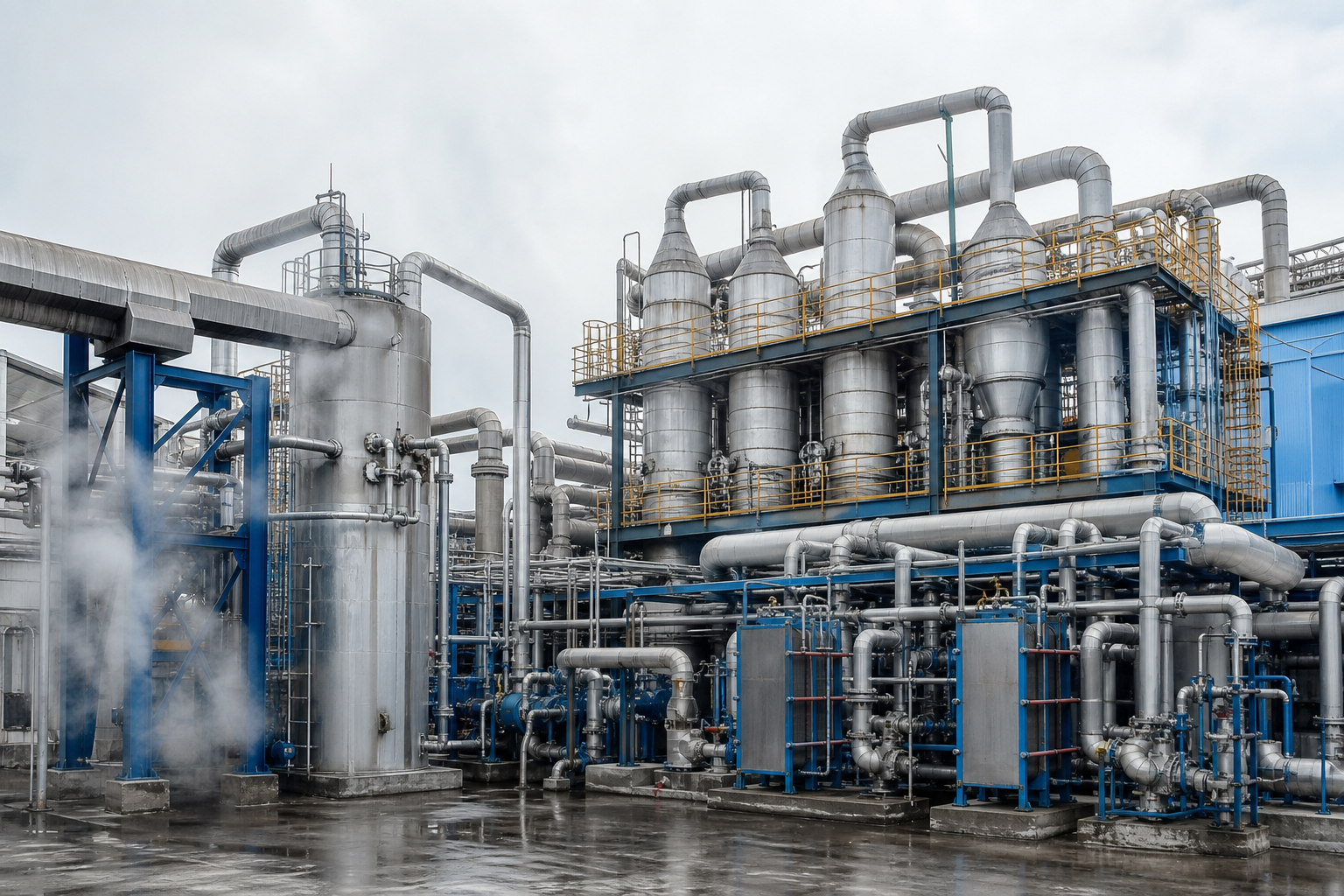
Papermaking chemical streams concentrate like their chemistry dictates: starch-based sizing solutions and polymer additives build viscosity steeply as solids rise, film poorly when the viscosity outruns the distributor, and gel or skin on any hot surface that dries out. The four-effect train in the published configuration is therefore a falling-film design — the standard answer for viscosity-building, quality-sensitive chemical feeds — with generous liquid distribution and effect staging under vacuum holding each body’s temperature inside the window where these streams neither gel nor discolor.
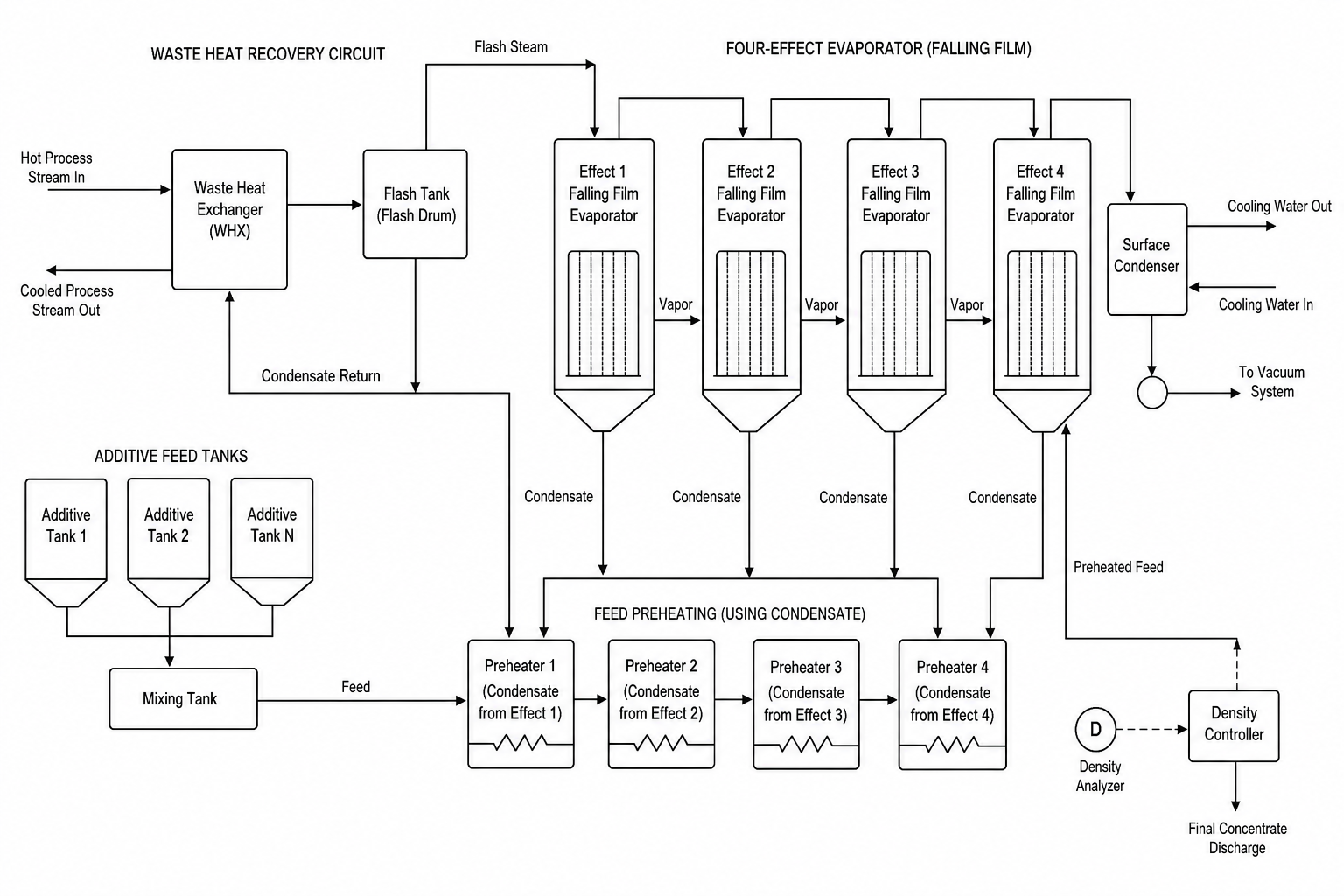
The waste-heat drive reshapes the effect balance. Where a steam-driven train counts effects against boiler fuel, a waste-heat train counts them against recovered temperature: the heat source’s grade fixes how low the first effect can run, and four effects of vacuum staging ladder the temperature from that ceiling down to the surface condenser. The published class of plant captures flash steam and hot-water heat into the first-effect circuit and preheats feed against condensate on the way in — heat integration on both sides of the train.
The product side runs to the paper industry’s calendar: batch-to-batch grade changes, clean-in-place between additive families, and density-controlled discharge to the storage tanks that feed the paper machine’s dosing systems. The evaporation train’s turndown follows the chemicals plant’s campaign rhythm, and the four-effect chain’s wide operating window absorbs it without efficiency collapse.
Condensate returns to the mill’s water circuits by cleanliness class. In a paper-group chemicals plant the condensate is close to process-plant utility water: hot, clean where the feed was clean, segregated where additive volatiles ride the vapor. The published project’s quiet achievement is a chemicals block whose water balance, like its heat balance, closes inside the paper group’s fence.
Equipment Configuration
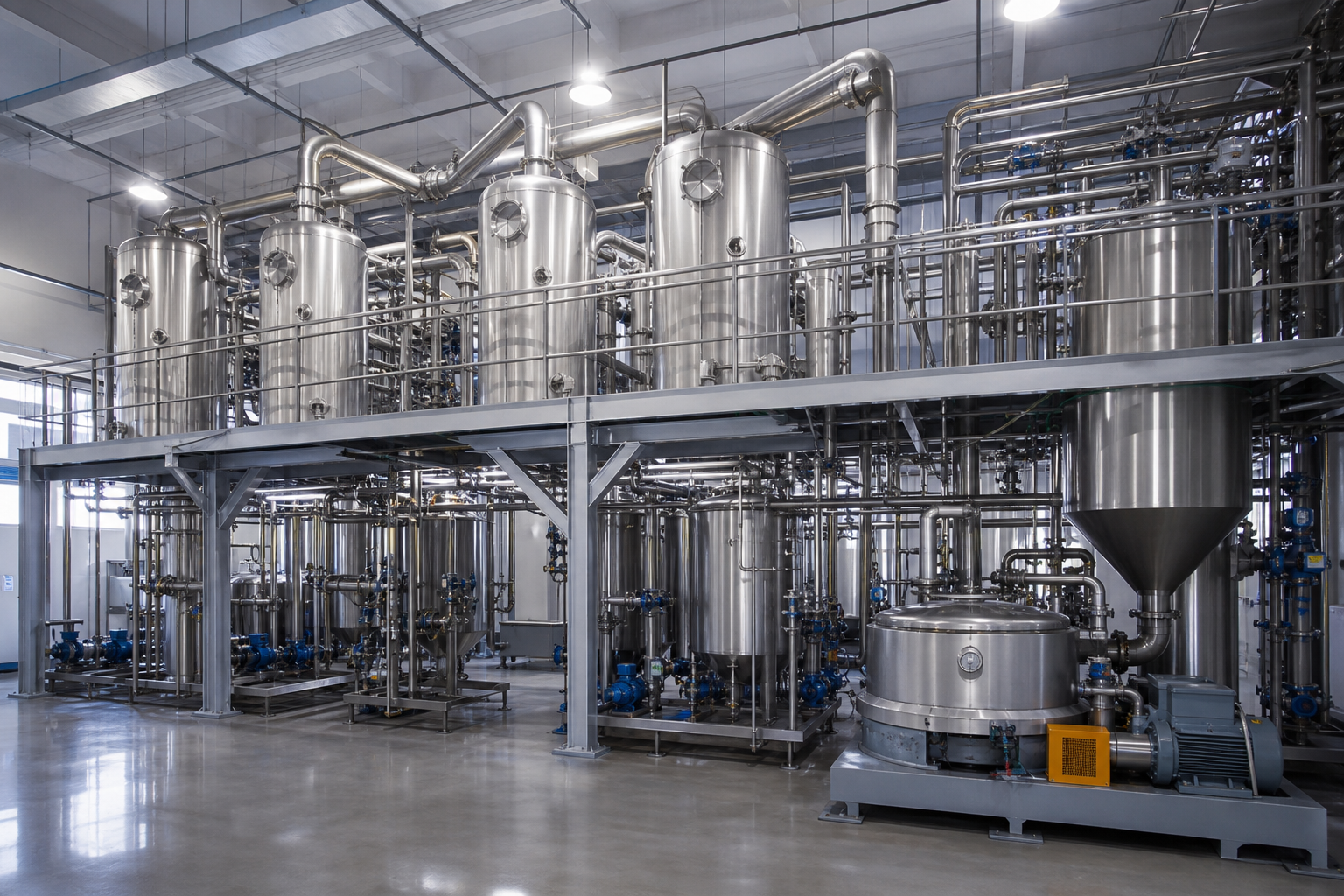
One set of the following equipment is typical for this duty:
- Additive-solution feed tanks with grade segregation
- Four-effect falling-film evaporation train with vacuum staging
- Waste-heat recovery circuit: flash steam / hot-water heat to the first-effect drive
- Feed preheating against condensate
- Surface condenser and vacuum system
- Density-controlled discharge to paper-machine dosing storage
- CIP systems between additive families; PLC control
Performance & Outcome
Compiled from published industry project data, indicative: waste-heat-driven trains of this class concentrate 30 t/h of papermaking chemical solutions at four-effect economy with the live-steam demand displaced by recovered site heat. Steam-equivalent savings are quoted per project heat-circuit specification.
Simplified PFD
The simplified process flow diagram above shows additive feed, the waste-heat recovery circuit, the four-effect train and condensate return.


