Project Parameters
| Parameter | Value |
|---|---|
| Process route | Bespoke pretreatment + high-recovery RO concentration + evaporation ZLD (concentrate closure) |
| Industry | PFAS-impacted industrial wastewater management (site location not disclosed) |
| Feed type & key components | PFAS-impacted wastewater (per- and polyfluoroalkyl substances across effluent streams) |
| Program scale | 4,500 m³/d |
Representative process configuration compiled from published industry project data. Indicative values, not a process guarantee.
Project Description
PFAS changed the arithmetic of industrial water treatment: a class of compounds that survive chemistry, biology and time itself cannot be “removed” in the ordinary sense — it can only be concentrated into the smallest possible volume and locked there. The reference configuration is a bespoke PFAS treatment program at 4,500 m³/d, engineered around exactly that logic: recover the water, minimize the residue, and leave nothing liquid at the end.
“Bespoke” is the operative word in the program’s own framing. PFAS portfolios differ site to site — precursor compounds, chain lengths, co-contaminants, and the matrix they ride in all shape the flow sheet — so the program assembles its pretreatment, membrane and thermal stages against the site’s actual chemistry rather than a standard train. The published anchor is the scale: 4,500 cubic meters per day of PFAS-impacted wastewater treated within a single integrated program.
Process Technology
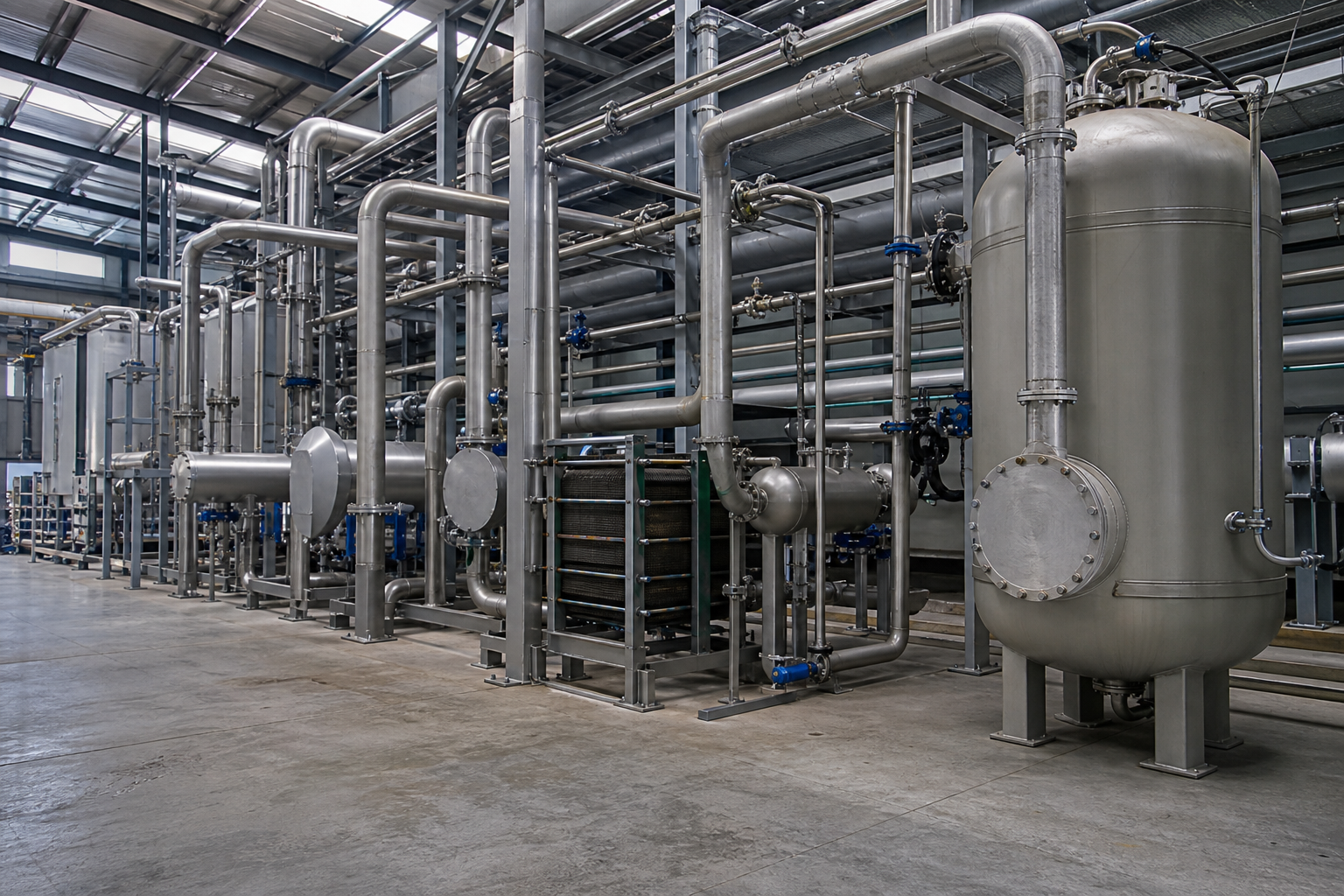
Wastewater passes pretreatment matched to its matrix — solids, hardness and co-contaminants controlled ahead of the membranes. The concentration heart of the program is high-recovery reverse osmosis: water is forced through the membrane against the osmotic pressure of an increasingly concentrated brine, and PFAS — large, charged or semi-charged organics that the RO layer rejects essentially completely — stay behind with the salts. Recovery is pushed as high as the brine’s osmotic pressure allows, because every increment of recovery is an increment of water returned and a decrement of residue to manage.
The RO concentrate, now carrying the site’s PFAS load in a small fraction of the original volume, terminates in evaporation: the thermal stage drives off the last of the water as clean condensate and leaves the PFAS locked in a dry salt-and-residue solid for compliant disposal. The closure logic is the point — nothing liquid leaves the program boundary, the PFAS never re-enter any water stream, and the site’s liability is converted from a daily effluent question into a bounded, characterizable solid stream.
Equipment Configuration
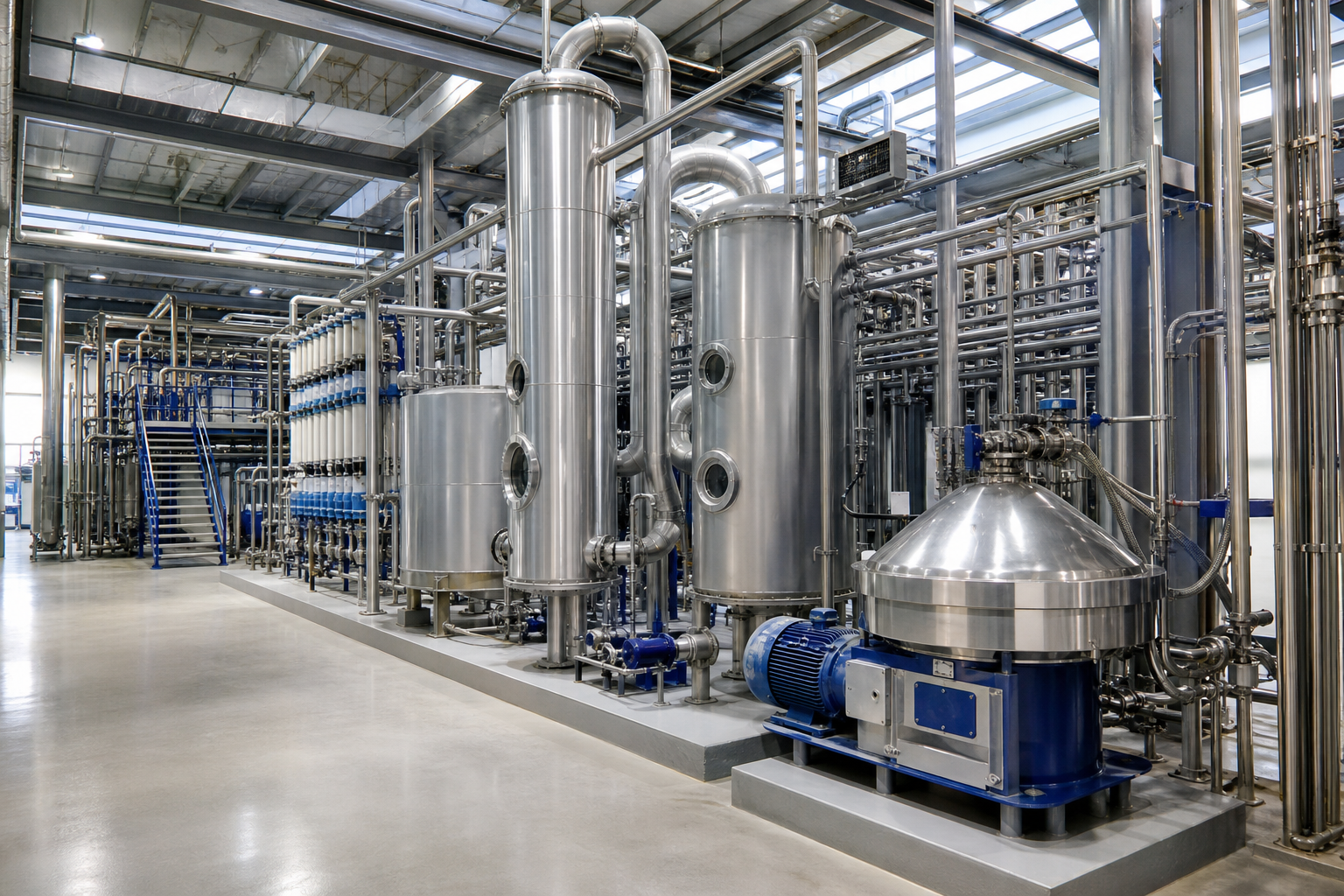
One set of the following equipment is typical for this duty:
- Site-matched pretreatment (solids, hardness, co-contaminant control)
- High-recovery RO concentration train
- Evaporation ZLD stage for concentrate closure
- Clean condensate recovery to site water systems
- Dry residue characterization, containment and compliant disposal
- PFAS monitoring across the train (feed, permeate, concentrate, residue)
- Program-level control of recovery ratios and residue tracking
Performance & Outcome
Compiled from published industry project data, indicative: the program treats 4,500 m³/d of PFAS-impacted wastewater, concentrating the PFAS load through high-recovery RO into a thermal ZLD stage that leaves no liquid discharge. PFAS rejection and residue characterization are quoted per site chemistry.
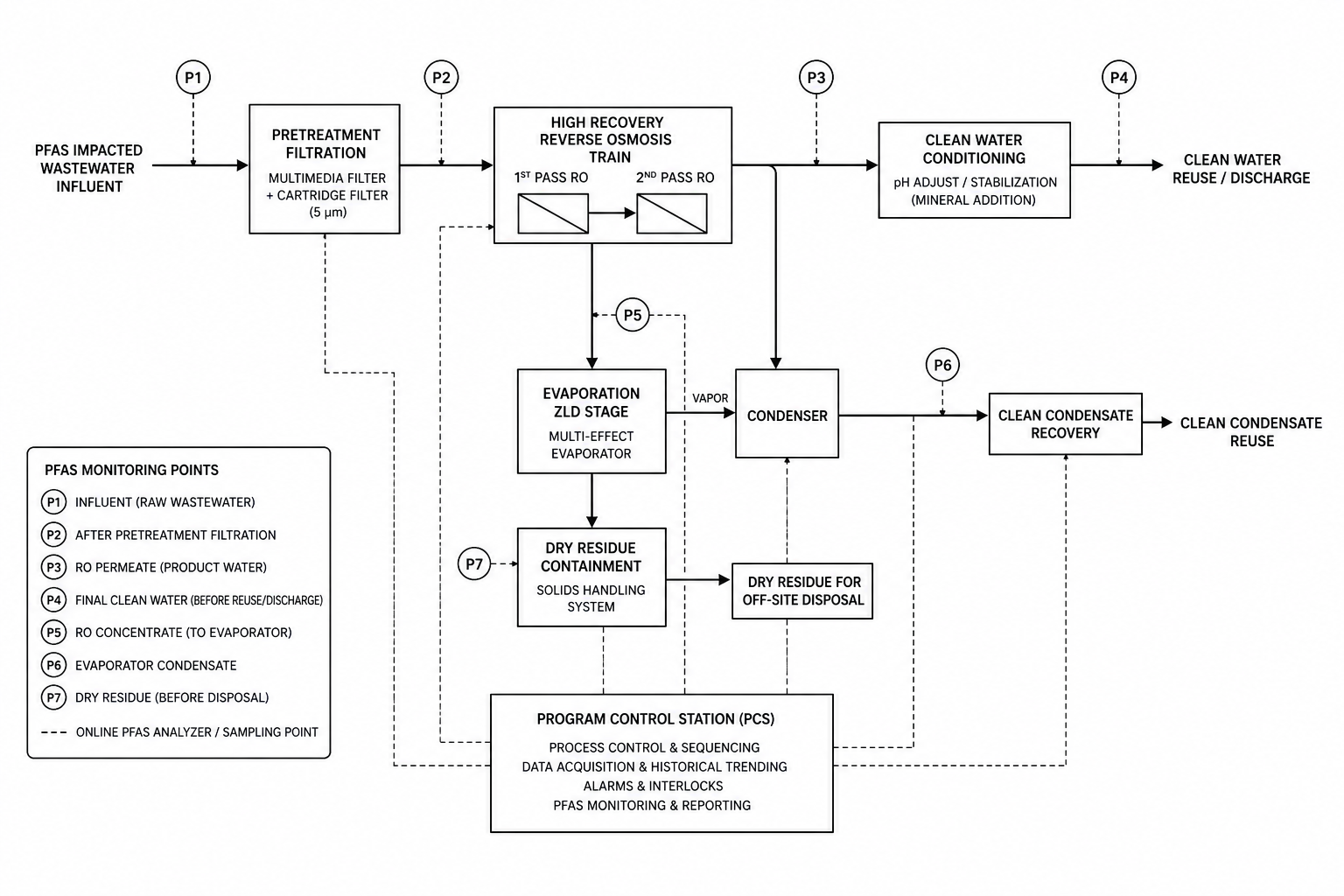
Simplified PFD
The simplified process flow diagram above shows pretreatment, high-recovery RO concentration, evaporation closure of the concentrate and monitored residue handling.