
Project Parameters
| Parameter | Value |
|---|---|
| Process route | Landfill leachate concentrate + DTRO membrane concentration + MVR evaporation (full-quantification service model) |
| Industry | Municipal solid waste landfill leachate, O&M service operations (Dalad Banner, Inner Mongolia) |
| Feed type & key components | Leachate concentrate: high-salinity, high-COD residual stream from leachate treatment, normally recirculated to the landfill |
| Evaporation capacity | Project-scale DTRO + MVR service train (capacity per service contract) |
| Construction materials | Corrosion-resistant wetted parts selected for chloride and ammonia service (indicative) |
Representative process configuration compiled from published industry project data. Indicative values, not a process guarantee.
Project Description
Every landfill leachate plant has a dirty secret called concentrate. Biological and membrane treatment recover most of the leachate as dischargeable water, but the membranes reject a fraction — saltier, more organic, and carrying the ammonia the biology missed — and the historic answer has been to spray it back on the landfill. Recirculation works until it doesn’t: the salts and refractory COD accumulate year over year, the leachate gets harder to treat, and regulators writing newer landfill standards have started refusing the loop entirely.
The reference configuration at Dalad Banner in Inner Mongolia is the alternative: a full-quantification service project, operated under contract, whose entire premise is that nothing returns to the landfill. The concentrate stream is treated to extinction — water out, residues out — as an operations service rather than a capital sale.
Process Technology
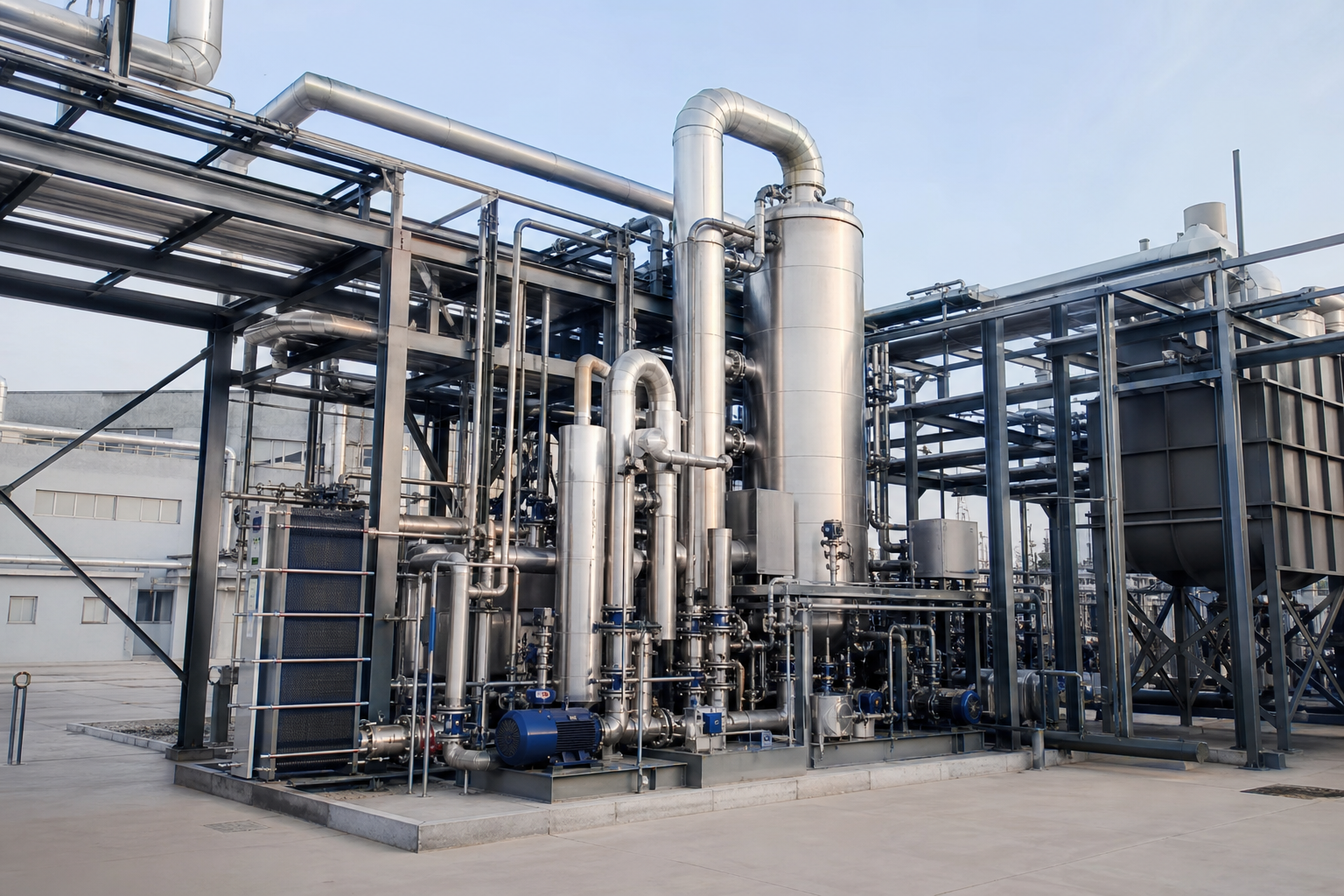
Disc-tube reverse osmosis (DTRO) is the front end, and it is chosen for survival. Landfill concentrate carries the fouling chemistry of a decades-old waste mass — organics, scaling salts, colloids — and the disc-tube module’s open flow channels tolerate a feed that would blind a conventional spiral element in weeks. DTRO pushes the concentrate through one more membrane stage, recovering a permeate fraction as water and cutting the volume that the thermal stage must swallow.
MVR evaporation handles the DTRO reject. Mechanical vapor recompression drives the evaporator electrically; the liquor boils under vacuum at temperatures chosen to manage the scaling and foaming tendencies of a high-COD, ammonia-bearing brine. Ammonia management is a design point throughout: leachate nitrogen follows the vapor chemistry, so pH control and condensate monitoring keep it reporting to the correct stream rather than contaminating the water product.
Water leaves as condensate, polished to the landfill discharge standard under the reference configuration. The non-volatile organics, salts and metals leave as a small concentrated residue — the mass that recirculation would have returned to the landfill for another lap. That is the accounting difference: the loop is closed, and the landfill stops being its own dump for treatment residuals.
As an operations model, the plant runs continuously against a service contract with the site operator — the economics that make full-quantification viable at landfill scale, where a treatment residual is a liability priced by the ton.
Equipment Configuration
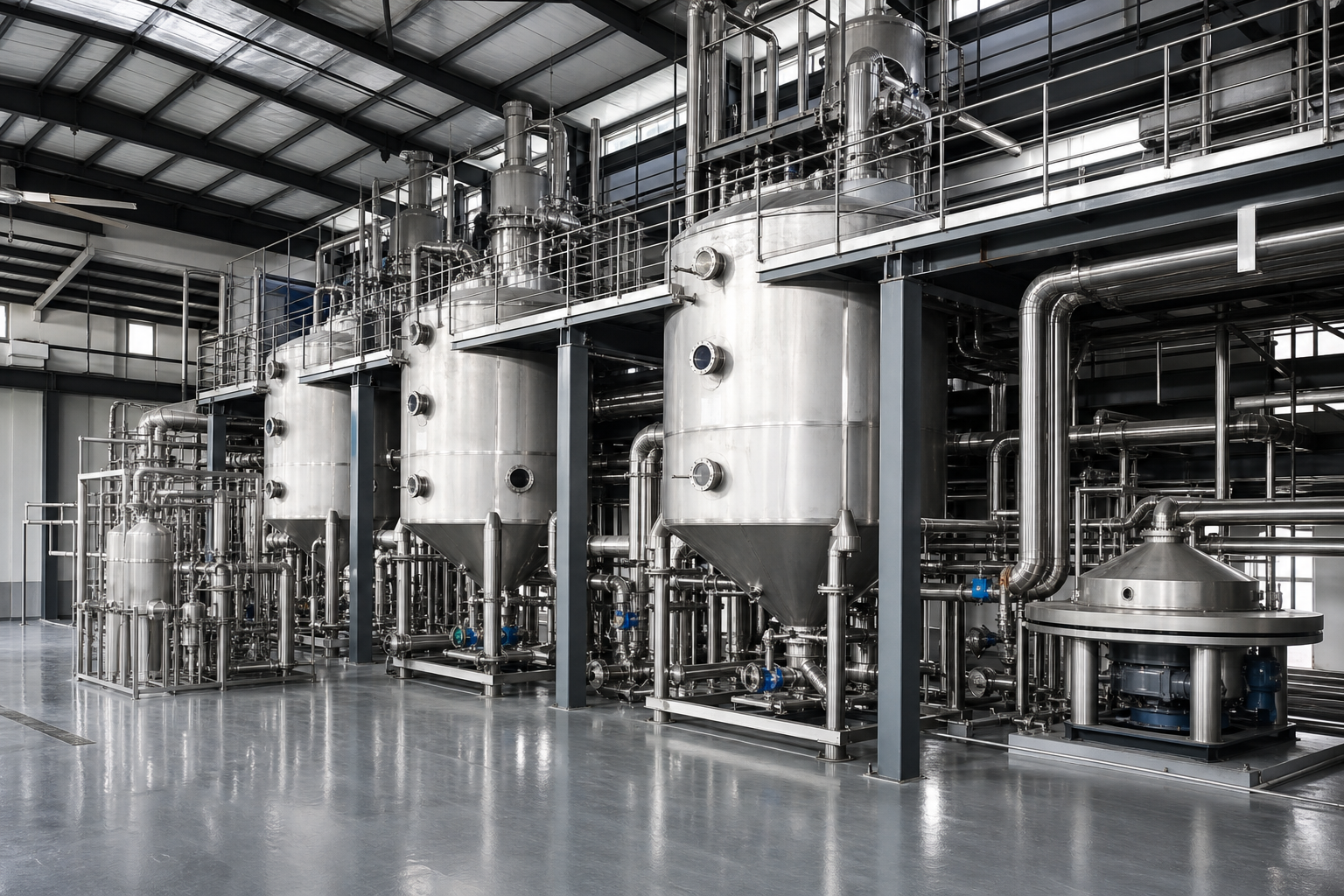
One set of the following equipment is typical for this duty:
- Leachate concentrate receiving and equalization
- DTRO disc-tube membrane concentration stage
- MVR evaporation train with ammonia-aware pH control
- Condensate polishing to landfill discharge standard
- Concentrated residue holding and off-take for managed disposal
- Remote-monitored O&M instrumentation under service operation
Performance & Outcome
Compiled from published industry project data, indicative: full-quantification DTRO + MVR services of this class end concentrate recirculation at landfill sites, recovering discharge-standard condensate and discharging only a dewatered residue. Volume reduction and operating cost per ton are quoted per leachate chemistry and contract.
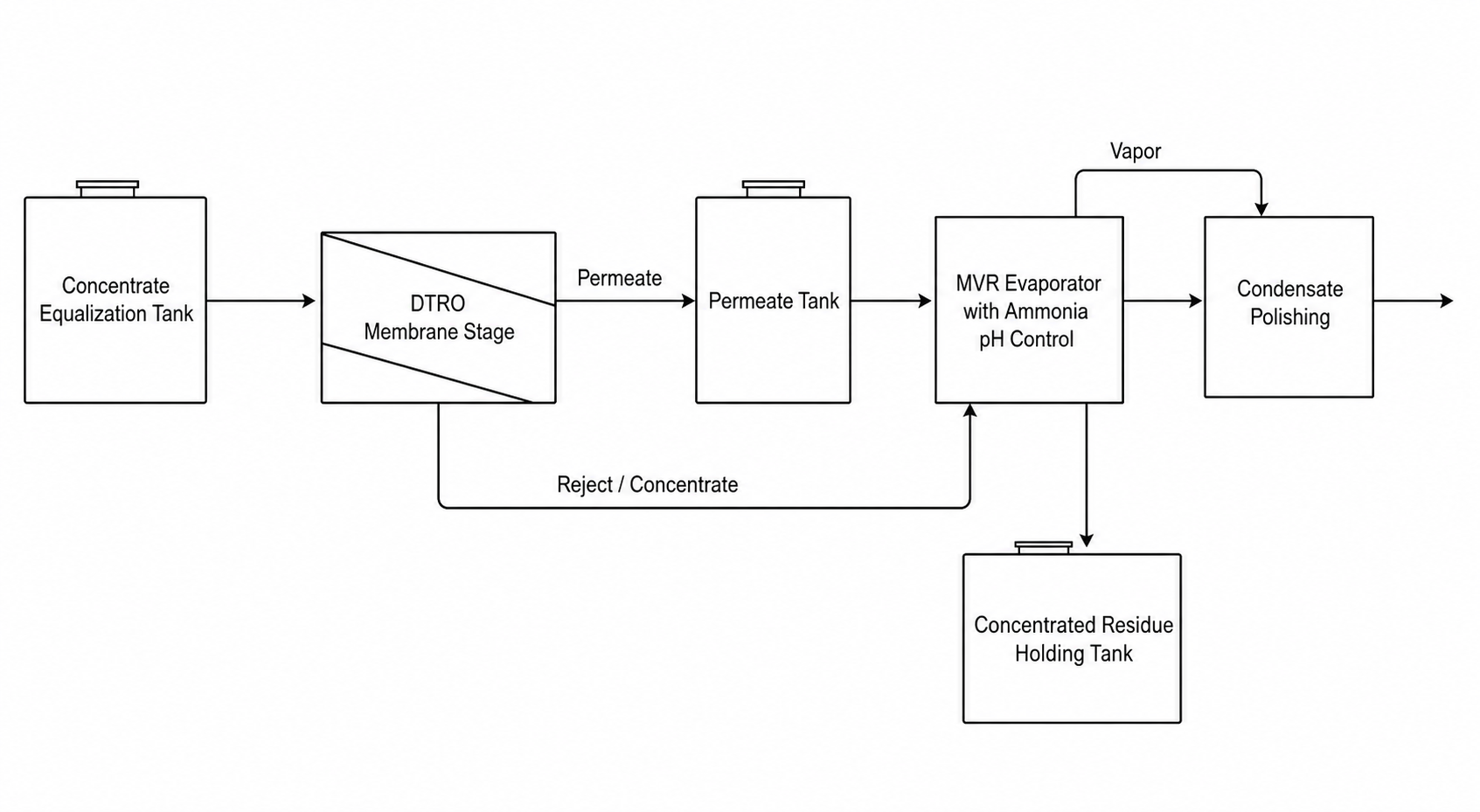
Simplified PFD
The simplified process flow diagram above shows concentrate equalization, the DTRO stage, MVR evaporation with ammonia control, condensate polishing and residue off-take.


