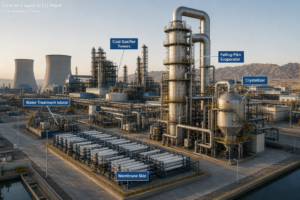
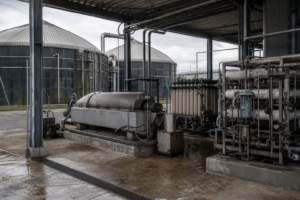
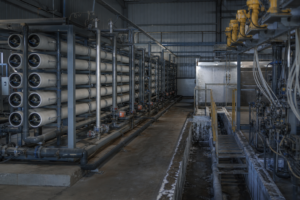
For desulfurization and denitrification wastewaters in the several-hundred-ton-per-day class, a double tube-sheet MVR evaporator with forced circulation is the configuration that reconciles three conflicting demands: high chloride corrosion load, fouling-prone solids, and a treatment capacity that makes energy efficiency a first-order cost decision. The reference scale for this discussion is a 360 T/D plant built around a twin-column tube-type MVR evaporator – an external industry reference published by a Chinese evaporation supplier, not an EvapCryst delivery.
Feed Characteristics: Why FGD Water Punishes Standard Evaporators
Desulfurization and denitrification blowdown is a concentrated cocktail: saturated calcium sulfite and sulfate from limestone-gypsum absorption, chlorides accumulated in the scrubber loop, heavy metals absorbed from the flue gas, and a COD fraction from organic carryover and process additives. The supplier case description summarizes the problem plainly – mixed inorganic salt ions, COD and suspended solids that jointly threaten both blockage and corrosion of the evaporation system.
The chloride content is the material-selection driver. FGD chloride levels routinely reach the tens of grams per liter; under boiling conditions this attacks standard stainless grades both generally and locally at crevices and welds. The solids and scaling species are the hydraulic driver: calcium salts and fly-ash fines plate onto hot surfaces whenever wall temperature and local supersaturation drift upward. Any evaporator selected for this duty must therefore be correct on two axes at once – metallurgy and flow regime.
Illustrative Feed Envelope for Screening
| Parameter | Illustrative range | Basis / note |
|---|---|---|
| Design capacity | 300-400 t/d treatment class | Reference plant 360 T/D |
| Chloride as Cl⁻ | 10,000-30,000 mg/L | Common FGD blowdown band; site-specific |
| Sulfate / sulfite | 1,000-10,000 mg/L as SO₄²⁻ | Gypsum saturation risk in concentration loop |
| Suspended solids | 500-5,000 mg/L after presettling | Gypsum fines, fly ash traces |
| COD | 500-5,000 mg/L raw; bulk removed in pretreatment | Oxidation/clarification step ahead of evaporation |
| pH | 6-9 after neutralization | Set in pretreatment, not in the evaporator |
This envelope is constructed from the supplier-published case description plus standard FGD water ranges used for screening; it is an illustrative envelope, not a customer dataset or an average industry dataset, and individual plants vary widely with coal quality and scrubber chemistry.
Process Solution: Pretreatment, Then a Twin-Column Forced-Circulation MVR Body
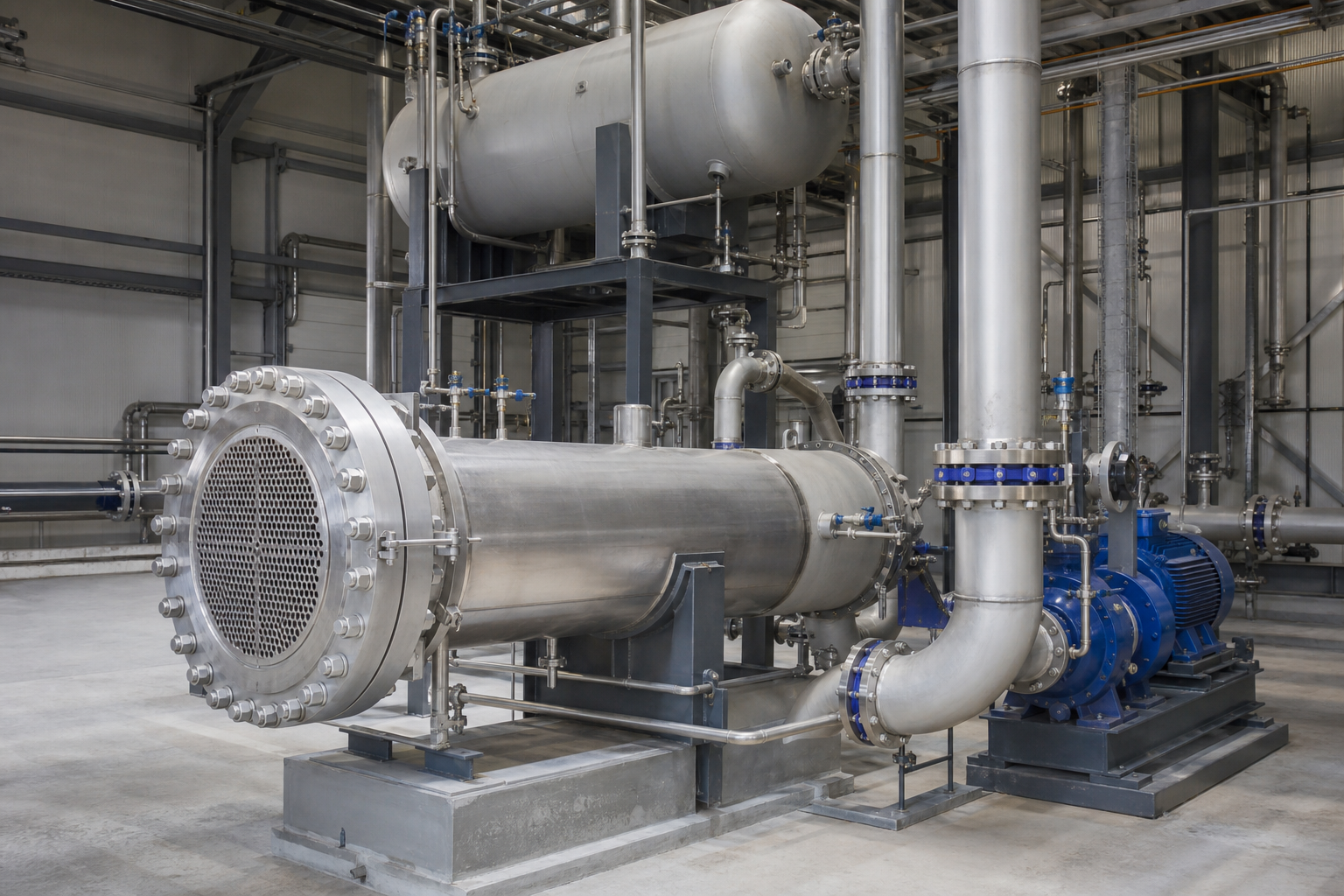
The flowsheet has two blocks. In the pretreatment block, the raw water passes through oxidation and clarification steps that remove the bulk of COD and the coarse solids – the supplier description specifies that raw liquor first enters a pretreatment system to strip most COD before any heat is invested. The clarified water is then preheated in a ladder that recovers heat from both the live-steam condensate and the process condensate, so the evaporator receives feed close to boiling.
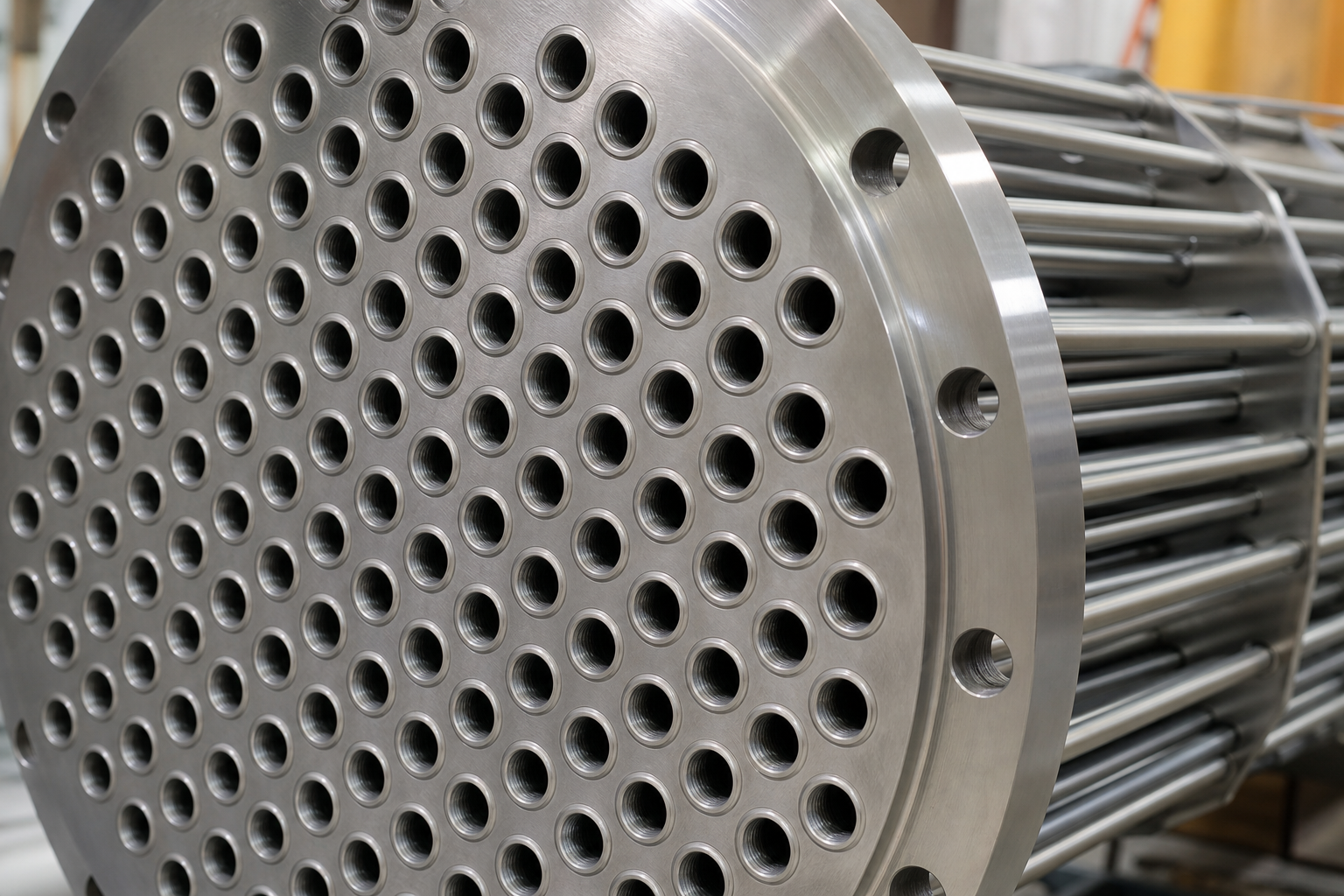
In the evaporation block, liquor circulates through the heating elements under a circulation pump, boils and separates in the vapor body, and concentrates until the crystal slurry reaches its design solids content. The double tube-sheet construction is the distinctive choice here: with tubes rolled into tube sheets at both ends of a twin-column arrangement, the shell-side heating vapor and the tube-side process liquor are isolated from each other even at the joint – eliminating the cross-contamination and crevice-corrosion paths that single tube-sheet designs can expose under high-chloride duty. Forced circulation keeps velocity high through the tubes, which suppresses the local supersaturation spikes that start gypsum scale.
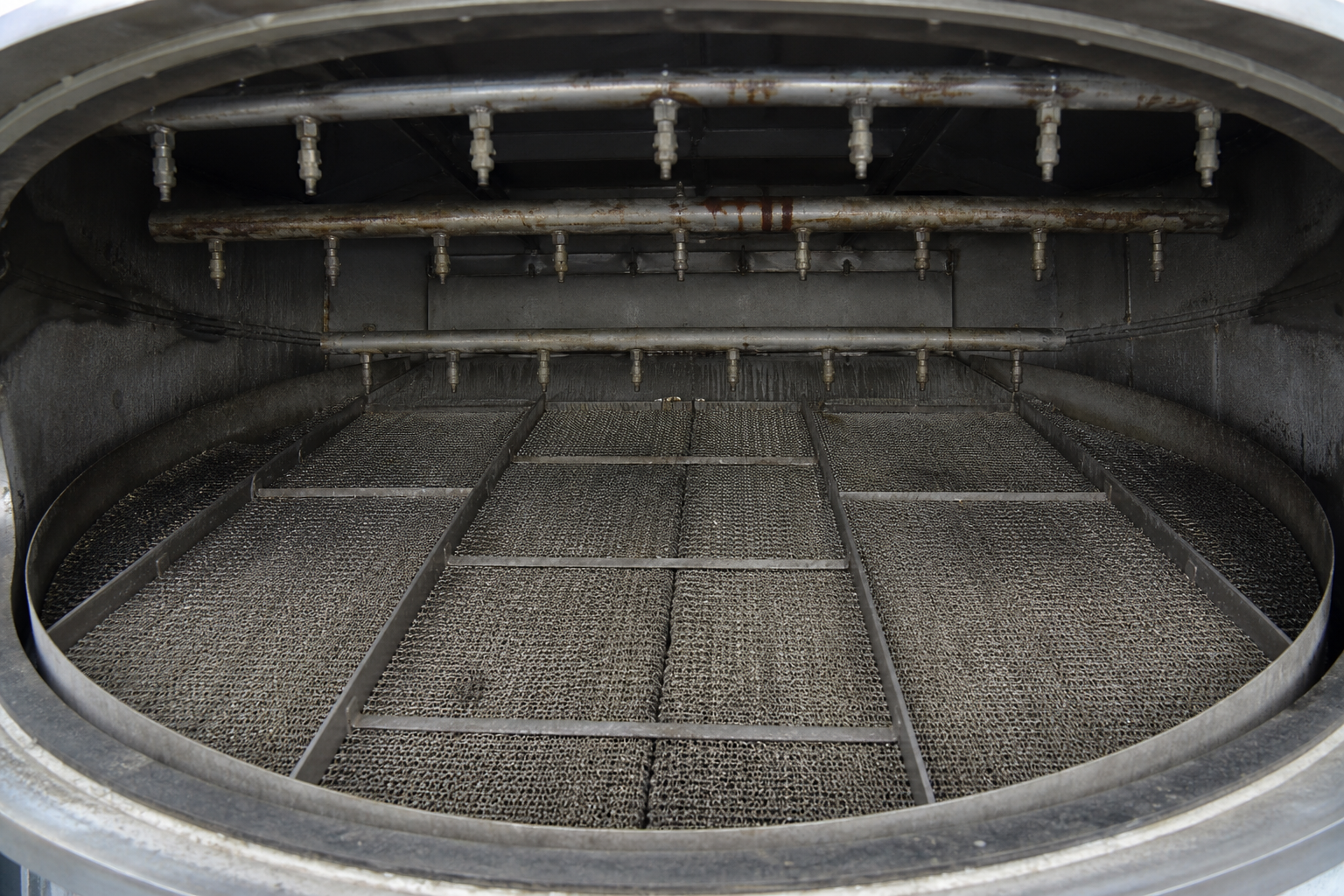
The secondary vapor leaving the vapor body passes through a demister washed counter-currently, knocking entrained droplets back into the liquor before the vapor is recompressed. When the slurry reaches design concentration it discharges to a thickener and centrifuge; the mother liquor is purged from the system rather than recycled indefinitely, which is how soluble COD and fine impurities are kept from accumulating in the loop.
Technical Features
One further energy detail from the reference flowsheet deserves attention: the live steam that heats the first effect does not leave the system as waste condensate. It condenses against the effect, drains, and is routed to the feed preheater where it warms the incoming raw liquor before discharging. That is a small heat exchanger doing quiet, continuous work – every kilojoule recovered there is a kilojoule the evaporator does not have to add. Combined with condensate-from-process preheating on the cold end, the train enters boiling with almost no purchased sensible heat, which is where many real-world evaporation systems quietly lose their design efficiency.
Four features carry the design. First, the double tube-sheet construction itself – a mechanical insurance policy against the two failure modes (cross-leak and crevice attack) that most often terminate high-chloride evaporator service. Second, forced circulation as the flow regime: the pump, not the boiling driving force, sets tube velocity, decoupling heat transfer from fouling risk. Third, the demister wash circuit, which keeps entrainment – and with it chloride carryover into the condensate – under control at the vapor outlet. Fourth, the full mother-liquor purge philosophy: accepting a modest yield loss in exchange for a system that cannot silently poison itself with accumulated COD and impurities.
Process Modules
| Process module | Candidate equipment types | Selection rationale | Module duty |
|---|---|---|---|
| COD removal | Oxidation / clarification package | Strips bulk organics before thermal treatment | Protect condensate quality and foaming behavior |
| Feed preheating | Condensate-and-live-steam heat ladder (plate or tubular exchangers) | Recovers sensible heat from both condensate streams | Raise feed to near-boiling before the heater |
| Evaporation body | Double tube-sheet forced-circulation MVR evaporator | Isolates shell/tube sides; high velocity resists gypsum scaling | Concentrate brine to design slurry density |
| Vapor cleaning | Counter-current washed demister | Removes entrained droplets from secondary vapor | Protect compressor and condensate quality |
| Vapor recompression | Centrifugal MVR compressor | Electric heat pump over the boiling loop | Recycle secondary vapor as heating medium |
| Slurry handling | Thickener + centrifuge | Densify and dewater crystal slurry | Dischargeable solid; mother liquor purge |
Configuration, materials and operating envelopes above are potential considerations only; actual selections depend on feed composition, temperature, corrosion review, fouling behavior, utilities and project capacity.
Expected Performance and Limits
For high-chloride FGD-class brines, forced-circulation MVR trains typically evaporate in the 20-40 kWh per cubic meter band (engineering estimate assuming single-stage recompression and clean condenser approach temperatures); the 360 T/D reference capacity is supplier-published and indicative, not a project guarantee. Condensate quality is governed by entrainment control and by the pretreatment COD removal – volatile organics that survive pretreatment will report partially to the condensate, which is why the pretreatment block is not optional in this flowsheet. The mixed salt cake is a disposal-stream question, not a product, unless a separation step is deliberately added.
Industry References and Validation
The anchor for this configuration is a supplier-published desulfurization/denitrification wastewater case: 360 T/D capacity, double tube-sheet (twin-column) MVR evaporator, forced circulation with washed demisters, thickener-and-centrifuge slurry train, full mother-liquor purge. This is an external industry reference, not an EvapCryst delivery; outcomes cited are indicative only. For validation of a specific project, the minimum package is: full water analysis including chloride, sulfate/sulfite ratio, calcium at gypsum saturation, metals and COD; a scaling-tendency assessment at the concentration endpoint; corrosion testing of candidate tube and sheet materials under chloride at boiling temperature; and a clarification trial to confirm achievable COD and solids ahead of the evaporator.
Frequently Asked Questions
What does the double tube-sheet actually buy?
It separates the heating vapor side from the process liquor side at the tube-sheet joints – the classic crevice and cross-leak location in chloride duty. You pay a capital premium for a failure mode that never gets a chance to develop.
Why forced circulation rather than falling film here?
FGD water carries gypsum and solids that scale on wall supersaturation. Forced circulation sets tube velocity with a pump, keeping the wall film swept; falling film would hand that control to the boiling process itself, which is exactly what you do not want with a scaling brine.
Why is the mother liquor fully purged?
Soluble COD and fine impurities concentrate in any recycled mother loop. In this chemistry they eventually inhibit crystallization and contaminate the salt. Purging the mother liquor keeps the system stable at the cost of some yield – a deliberate availability-over-yield trade.
Can the condensate go back to the scrubber?
Usually yes, provided entrainment is controlled and volatile COD was removed in pretreatment. Condensate reuse back to the absorption tower loop is the standard water-closure path for this configuration.
Is MVR always better than multi-effect at this scale?
Not always – it is a utilities question. Where steam is cheap and power expensive, a triple-effect train can win on OPEX despite higher steam use. The MVR advantage grows with capacity and with steam price.
When This Route May Not Fit
If the wastewater is dilute – TDS in the low thousands of mg/L – evaporation of the full flow is the wrong tool; membrane concentration first, evaporation of the brine only. If the chloride load is combined with high levels of ammonia or volatile organics that cannot be pretreated out, the condensate will not close the loop without additional polishing. And where the plant already operates a large steam system with spare capacity, multi-effect evaporation deserves a straight comparison before MVR is assumed.
What Must Be Verified Before Committing
A complete water analysis (ions, silica, metals, COD fractionation); gypsum saturation margins along the concentration path; material corrosion testing under boiling chloride; pretreatment performance trials for COD and solids; a site utilities survey (power quality and price, steam availability); and a disposal route for the mixed salt cake. These are the inputs that turn the illustrative envelope above into a project.