Project Parameters
| Parameter | Value |
|---|---|
| Process route | MVR evaporation with staged four-salt separation |
| Industry | Rare earth separation and metallurgy |
| Feed type & key components | Rare earth separation effluent bearing NaCl, Na2SO4, Na2CO3 and ZnSO4 |
| Throughput | 150 t/d feed treatment (published as processing capacity) |
| Construction materials | SS316L / duplex (indicative) |
Representative process configuration compiled from published industry project data. Indicative values, not a process guarantee.
Project Description
A rare earth separation plant in North China dissolves concentrate, separates individual rare earths by solvent extraction, and precipitates them as carbonates — a flowsheet that consumes sodium carbonate, washes with chloride-bearing waters, and carries zinc into the circuit from zinc-powder purification steps and ore associates. The result is an effluent unique among saline wastewaters: not one salt or two, but four — sodium chloride, sodium sulfate, sodium carbonate and zinc sulfate — each with different solubility behavior, and one of them carrying a recoverable metal value. Direct evaporation to mixed solids would landfill the zinc with the sodium salts; the site’s program is a separation train that splits the salt load into recoverable fractions.
The reference configuration is an MVR evaporation system with staged separation at a published 150 t/d processing capacity. Mechanical vapor recompression suits the duty’s economics — a continuous campaign load driven electrically, at a scale where steam supply to a multi-effect train would dominate operating cost — while the separation chemistry does its work in how the train is staged and cut.
Process Technology

The effluent is equalized and filtered, with residual rare earth values scavenged upstream so the train receives a liquor whose metal content beyond zinc has already been minimized — protecting both salt purity and product yield. The carbonate alkalinity of the feed is managed in conditioning, both because free carbonate shifts crystallization windows and because it pairs with calcium hardness into scale if allowed through.
Separation exploits the four salts’ different departure points from solution. As the MVR-driven body concentrates the liquor, sodium chloride — with weak temperature dependence — is drawn toward a crystallizing section operating on evaporation alone, while sodium sulfate is routed to exploit its strong retrograde solubility: cooled sections precipitate Glauber’s salt where chloride stays dissolved. Zinc sulfate, the value carrier, is held in solution through the sodium cuts and concentrated toward its own crystallization or a downstream zinc recovery route, so the metal reports to a zinc-bearing fraction instead of diluting the salt streams. Sodium carbonate follows the sodium chloride cut as the soluble sodium residue, its split defined by the site’s cut chemistry rather than by any single effect.
In practice the train runs as concentration bodies under the MVR compressor serving staged crystallizers, each cut taken at its own density and temperature setpoint, mother liquors recycled within their cut to hold purity, and a purge on each loop preventing the trace impurities of a separation plant — organics from extraction chemistry, calcium, residual heavy metals — from accumulating to the point of contaminating product fractions. Condensate from the surface condenser returns to the plant’s washing circuits; in a water-permit-constrained region this closed loop matters as much as the salt split.
Equipment Configuration
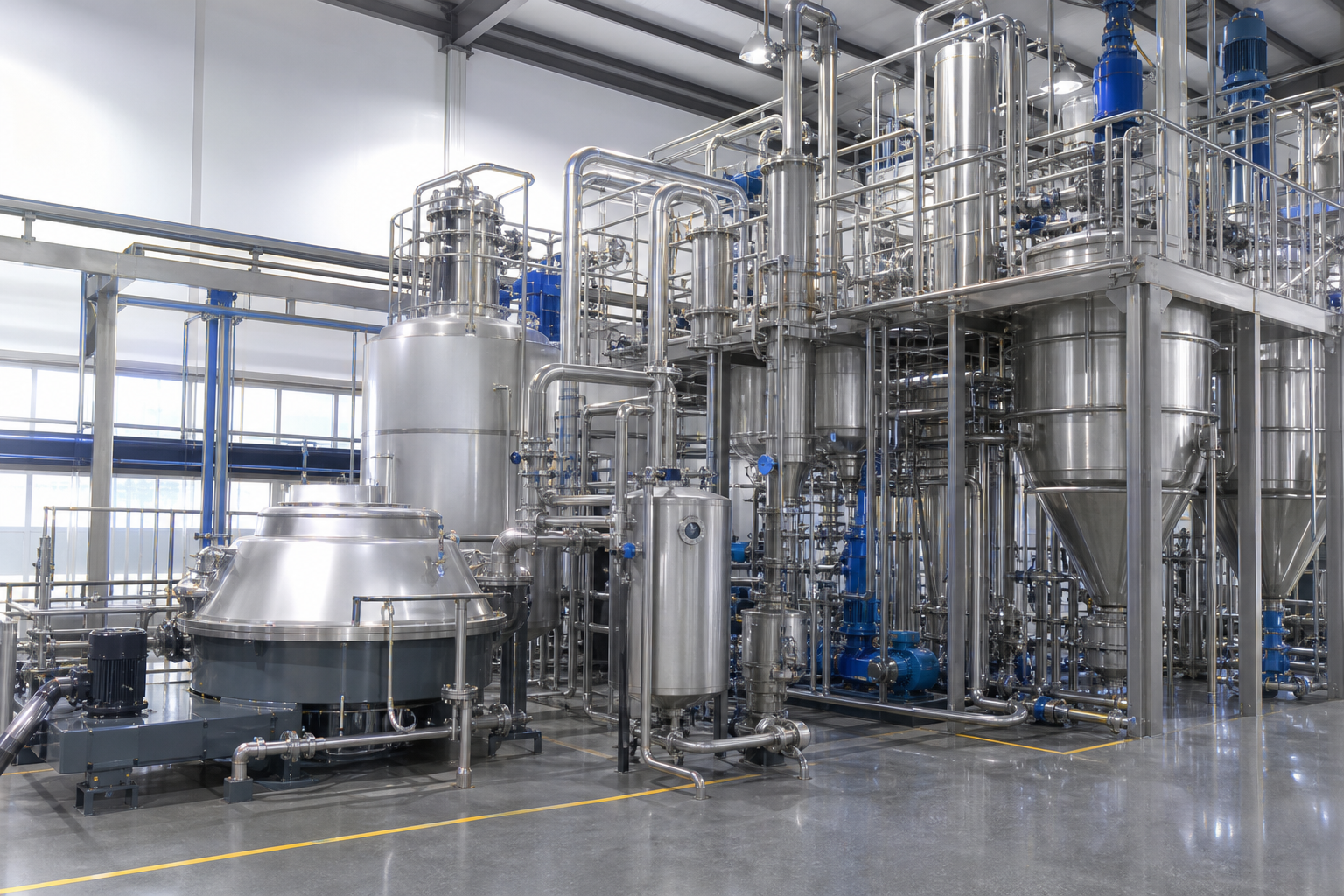
One system of this class comprises:
- Equalization, filtration and rare earth scavenging interface; carbonate and hardness conditioning
- MVR evaporation bodies with mechanical vapor recompressor, demisters and anti-surge control
- Staged crystallizing sections: evaporative NaCl cut, cooling-based Na2SO4 cut, zinc sulfate concentration toward recovery
- Centrifuges per cut with segregated cake handling; mother-liquor recycle loops with purges
- Surface condenser, condensate tank and reuse pumping to washing circuits
- Density- and temperature-based cut control with clean-in-place circuits
SS316L is the indicative baseline, with duplex where hot chloride concentration peaks; zinc service adds review of weld procedures and chloride stress-corrosion margins on the zinc cut.
Performance & Outcome
Compiled from published industry project data, indicative: staged MVR systems of this class process four-salt rare earth effluent at published capacities around 150 t/d, splitting the load into separated sodium salt fractions and a zinc-bearing stream directed to recovery, with condensate returned to plant reuse. Cut purities, zinc recovery and energy figures depend on the salt ratios of the feed and are engineered per project.
Simplified PFD
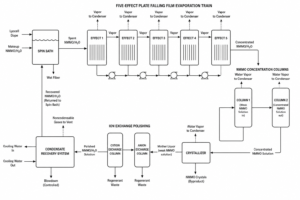
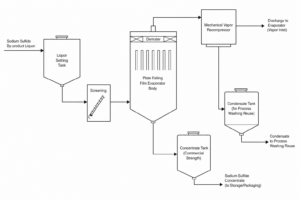
The simplified process flow diagram above illustrates the system from equalization through MVR concentration to staged salt cuts and zinc recovery routing.