
Project Parameters
| Parameter | Value |
|---|---|
| Process route | Four-effect evaporation + forced-circulation crystallization |
| Industry | Rubber chemicals — accelerators, antioxidants and intermediates |
| Feed type & key components | Sodium sulfate-bearing wastewater from sulfidation, reduction and neutralization chemistry |
| Evaporation capacity | 550 t/d feed treatment (approx. 23 t/h) |
| Construction materials | SS316L / duplex (indicative) |
Representative process configuration compiled from published industry project data. Indicative values, not a process guarantee.
Project Description
A rubber chemicals plant in China produces accelerators, antioxidants and their intermediates through chemistry that runs on sodium — sulfidation, reduction and neutralization steps that leave sodium sulfate as the standing by-product salt, entangled with aniline and amine derivatives, thiocarbamate residues and the colored organics characteristic of the product families. The wastewater is high-volume by effluent standards — 550 t/d — saline, organically loaded, and under a discharge regime that closed the dilution route years ago. The plant’s program is a four-effect evaporation and crystallization train that removes the salt as a sodium sulfate solid and returns the water, at a scale where energy economy is not an optimization detail but the difference between a defensible and an indefensible operating cost.
The reference configuration is a four-effect train with forced-circulation crystallizing sections. Four effects is the answer the duty arithmetic gives: above roughly twenty tonnes per hour of water removal, each additional effect pays its capital back in steam, and the rubber chemicals site’s dependable steam supply makes the long cascade the economical machine. Forced circulation carries the finish because sodium sulfate crystallizes on the way through — and it is a crystallization with habits of its own.
Process Technology
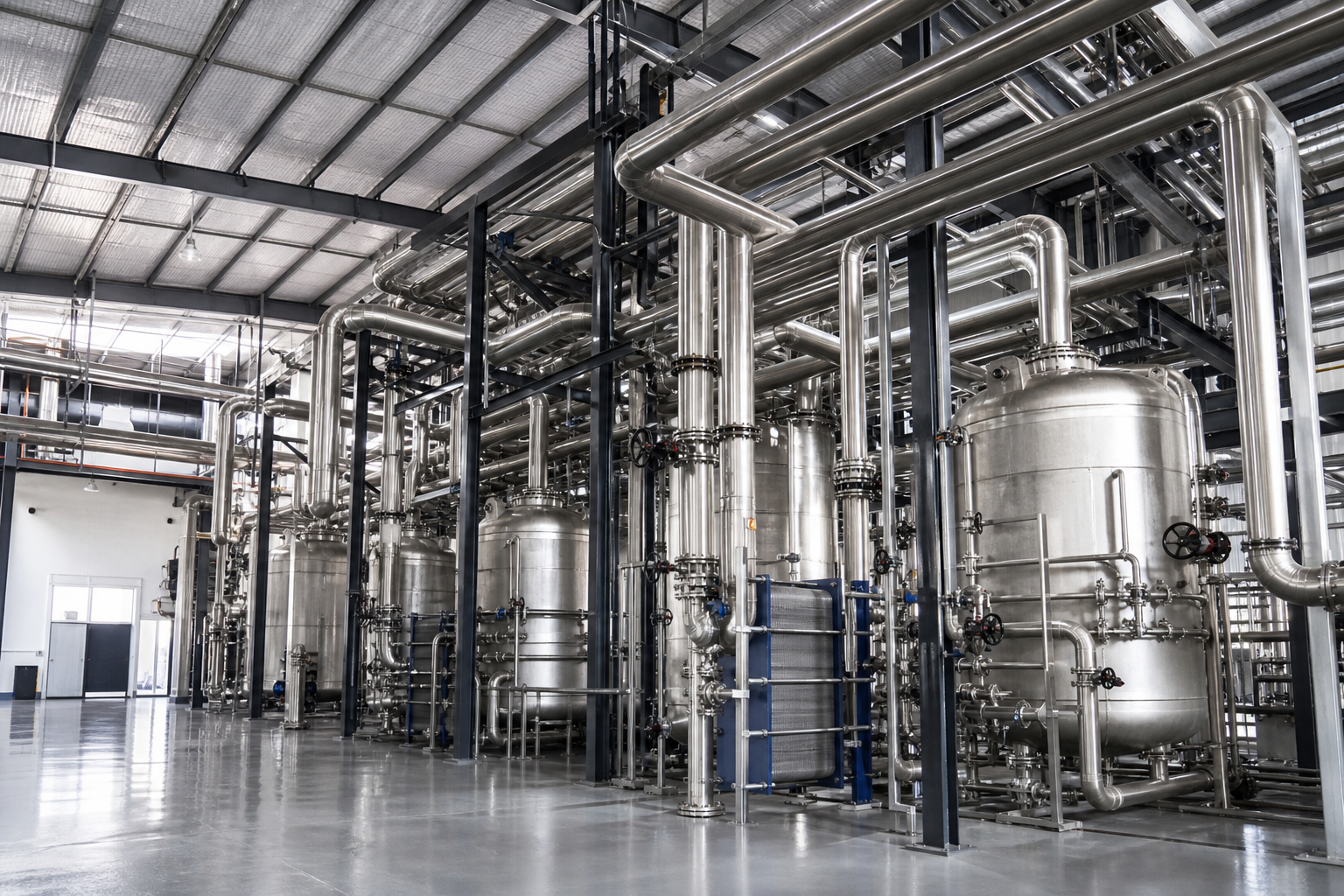
The wastewater is equalized across production campaigns and pretreated for the organics that define this stream: dissolved amines and anilines are partially removed or oxidized upstream to protect both salt quality and condensate, and filtration takes out carbon and tar fines. Where the chemistry leaves color bodies at high levels, the salt product specification drives how deep this pretreatment goes — the recovered sulfate is sold or disposed by its purity.
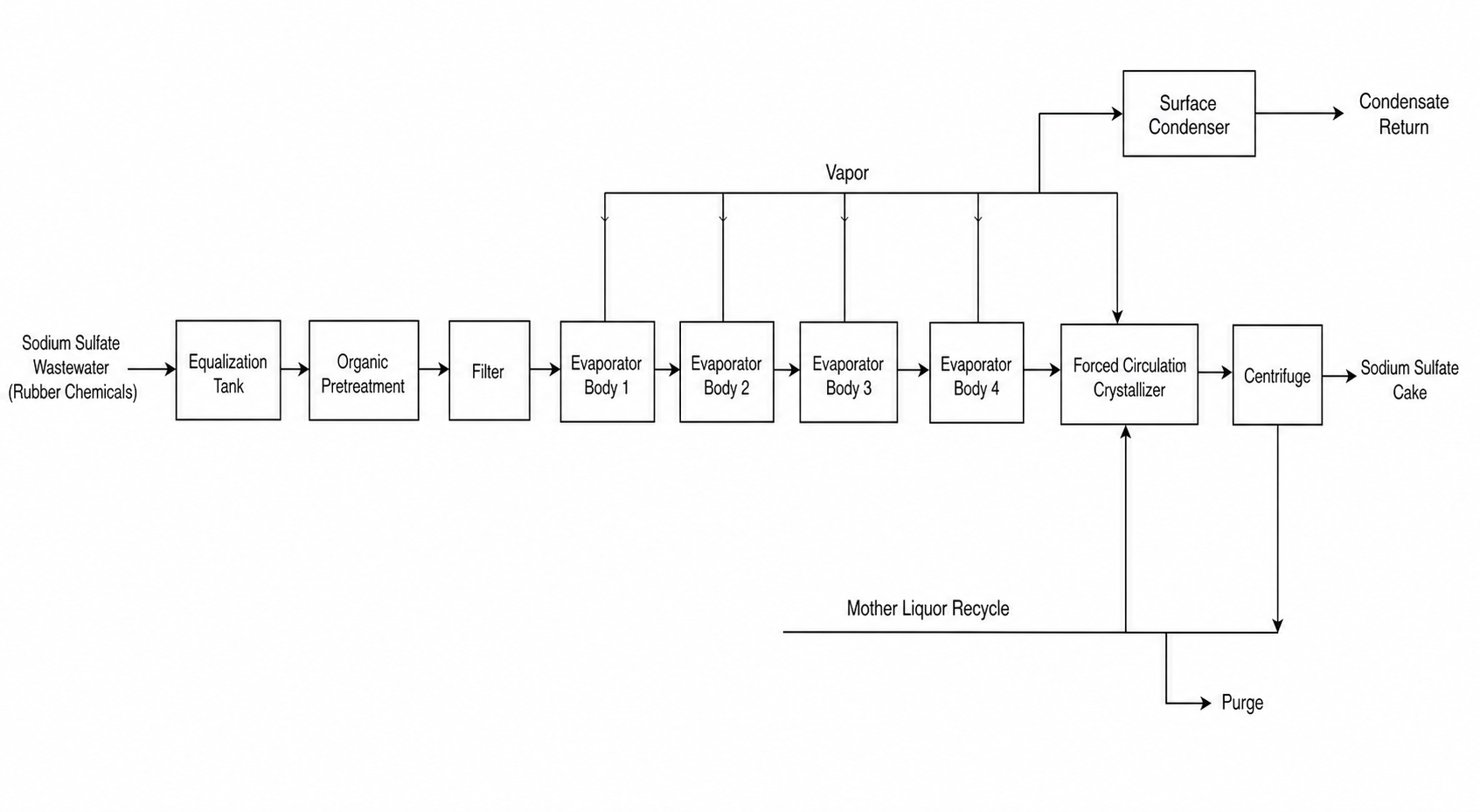
The four effects run in a descending temperature ladder, each body heated by its predecessor’s vapor, the final body under vacuum at the surface condenser. The front effects concentrate the liquor while it remains below saturation, harvesting steam economy on plain water removal. Sodium sulfate’s crystallization behavior dominates the design of the back half: above 32.4 °C it crystallizes as anhydrous mirabilite-then-thenardite with a flat, uncooperative solubility curve, below it as Glauber’s salt with a steep one — and the train’s crystallizing sections operate with this phase map in view, running hot forced-circulation sections that manage the anhydrous transition without plating sulfate onto the walls. The crystals grow in the moving bulk liquor and are drawn off as slurry; dewatering on centrifuges or filters yields a sodium sulfate cake routed to salt refining or managed disposal per its grade.
Mother liquor recycles with a purge — on rubber chemicals service the purge is what keeps the colored organics from accumulating to the level that stains the salt and fouls the train — and condensate from the surface condenser returns to the plant’s washing circuits. At 23 t/h class water removal, the condensate return is a utility stream the site counts on the credit side of the project.
Equipment Configuration
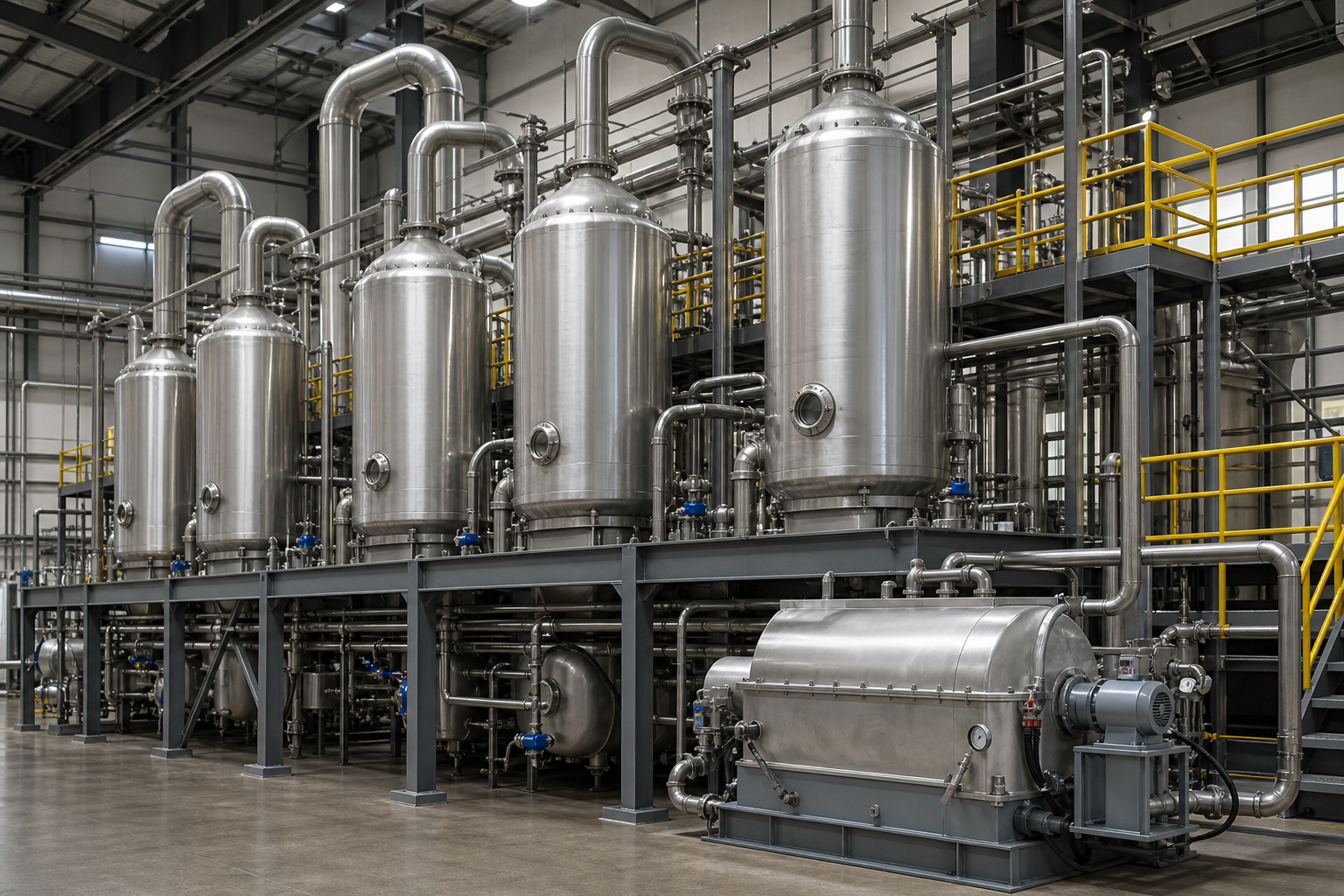
One train of this class comprises:
- Campaign equalization; organic pretreatment and filtration for amine, aniline and carbon fines control
- Four-effect evaporator bodies with inter-effect vapor transfers, surface condenser and vacuum system
- Forced-circulation crystallizing sections designed around the sodium sulfate phase map
- Centrifuge or filter for sodium sulfate cake; mother-liquor recycle with organic purge
- Condensate collection and return to washing circuits
- Density- and temperature-based control with clean-in-place circuits
SS316L with duplex at the hot concentrated end is the indicative metallurgy; sulfate service is forgiving relative to chloride, but the organic load and temperature profile set the specification per section.
Performance & Outcome
Compiled from published industry project data, indicative: four-effect forced-circulation trains of this class recover sodium sulfate from rubber chemicals wastewater at feed rates around 550 t/d with multi-effect steam economy, producing a dewaterable sulfate cake and returning condensate to plant reuse. Salt grade, organic control and steam economy depend on feed composition and are engineered per project.
Simplified PFD
The simplified process flow diagram above illustrates the train from pretreatment through the four effects to sulfate crystallization, dewatering and condensate return.


