An external circulation evaporator moves liquid through an outboard loop: a heating chamber, a separate boiling-and-separation vessel, and upper and lower external circulation pipes that connect them. When that loop is driven purely by the density difference between the two-phase mixture in the tubes and the heavier liquid in the downcomer — thermosiphon, or natural circulation — the machine has no circulation pump at all. With velocities of 2–4 m/s when pump-driven, heat-transfer efficiency improving 10–15% for every 1 m/s of added circulation velocity, and evaporation intensity of 1.2–1.5 kg/m²·h, this family is the workhorse for scaling-prone, high-concentration-duty feeds in food, chemical, and fermentation service (figures are typical published values; sectors listed as illustrative applications). This guide explains the structure, the design numbers that matter, and how to choose between natural and forced external circulation.
What Is an External Circulation Evaporator?
The defining structural feature is in the name: the circulation path sits outside the boiling vessel. A complete unit consists of three parts:
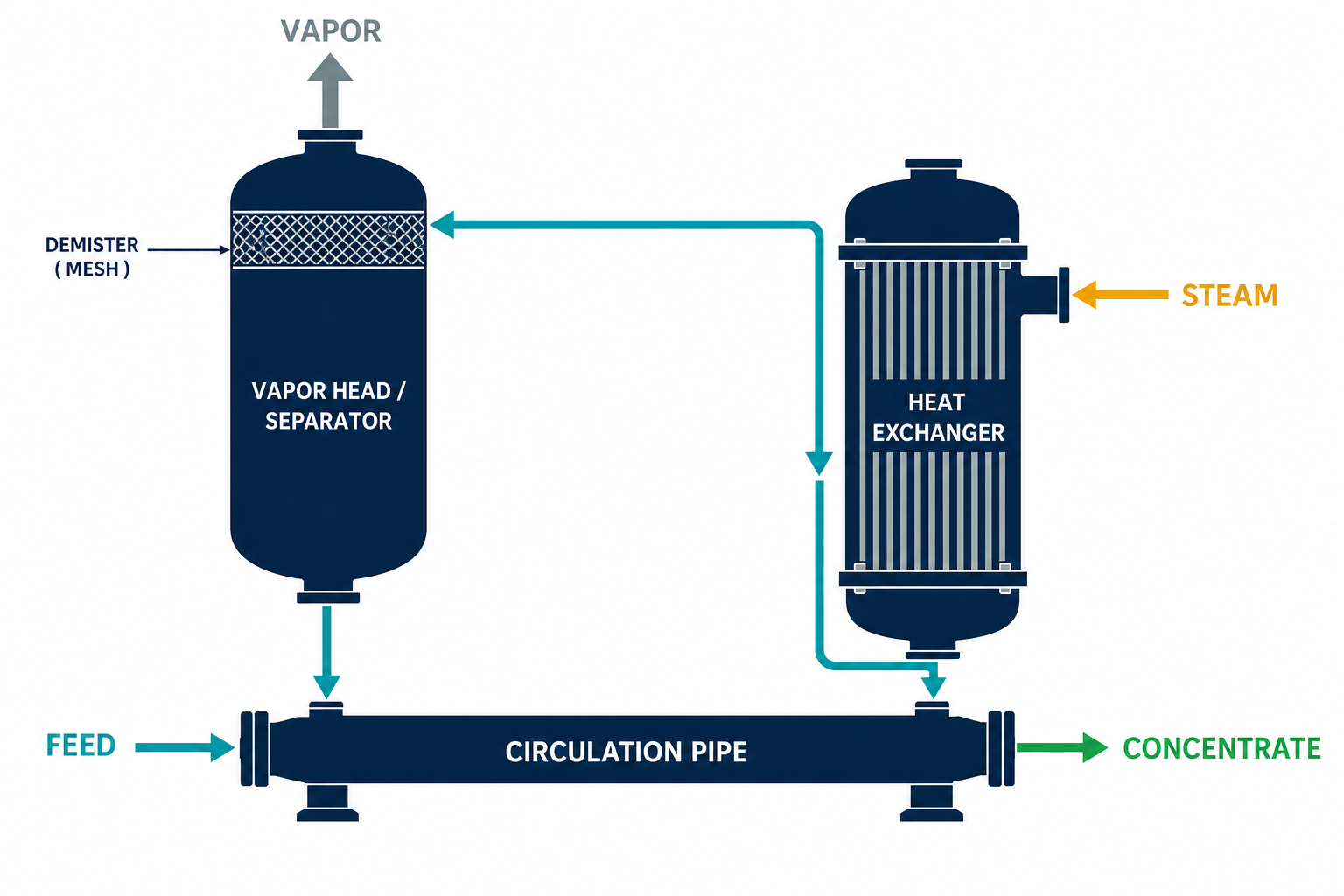
- Heating chamber — a tubular heat exchanger, usually vertical, where the liquid picks up heat from steam or thermal oil on the shell side.
- Evaporation-and-separation vessel — the boiling body (also called the separator), where vapor disengages from the liquid surface and passes to the condenser.
- Upper and lower external circulation pipes — the outboard loop that returns separated liquid from the vessel bottom to the heating chamber inlet, and carries the two-phase mixture back up to the vessel.
Placing the heater outside the boiling body is what buys this evaporator its two practical advantages. First, the heat-transfer surface is accessible for inspection and cleaning without opening the vapor body. Second, the liquid holdup in the vessel acts as a buffer, so concentration and level move gradually rather than violently — the property that makes the type tolerant of feeds that scale, foam, or swing in viscosity.
External vs. Natural vs. Forced: Untangling Three Overloaded Terms
These three words are frequently used as if they named competing evaporator types. They do not — they describe two independent design axes, and mixing them up causes real procurement errors:
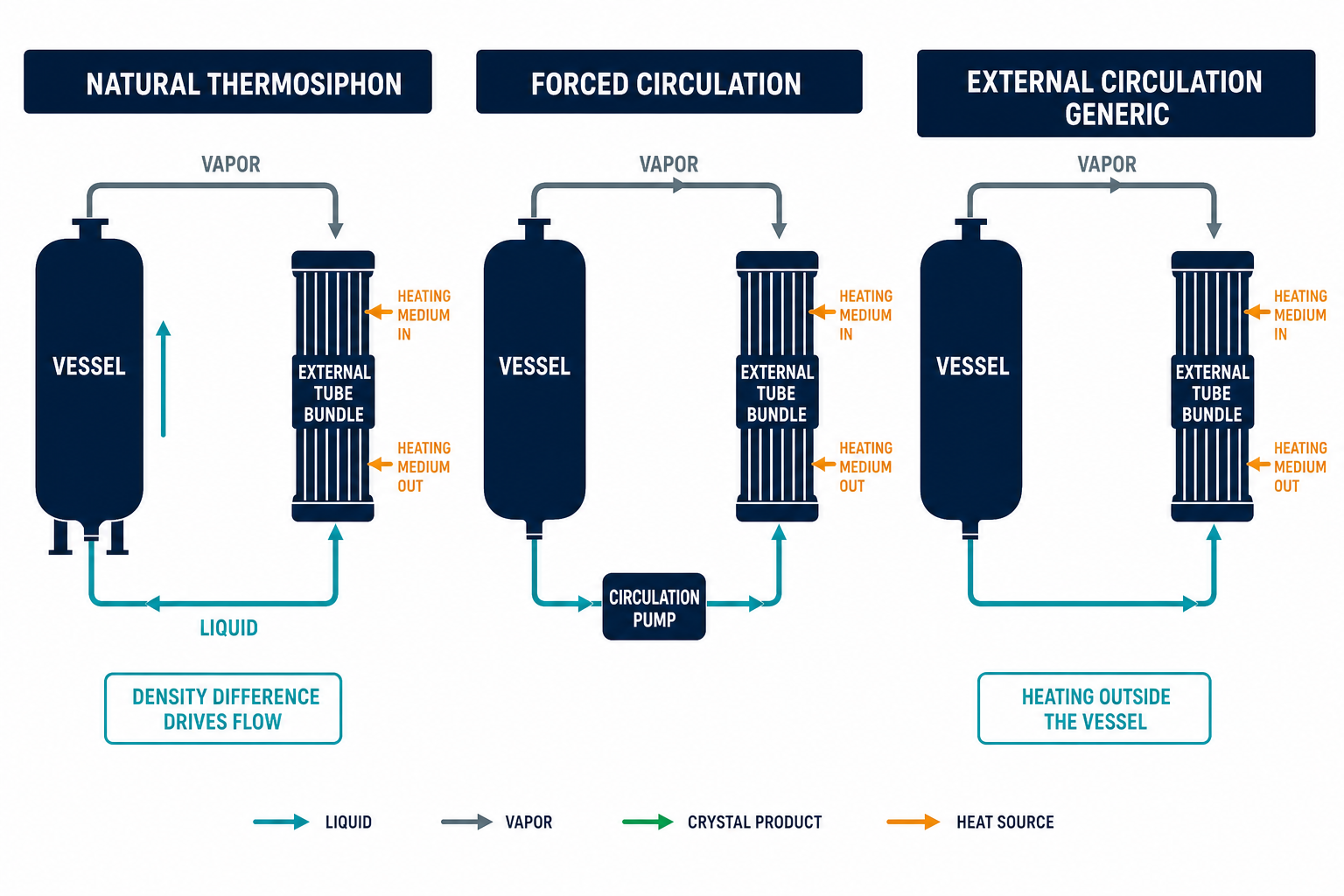
- External circulation is a structural concept. It says where the circulation path is: outside the vessel, through external piping. Its opposite is internal circulation, where the heating element or draft tube sits inside the body.
- Natural circulation is a drive concept. It says what moves the liquid: density difference alone (thermosiphon), with no pump in the loop. Its opposite is forced circulation, where a pump does the work.
The two axes combine freely. An external-circulation evaporator can run as natural circulation (thermosiphon loop, no pump) or as forced circulation (a circulation pump inserted in the lower pipe). Pump-driven external loops typically run at 2–4 m/s — markedly higher than internal-circuit designs — which is precisely why the type earns its reputation with scaling and viscous feeds. When the loop is instead kept inside the vessel around a draft tube, you are looking at internal-circulation machinery, a different family altogether; the forced-circulation evaporation overview covers that pump-driven branch in detail.
How Natural (Thermosiphon) Circulation Works
The driving force is gravity acting on a density difference. Liquid films on the inner walls of the heating tubes absorb heat and begin to boil; vapor bubbles form, rise, and drag liquid upward with them — the same mechanism that drives rising-film evaporation. The two-phase mixture reaches the separation vessel, the vapor leaves overhead to the condenser, and the now-denser degassed liquid flows down the external circulation pipe back to the heater inlet. The loop sustains itself as long as the heating temperature is high enough to sustain boiling in the tubes and the temperature difference between heating chamber and boiling chamber is large enough to keep the density gradient alive.
This is why natural-circulation service has a reputation for wanting generous temperature driving force: the circulation rate is not set by a pump curve but by the boiling physics. Feed the unit a small ΔT and circulation slows to a crawl, velocities fall below the fouling-deposition threshold, and the tubes scale. Feed it a healthy ΔT and it circulates hard with zero pumping power and zero rotating equipment in the loop — which is the type’s core appeal for plants that value simplicity over controllability.
The Design Parameters That Make or Break the Loop
Two numbers decide whether an external-circulation evaporator runs clean or plugs, and both are set at the design stage:
Liquid level above the upper tubesheet: 4–6 m. The boiling vessel’s liquid level must stand higher than the upper tubesheet of the heating chamber by four to six meters. That static head submerges the tube inlets and suppresses boiling inside the tubes themselves — liquid arrives superheated-but-liquid, flashes only after it leaves the tube and enters the vessel. The payoff is that crystals and scale-forming species precipitate in the body, where slurry can be managed, not on the tube wall where they plug flow. Get this dimension wrong and the evaporator fouls tube-by-tube from the top down.
Circulation-pipe velocities. The two legs of the loop run at deliberately different speeds:
| Loop section | Design velocity | Reason |
|---|---|---|
| Upper circulation pipe (two-phase, vessel return) | Below 1 m/s | Prevents flash-boiling surges under vacuum; pipe diameter is made slightly larger to slow the mixture |
| Lower circulation pipe (single-phase, heater feed) | 1.3–1.5 m/s | Keeps solids suspended and moving toward the heater without erosion |
| Pump-driven external loop (whole circuit) | 2–4 m/s | High sweep velocity for scaling-prone and viscous duties; shear also lowers apparent viscosity of non-Newtonian feeds |
The velocity dividend is measurable in typical published figures: every 1 m/s of additional circulation velocity improves heat-transfer efficiency by roughly 10–15%, and overall evaporation intensity lands at 1.2–1.5 kg/m²·h — some 1.8–2.4 times what a plain natural-circulation internal design delivers. A larger ΔT between heating and boiling chambers raises circulation and heat-transfer rates further still, which is why designers of thermosiphon units protect driving force rather than chasing maximum steam economy.
Vacuum Operation for Heat-Sensitive Feeds
External-circulation evaporators take vacuum well, and vacuum is how the type serves sugar solutions, fruit juices, herbal extracts, and amino-acid and biological liquors without cooking them. Typical relationships between vacuum depth and boiling-point depression:
| Operating vacuum | Boiling-point reduction | Representative feed |
|---|---|---|
| 70 kPa | ≈15 °C | Sugar solutions |
| 85 kPa | ≈22 °C | Fruit juices, traditional-Chinese-medicine extracts |
| 95 kPa | ≈30 °C | Amino-acid and biological liquors |
At 85–95 kPa vacuum the product temperature holds between 45 and 65 °C, and degradation of heat-sensitive components is minimal. The combination of low temperature and high circulation velocity is exactly what fermentation and extraction products need — enough to keep quality high while the loop scrubs the heat-transfer surface clean. Food and fermentation plants running these duties (illustrative applications) are profiled on the food and fermentation industry page.
The Partitioned Boiling Chamber: Less Area for the Same Duty
The most under-appreciated trick in this evaporator family is splitting the boiling chamber into multiple compartments, each with its own independent circulation loop. The logic exploits how concentration evolves through an evaporation train: only the final compartment ever sees terminal concentration, where viscosity is highest and boiling-point elevation steepest. Every upstream compartment operates at lower concentration, lower viscosity, and lower boiling-point elevation — all of which mean higher heat-transfer coefficients.
Distributing heat-transfer area across the compartments this way can substantially reduce the total area needed to reach a high final concentration, because the difficult end-duty no longer dictates the size of the whole surface. For retrofits where shell space is fixed, partitioning is often the only route to a concentration upgrade without a new vessel.
Which Feed Materials Suit External Circulation
The type’s sweet spot is a feed with one or more of these characteristics:
- Insensitive to higher temperatures — the circulation loop runs hot by design.
- Large evaporation ratio — big water-removal per unit of feed.
- Scaling- or fouling-prone — high sweep velocity keeps surfaces productive between cleanings.
- Non-Newtonian behavior — high circulation velocity lowers apparent viscosity, keeping the fluid in a regime where heat transfer still works.
In practice the population splits into food (fruit juice, sugar liquor, plant extracts), chemicals (salt solutions, high-salinity wastewater, electroplating liquor recovery), and bio-fermentation (amino acids, enzymes, proteins), all illustrative applications rather than a fit guarantee. For feeds at the opposite pole — extremely heat-sensitive or extremely viscous past the pumpable range — a scraped-surface machine is the better answer; the scraped-surface and wiped-film evaporator guide treats that branch separately.
External Circulation vs. Falling Film vs. Forced Circulation
Three evaporation types compete for the same medium-duty jobs, and they trade off predictably:
| Criterion | Falling film | External circulation (natural) | Forced circulation |
|---|---|---|---|
| Heat-transfer efficiency | Highest of the three | Moderate, ΔT-dependent | High and controllable |
| High-viscosity compatibility | Poor (low rating) | Moderate | Strong — the workhorse answer |
| Scaling tolerance | Low — thin films foul fast | Good with correct velocities | Best, with 2–4 m/s sweep |
| Rotating equipment in loop | Distribution pumps only | None | Circulation pump (power draw) |
| Sensitivity to ΔT | Works at small ΔT | Needs generous ΔT | Tolerates small ΔT |
Falling film wins on thermodynamic elegance but is fragile on fouling and viscous service. External-circulation and forced-circulation machines are both workhorses; between them, the choice is whether you can live with a thermosiphon’s dependence on driving force or would rather pay pump power for velocity on demand.
Eight Specifications to Fix Before You Buy
A procurable specification for this evaporator family needs eight numbers, not a brochure:
- Evaporation capacity (kg/h of water removed) at your feed concentration and terminal concentration.
- Heat-transfer area (m²) and tube geometry, consistent with the velocity targets above.
- Heat source — saturated steam pressure or thermal-oil temperature, matched to the ΔT the circulation mode requires.
- Viscosity and solids range the loop must sweep, worst case, not average case.
- Circulation pump flow and head (forced-circulation variants) — sized for the design velocity at terminal viscosity.
- Vacuum range (kPa) and the condenser duty that supports it.
- Wetted materials — SS304 for benign food duty, SS316L for corrosion and hygiene, duplex grades for chloride stress service.
- Automation level — PLC or DCS, with the loops that matter: level, vacuum, steam pressure, and concentration.
On a constrained budget, spend first on heat-transfer area, vacuum capability, and pump configuration — the three items that cannot be upgraded cheaply after installation.
Keeping It Productive: Operating Windows That Pay
Field-practice targets for a healthy external-circulation evaporator:
- Circulation-pump flow held at or above 90% of design value; falling flow signals wear or fouling before efficiency does.
- Vacuum fluctuation kept under 1 kPa — wandering vacuum destabilizes both boiling and product temperature.
- Steam pressure in the 0.2–0.4 MPa band the heater was designed for.
- Heat exchanger cleaned on a 3–6 month schedule rather than on failure.
- Condenser approach ΔT above 8 °C triggers cleaning before capacity collapses.
- Feed preheating with condensate or vapor heat typically lifts evaporation capacity 10–18% for near-zero operating cost.
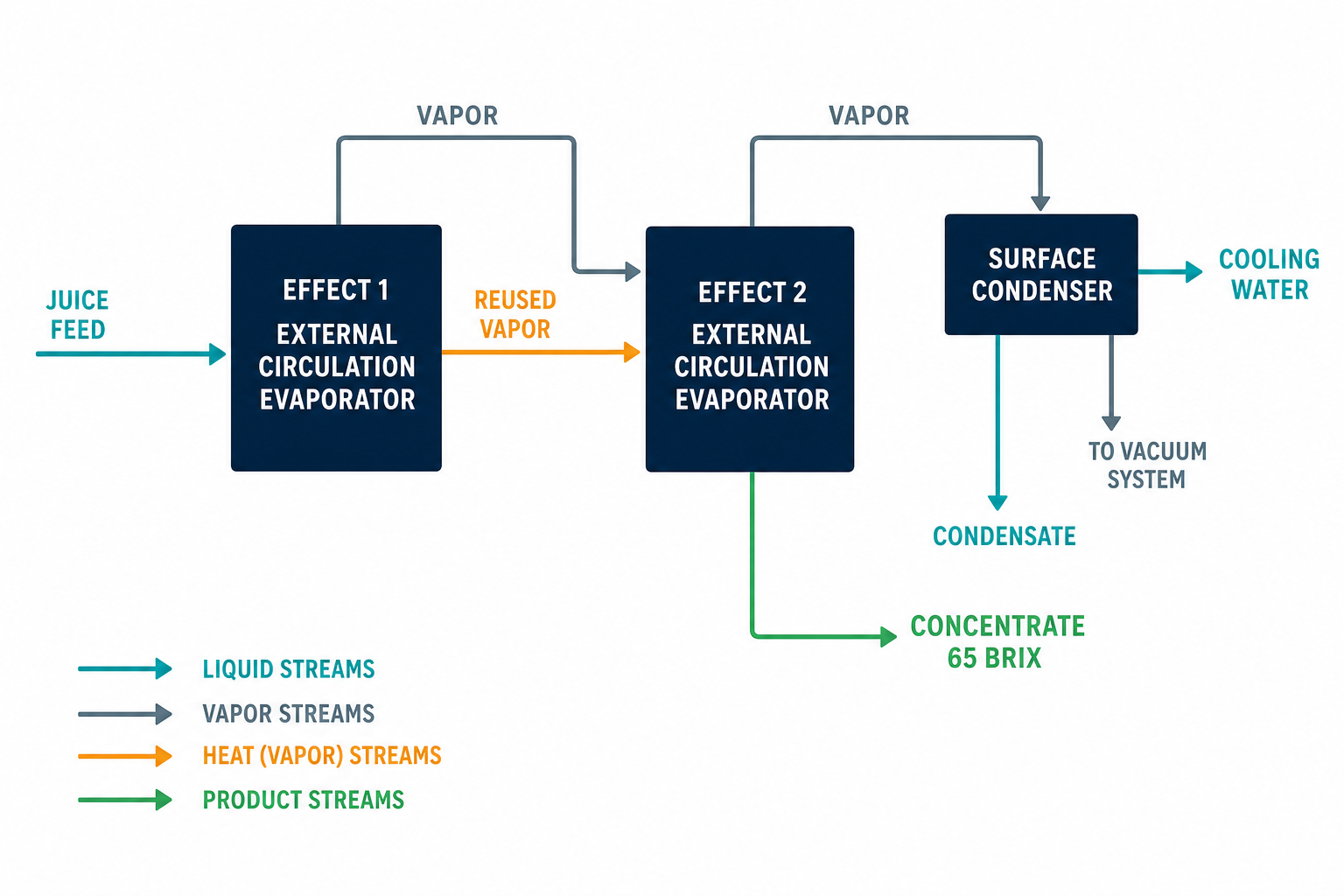
In typical published figures, pump-driven external circulation runs 20–30% below natural-circulation designs on specific energy when paired with multi-effect configuration, and multi-effect arrangement cuts a further 40–60%; annual maintenance cost runs 10–30% lower than comparable internal-circulation machinery. Plant-wide energy architecture — including where mechanical vapor recompression or multi-effect staging fits — deserves its own analysis before the circulation type is frozen.
Retrofit Case: Juice Concentration, 1,500 kg/h
A fruit-juice concentration line rated at 1,500 kg/h water removal replaced an aging natural-circulation internal design with a pump-driven external-circulation evaporator. Measured results (external industry reference): steam consumption fell from 1.25 to 0.86 t per ton of evaporated water; heat-transfer efficiency rose 42%; product changeover (cleaning between juices) shortened from 4 hours to 1.5; annual maintenance cost dropped from RMB 180,000 to RMB 80,000. The project paid back in 13 months with total cost down 38%. The pattern generalizes: when an old thermosiphon unit is fouling-bound and changeover-dominated, converting the loop to external pump-driven circulation recovers capacity faster than any chemistry-side intervention.
Where the Type Is Heading
Four directions are visible in current equipment: automatic control that coordinates steam and vacuum without operator attention; hybrid trains that pair external-circulation bodies with multi-effect or MVR energy systems; strengthened circulation for ever-higher solids and viscosity; and low-maintenance structural design — quick-opening heaters, external inspection access — that shortens the cleaning episodes that dominate downtime on this family.
FAQ
Is external circulation the same as natural circulation?
No. External circulation describes structure — the circulation loop runs outside the boiling vessel. Natural circulation describes the driving force — thermosiphon density difference with no pump. An external-circulation evaporator can be built either way: thermosiphon-driven or pump-driven (forced) at 2–4 m/s.
Why must the vessel liquid level sit 4–6 m above the heating chamber tubesheet?
The static head suppresses boiling inside the heating tubes, so the liquid enters superheated but single-phase and flashes only in the vessel. That keeps dissolved solids precipitating in the body instead of on the tube wall — the difference between a clean runner and a plugged heater.
What circulation velocities should the loop run?
Upper circulation pipe below 1 m/s to avoid vacuum flash surges; lower circulation pipe 1.3–1.5 m/s to keep solids moving; pump-driven whole-loop circuits 2–4 m/s for scaling and viscous duty. Every extra 1 m/s buys roughly 10–15% more heat-transfer efficiency.
What products suit this evaporator best?
Temperature-tolerant feeds with large evaporation ratios, scaling tendency, or non-Newtonian viscosity: fruit juices, sugar liquors, plant extracts, salt solutions, high-salinity wastewater, electroplating liquors, amino acids, enzymes, and protein broths.
How does it compare with a falling-film evaporator?
Falling film has the best heat-transfer efficiency and works at small ΔT, but its thin film is fragile with fouling and viscous feeds. External circulation tolerates scaling far better and handles non-Newtonian liquids; forced-circulation variants extend that to the heaviest duties at the cost of pump power.