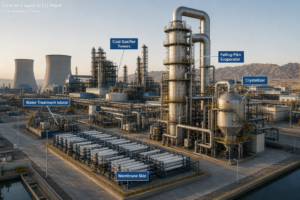
For rare earth mines whose water problem is hardness, silica and moderate dissolved salts at large flow, the workable route before any thermal ZLD is membrane concentration with engineered softening: high-rate chemical softening, filtration and ion exchange strip the scaling ions, then reverse osmosis operated at elevated pH recovers most of the water – and where the site has a chlor-alkali or reagent plant, the RO reject becomes feedstock rather than waste. The design premise: at dilute-to-moderate salinity, membranes recover water an order of magnitude more cheaply than evaporators, and the scaling species that normally limit them are removable by chemistry in front of the train.
The Problem: Mine Water That Fouls Before It Concentrates
Rare earth mining and beneficiation water – well water mixed with process wastewater at a typical site – carries the scaling suite: calcium and magnesium hardness, silica, suspended solids, and trace metals, at salinities far below what justifies thermal treatment. Straight reverse osmosis on this water fouls: hardness and silica precipitate on the membrane as recovery climbs, and the plant settles into a low-recovery, high-cleaning regime that wastes both water and membranes. The alternative that defines this application is the OPUS architecture – optimized pretreatment and unique separation – public reference: a Veolia-designed plant for a rare earth mine treating 1,000 gpm (about 227 m³/h) of well water and wastewater through MULTIFLO high-rate softening, filtration, ion exchange softening and high-pH reverse osmosis, with the concentrated reject sent to salt recovery and then to the site’s chlor-alkali plant as feed for the principal reagents of rare earth separation, enabling production of approximately 20,000 metric tons per year under a zero wastewater discharge goal, and supplied under a long-term performance guarantee (Veolia Water Technologies case study – an external industry reference, not an EvapCryst delivery).
The distinctive closing move in that reference deserves attention: the RO reject is not a waste to be hidden but a chemical feedstock. A rare earth separation plant consumes chlor-alkali products – sodium hydroxide, chlorine, hydrochloric acid – as its principal reagents. Routing the salt-laden reject to the on-site chlor-alkali plant turns the desalination byproduct into raw material, which is what makes zero wastewater discharge an integrated-plant decision rather than an end-of-pipe cost.
Illustrative Feed Envelope for Screening
The envelope below consolidates published reference values with ranges commonly used for screening rare earth mine and beneficiation waters. It is an illustrative envelope built from public industry material and stated assumptions – not a customer dataset, and not a performance guarantee.
| Parameter | Illustrative range | Basis / note |
|---|---|---|
| Water family | Well water + process wastewater blend | Reference plant feed basis |
| Hardness (Ca/Mg) | High – the primary membrane limiter | Softening chemistry driver |
| Reactive silica | Elevated in many rare earth basins | Second limiter; managed by chemistry and pH |
| Suspended solids / metals | Present from mining and beneficiation | Filtration and softening remove ahead of RO |
| Reference scale | 1,000 gpm (~227 m³/h); supports ~20,000 t/y REE output | Published reference plant |
| Treatment objective | High water recovery at elevated pH; reject to reagent value; zero discharge | Integrated-plant closure |
Process Solution: Soften Thoroughly, Then Push Recovery
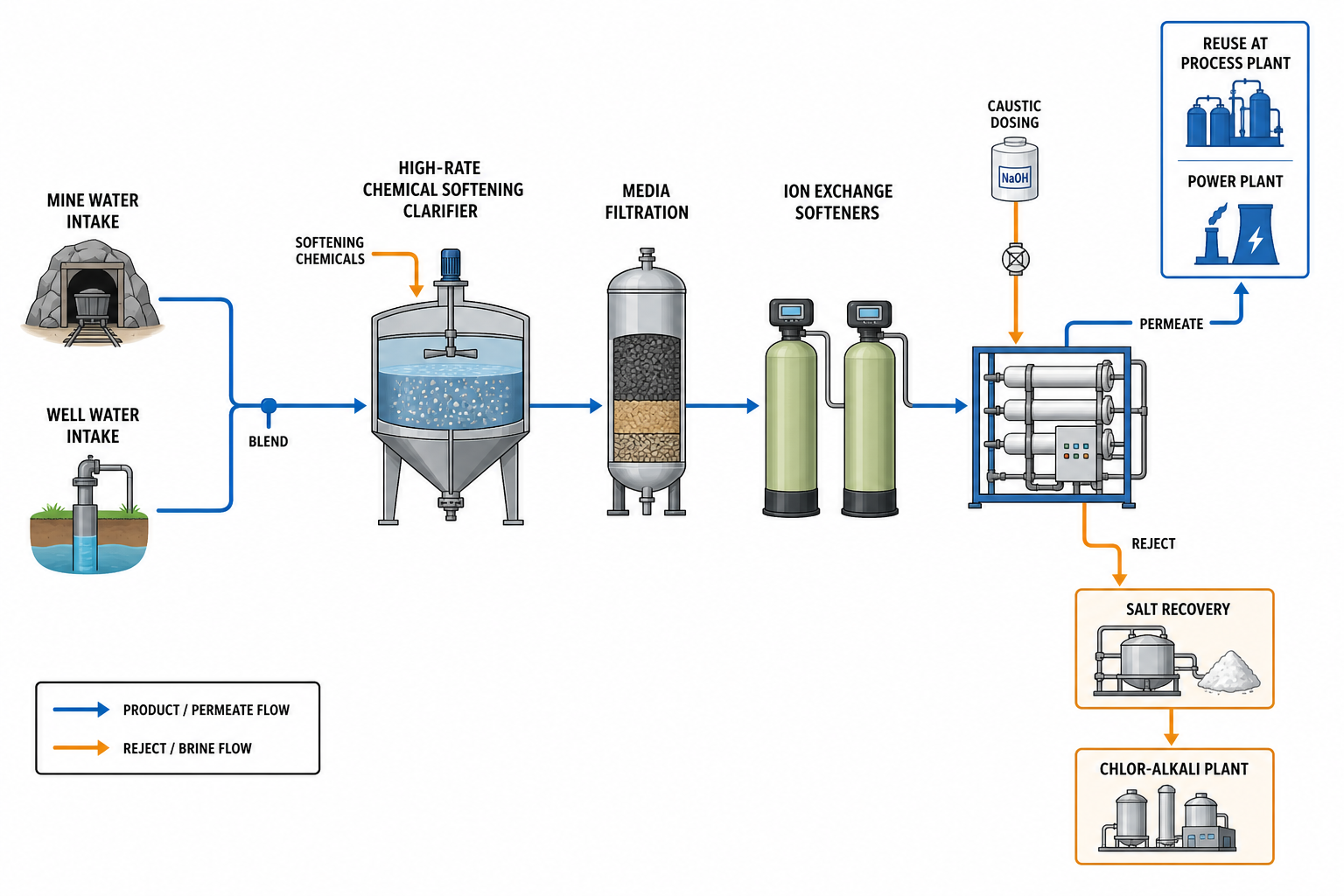
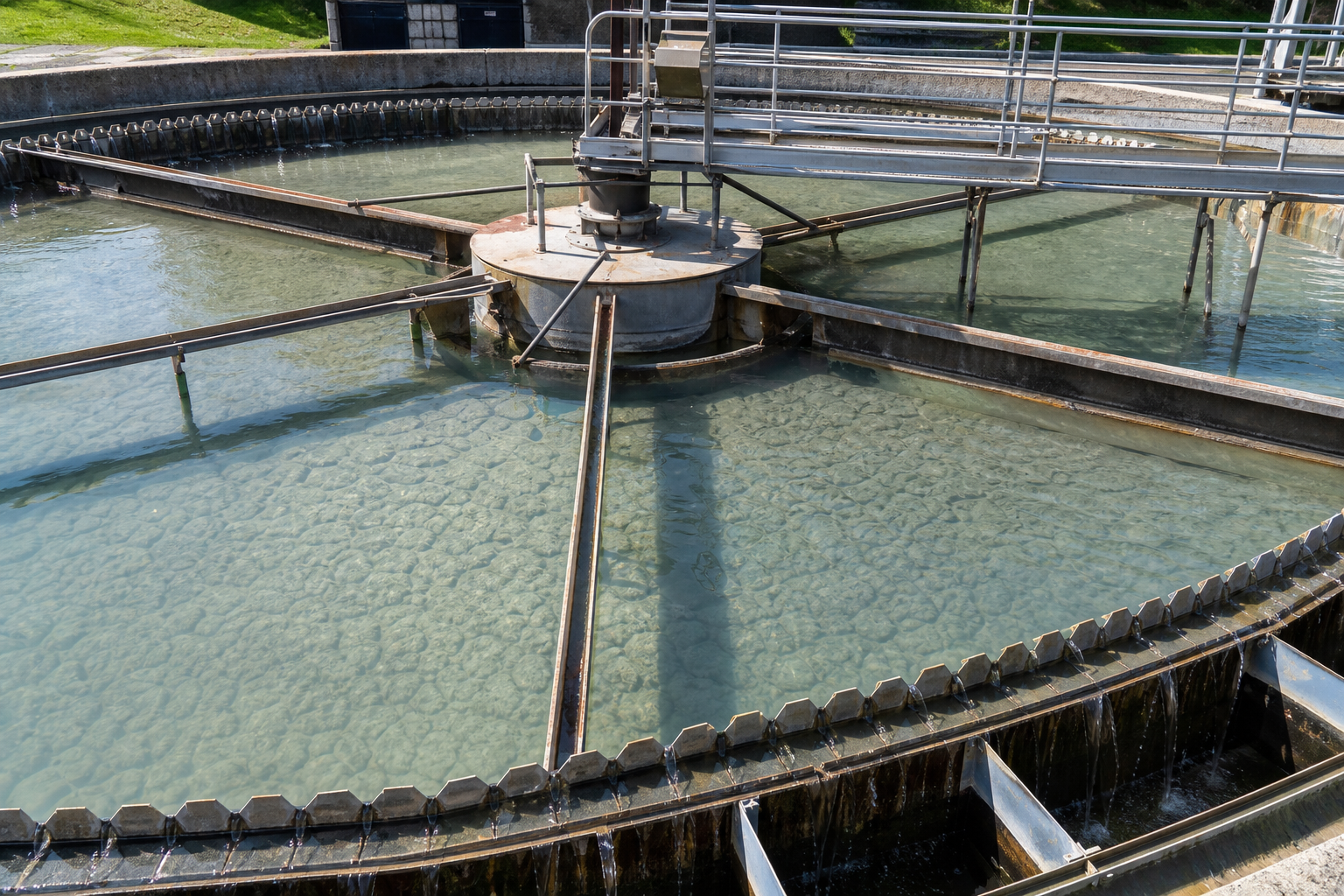
The train runs in four blocks. First, high-rate chemical softening: the raw blend receives lime or soda-ash chemistry in a solids-contact clarifier of the high-rate type, precipitating calcium and magnesium and co-precipitating a share of silica and metals into a compact sludge – the block that removes the species which would otherwise define the RO cleaning calendar. Second, filtration and ion exchange polishing: the clarified water passes media filtration and then ion exchange softening, taking residual hardness to the near-zero levels that high-pH RO demands.
Third, elevated-pH reverse osmosis: the softened feed is pH-adjusted upward and run through the RO train. High pH serves two purposes in this architecture – it keeps residual silica in its ionized, more soluble form, and it depresses organic fouling; together with the front-end softening, it is what allows the recovery to climb to the levels that make the plant worth building. Fourth, reject valorization and closure: the concentrated salt stream reports to salt recovery units and then to the chlor-alkali plant as reagent feedstock, while the permeate returns to rare earth processing and power generation. Where a chlor-alkali sink does not exist, the same RO reject becomes the feed to a thermal concentration-crystallization island – smaller by exactly the recovery the membranes achieved.
Technical Features That Make High Recovery Real
Three features carry the engineering weight. The first is the softening train as a unit. MULTIFLO-class high-rate softening combines reaction, clarification and sludge densification in one compact unit, which matters at mine sites where footprint and operator attention are both scarce. The depth of softening – not just its presence – sets how far the RO recovery can be pushed before scaling returns.
The second is elevated-pH operation as the silica strategy. At high pH, silica speciation shifts toward ionized forms whose solubility is higher and whose gel-fouling tendency is lower; paired with hardness removal to near zero, this is the chemical license for recovery levels standard neutral-pH RO cannot hold on this water. The operating cost of that license is the pH adjustment itself – alkali in, acid for permeate re-neutralization out – which belongs in the water cost model explicitly.
The third is the reject destination as an economic decision. Reference plant: reject to chlor-alkali as reagent feedstock, with the whole plant supplied under a long-term performance guarantee on water quality, availability and production rate. The alternative destination – thermal ZLD – is fully workable but converts a revenue stream into an energy bill; the flowsheet choice between them is a site integration question, not a water treatment question.
Process Modules
| Process module | Candidate equipment types | Selection rationale | Module duty |
|---|---|---|---|
| High-rate softening | Solids-contact high-rate chemical softener | Precipitates Ca/Mg, co-removes silica/metals compactly | Strip the scaling suite before membranes |
| Solids removal | Media filtration | Polishes softener effluent to RO feed quality | Protect IX and RO from particulates |
| Ion exchange softening | IX polishers | Hardness to near-zero for high-pH RO | Remove the last scaling precursor |
| Water recovery | Elevated-pH reverse osmosis train | Ionized silica management; organic fouling suppression | High-recovery permeate production |
| Reject valorization | Salt recovery + chlor-alkali integration (or thermal ZLD feed) | Reference route converts reject to reagent feedstock | Close the salt balance without waste |
| Permeate distribution | Re-neutralization and routing to process/power | Reuse-grade water for processing and generation | Deliver the recovered water value |
Configuration, materials and operating envelopes above are potential considerations only; actual selections depend on feed composition, temperature, corrosion review, fouling behavior, utilities and project capacity.
Expected Performance and Limits
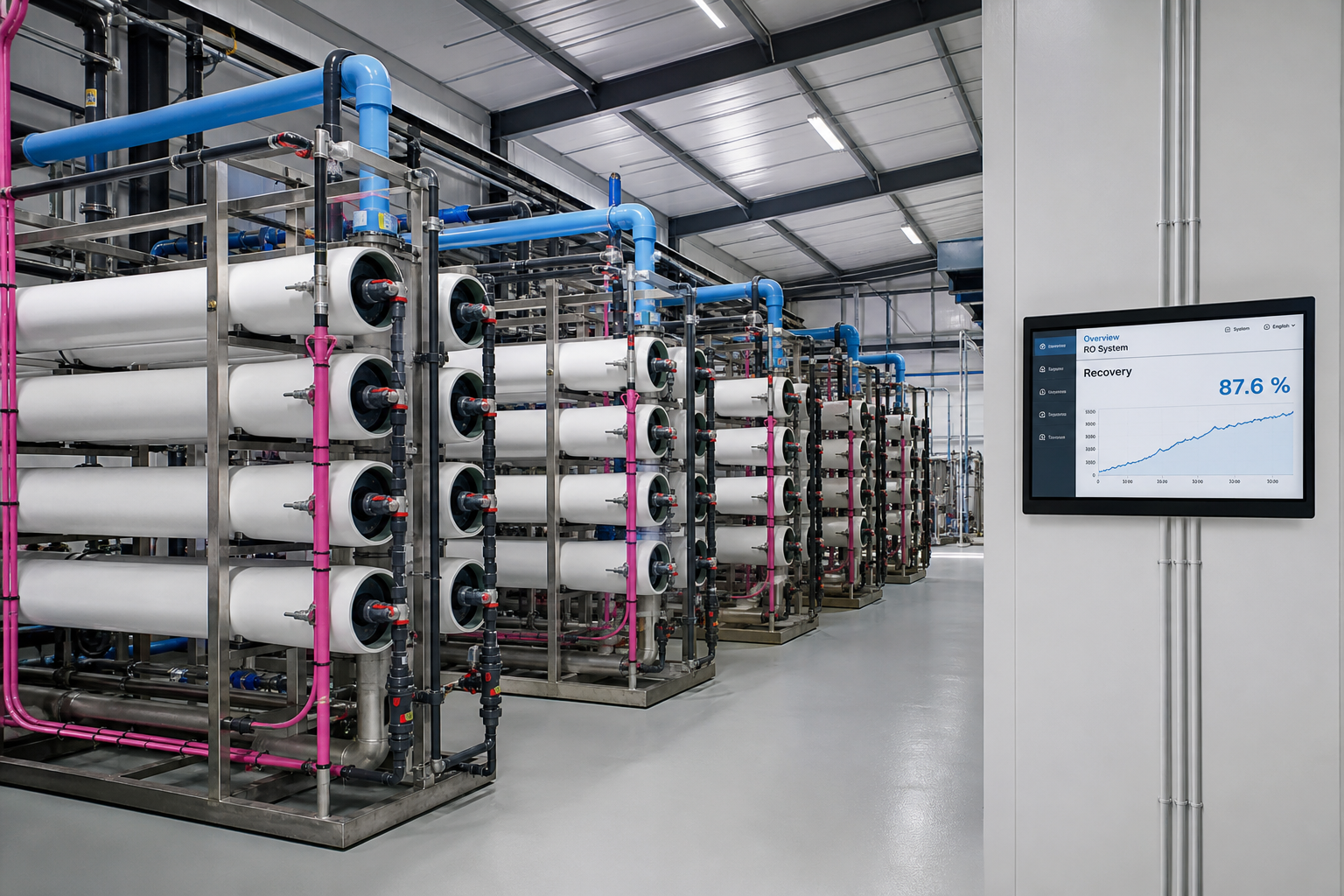
Published reference performance: 1,000 gpm of well water and wastewater treated through MULTIFLO softening, filtration, ion exchange and elevated-pH RO at the reference rare earth mine, producing high-quality water with low waste volume, enabling approximately 20,000 t/y of rare earth production with zero wastewater discharge, and supplied under a long-term performance guarantee covering water quality, system availability and production rates (Veolia Water Technologies – external industry reference; indicative of that installation, not a project guarantee). Engineering context for the membrane-first economics: MLD analyses put membrane-domain recovery at up to 95% with overall ZLD cost reductions up to 60% versus thermal-only routes (DuPont MLD published analysis – external industry reference), which is the structural argument for softening-then-membranes ahead of any evaporator. Limits worth respecting: the chemistry bill for softening and pH adjustment scales with the hardness and silica removed – very hard waters can push reagent cost toward the thermal alternative; elevated-pH operation demands caustic-compatible system design and careful permeate re-neutralization; and the reject-to-chlor-alkali closure exists only where the site has that sink – otherwise the reject is a brine that still needs its own ending.
Industry References and Validation
The route is anchored on the Veolia rare earth mine water treatment case: OPUS-technology plant combining MULTIFLO high-rate softening with filtration, ion exchange softening and elevated-pH RO, treating 1,000 gpm to support 20,000 t/y production, with reject to salt recovery and the on-site chlor-alkali plant for reagent production, zero wastewater discharge, and a long-term performance guarantee (Veolia Water Technologies case study – an external industry reference, not an EvapCryst delivery). For membrane-first ZLD economics, the published MLD analysis above provides the cost-structure context (DuPont – external industry reference). For your own project, validation effort should concentrate on: a scaling-species characterization (hardness, silica, metals profile across seasons); softening jar testing to fix reagent doses and sludge production; an RO projection at candidate recovery with cleaning-frequency modeling under your chemistry; and a site integration review establishing what can consume your reject stream before defaulting it to thermal treatment.
Frequently Asked Questions
Why soften twice – chemical softening and then ion exchange?
Depth. Chemical softening removes the bulk hardness cheaply; ion exchange takes the residual to near zero. High-pH RO is unforgiving of trace hardness at elevated recovery – the last few milligrams are what the IX step exists to remove.
What does running RO at elevated pH actually buy?
Silica tolerance and cleaner membranes. At high pH, silica shifts to ionized forms with higher solubility and less gel-fouling tendency, and organics that would foul a neutral-pH membrane stay dispersed. Combined with deep softening, it is what licenses high recovery.
Can any mine send its RO reject to a chlor-alkali plant?
Only one with that sink on site or next door. The reference plant integrated its reject into reagent production for rare earth separation – an elegant closure unique to that configuration. Sites without it route the reject to thermal concentration-crystallization instead.
How does this compare to going straight to evaporation?
Cost per cubic meter. At dilute-to-moderate salinity, membranes recover water several times more cheaply than evaporators; published MLD analyses put overall ZLD savings up to 60% when membranes do most of the recovery first. Evaporation earns its place only on the concentrated tail.
What is the main operating risk?
Softening drift. If lime or soda-ash dosing lags the raw water’s hardness swings, scaling species break through to the membranes and the high-recovery premise collapses within days. Online hardness monitoring between the softener and the RO is cheap insurance.
When This Route May Not Fit
If your water is already highly saline – tens of grams per liter – membranes surrender to osmotic pressure and the thermal route takes over regardless of softening. If hardness and silica are extreme, the reagent cost of deep softening can approach the energy cost of evaporation and the comparison must be run honestly. And at very small flows, the chemistry and monitoring infrastructure of a high-recovery membrane plant outweighs a simple contract-treatment arrangement.
What Must Be Verified Before Committing
Five items: seasonal characterization of hardness, silica, metals and salinity on the actual blend; softening jar tests fixing chemistry, dose and sludge volume; an RO recovery projection with scaling and cleaning modeling at your water’s worst case; a reagent and pH-adjustment cost model so the water’s true full cost is known; and a site integration assessment of what can consume the reject before thermal treatment is assumed. These map directly onto the modules above and are the standard screening package we would run before any quote.