Pulp, Paper & Biomass

Evaporation for the chemical recovery loop: Kraft black liquor, sulfite red liquor and biomass refinery streams. Falling-film and forced-circulation evaporators engineered as one cascaded train — sized to liquor viscosity, carbonate–sulfate–silica scaling and the mill’s steam economy.

Phase 2 — In Preparation
industries pulp
Process Challenges

What Makes Pulp Mill Evaporation Hard

The evaporator train sits at the heart of the chemical recovery loop — its performance defines the mill’s steam economy and alkali balance. Two liquor families, two different failure modes.

LIQUOR 01Scaling-Critical

Kraft Black Liquor

The recovery loop’s most demanding stream: viscosity climbs exponentially with solids while carbonate–sulfate–silica–calcium scaling species attack the same surfaces that must push the liquor to boiler-firing concentration.

  • High viscosity at high solids: above ~50% solids the film becomes the constraint — falling-film distribution turns unreliable past roughly 50 cP, forcing a configuration change before the finishing stage
  • Scaling chemistry: Na₂CO₃Na₂SO₄ eutectic (“burrito” scale), silica and calcium species depositing on heat-transfer surfaces
  • Soap & tall-oil carryover: foaming inside the effects and a firing-safety hazard in the recovery boiler if soap is not removed first
  • Recovery upside: tall oil, turpentine and lignin by-product routes coordinated with train operation
65–80%recovery-boiler firing-solids target range — modern boilers typically fire 65–75%, older units 60–70%; the achievable endpoint is set by the liquor’s viscosity–temperature curve
LIQUOR 02By-product Recovery

Sulfite Red Liquor

Acidic spent sulfite liquor, where the base-salt chemistry — calcium, magnesium, sodium or ammonium sulfite — rather than raw viscosity drives corrosion allowance, scaling form and the by-product recovery route.

  • Base-salt chemistry: Ca / Mg / Na / NH₄ sulfite systems set the whole design — calcium-based liquors carry a CaSO₃ scaling duty that shapes washing-cycle design
  • Acid service: pH 2–4 with residual SO₂ across the train pushes materials to Duplex 2205 / titanium
  • By-product routes: lignosulfonate and wood-sugar recovery integrated with concentration instead of treated as waste
  • Corrosion-led materials: wetted-part selection follows chloride and SO₂ profile, not a catalog default
Ca / Mg / Na / NH₄four sulfite base chemistries — each determines scaling form, corrosion allowance and the lignosulfonate recovery route; red-liquor design is base-specific, never generic
Configuration Logic

Why Both Falling Film and Forced-Circulation Are Needed

Black liquor is not the same liquid at the outlet as at the inlet. Viscosity, scaling propensity and boiling-point rise all climb with solids — so the configuration is cascaded, not chosen once.

In the mid-to-low solids region, falling-film evaporators deliver high heat-transfer coefficients with short residence time and low pumping power. In the high-solids, scaling-prone finishing zone, forced circulation with suppressed boiling in the tubes takes over. The cascade between them — where falling film hands off to forced circulation — is the core design decision, not an equipment preference.

Stage A
15% TS feed
Weak Liquor — Front Effects, Falling Film

Lowest viscosity and lowest BPE live here: maximum duty per m² of surface, short residence. The low-BPE front effects (1–3 of a 5–7-effect train) are the MVR integration candidates.

Stage B
~15 → 50% TS
Multi-Effect Falling-Film Body

Falling film holds high heat-transfer coefficients and short residence while the liquor is still filmable; effects are sequenced up the ΔT ladder as viscosity and BPE rise.

Stage C
50 → 65–75% TS
Forced-Circulation Finishing

At high solids the film breaks and carbonate–sulfate scaling accelerates: FC with suppressed boiling in the tubes and 2–3 m/s tube velocity tolerates the viscous, scaling-prone duty.

Stage D
65–80% TS
Recovery-Boiler Firing

Firing-solids target after soap removal — every point of extra solids is steam saved in the boiler, but the endpoint is capped by the viscosity–temperature curve of the specific liquor.

15% solids 65–80% firing Viscosity · scaling propensity · boiling-point rise all increase with total solids — the configuration follows the property profile.

Cascade configuration disclaimer: the falling-film → forced-circulation split point, effect count and MVR placement are not catalog choices — they depend on the target firing solids, the liquor’s scaling propensity and its boiling-point-rise profile. Final design requires black-liquor characterization (solids, viscosity–temperature curve, silica, soap content) and fouling test data.

Where We Work

Typical Applications

Four duty families across the mill — each with its own driver, and each routed to the configuration the liquor chemistry demands.

APP 01Energy-Integration

Black Liquor Concentration

The classic recovery-loop train: multi-effect falling-film body with MVR integration on the low-BPE front effects and a high-solids forced-circulation finishing effect.

  • Multi-effect falling-film body — 5–7 effects, liquor sequenced weak-to-strong across the ΔT ladder
  • MVR integration on the low-BPE front effects (effects 1–3 of a 5–7-effect train)
  • High-solids forced-circulation finishing effect to firing concentration
  • Engineered falling-film → forced-circulation cascade (see the logic above)
0.25–0.40 t steam / t watermulti-effect steam economy on black liquor over 5–7 effects — depends on effect count, ΔT allocation and BPE profile; MVR alternative draws 15–25 kWh per tonne of water where power price favors it ($0.04–0.07/kWh)
APP 02Scaling-Critical

Red Liquor Concentration

Falling-film concentration of acidic spent sulfite liquor, engineered around the base-salt chemistry rather than against it.

  • pH 2–4 service with residual SO₂ across the train
  • Calcium-based liquors: CaSO₃ scaling duty managed through washing-cycle design
  • Materials upgraded to Duplex 2205 / titanium per SO₂ and chloride profile
  • SO₂ and heat recovery coordinated with the acid preparation island
4 base saltsCa / Mg / Na / NH₄ sulfite chemistries — each sets its own scaling form and corrosion allowance, so red-liquor trains are designed base-by-base after liquor characterization
APP 03By-product Recovery

Alkali Recovery Interface

The evaporator train’s neighbors in the recovery loop — soap handling, green-liquor slurry duty and a clean, declared boundary to the boiler island.

  • Soap & tall-oil skimming integrated between effects; turpentine handled on the vapor side
  • Green-liquor duty: Na₂CO₃ + Na₂S at 100–150 g/L with heavy CaCO₃ slurry scaling — forced-circulation slurry handling
  • Clean scope boundary: EvapCryst delivers the evaporation train and its fluid interfaces; the recovery boiler, recausticizing plant and lime kiln come from specialized partners — the boundary is declared in the proposal
100–150 g/Lgreen-liquor Na₂CO₃ + Na₂S strength feeding the causticizer — heavy CaCO₃ slurry scaling makes forced-circulation slurry handling the standard route for this duty
APP 04Viscosity

Biomass & Biorefinery Liquors

The non-pulp side of the fiber line: pretreatment liquors, fermentation-stage streams and lignin-recovery mother liquors — thermally sensitive and fouling-prone.

  • Pretreatment / prehydrolysate liquors from cellulosic biomass
  • Fermentation-stage liquor concentration — engineered interface with Food, Fermentation & Bioprocessing
  • Lignin-recovery mother liquors: high-viscosity, fouling-prone finishing duty
  • Low-ΔT, short-residence falling-film design for heat-sensitive sugar streams
5–20%C5/C6 sugar content of typical cellulosic hydrolysate — thermal sensitivity above 75 °C favors low-ΔT, short-residence falling film over high-temperature duty
Typical Process Route

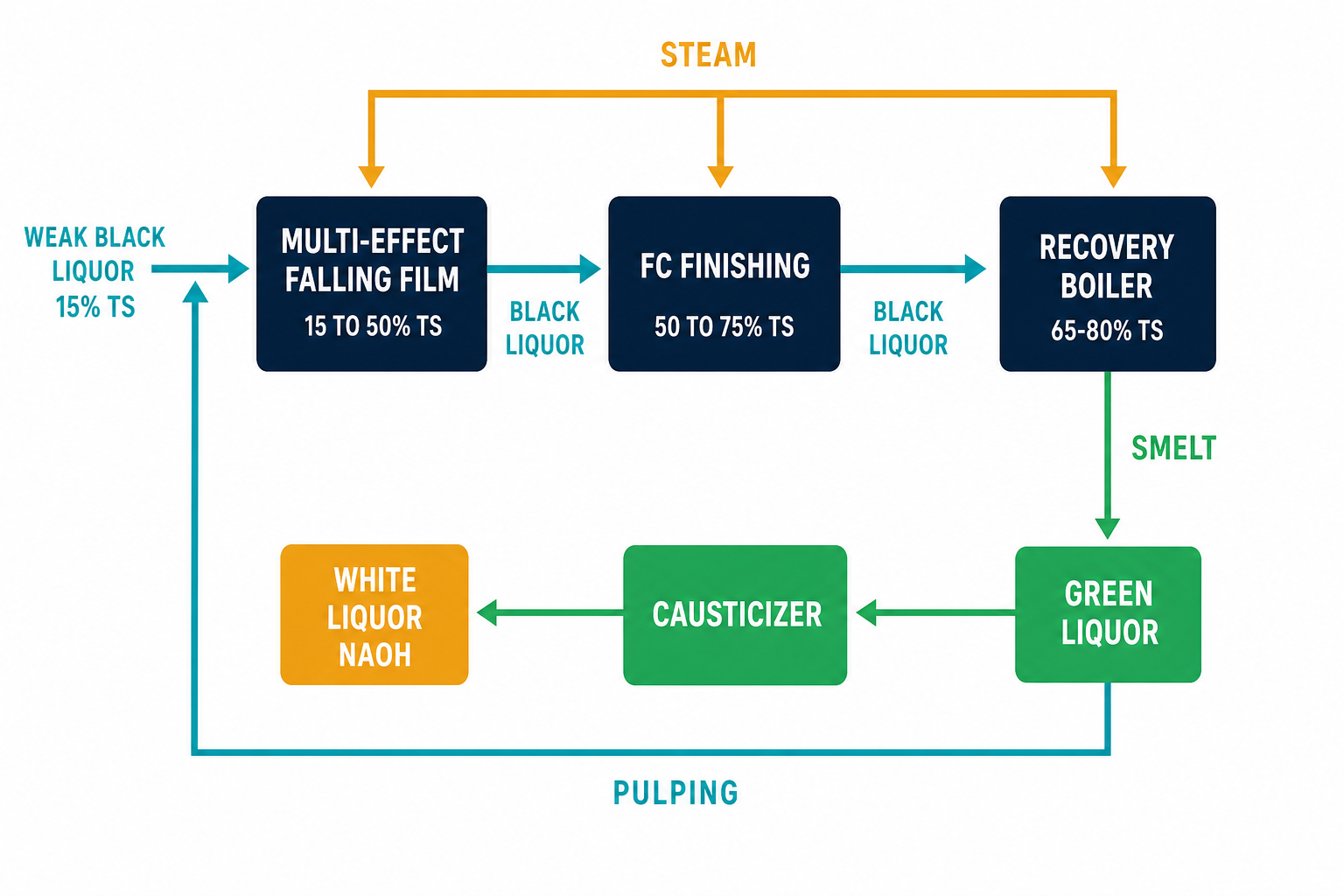
Kraft Black Liquor Evaporation Train

Indicative routing for Kraft black liquor evaporation to recovery-boiler firing solids — the canonical sequence from washing to firing.

Step 1 · Liquor

Weak Black Liquor Feed

15% solids from brown-stock washing — soap-bearing, low viscosity, entering the front effects of the train.

Step 2 · Vapor Side

Soap / Tall-Oil Removal

Skimming and degassing between effects; turpentine vent management and foam control protect both the effects and the boiler.

Step 3 · Energy

Multi-Effect / MVR Evaporation

5–7-effect falling-film body concentrating to ~50%; MVR on the low-BPE front effects cuts live-steam draw 30–60% where the mill balance allows.

Step 4 · Firing

High-Solids Finishing & Firing

Forced-circulation concentrator (2–3 m/s tube velocity) to 65–75% — firing-solids target range 65–80% — feeding the recovery boiler.

Simplified PFD for indicative routing only. Effect count, MVR integration point, soap-removal location and washing strategy are project-specific — they depend on the mill steam balance, recovery-boiler design and black-liquor composition.

Stream Reference

Typical Streams, Routes & Materials

Common feed streams across pulp, paper and biomass processing — with the technology route and material focus for first-pass screening.

StreamSource / ContextKey BehaviorTypical RouteMaterial Focus
Kraft black liquorNaOH / Na₂S pulping of softwood / hardwood15–75% solids; viscosity above 500 cP at 65% solids; silica 100–500 mg/L (wood)Falling Film + FC316L / Duplex 2205
Sulfite red liquorAcidic sulfite pulping — Ca / Mg / Na / NH₄ basepH 2–4; residual SO₂; higher corrosion dutyFalling FilmDuplex 2205 / Titanium
Bleach plant effluentECF (ClO₂) / TCF bleaching stage effluentCl⁻ 500–5,000 mg/L; chlorate; pH 2–7; COD 1,000–5,000 mg/LPretreat + FCTitanium throughout wetted parts
Biomass hydrolysateCellulosic sugar production for biofuels / bio-chemicalsC5/C6 sugars 5–20%; thermal sensitivity above 75 °C; foulingFalling Film, low ΔT316L
Paper machine white waterSheet-forming drainage; filler & finesTDS <1,000 mg/L; TSS 500–5,000 mg/L; CaCO₃ fillerMembrane + Multi-Effect316L
Recausticizing green liquorNa₂CO₃NaOH conversion in the causticizerNa₂CO₃ + Na₂S 100–150 g/L; heavy CaCO₃ slurry scalingFC Slurry Crystallizer316L

Routes shown are for preliminary screening only — recovery-cycle integration requires a mill-wide mass and energy balance. Bleach-plant effluent with high chloride demands titanium throughout the wetted parts.

Fouling Control

Scaling Management: What Deposits, Where, and How It Is Cleaned

On black-liquor service the washing strategy is core engineering, not an afterthought — each scale species has its own location and its own removal chemistry.

Scale TypeTypical LocationCleaning & Control Strategy
“Burrito” scale — Na₂CO₃Na₂SO₄ eutecticHigh-solids effects and forced-circulation tubesAlkaline boil-out on a scheduled cycle; deposition suppressed by FC design — 2–3 m/s tube velocity with suppressed boiling in the tubes
Calcium scale — CaCO₃ / CaSO₃Mid-train heat-transfer surfacesAcid wash on cycle; calcium-based red liquors sized with longer washing allowance from the start
Sodium silicate (non-wood liquors)Whole train — silica 1,000–5,000 mg/L in straw / bagasse vs 100–500 mg/L in woodUpstream desilication: CaO at 5–15 g/L (or CO₂) precipitating silica as CaSiO₃ at pH 10–11 before the evaporator — formed silicate scale is very difficult to remove chemically
Soap / tall-oil foaming & carryoverEffect vapor spaces and condensersSoap skimming between effects plus antifoam dosing; complete removal before firing is a recovery-boiler safety requirement, not a preference

Without a matched washing strategy, heat-transfer coefficient drops 30–50% within 7–14 days on scaling black-liquor service. The standard cycle — acid wash plus alkaline boil-out every 5–15 days — is delivered through CIP (clean-in-place) routing and tuned to the measured scaling rate of the specific liquor.

Related Projects

Representative Project Scopes

The duty families this industry most often brings us — the full case index lives on the Projects page.

Multi-effect falling-film trains with high-solids forced-circulation finishing, engineered to boiler firing solids with matched washing cycles.

Front-effect MVR integration on existing 5–7-effect trains — cutting live-steam draw where the mill steam balance allows electrification.

Hydrolysate and lignin-recovery mother-liquor concentration in low-ΔT, short-residence falling-film duty.

Representative scopes for orientation — the full project index, with streams and capacities, is maintained on the Projects page.

Discuss Your Pulp, Paper or Biomass Project

Send your black-liquor analysis — solids %, viscosity profile, silica, soap — and your target firing solids. You will receive a feasibility assessment, a simplified PFD and indicative scope within two business days.

Request a Proposal

Send your feed characterization (TDS, COD, main salts, viscosity), throughput and product targets — we respond with a preliminary process route within two business days.