Calcium carbonate scaling in black liquor evaporators is the availability problem of the application: hard, adherent scale on heated surfaces that shuts effects down for acid cleaning. The public evidence of what successful prevention looks like comes from a Mitsubishi Paper mill, where externally-mounted ultrasonic treatment on the evaporator inlet pipe extended the run between cleanings from roughly one month to a stable four months – continuous operation through the winter campaign with no hydrochloric acid cleaning and no chemical injection, verified by the 20°C steam-to-liquor approach-temperature criterion and by physical inspection (Altum Technologies results from a Mitsubishi Paper mill, published with the TAPPI Japan 2023 seminar white paper – an external industry reference, not an EvapCryst delivery). The design premise: in black liquor service, scale prevention is worth more than scale removal, because the removal cycle is the production cycle.
What the Scale Is and Where It Comes From
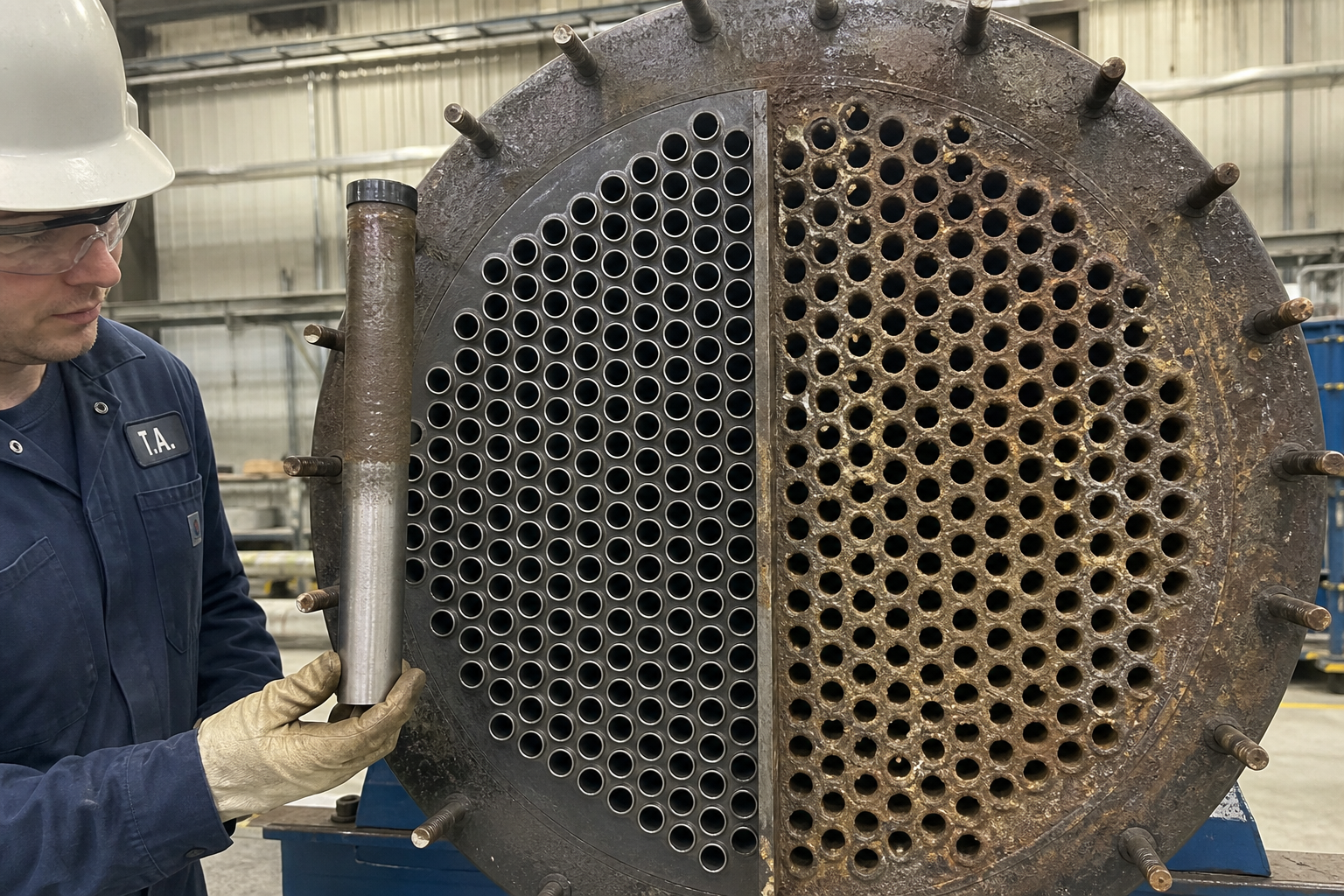
Black liquor carries calcium from the wood and makeup, carbonate from the cooking chemistry, and – as concentration climbs – the solubility arithmetic turns against the solution: calcium carbonate precipitates onto the hottest surfaces it finds, which are the evaporator tube walls. The published Mitsubishi Paper case describes the deposit as very hard and difficult to remove. Its damage is threefold: the scale layer’s thermal conductivity is a small fraction of the tube metal’s, so heat transfer collapses; the deposit physically blocks liquor from contacting the heated surface beneath it, so effective area shrinks; and the cleaning that removes it is costly in itself – the mill’s prior regime used a regulated acid with corrosive tendencies toward the equipment.
The operational signature is the approach temperature. In the published case the difference between heating steam and liquor temperature was the shutdown criterion: once it exceeded 20°C, the effect was considered no longer operational and the plant stopped for cleaning. Before ultrasonic treatment that threshold arrived in about a month. That is the unglamorous arithmetic of scale: heat transfer decays until the effect is effectively out of the train, four to twelve times a year, every year.
The Standard Countermeasures and Their Limits
Mill practice offers a ladder of countermeasures, and the published case is valuable precisely because it documents the rungs below the top. Chemical injection – antiscalants and chelants dosed into the liquor – was the case mill’s first attempt; the documented result was scale shifting downstream and re-forming in the second effect, the classic displacement failure of chemical control on hard carbonate. Acid cleaning – periodic hydrochloric acid circulation – removes the deposit but costs downtime and, as the case notes, uses a regulated chemical harmful to equipment through its corrosivity. Design-stage countermeasures – falling-film bodies with wetted walls, forced circulation with suppressed boiling in the high-solids effects, and effect-body switching (running one effect body on weak liquor or wash while others evaporate) – manage where and how fast scale forms, and remain the structural baseline of every modern train. The crystallization-route articles cover the chemistry-side solution: sulfate seeding to grow precipitating salts on suspended nuclei instead of walls.
What the Mitsubishi Paper case adds is the nucleation-side intervention: ultrasound applied to the liquor before the heated elements induces nucleation so that precipitation happens as suspended crystallization rather than wall adhesion. The mechanism is the same one deliberate-suspension crystallization uses – give the precipitating salt somewhere better than the wall to form – but delivered by physical energy rather than chemistry.
The Ultrasound Result, Quantified
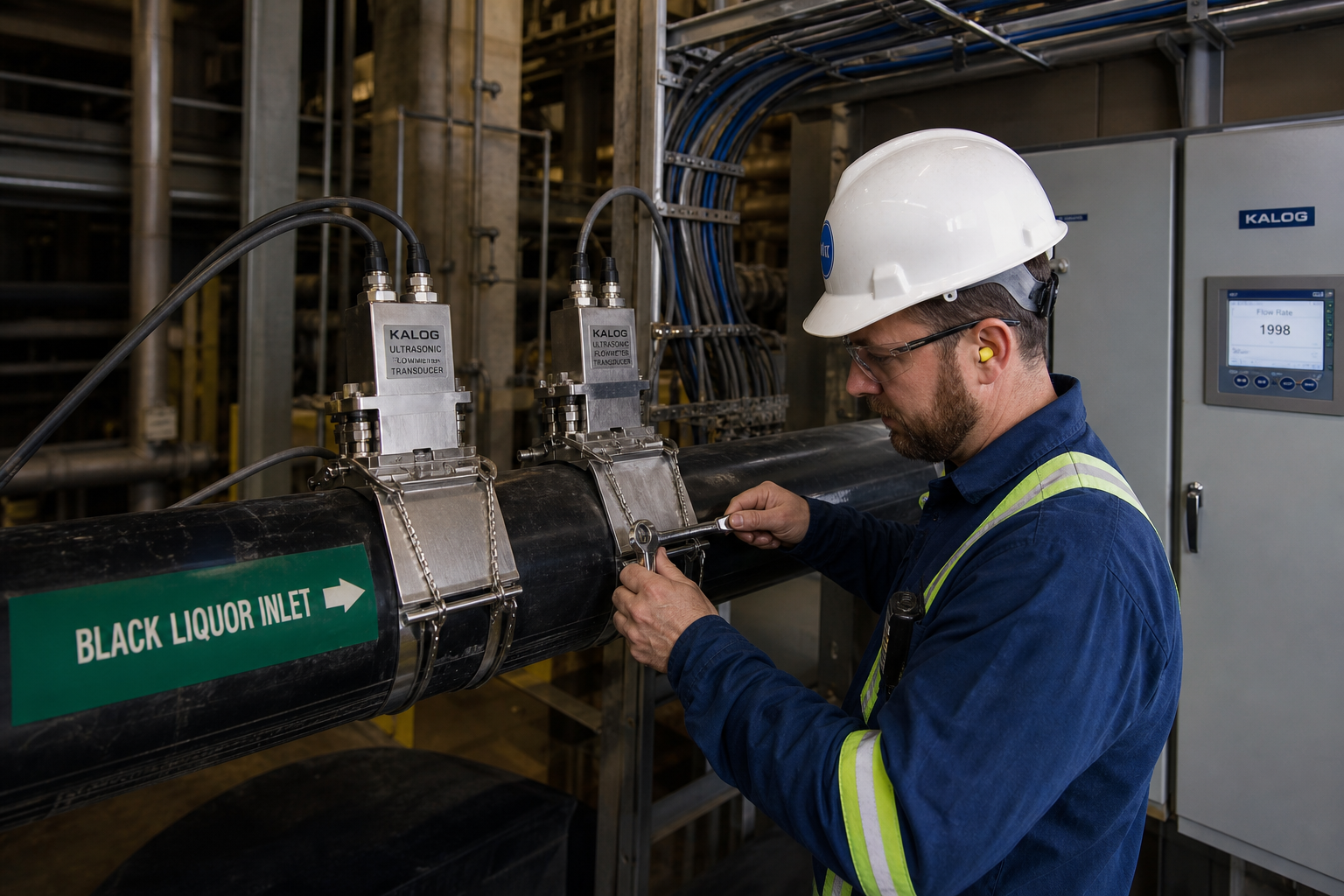
The published installation: Altum’s multichannel ZPD (Zero Process Downtime) system mounted externally on the inlet pipe to the evaporators – no equipment dismantling, no production stop for installation. Operating principle: ultrasonic intensity sufficient to induce the crystallization/nucleation effect even in viscous black liquor. Verification was twofold: the approach-temperature criterion (before treatment: 20°C reached in ~1 month; with treatment: temperature difference remained constant, enabling stable four-month continuous operation) and visual inspection on opening (visibly cleaner effects; hydrochloric acid cleaning no longer required; no chemical injections through the winter cycle). The headline results as published: three months longer operation cycle (one month to four), decreased maintenance needs, no acid use, a more stable and predictable process (Altum Technologies / Mitsubishi Paper white paper, TAPPI Japan October 2023 – an external industry reference; indicative, not a project guarantee, and not an EvapCryst delivery).
Scale-Control Options Compared
| Option class | Mechanism | Documented strength | Limit / failure mode |
|---|---|---|---|
| Chemical injection (antiscalant/chelant) | Sequester or threshold-inhibit precipitation | No hardware change | Documented displacement: scale moved downstream to 2nd effect |
| Acid cleaning cycles | Dissolve deposit with regulated acid | Restores surface (temporarily) | Downtime per cycle; corrosive chemical handling; cost recurs |
| Design-stage control (falling film, forced circulation, body switching) | Keep walls wetted; suppress wall boiling; wash bodies in rotation | Structural baseline of modern trains | Manages, not eliminates; high-solids effects still run limited campaigns |
| Crystallization chemistry (sulfate seeding) | Grow precipitating salts on suspended nuclei | Documented 4-8% additive route to 73-80% solids without scaling (patent route) | Chemistry discipline required; additive consumption |
| Ultrasonic nucleation (external, ZPD-class) | Induce nucleation in feed liquor before heated elements | Documented 1→4 month cycle extension; no acid, no chemical | Energy input; case-specific verification needed |
Configuration, materials and operating envelopes above are potential considerations only; actual selections depend on liquor chemistry, scaling species, effect layout and project constraints.
Expected Performance and Limits
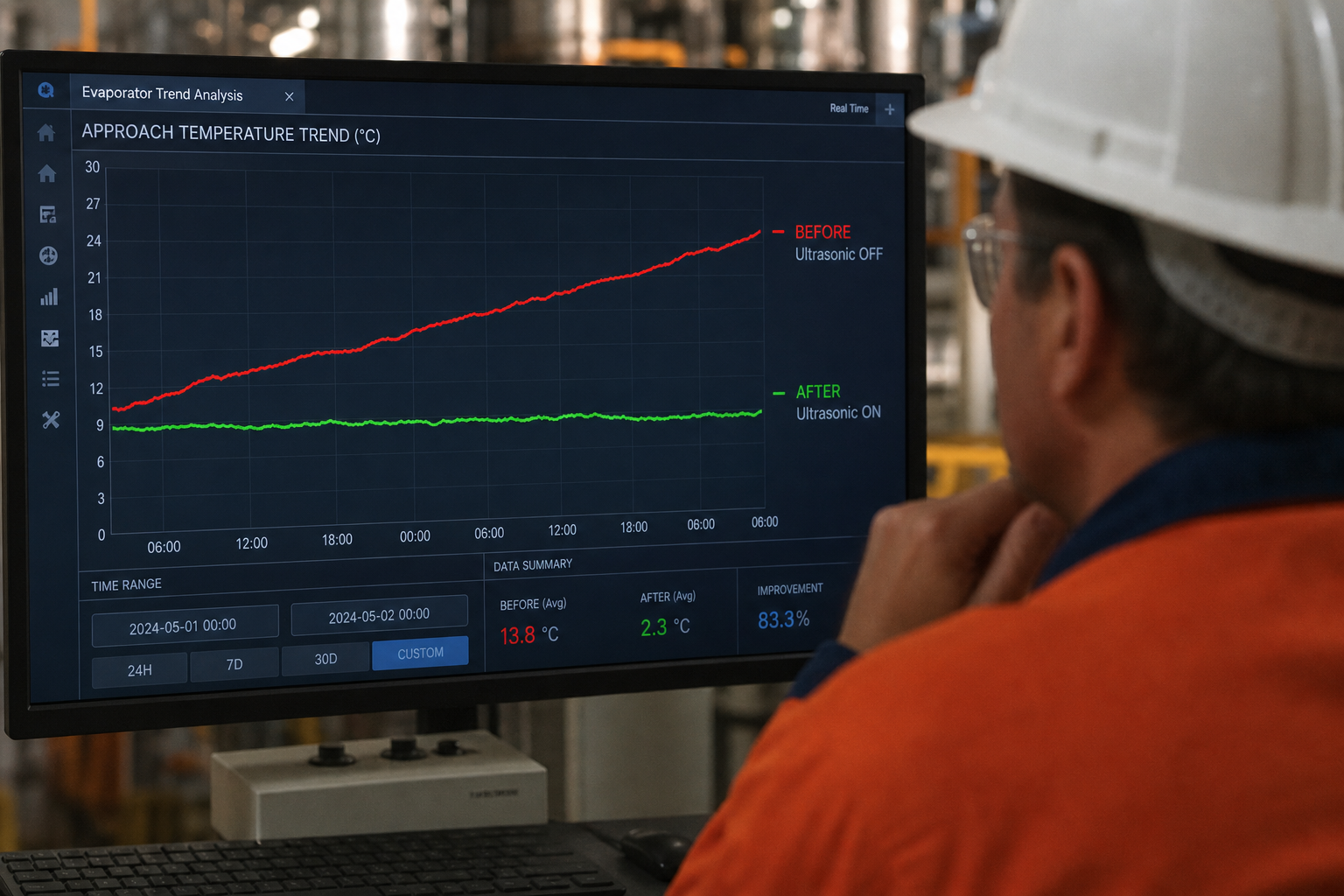
The published reference performance: operation cycle extended from approximately one month to four months (a three-month gain), stable approach temperature across the campaign, hydrochloric acid cleaning eliminated, chemical injection eliminated during the long winter cycle, externally mounted equipment with no production stop for installation – all at a Mitsubishi Paper mill, published with the TAPPI Japan October 2023 seminar material (an external industry reference; indicative, not a project guarantee, and not an EvapCryst delivery). The practical limits: the case is one liquor chemistry and one evaporator geometry – calcium carbonate dominance with hard-scale character; extrapolation to other scaling species (silica from nonwood furnish, burkeite, sodium carbonate scale in the ash loop) needs case-specific verification. The approach-temperature methodology transfers cleanly: whatever the countermeasure, the 20°C-criterion-style trend is the measurement that proves or disproves it on your train.
Engineering context for scale-economics screening: each avoided cleaning campaign returns days of full train availability. On a multi-effect black liquor train whose throughput gates the recovery boiler, availability is the mill’s recovery capacity – the value of an avoided shutdown compounds across the year. The ultrasound case’s three-month extension quadrupled the cleaning interval; even partial replication of that on a scaling train dominates most OPEX lines in the scale-control budget.
Industry References and Validation
One public anchor with unusual verification quality: the Mitsubishi Paper / Altum ZPD case – objective criterion (approach temperature to 20°C), physical inspection confirmation, before/after cycle times, and the eliminated chemical consumptions, published with the TAPPI Japan October 2023 white paper (Altum Technologies published material; an external industry reference, not an EvapCryst delivery). The companion chemistry-side reference is the crystallization-evaporation patent route documented separately in this cluster. For your own project, validation effort should concentrate on: scale speciation from your deposit history (carbonate versus silicate versus double salts); approach-temperature trending per effect as the baseline metric; a countermeasure trial protocol with the temperature criterion as pass/fail; and for ultrasonic or any external device class, a reference check against liquor chemistry similar to yours.
Frequently Asked Questions
Why does calcium carbonate specifically plague black liquor evaporators?
Calcium rides in with wood and makeup chemicals; carbonate is intrinsic to kraft chemistry. As effects concentrate the liquor and heat surfaces run hot, the pair precipitates – and unlike softer deposits it forms a hard, adherent layer that both insulates the tube and masks the wall from the liquor.
What is the 20°C criterion?
The steam-to-liquor approach temperature. As scale grows, the same heat duty needs a bigger temperature difference to push through it. The case mill treated 20°C as the operational limit and shut down for cleaning when reached – which makes the criterion a continuous, quantitative scale gauge.
Why did chemical injection fail in the documented case?
It moved the problem rather than solving it: the scale shifted downstream and re-formed in the second effect. Inhibition chemistry that slows nucleation without eliminating supersaturation redistributes where the deposit lands – on trains with multiple hot surfaces, redistribution is not relief.
How does ultrasound prevent scale mechanically?
By inducing nucleation in the liquor before it reaches the heated elements. Precipitation then happens on suspended nuclei in the bulk – where the crystals harmlessly circulate – instead of on the hottest available surface, which is the tube wall. Same thermodynamics, better geometry.
Does external mounting really avoid downtime?
That is the documented configuration: transmitters clamped to the outside of the inlet pipe, no dismantling, no production stop. It is also the commercial logic of the ZPD (Zero Process Downtime) label – the retrofit itself avoids what it treats.
When This Route May Not Fit
If the mill’s scaling is silica-dominated (nonwood furnish – straw, bagasse, bamboo), carbonate-nucleation logic transfers imperfectly and the countermeasure list shortens to design-stage and chemistry routes. If the train’s cleaning campaigns are already long (well-managed chemistry, benign liquor), the incremental value of cycle extension may not justify the equipment. And if deposit history shows the limiting problem to be corrosion or erosion rather than fouling, this entire scale-control conversation is not the binding constraint.
What Must Be Verified Before Committing
Five items: a deposit history with speciation (what is actually on the walls, effect by effect); approach-temperature baseline trending per effect over at least one campaign; liquor scaling-species profiling (Ca, carbonate, silica, oxalate); a trial protocol with the temperature criterion as the objective pass/fail; and for the selected countermeasure, a reference configuration matched to liquor chemistry and train geometry. These map directly onto the options above and are the standard screening package we would run before any quote.