Project Parameters
| Parameter | Value |
|---|---|
| Process route | MVR tubular falling-film evaporation under vacuum |
| Industry | Agrochemicals — fermentation-produced plant growth regulator (gibberellic acid) |
| Feed type & key components | Gibberellin (GA3) solution from fermentation and extraction; heat-sensitive actives, residual organics |
| Evaporation capacity | 10 t/h |
| Region | East China (Jiangsu) |
Representative process configuration compiled from published industry project data. Indicative values, not a process guarantee.
Project Description
Gibberellic acid — GA3, the plant growth regulator that manages everything from grape sizing to barley malting — is made by fermentation, and its process liquor is precious and fragile in equal measure. The active molecule degrades under heat; the solution carries fermentation residues; and the product’s value per tonne sits orders of magnitude above the water it is dissolved in. The published project behind this configuration concentrates gibberellin solution at 10 t/h for an agrochemical producer in East China, using MVR tubular falling-film evaporation.
The scale is boutique by evaporation standards and that is the point. A 10 t/h train for a high-value active is engineered like pharmaceutical equipment — gentle on the molecule, conservative with residence time, precise with the endpoint — while the MVR drive keeps the operating cost proportionate to a plant whose steam system serves synthesis and formulation, not bulk evaporation.
Process Technology
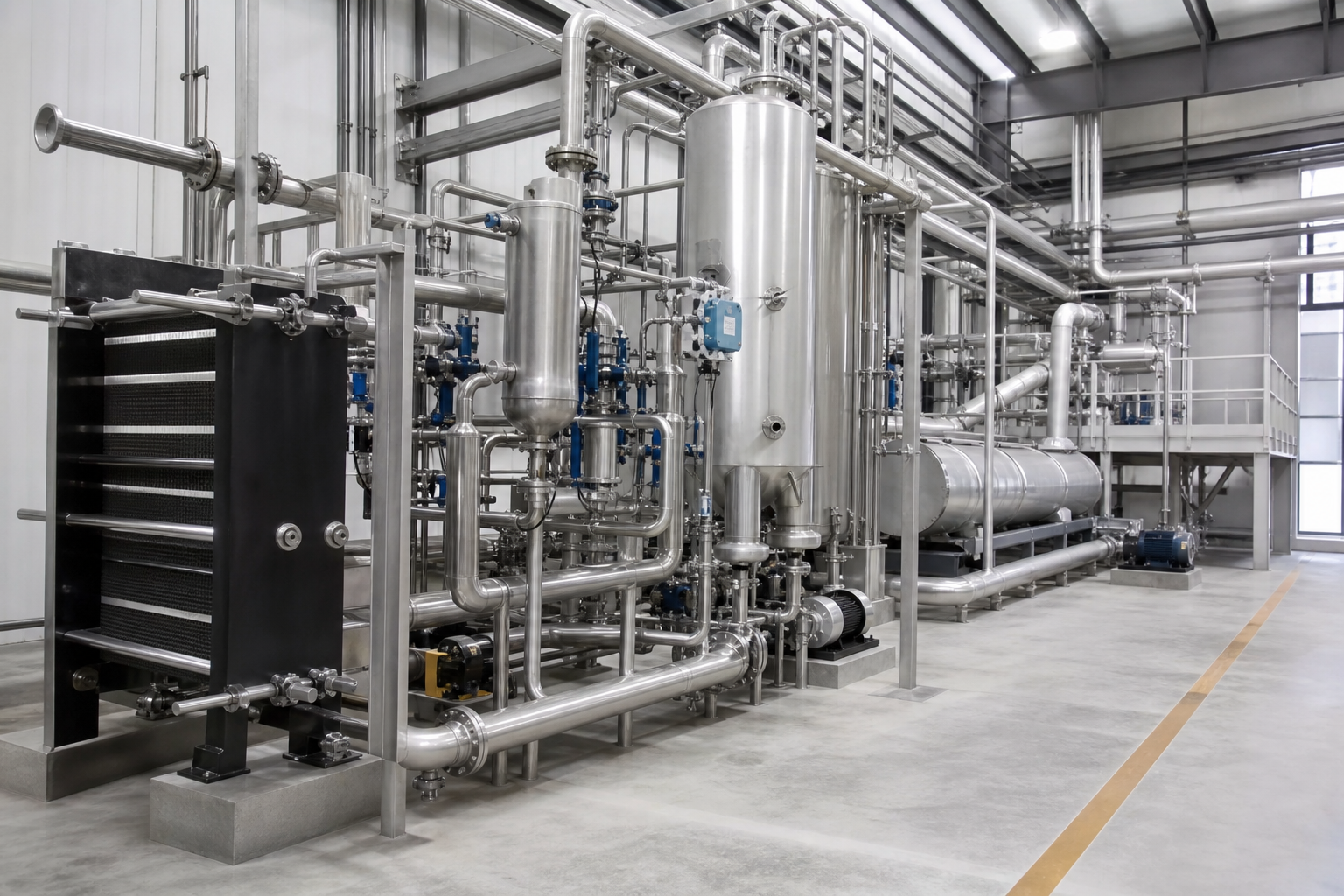
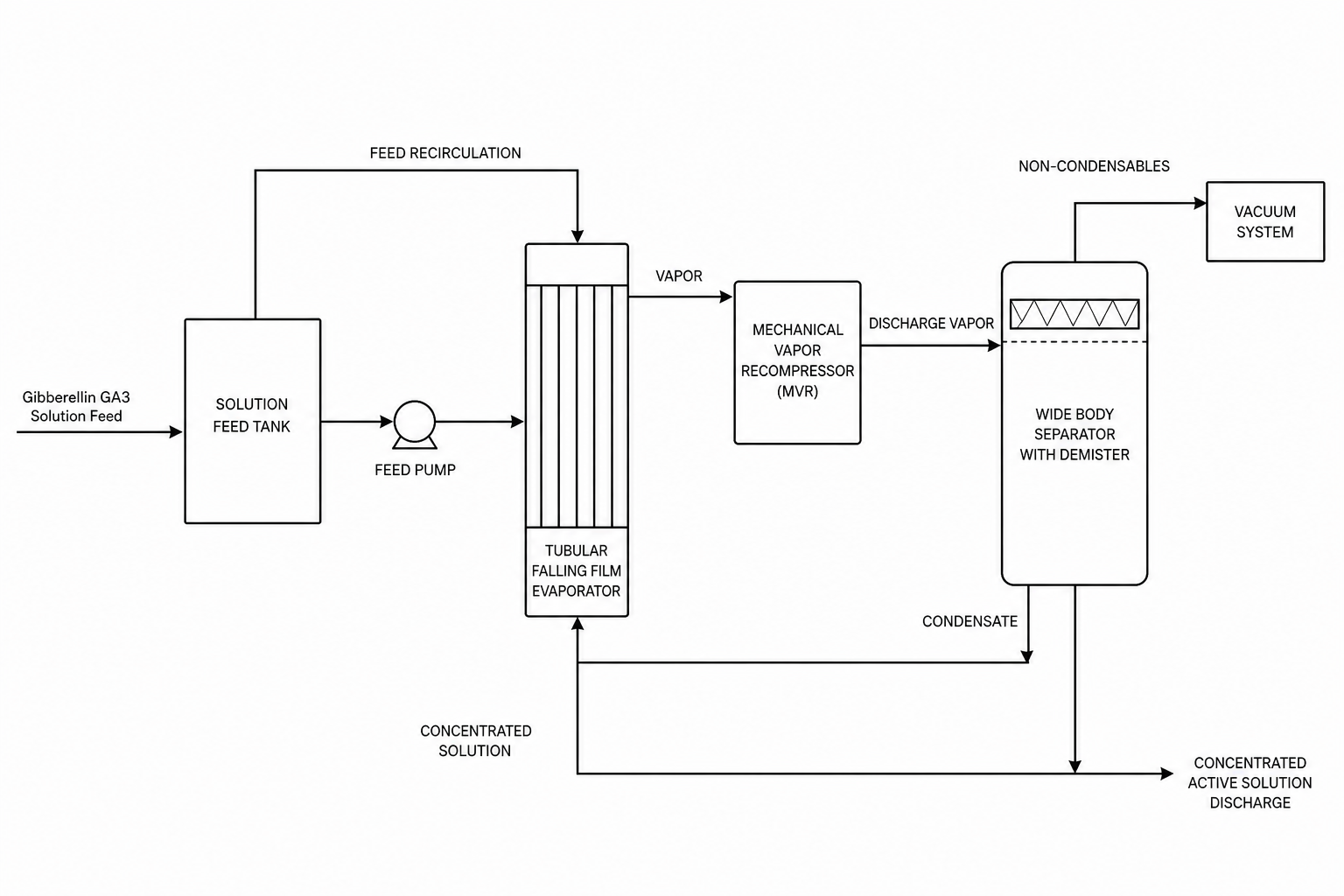
Clarified gibberellin solution feeds the tubular falling-film evaporator. Tubular falling film is the published choice for the molecule: the liquor descends inside vertical tubes as a thin annular film, heated externally by condensing vapor at a low temperature difference. Each element of the liquor’s contact with heat is minimized — low wall temperature from vacuum operation, low temperature difference from the film mechanism, and seconds of residence per pass — because GA3 potency is a direct function of thermal exposure.
The MVR loop supplies the heat without a steam draw. The recompressor takes vapor from the separator, raises its pressure by a modest compression ratio, and returns it to the tube side as heating steam; the plant runs on electricity, with no boiler dependency and no cooling-water load for vapor rejection. For a 10 t/h duty the compressor is a compact machine, and the energy arithmetic publishes in the agrochemical plant’s favor against live steam across the train’s life.
Vacuum staging is the molecule’s second protection: the evaporator body operates well below atmospheric boiling, holding the liquor inside the thermal window where GA3 is stable. Vapor-liquid separation is sized generously — fermentation-derived solutions foam, and entrainment into the compressor would carry active product into the condensate, which is yield loss measured in the product’s currency.
The concentrated active solution discharges at the extraction-side or formulation-side density under inline control. Condensate — hot, clean water — returns to the plant’s water circuits; clean-in-place manages the organic films that fermentation residues leave between campaigns. There is no crystallizer in this configuration: the product leaves as concentrated solution for the downstream purification and formulation steps, which is where gibberellin’s quality story concludes.
Equipment Configuration
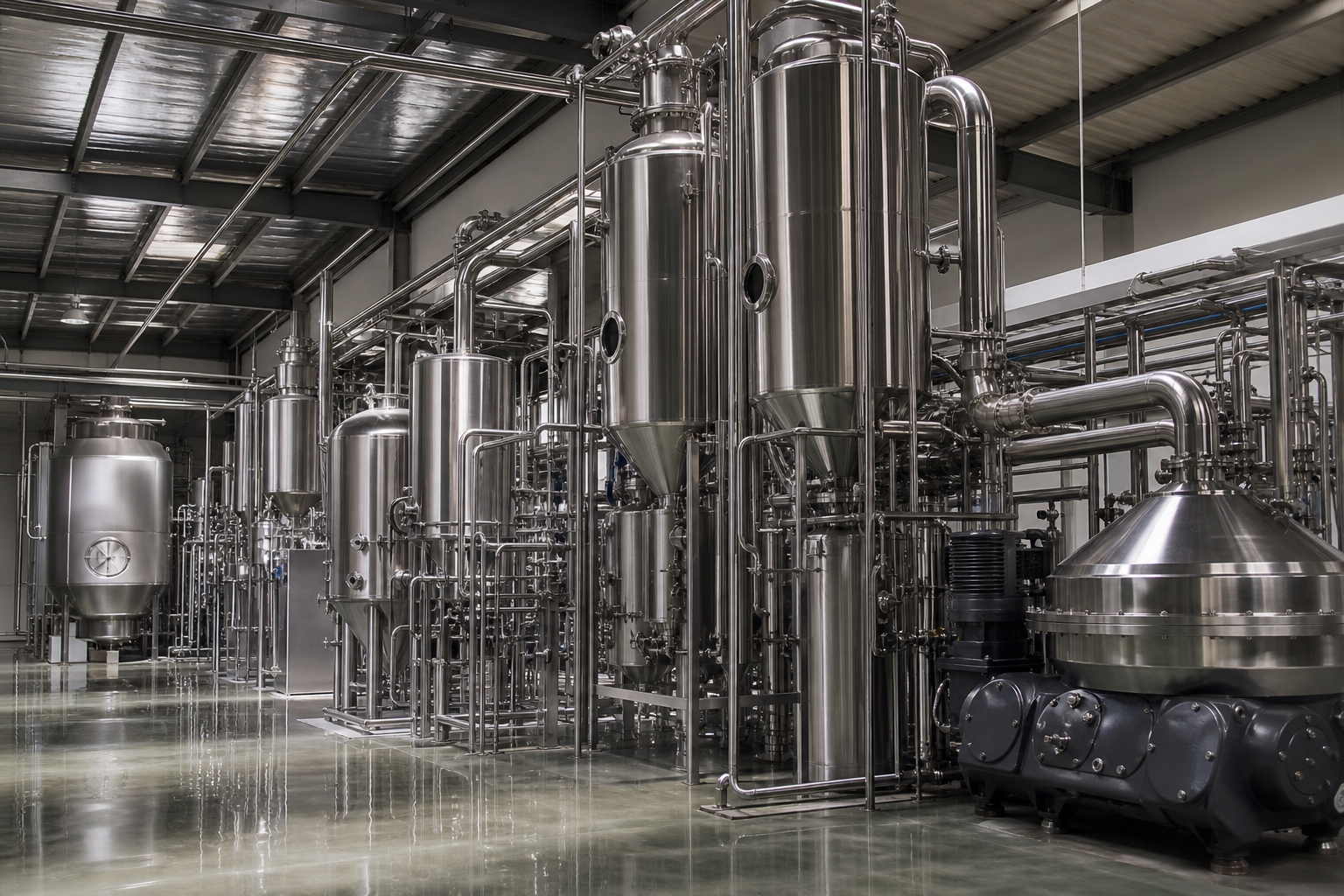
One set of the following equipment is typical for this duty:
- Gibberellin solution feed tank with clarification
- Tubular falling-film evaporator body with high-capacity distributors
- Mechanical vapor recompressor with low temperature lift
- Vacuum system holding low-temperature operation
- Wide-body separator with demisters for foam and active recovery
- Density-controlled discharge to extraction / formulation
- Clean condensate return; CIP for fermentation-residue service
Performance & Outcome
Compiled from published industry project data, indicative: trains of this class concentrate GA3 solution at 10 t/h on MVR electric energy under vacuum at low temperature, protecting active potency while eliminating steam draw. Potency retention and specific energy are quoted per project solution specification.