Project Parameters
| Parameter | Value |
|---|---|
| Process route | Fenton pretreatment + double-effect MVR evaporation + single-effect finisher on mother liquor + centrifuge separation |
| Industry | Rubber chemicals / accelerators production (Qingzhou, Shandong, East China) |
| Feed type & key components | High-salt, high-COD rubber auxiliary wastewater: NaCl-dominant brine with thiazole-class accelerators, morpholine and resin carryover |
| Evaporation capacity | 300 t/d |
| Construction materials | Titanium wetted parts for hot chloride service |
Representative process configuration compiled from published industry project data. Indicative values, not a process guarantee.
Project Description
Rubber accelerator chemistry runs on chlorination and amine routes, and its wastewater shows the lineage: a sodium chloride brine carrying the process’s organic signature — thiazole-class accelerator molecules, morpholine, resinous by-products — at COD levels that make direct crystallization an exercise in fouling. The plant at the reference site in Qingzhou, Shandong produces these intermediates at scale, and its 300 t/d salted stream needed a treatment answer that addressed both fractions of the problem at once.
The representative configuration is that answer, built as a two-front campaign: oxidation chemistry to break the organics down before they reach a heat transfer surface, and a layered evaporation train to recover salt and water from what remains.
Process Technology
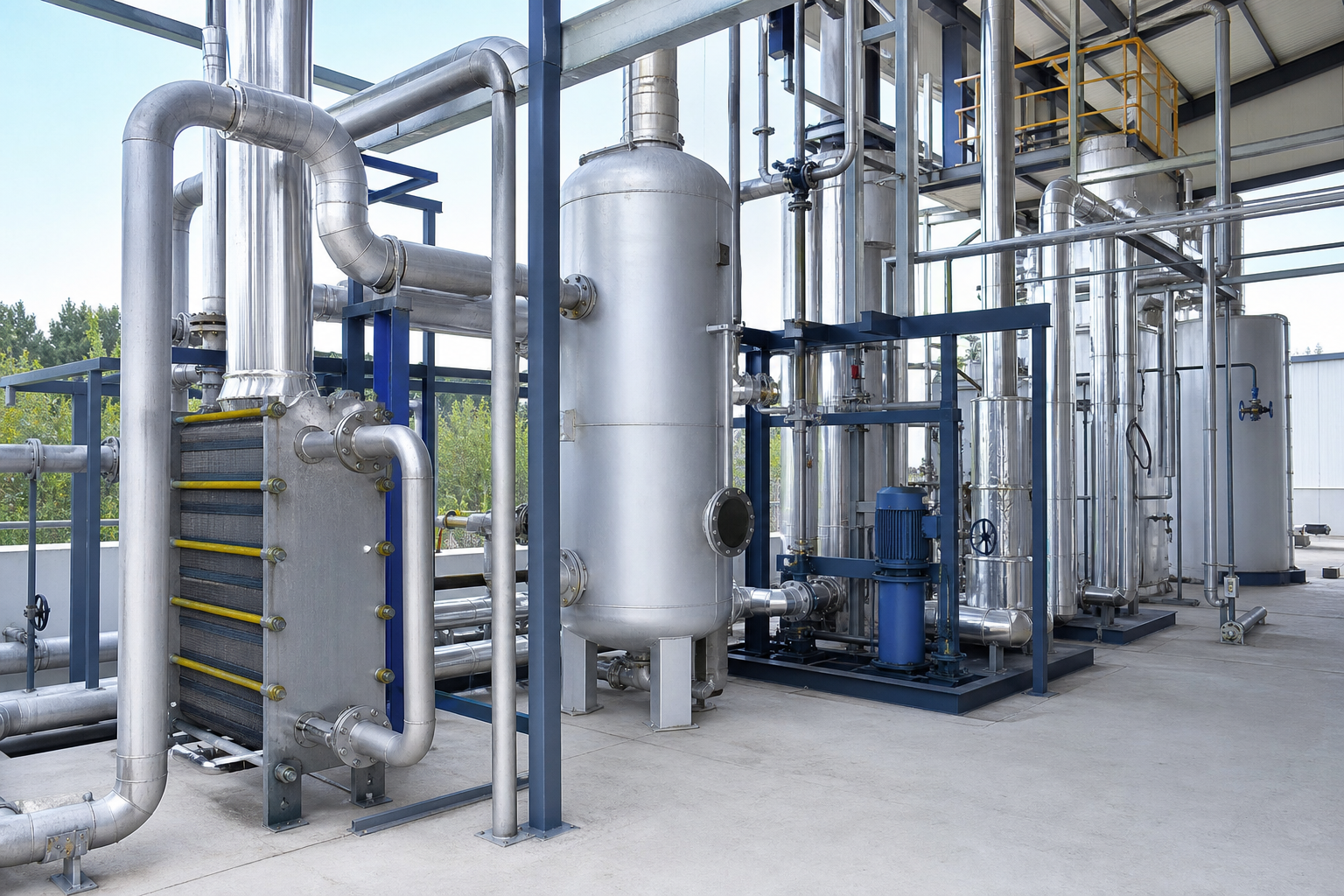
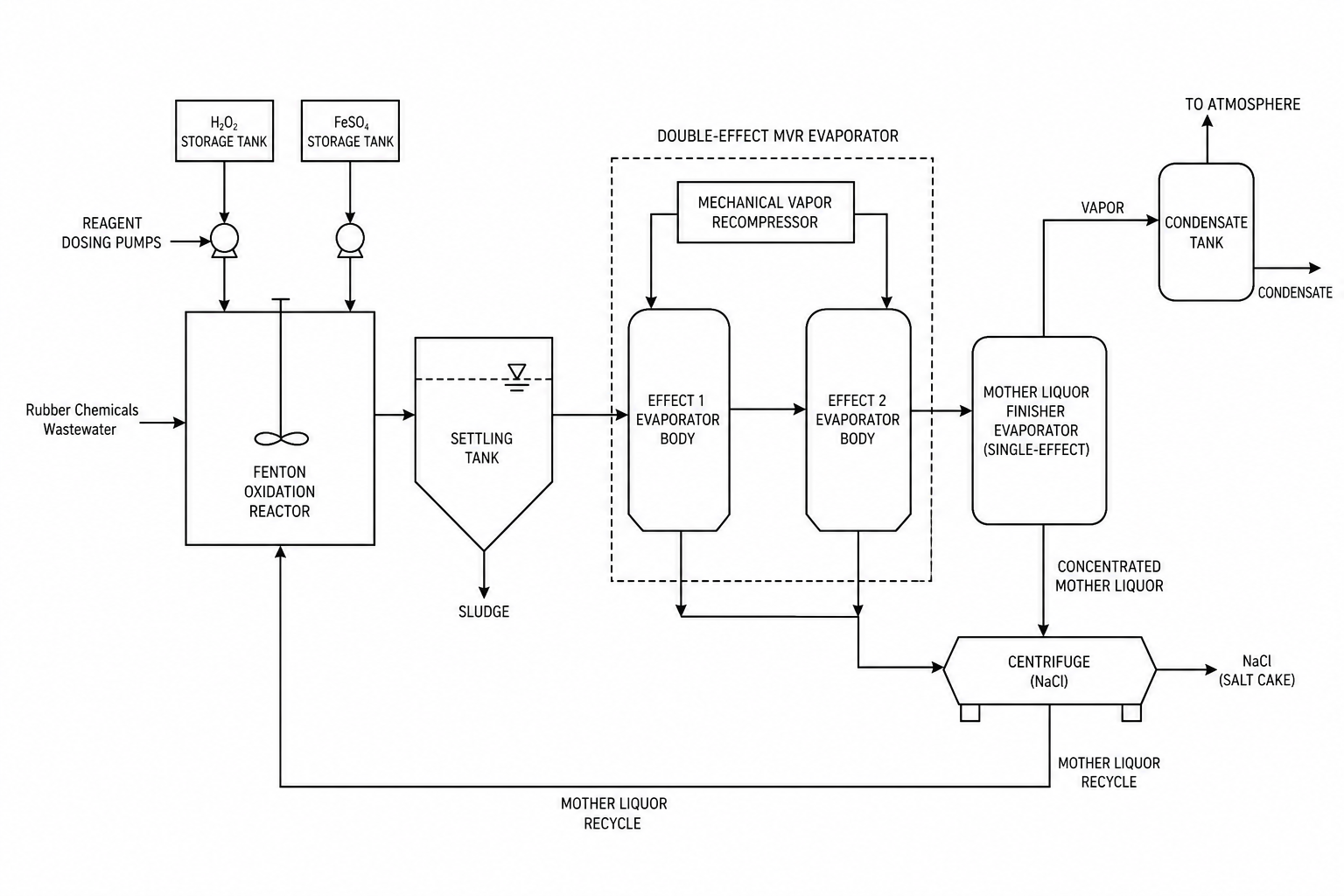
Fenton pretreatment leads. Hydrogen peroxide with an iron catalyst generates hydroxyl radicals that attack the thiazole rings and morpholine fragments, cutting the COD load and — as important for what follows — converting the sticky, resinous fraction into species that behave like ordinary dissolved organics instead of film-forming foulants. The Fenton stage conditions the brine; it does not finish it, and it does not need to.
The oxidized feed then enters double-effect MVR evaporation. Two effects in series reuse the boiled vapor: the first effect’s vapor becomes the second effect’s heating medium, and the MVR recompressor closes the energy balance electrically, lifting secondary vapor back to first-effect temperature. For a 300 t/d duty the double-effect-plus-MVR arrangement is the operating-cost sweet spot — the steam economy of multi-effect with the live-steam independence of MVR.
The flowsheet’s distinctive move is the single-effect finisher on the mother liquor. Concentrate from the double-effect train — salt-heavy, organics-accumulated — is not forced through the same bodies that do the clean early concentration. Part of the mother liquor recycles to the front, and part reports to a single-effect evaporator that finishes the dirtiest fraction in a machine built to be cleaned, keeping the high-efficiency double-effect bodies running on the cleaner duty. Heat transfer where it is cheap; torture-duty hardware where the feed is hard.
Titanium wetted parts carry the hot chloride service — the stated basis for long-term stability in the reference configuration. Centrifuges dewater the crystallized NaCl; condensate meets the receiving water standard (DB 37/675-2007 in the reference). The plant runs at low operating cost on the published basis, stable and compliant.
Equipment Configuration
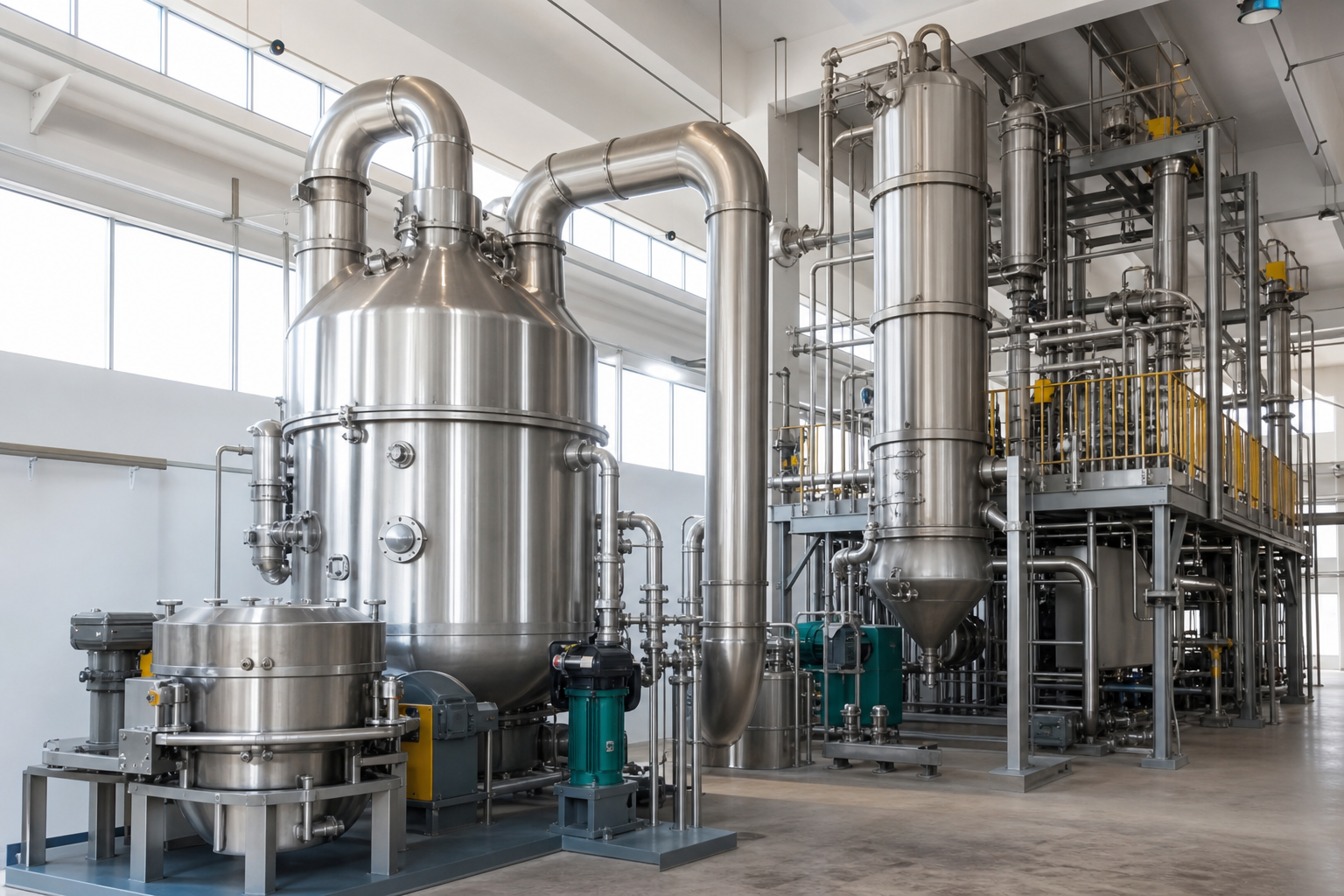
One set of the following equipment is typical for this duty:
- Fenton oxidation pretreatment with catalyst dosing and sludge settling
- Double-effect MVR evaporation train with mechanical vapor recompressor
- Single-effect finisher evaporator on the dirty mother-liquor fraction
- Titanium wetted parts across the hot chloride train
- Centrifuge for NaCl separation; mother-liquor split between recycle and finisher
- Condensate to DB 37/675-2007; PLC/DCS control of effects and inventory
Performance & Outcome
Compiled from published industry project data, indicative: 300 t/d trains of this class run Fenton + layered MVR evaporation on rubber-chemicals brine, dewatering NaCl and holding condensate to provincial discharge standards at low specific operating cost. Salt quality and dose rates are quoted per wastewater formulation.
Simplified PFD
The simplified process flow diagram above shows Fenton pretreatment, the double-effect MVR bodies, the single-effect mother-liquor finisher and centrifuge separation.