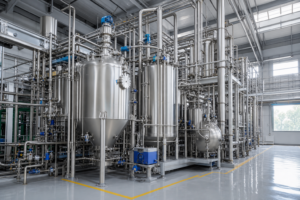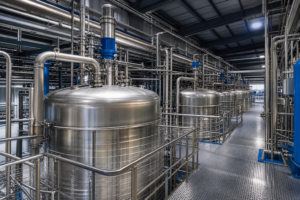
Calcium chloride production from soda ash plant distiller waste is, by weight of water evaporated per tonne of product, one of the most evaporation-intensive duties in the inorganic chemicals industry – and the reference plant cited across published industry reporting operates at 600,000 TPA in Saudi Arabia – reported as the largest anhydrous calcium chloride granule facility in the world. The engineering challenge is a chain of three: purify the 10-15% calcium chloride liquor that ammonia-soda plants generate as a by-product, concentrate it through a steep boiling-point elevation curve into the 70%+ range, then dehydrate and granulate a hygroscopic, corrosive melt into a 94-97% anhydrous product. Success is decided by evaporator configuration, metallurgy, and granulation technology; failure shows up as corroded heaters, caked product, and energy bills that exceed the product’s value.
Where the Feed Comes From: Soda Ash Integration
The Solvay (ammonia-soda) process makes soda ash from salt and limestone, and its unavoidable by-product is calcium chloride. Every tonne of soda ash produced co-generates roughly 0.9-1.1 tonnes of calcium chloride (on a 100% basis), arriving – on an illustrative feed envelope compiled from published Solvay-process data, not a record of any single plant – as roughly 10 m³ of dilute distiller waste liquor containing typically 10-15% CaCl2 along with 4-6% sodium chloride and suspended solids. Two consequences follow:
- Scale coupling: a 600,000 TPA soda ash plant naturally yields a calcium chloride stream of comparable magnitude, which is why soda ash and calcium chloride are built as integrated projects rather than standalone plants.
- Zero-liquid-discharge pressure: distiller waste is the single largest liquid effluent of an ammonia-soda site. Converting it into saleable calcium chloride simultaneously solves the compliance problem and monetizes it – the most elegant ZLD arrangement available to this industry.
The Process Train: Purify, Concentrate, Granulate
| Stage | Duty | Typical Equipment | Critical Control Point |
|---|---|---|---|
| Liquor purification | Remove Mg, sulfate, heavy metals, suspended solids | Lime/Na2SO4 dosing, clarifier, polishing filter | Feed turbidity and Mg/SO4 carryover (they poison product whiteness and granulation) |
| Primary concentration | 10-15% to ~35-40% CaCl2 | Multi-effect forced-circulation evaporator | Boiling-point rise management; heater fouling |
| Secondary concentration | ~40% to 68-74% (dihydrate slurry range) | Forced-circulation finisher; MVR generally not viable in this band (BPE 25-40°C) | Viscosity and corrosion at peak chloride concentration |
| Flaking (dihydrate route) | Form CaCl2·2H2O flakes | Flaking drum with cooling | Flake thickness and moisture uniformity |
| Anhydrous granulation | Melt/prill to 94-97% granules | Spray-granulation fluid bed or rotary granulator-dryer | Bed temperature control; particle size distribution; attrition |
| Screening and packaging | Size product; protect from moisture | Vibrating screens, dehumidified bagging | Climate-controlled packaging hall; liner integrity |
Why Calcium Chloride Concentration Is Harder Than It Looks
The boiling point rises relentlessly. Dilute CaCl2 liquor behaves in the evaporator, but as concentration climbs, the boiling-point elevation grows from roughly 15-20 K near 35-40% to several tens of degrees above 50% (industry-reported), which compresses the available temperature difference in multi-effect arrangements and caps how many effects can be economically stacked. The finishing stages therefore run as forced-circulation evaporators designed for high boiling-point rise, with MVR applicable where the compressor temperature lift matches the service.
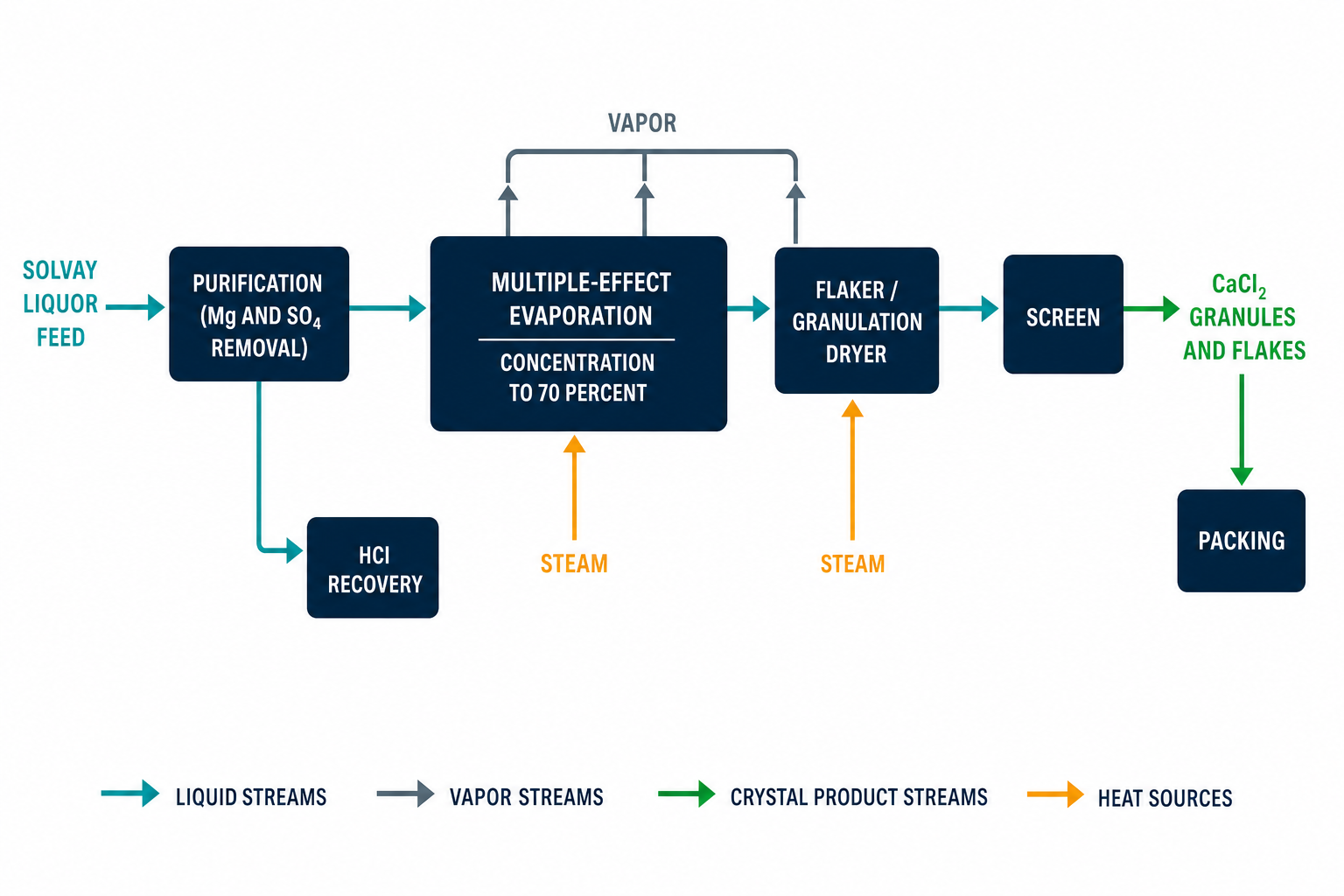
Evaporation duty is enormous. Lifting a 10-15% feed to a ~95% anhydrous product means evaporating on the order of 5-8 tonnes of water per tonne of product across a 10-15% feed range (illustrative). Energy selection (effect count, MVR placement, vapor bleed to other plant users) moves the production cost by double-digit percentages – this is the single largest lever in plant economics.
Chloride at temperature is merciless to steel. Hot, concentrated calcium chloride – especially with traces of free acid – attacks common austenitic stainless grades through pitting and stress-corrosion cracking. Equipment in the hot concentrated services is specified in higher-alloy materials (duplex and nickel-bearing grades, titanium in selected duties), and weld procedures matter as much as plate selection. Under-specifying metallurgy is the classic first-cost trap in this industry.
Read as process modules, the concentration-and-granulation train looks like this – candidate equipment types, the selection rationale, and the indicative operating envelope each module must cover (envelopes derived from published industry data, not project specifications):
| Process Module | Candidate Equipment Types | Selection Rationale | Indicative Operating Envelope |
|---|---|---|---|
| Primary concentration | Multi-effect forced-circulation evaporator | Bulk water removal on dilute liquor; effect count capped by boiling-point rise | 10-15% to ~35-40% CaCl2 (illustrative) |
| Secondary concentration | Forced-circulation finisher; MVR generally not viable in this band (BPE 25-40°C) | Handles viscosity and corrosion at peak chloride concentration | ~40% to 68-74% (dihydrate slurry range) |
| Dihydrate forming | Flaking drum with cooling | Commodity flake route with lower energy demand | CaCl2·2H2O flakes at 74-77% |
| Anhydrous granulation | Spray-granulation fluid bed or rotary granulator-dryer | Premium product value is made here | Melt or prill to 94-97% granules |
| Hot-service metallurgy | Duplex and nickel-bearing alloys; titanium in selected duties | Hot concentrated chloride attacks austenitic grades | Corrosion monitoring routine on hot circuits |
Configuration, materials, and operating ranges depend on the actual feed, temperatures, pressures, corrosion review, fouling behavior, utilities, and project capacity.
Anhydrous Granulation: Where Product Value Is Made
The market pays a premium for anhydrous granular calcium chloride (typically 94-97% CaCl2) over dihydrate flakes (74-77% as CaCl2·2H2O) because granules dissolve faster without exotherm surprises, flow and meter better, and cost less to transport per tonne of active chloride. The industrial reference technology is spray granulation in a fluid bed: concentrated calcium chloride liquor is atomized onto a fluidized bed of seeds, where successive wetting-and-drying layers build dense, round granules while water is driven off by a hot gas stream. The competing approach runs the melt through prilling or rotary granulation-drying equipment.
| Property | Dihydrate Flakes | Anhydrous Granules |
|---|---|---|
| CaCl2 content (typical) | 74-77% | 94-97% |
| Water of hydration | 2 molecules per CaCl2 | Essentially none |
| Handling | Powdery, higher caking tendency | Free-flowing round particles |
| Dissolution heat release | Moderate | High (full hydration + solution heat) |
| Freight efficiency per active tonne | Lower | Higher |
| Typical outlets | Dust control, concrete acceleration, general industrial | De-icing, oilfield completion fluids, drying, premium industrial |
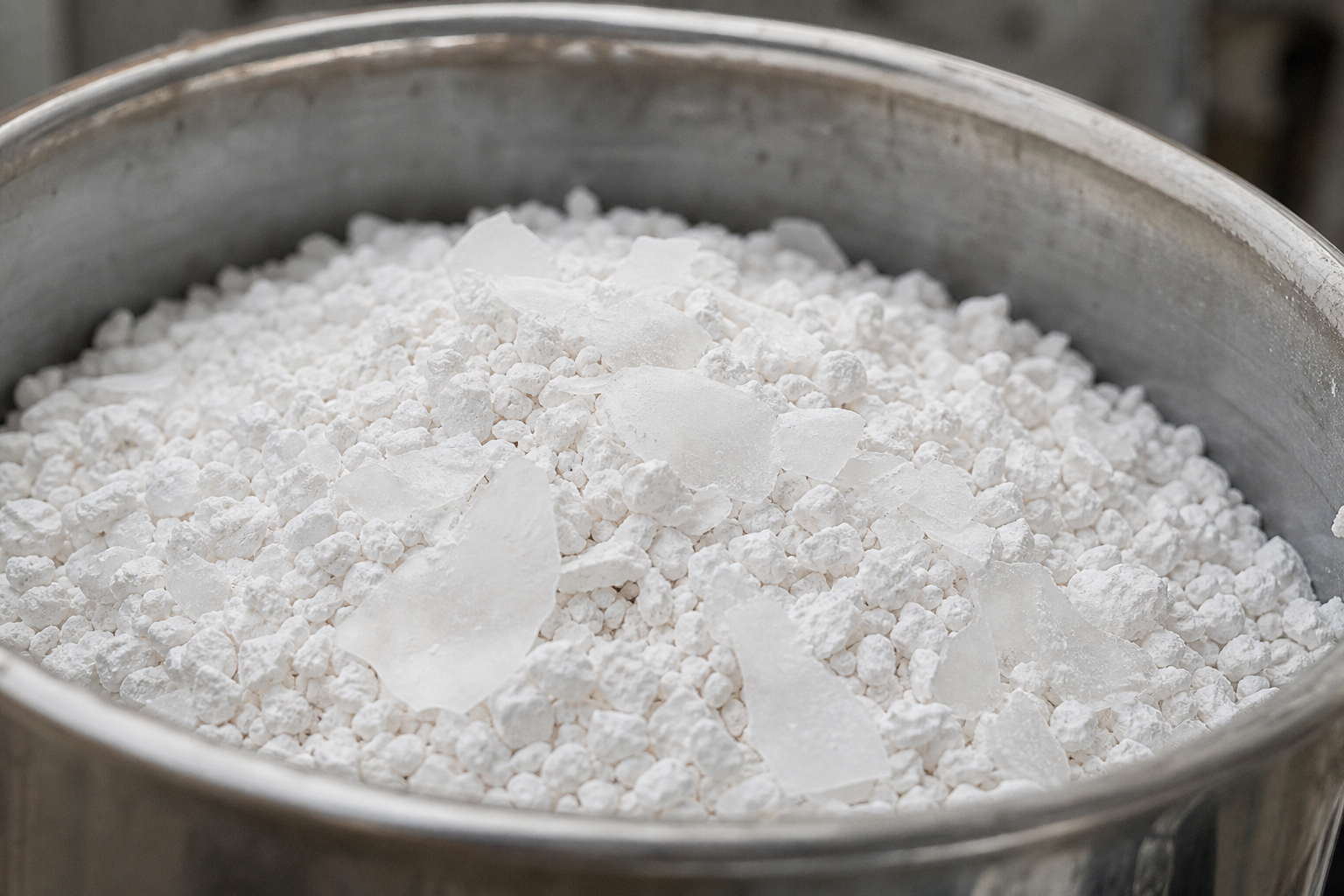
Because finished calcium chloride is strongly hygroscopic, the packaging hall is engineered as a dry island: dehumidified air, PE-lined or laminated bags at 25 kg and 1-tonne formats, sealed silo discharge to trucks where bulk loading applies. Product left in an uncontrolled humidity environment gains weight, cakes, and loses the free-flow properties customers paid for.
The 600,000 TPA Benchmark and What It Proves
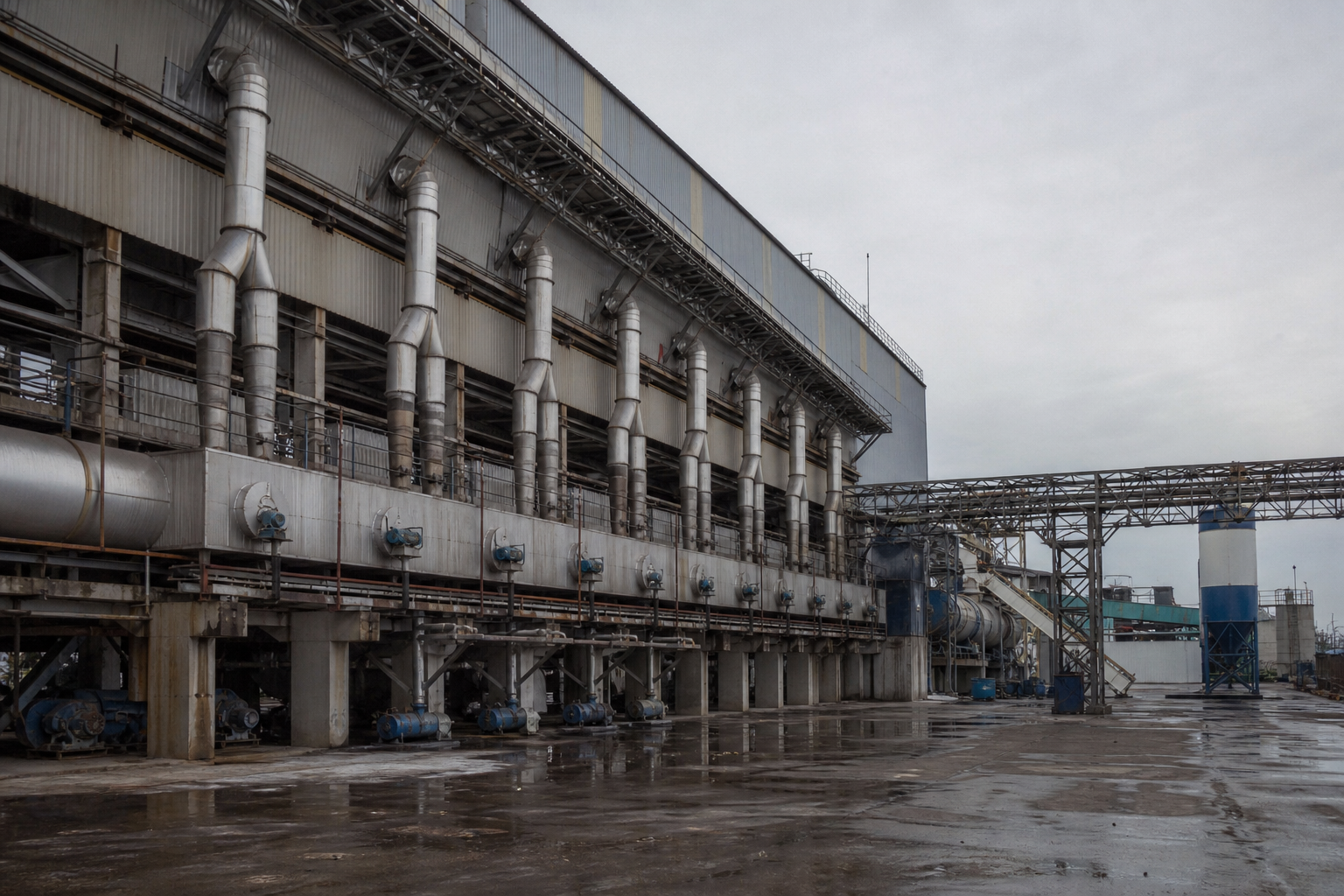
The Saudi Arabian 600,000 TPA soda ash and calcium chloride integrated project – reported in trade press as built with Chinese technology and equipment, and a published industry reference rather than an EvapCryst delivery – is cited as evidence of this flowsheet’s maturity at world scale: the evaporation-granulation train scales past half a million tonnes in a single project, and soda ash-calcium chloride integration is a repeatedly published template. See the by-product HCl and CaCl2 solutions page for the full case discussion.
Applications That Anchor the Business Case
- De-icing and dust control: calcium chloride’s exothermic dissolution and low freezing-point depression make it the premium de-icer; the same hygroscopicity keeps unpaved road surfaces damp for dust suppression.
- Oilfield: completion and workover brines, drilling fluid densification – a major Middle Eastern demand center co-located with the Saudi-scale projects.
- Construction: concrete set acceleration and cold-weather concreting.
- Industrial drying and chemistry: desiccant grades, calcium salts production, wastewater treatment calcium source.
Explore the underlying capabilities: MVR evaporation for high-BPE concentration duties, salt separation systems for chloride stream purification and co-salt management, drying, granulation, and packing systems for fluid-bed spray granulation, and zero liquid discharge for total effluent conversion. For the related inorganic-salt crystallization duty in battery materials, see our lithium carbonate evaporation and crystallization solutions.
Operating Lessons from World-Scale Plants
Calcium chloride assets live or die on a handful of operating disciplines, well documented in published operating literature across soda ash-integrated sites:
- Clarifier discipline upstream. Magnesium and sulfate that escape purification report to the evaporators as scale (sulfate-calcium deposits on heater tubes) and to the granulation bed as discoloration. Plants that hold feed turbidity and Mg/SO4 dosing within limits run years between heater cleanings; plants that do not, acid-clean every few months.
- Granulation bed population balance. A spray-granulation fluid bed holds its particle size distribution only if seed generation, layering growth, and product extraction stay balanced. Worn atomizers and drifting bed temperatures shift the distribution until screening rejects climb; periodic nozzle inspection and bed-temperature interlocks are standard practice.
- Corrosion monitoring as a routine, not an event. Corrosion coupons, wall-thickness surveys on the hot concentrated circuits, and leak detection on chloride-bearing condensates catch metallurgy problems during maintenance windows rather than after them.
- Climate-appropriate design. The reference Gulf-region project designs against extreme heat and freshwater scarcity – favoring air-cooled condensing where feasible and maximum water recycle – while temperate-region replicas of the same flowsheet instead fight freezing in hygroscopic product handling. Both problems are solved in the design phase, not the operating phase.
- Energy system redundancy. With evaporation water on the order of 5-8 tonnes per tonne of product, a trip of the single MVR compressor or the steam supply stops the plant within hours. Well-run plants either dual-source the driving heat or stage the concentration train so partial load is sustainable.
These disciplines explain why reference-scale execution matters to buyers: as reported for the 600,000 TPA Saudi plant, success rests not on flowsheet novelty but on the accumulated detailing of a million small decisions – metallurgy, scaling management, granulation control, water balance – that only shows up in operating factor.
When This Route May Not Fit
This train is justified by the feed being free – distiller waste from an operating ammonia-soda plant. Standalone calcium chloride production on purchased limestone and acid carries a different, usually weaker economics. Small co-generation streams – a few tonnes per day – cannot amortize anhydrous granulation; dihydrate flaking or simple sale of dilute liquor to local users is the honest scope. Where energy is expensive and no integration with the soda ash island exists, the evaporation bill can exceed product value – the failure mode this page opened with. And markets that only take flake or solution product do not need the granulation block at all.
What Must Be Verified
Before configuring this train: the distiller waste analysis – CaCl2 strength and variability, NaCl co-content, magnesium, sulfate, heavy metals, and suspended solids – because purification sizing and product whiteness hang on it; the boiling-point-elevation curve of the actual liquor at target concentrations, which caps effect count and sets MVR applicability; and corrosion testing of candidate alloys against the hot concentrated chloride service. On the product side, the specification the market pays for – dihydrate flake versus anhydrous granule, 74-77% versus 94-97% – decides whether the granulation block belongs in scope. Packaging climate design and the site’s water and energy balance complete the verification set.
Frequently Asked Questions
How much calcium chloride does a soda ash plant produce?
The ammonia-soda (Solvay) process co-generates roughly 0.9-1.1 tonnes of calcium chloride per tonne of soda ash on a 100% basis, as about 10 m³ of dilute (typically 10-15% CaCl2) distiller waste. That is why soda ash and calcium chloride units are built as integrated projects – the publicly reported 600,000 TPA Saudi complex is the reference case.
Why is calcium chloride evaporation so energy-intensive?
Concentrating from ~10-15% feed to a ~95% anhydrous product requires evaporating roughly 5-8 tonnes of water per tonne of product across a 10-15% feed range (illustrative), and calcium chloride’s boiling-point elevation grows from roughly 15-20 K near 35-40% to several tens of degrees above 50% (industry-reported), limiting multi-effect temperature drops. Forced-circulation evaporators, careful MVR placement, and vapor integration with the soda ash island are the standard countermeasures.
What is the difference between calcium chloride flakes and granules?
Flakes are calcium chloride dihydrate, typically 74-77% CaCl2, made by cooling a concentrated melt on a flaking drum. Granules are anhydrous, typically 94-97% CaCl2, built up by spray granulation in a fluid bed. Granules flow better, carry more active chloride per tonne of freight, and serve premium de-icing and oilfield markets.
What materials of construction are needed?
Hot concentrated calcium chloride is highly corrosive – standard austenitic stainless grades suffer pitting and stress-corrosion cracking. Evaporator and granulation equipment in concentrated, hot services is specified in duplex and nickel-bearing alloys, with titanium in selected duties; fabrication quality and weld procedure qualification matter as much as the base metallurgy.
How is caking prevented in storage and transport?
Finished calcium chloride is packaged in a dehumidified, climate-controlled hall into PE-lined or laminated bags (25 kg and 1-tonne formats) or sealed bulk transfer. Because the product absorbs moisture from ambient air rapidly, packaging-line humidity control and liner integrity are the decisive factors for preserving free-flow properties to the customer.
To start a first-pass screening, send the distiller-waste analysis (CaCl2 strength, NaCl co-content, Mg, sulfate, solids) and the target outputs – flake or granule specification and capacity intent – for this route.