Project Parameters
| Parameter | Value |
|---|---|
| Process route | MVR forced circulation evaporation + crystallization |
| Industry | Chemical industry mother liquor (Southwest China, Chongqing area) |
| Feed type & key components | Ammonium sulfate mother liquor, (NH₄)₂SO₄ 15–22%; chloride-free; pH 2.7–3.3; feed > 25 °C; boiling point rise ≤ 10.7 °C |
| Evaporation capacity | ≥ 22 t/h (feed rate 26–28.4 t/h) |
| Energy (published values) | ≤ 53 kWh per tonne of distillate; ≤ 62 kg steam per tonne of distillate |
| Distillate quality | Ammonia nitrogen ≤ 30 mg/L |
| Construction materials | SS316L wetted parts (indicative for chloride-free sulfate service) |
Representative process configuration compiled from published industry project data. Indicative values, not a process guarantee.
Project Description
Ammonium sulfate mother liquor is the quiet constant of the chemical industries: caprolactam, desulfurization, rare-earth precipitation and coke-plant ammonia recovery all end their chemistry with a sulfate-ammonium stream that is half product and half problem. The reference configuration is a 22 t/h MVR forced circulation crystallization train in the Chongqing area of Southwest China, recovering fertilizer-grade ammonium sulfate from a mother liquor running 15–22% salt.
Two properties of this particular liquor write the design. First, it is chloride-free — a genuine luxury in the ammonium sulfate world, meaning standard SS316L serves throughout where chloride-bearing liquors force 2205 or titanium; the mildly acidic pH of 2.7–3.3 stays comfortably inside that envelope. Second, the liquor’s boiling point rise is bounded at 10.7 °C — the thermodynamic tax that dissolved sulfate charges on every degree of driving force — which sets the compressor ratio and the heat transfer area the train must carry to hold 22 t/h of evaporation.
Process Technology
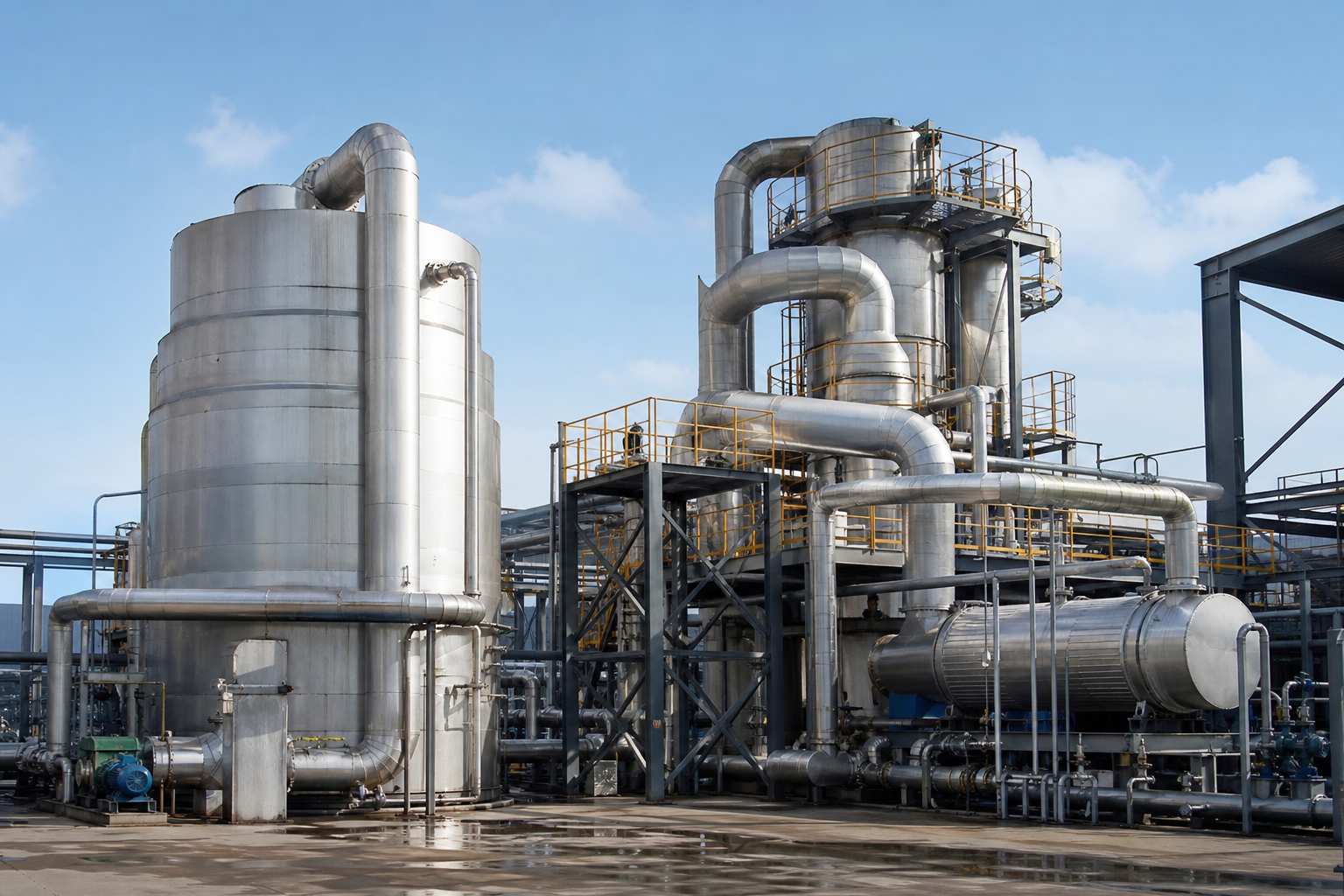
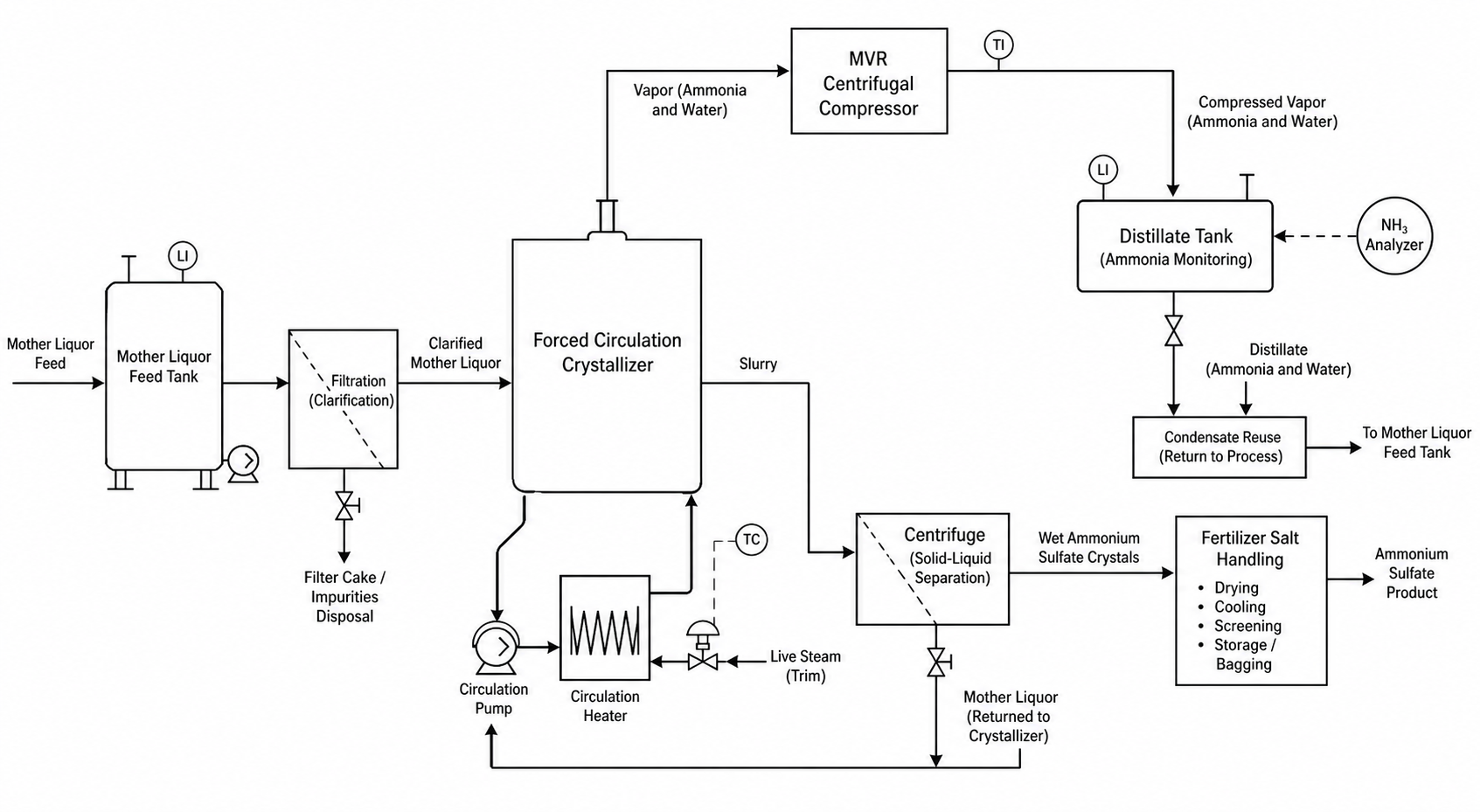
Mother liquor at 26–28.4 t/h feeds the forced circulation crystallizer. The circulation pump drives liquor through the heat exchanger at high velocity and back through the body, where it flashes at the boiling surface; the high velocity suppresses nucleation on the walls and keeps crystals growing in the bulk liquor to the coarse size that centrifuges and fertilizer handling demand. The MVR compressor lifts the evaporated vapor and returns it to the exchanger shell as heating steam — the electrical loop that holds measured energy at or below 53 kWh per tonne of distillate, with live steam limited to 62 kg per tonne for startup, trim and the small thermal balance the crystal load requires.
Crystals grow to specification and draw off continuously to centrifuging; the dewatered salt is the fertilizer-grade ammonium sulfate product. Mother liquor recycles to the crystallizer body with a purge, and the distillate — the two-thirds of the feed that leaves as water — carries ammonia nitrogen at or below 30 mg/L, clean enough for process reuse or compliant discharge. The whole circuit runs on the chloride-free advantage: one metallurgy, one crystallizer, no halide stress-corrosion asterisks anywhere in the inspection plan.
Equipment Configuration
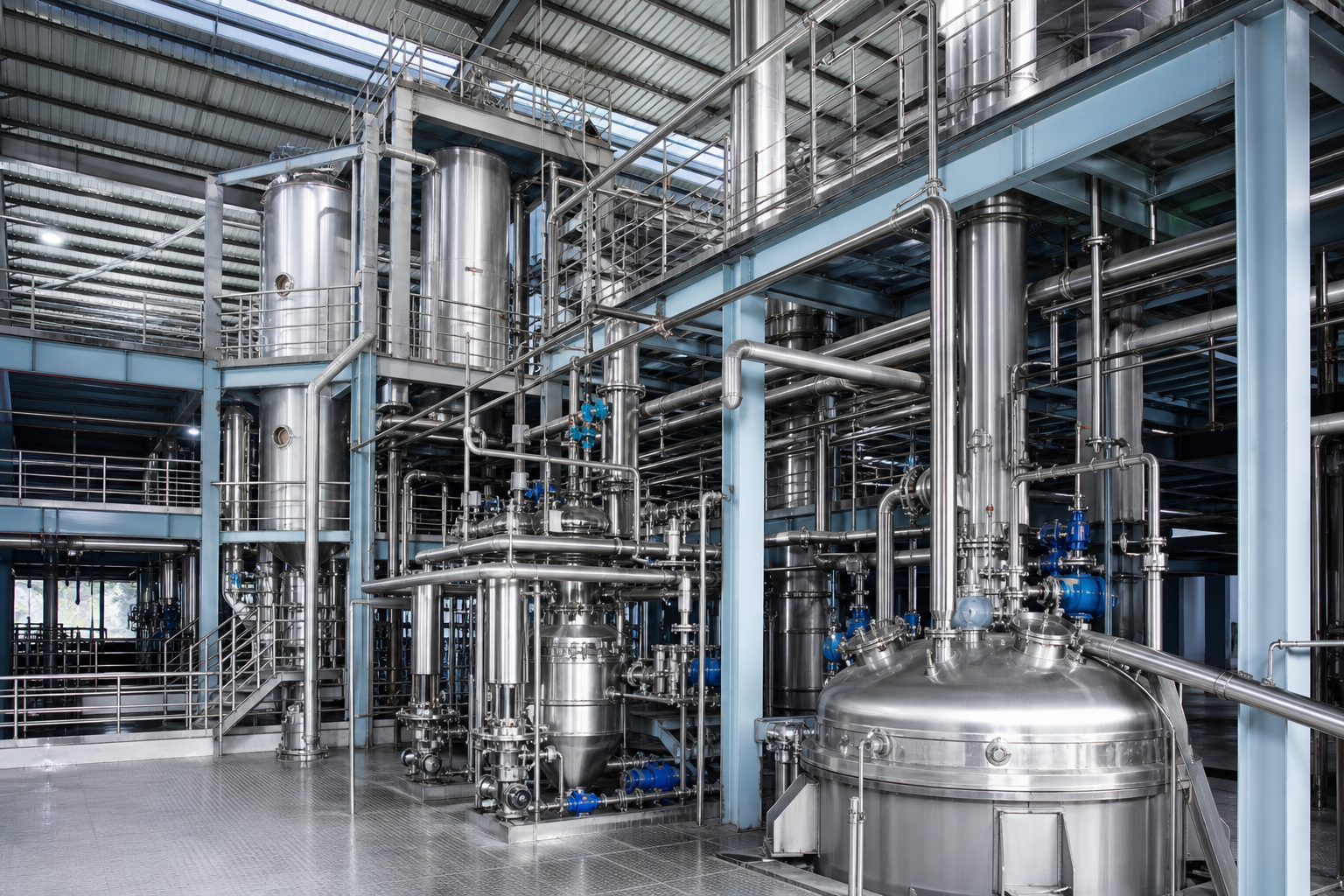
One set of the following equipment is typical for this duty:
- Mother liquor feed tank and filtration
- Forced circulation crystallizer body with circulation heater
- Centrifugal MVR compressor sized for ≤ 10.7 °C boiling point rise
- Live-steam trim interface (startup and balance duty)
- Centrifuge for fertilizer-grade salt dewatering
- Mother liquor return with purge control
- Distillate tank with ammonia nitrogen monitoring for reuse routing
- PLC control of circulation, crystal inventory and energy balance
Performance & Outcome
Compiled from published industry project data, indicative: the train evaporates ≥ 22 t/h at published energy of ≤ 53 kWh and ≤ 62 kg steam per tonne of distillate, with distillate ammonia nitrogen ≤ 30 mg/L and fertilizer-grade ammonium sulfate as the recovered product.
Simplified PFD
The simplified process flow diagram above shows mother liquor feed, MVR forced circulation crystallization, salt centrifuging and monitored distillate return.