Project Parameters
| Parameter | Value |
|---|---|
| Process route | OSLO freeze crystallization denitration + MVR evaporation concentration for lithium recovery |
| Industry | Lithium battery recycling, hydrometallurgical cathode recovery (USA) |
| Feed type & key components | Leach solution from recycled cathode material: lithium values with sodium sulfate burden |
| Evaporation capacity | 80 t/d feed throughput |
| Construction materials | SS316L wetted parts baseline, higher alloys in concentrated chloride/sulfate zones (indicative) |
Representative process configuration compiled from published industry project data. Indicative values, not a process guarantee.
Project Description
North American battery recycling capacity is scaling faster than the supply chains that feed it, and the plants being built in the USA are engineered around one asymmetry: black mass is rich in nickel, cobalt and lithium, but the processing chemistry imports sodium by the ton. Leaching, impurity precipitation and especially sodium removal all push sodium sulfate into the lithium-bearing liquor, and every thermal step that follows pays for that burden twice — once in evaporation energy, once in lithium lost to the sodium circuit.
The representative configuration treats this duty at 80 t/d at a cathode recycling operation in the USA, and it is built as the lithium endgame of the recycling flowsheet: after the pay-metal recovery circuits have taken their nickel and cobalt fractions, the train concentrates the residual lithium liquor back toward battery-grade product. The design goal that shapes the flowsheet is lithium yield — keeping the lithium out of the sodium waste stream and inside the product loop.
Process Technology
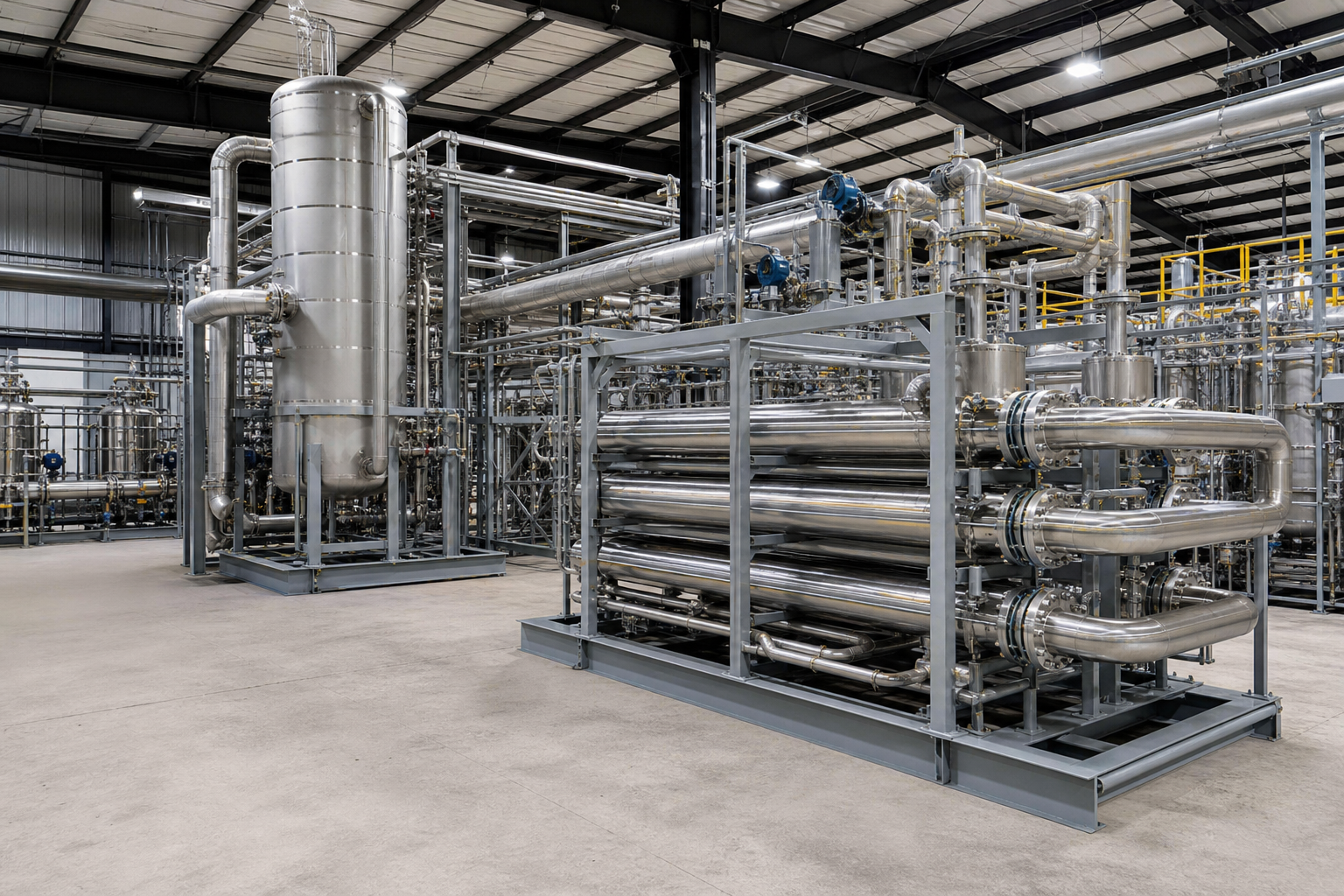
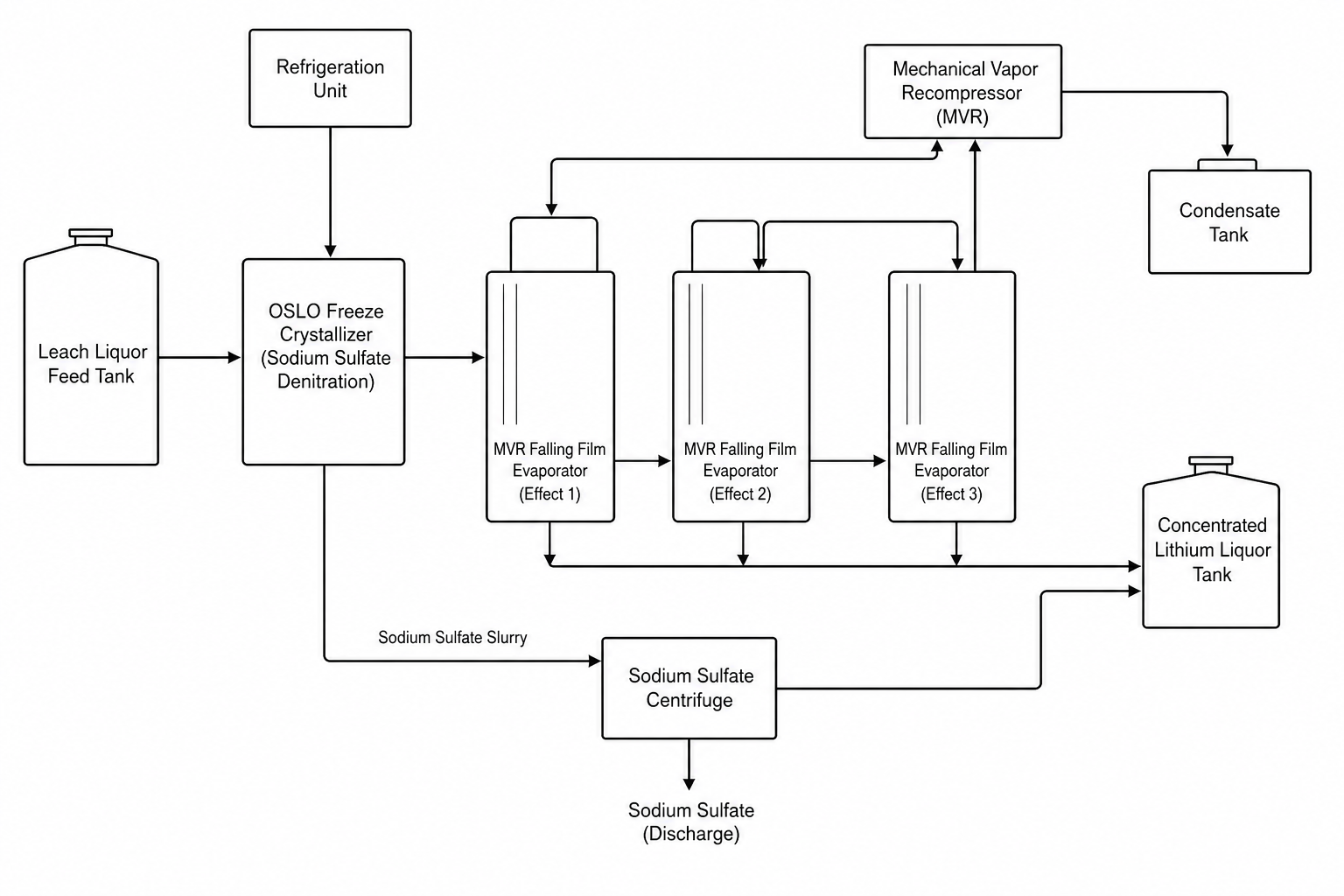
The distinguishing choice is denitration by OSLO freeze crystallization ahead of evaporation. Sodium sulfate in these liquors behaves like Glauber’s salt: chill the solution and Na2SO4·10H2O crystallizes out cold, in an OSLO growth vessel where supersaturation is relieved on suspended crystals rather than on cooling surfaces. Running the sodium removal as a cold crystallization step instead of a hot evaporative one changes the process economics in the direction that matters here: the published basis for this class of train reports lower lithium loss than conventional full-thermal sodium-removal routes, because lithium stays dissolved in the mother liquor through the cold stage instead of co-precipitating with sodium in a hot one.
The denitrated liquor then enters MVR evaporation concentration. Mechanical vapor recompression drives the evaporator electrically: secondary vapor is compressed to a usable temperature lift and returned as heating steam, so the concentration step consumes electricity rather than continuous live steam — the standard economics for a mid-size plant without a steam utility. The train concentrates the lithium liquor to the specification of the downstream precipitation circuit.
Cold sodium sulfate crystals from the OSLO vessel are centrifuged off as a dewatered by-product stream; mother liquor returns to the head of the crystallizer. Condensate from the MVR train is collected clean and hot and reused in the recycling plant’s washing and leaching duties. The overall effect reported for this configuration class: a higher-quality downstream lithium carbonate product, because the sodium that would have followed the lithium into precipitation was already removed cold.
Published references for the train report stable operation at the 80 t/d design rate over an extended initial campaign, in the reference case as the supplier’s first overseas lithium recovery project.
Equipment Configuration
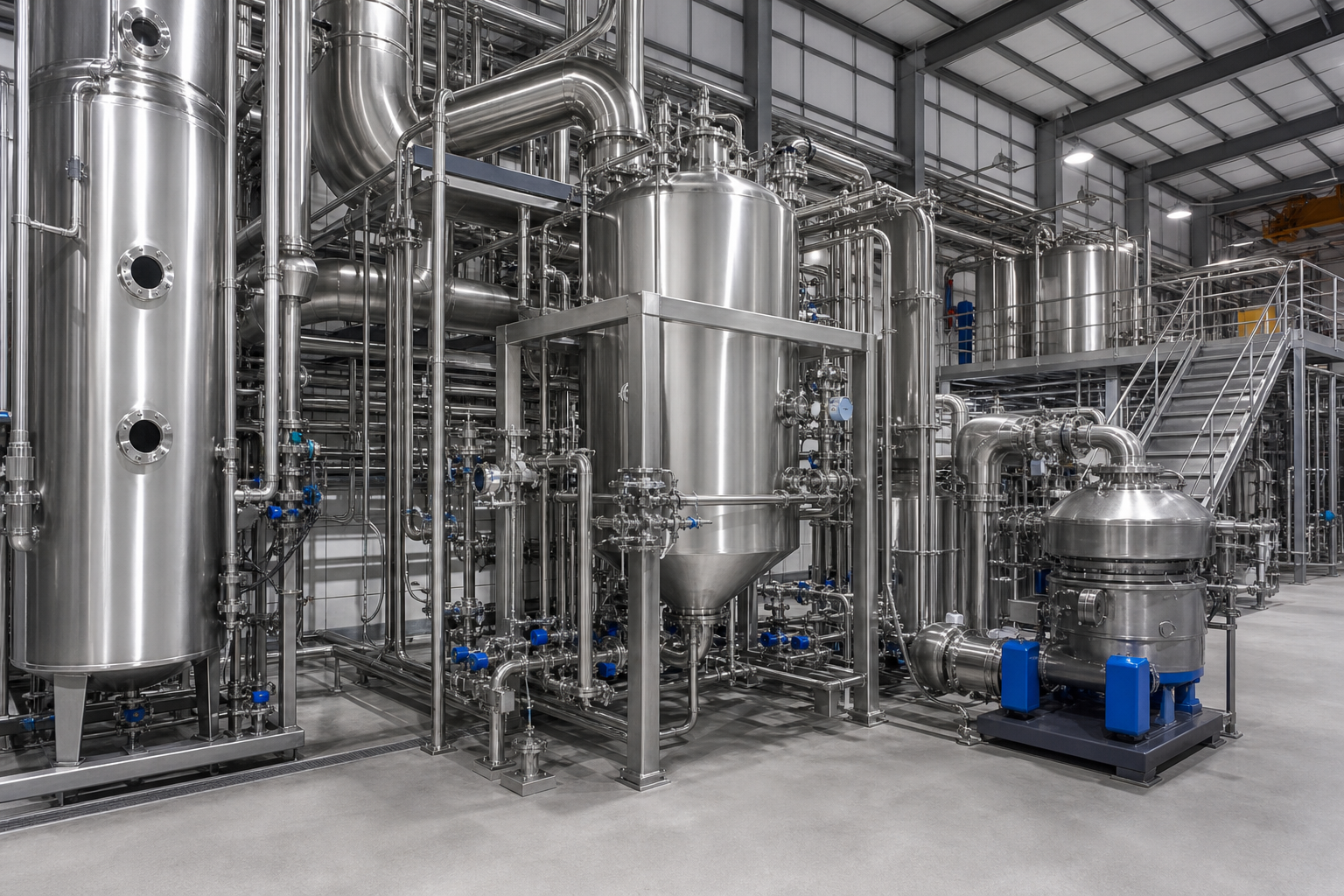
One set of the following equipment is typical for this duty:
- Feed equalization and filtration of the lithium-bearing leach liquor
- OSLO freeze crystallizer train for sodium sulfate denitration
- Refrigeration/cooling plant serving the crystallization stage
- MVR evaporation concentration train with mechanical vapor recompressor
- Centrifuge for sodium sulfate by-product; mother-liquor return
- Condensate collection and reuse; DCS control of lithium and sodium inventories
Performance & Outcome
Compiled from published industry project data, indicative: freeze-denitration-plus-MVR trains of this class run 80 t/d on recycled cathode liquor with lower lithium loss than full-thermal sodium removal, discharging sodium sulfate as a dewatered by-product and returning clean condensate to the plant. Lithium yield and product purity are quoted per project flowsheet.