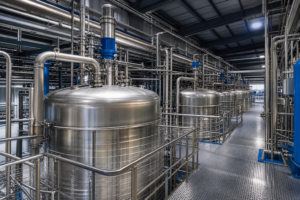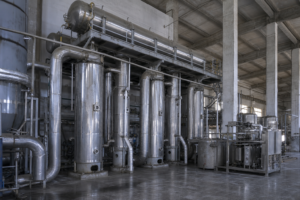
Aluminum hydroxide (Al(OH)₃, hydrate alumina) production is a particle-engineering business: the material is made either as the intermediate of the Bayer process — where it is seeded from sodium aluminate liquor and then calcined to alumina — or by chemical precipitation routes that deliver the fine, high-purity grades used as flame retardants, pharmaceutical antacids, and catalyst precursors. In both routes the commercial value of the product is set less by its chemistry than by its particle size distribution, crystal form, and residual impurities — and the plant sections that decide those attributes are precipitation/crystallization, washing, and drying. This article walks through the production routes, the process controls that govern particle quality, impurity management, and the drying line — including the spin-flash dryer configuration used for wet aluminum hydroxide filter cake, described stage by stage.
Two Production Routes, Two Product Classes
Practically all commercial aluminum hydroxide comes from one of two families of process:
- Bayer route (metallurgical grade) — bauxite is digested in caustic soda; the sodium aluminate liquor is cooled and seeded with fine hydroxide crystals, onto which dissolved aluminum hydroxide precipitates and grows; the coarse fraction is harvested, washed, and either calcined to smelter-grade alumina or sold as hydrate. Particle strength and size uniformity matter most here, because calcination and smelter handling punish fragile or fine material.
- Precipitation route (specialty grades) — aluminum salts or sodium aluminate are neutralized under controlled pH, temperature, and seeding to precipitate aluminum hydroxide of defined fineness and purity for flame-retardant plastics and rubbers, pharmaceuticals, water treatment, and catalyst-carrier applications. Here the controlled variables are supersaturation, residence time, and the suppression of uncontrolled nucleation — the same discipline that governs any precipitation crystallization.
The routes share downstream sections: solid-liquid separation (settler, filter, or centrifuge), washing to remove mother-liquor residues, drying, and packaging. And they share the central engineering fact of this product: aluminum hydroxide exists in several crystalline polymorphs (gibbsite being the stable ambient form), and which form plus what particle size you get is a direct function of precipitation conditions — temperature, caustic/salt concentration, seed quality, and time.
Why Particle Engineering Dominates Product Value
Aluminum hydroxide’s largest specialty market is flame retardancy, and the mechanism explains the specification. When heated strongly, the hydrate decomposes endothermically and releases water vapor — absorbing heat from the flame and diluting combustible gases with steam — while leaving a refractory alumina residue. That decomposition behavior, combined with the material’s fineness (which controls how well it disperses in polymer compounds and how it behaves in filled systems), is what plastic and rubber compounders pay for. Coarse or agglomerated material burns poorly into compound; ultrafine material raises viscosity and dusting. Particle size distribution is therefore a commercial property, and it is won in the precipitation/crystallization step — not adjustable later.
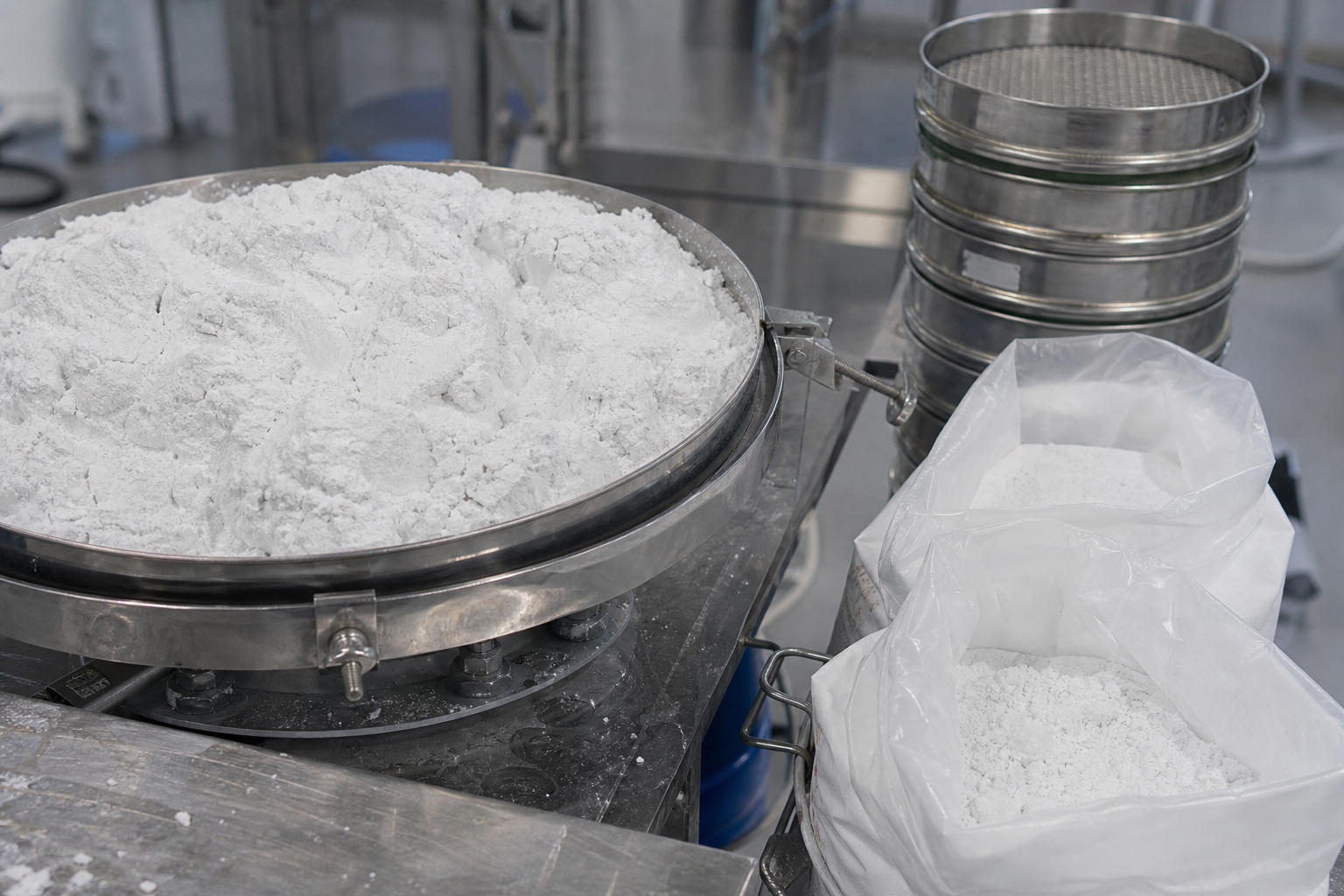
For metallurgical hydrate the equivalent statement is mechanical: fines and weak crystals generate dust and attrition through calcination and handling, and the specification is again set at precipitation.
Precipitation and Crystallization Control
The levers that matter in seeded precipitation, in the order they bite:
- Supersaturation — the driving force set by liquor concentration and cooling. Run high and nucleation floods the population with fines; run low and growth stalls. The objective is growth on seed at a rate the crystal can sustain without occluding mother liquor.
- Seed quantity and quality — seed surface area defines where growth happens. Fresh, well-formed seed makes well-formed product; degraded or contaminated seed propagates its defects into the crop.
- Temperature profile — precipitation is strongly temperature-dependent; the cooling path through the crystallizer train is the primary shape control on the size distribution.
- Residence time and agitation — time converts supersaturation into growth; agitation keeps the suspension uniform without attrition. Both are traded against tank volume, which is why precipitation trains in this industry are long banks of agitated vessels rather than single units.
- Classification and discharge — harvesting the coarse fraction and returning fines as seed closes the size-control loop; this is the same classified-product-removal logic used in industrial crystallizers generally.
For specialty precipitation grades, add pH and reagent purity to the list: the polymorph that precipitates, and the impurities it carries down, respond to both.
Washing and Impurity Control
Between separation and drying sits washing, and it is under-rated. Bayer hydrate carries occluded and surface caustic; specialty precipitates carry the salts of their neutralization chemistry. Residual sodium in particular is a watched specification in most commercial grades, because it survives drying and reappears in the customer’s product — as ash flux issues in ceramics, conductivity in electronic-adjacent applications, or simple specification failure in pharmaceutical grades. Effective washing is a filter or centrifuge displacement problem: wash-water quantity, contact time, and cake cracking (cracked cakes short-circuit the wash) determine the residual, and the wash filtrate becomes a plant wastewater stream that must be routed somewhere — in closed-loop plants it returns to the process; in others it joins the effluent train. Where that effluent carries dissolved salts at levels that prohibit discharge, evaporation-based recovery using MVR recompression is the standard concentrating step; the cycle is described on our MVR technology page, and the end-to-end position of such recovery in plant water management is covered under ZLD solutions.
Drying Wet Aluminum Hydroxide: The Spin-Flash Line
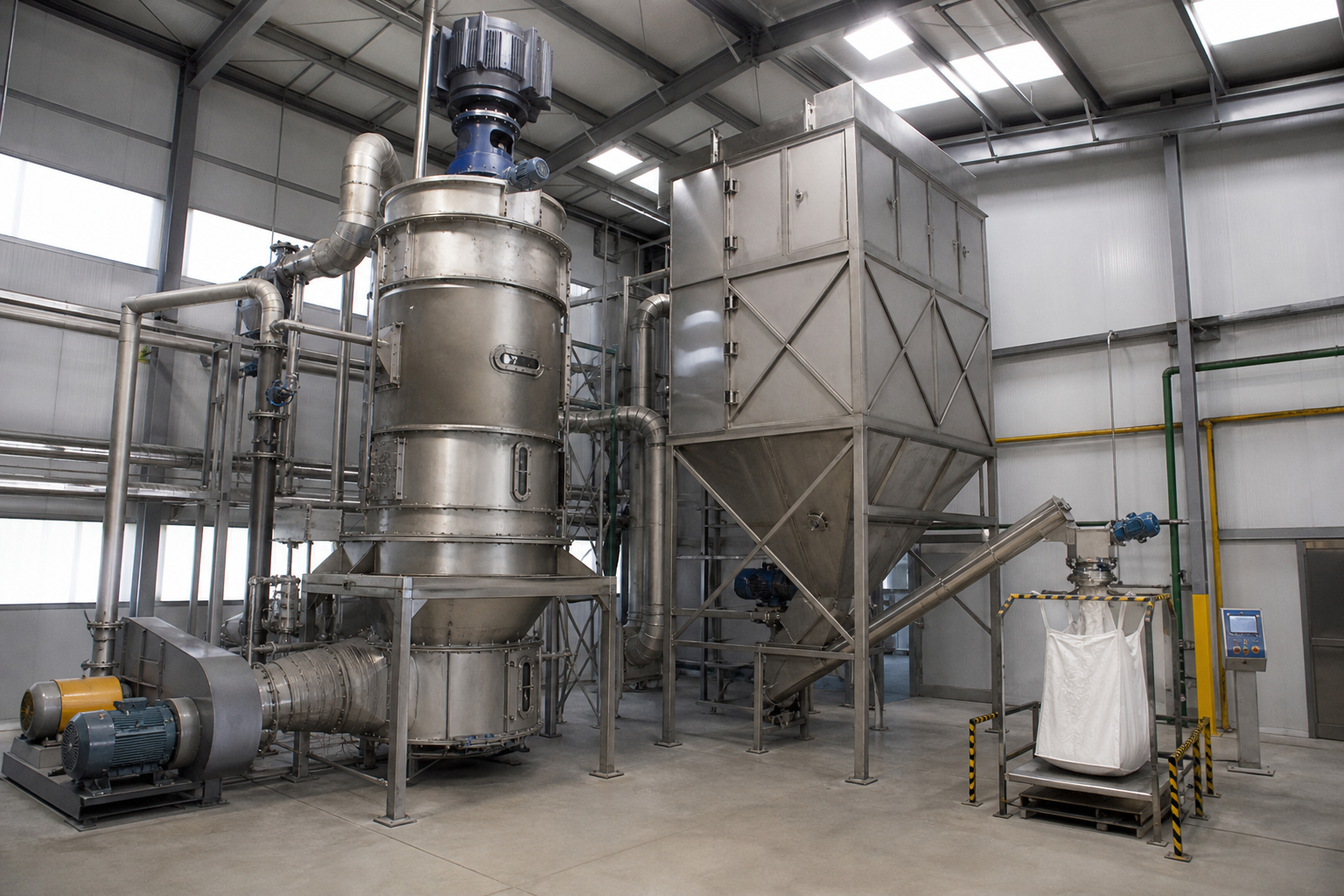
However it is produced, aluminum hydroxide arrives at the dryer as a wet solid — filter cake or centrifuge cake carrying surface and interstitial water — and the dryer must remove that water without degrading the particle or overdrawing energy. The spin-flash (rotary flash) dryer configuration, reported in vendor-published drying literature for wet aluminum hydroxide service (external industry reference, not an EvapCryst delivery), runs as follows:
- Feed — wet aluminum hydroxide is fed into the spin flash dryer through a screw feeder, which meters the sticky cake into the drying zone continuously.
- Air preparation — natural air passes through a filter, is compressed by the blower, and enters the gas (hot-air) furnace, where it is raised to drying temperature.
- Drying zone — hot air enters the bottom air chamber of the spin flash dryer; the wet material is crushed by the dispersing device inside the dryer while simultaneously undergoing heat exchange and drying with the hot air. Dispersal is the point: it exposes fresh surface continuously and prevents the cake from passing through in lumps.
- Gas-solids separation — dried material and exhaust gas flow together to the bag filter, where product is separated; clean exhaust gas leaves the top of the bag filter and is released to atmosphere through the induced-draft fan.
- Product discharge — qualified dried product drops from the bottom of the bag filter into the packaging system.
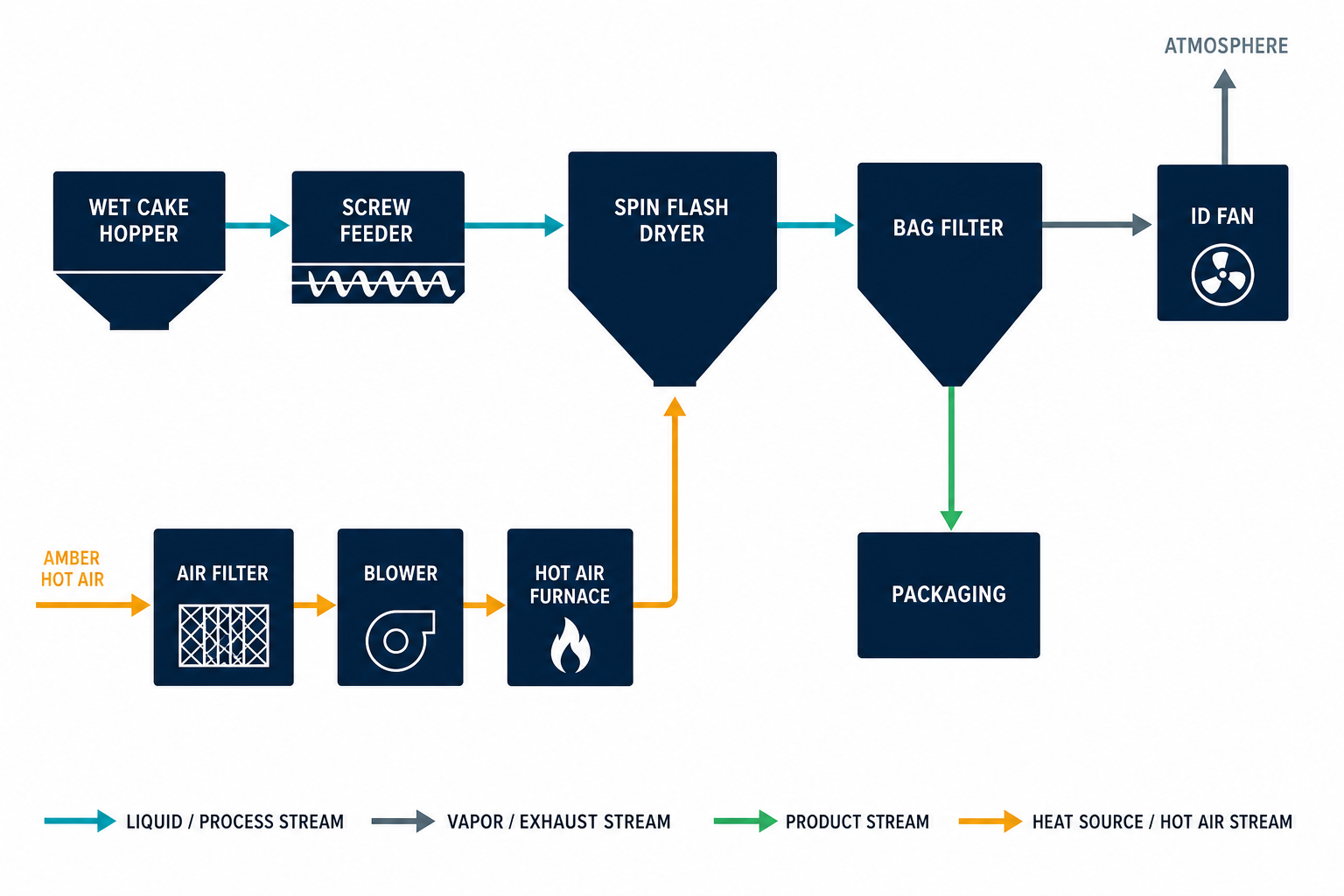
The characteristics that make spin-flash drying a frequent choice for this duty: near-instantaneous drying of dispersed particles (gentle despite high air temperature, because residence time is seconds), tolerance of pastes and filter cakes that would blind a fluid bed, and a dry, free-flowing product without a separate milling step in many cases. Where the feed is instead a granular, free-flowing hydrate, fluid-bed drying competes on energy integration (built-in heat exchangers, steam heating) — the trade space between spin-flash, fluid-bed, and other dryer families for salt and hydrate products is laid out on the drying and packing technology page.
Dryer Selection Summary
| Criterion | Spin flash dryer | Fluid bed dryer |
|---|---|---|
| Feed form | Wet cake, paste, sticky or agglomerating solids — disperser handles them | Free-flowing granular or crystalline solids |
| Residence time | Seconds; continuous single-pass | Minutes; controlled by bed height and discharge weir |
| Particle integrity | Some attrition from the dispersing action — usually acceptable or beneficial | Minimal attrition; preserves crystal size |
| Typical role for Al(OH)₃ | Wet filter cake to dry powder in one step | Coarse metallurgical hydrate; steam-heated variants for energy integration |
| Module | Candidate Equipment Types | Selection Rationale | Indicative Operating Envelope |
|---|---|---|---|
| Precipitation / crystallization train | Agitated tanks in series, classified-seed circuit | Growth on seed at sustainable supersaturation; classification returns fines as seed | Ambient-to-moderate temperature cooling profile per liquor chemistry |
| Solid-liquid separation | Settler/thickener, vacuum or pressure filter, centrifuge | Chosen by particle size, throughput, and required cake dryness | Cake moisture set by cake washing downstream needs |
| Washing stage | Filter displacement wash, reslurry wash, centrifuge rinse | Residual sodium specification drives wash quantity and contact design | Limited by cake cracking behavior |
| Drying | Spin-flash dryer, fluid-bed dryer | Spin-flash for sticky wet cakes; fluid bed for free-flowing granular hydrate | Seconds residence (spin-flash) to minutes (fluid bed) |
| Gas-solids separation and packing | Bag filter, induced-draft fan, packing system | Negative pressure contains fine-dust emissions | Filtered atmospheric exhaust |
Configuration, materials, and operating ranges depend on the actual feed chemistry, corrosion review, fouling behavior, site utilities, and project capacity.
Plant Integration and Materials Notes
Three integration points decide whether an aluminum hydroxide line runs clean. First, moisture consistency of the filter cake: the dryer is sized for the worst cake, and every point of extra moisture the filter passes is evaporative duty and fuel the plant pays for all year — tightening filtration is usually cheaper than upsizing drying. Second, dust containment: fine hydrate is dusty, and the bag filter plus packaging system carry the containment burden; negative-pressure design of the drying train, as in the configuration above (induced-draft fan on the clean side), keeps emissions inside the equipment. Third, materials of construction: aluminum hydroxide itself is gentle to steel, but the washing circuit’s chemistry (caustic carryover in Bayer service, salt solutions in precipitation service) is what actually selects materials for wetted parts.
Related Solution Lines
Adjacent duties covered separately: organic-acid crystallization with its temperature-sensitivity discipline (adipic acid production, wastewater, and N2O treatment), ammonium salt recovery (ammonium sulfate), and mixed-salt separation for effluent trains on the salt separation page.
Validation Focus
No public project dataset is cited on this page, so the configuration notes above are engineering guidance rather than demonstrated performance. Validation before a line is engineered should cover batch precipitation tests on the actual liquor (polymorph, particle size, impurity carrydown), wash-displacement trials on real cake, and drying trials at actual cake moisture. Vendor drying curves are external references, indicative only, not feed-specific evidence.
When This Route May Not Fit
This page’s routes assume the product is sold on particle specifications. Where aluminum hydroxide is only an intermediate stream inside an integrated alumina complex, a specialty line is over-engineering; debottleneck the existing train instead. Where the feed liquor carries heavy organic contamination or high silica, seeded precipitation control degrades and the wash and drying sections inherit the problem. Spin-flash drying earns its place on sticky wet cakes; free-flowing granular hydrate dries more cheaply in a fluid bed, and very heat-sensitive or ultrafine grades may need low-temperature inert-gas drying a standard hot-air line does not provide. Effluent evaporation only pays where wash-filtrate volumes and salt loads justify the energy input. Each exception has a cheaper answer.
What Must Be Verified
Project commitments on this product should rest on verified data, not literature values. Required checks include a full liquor analysis (caustic or salt concentration, dissolved silica, organics), precipitation tests that pin down polymorph and particle size on the actual feed, and wash trials measuring residual sodium against the target specification. For the drying line, cake moisture and stickiness must be established from real filtration samples, because dryer sizing and disperser design follow them. Utilities need confirming: fuel or steam for the dryer, wash-water quality and balance, and dust-containment standards for the packing hall. Where residual-sodium or polymorph specifications are tight, customer-agreed test methods should be fixed before equipment is ordered. Verification converts assumptions into evidence.
FAQ
How is aluminum hydroxide produced?
Two main routes: the Bayer process (digesting bauxite in caustic soda, then seeded precipitation of hydroxide from sodium aluminate liquor — mostly calcined to alumina) and chemical precipitation routes (neutralizing aluminum salts or sodium aluminate for high-purity specialty grades).
Why does particle size matter so much for aluminum hydroxide?
The main specialty use is flame retardancy: on strong heating the hydrate endothermically releases water vapor that cools and dilutes the flame. Performance in filled polymers depends on fineness and dispersion, so particle size distribution is the commercial specification and is fixed at precipitation.
How is wet aluminum hydroxide dried?
In spin-flash service, wet material is screw-fed into the dryer, crushed by the internal dispersing device, dried in seconds against hot air from a gas furnace, separated in a bag filter, and discharged from the filter bottom to packaging, with exhaust released through an induced-draft fan. Fluid-bed drying suits coarser, free-flowing hydrate.
What impurities are controlled in aluminum hydroxide production?
Chiefly residual sodium and other soluble salts from the mother liquor, controlled by wash quantity and cake displacement on the filter or centrifuge; specialty grades additionally control the precipitation chemistry that governs polymorph and down-carried impurities.
Can aluminum hydroxide plant effluent be treated by evaporation?
Yes — wash filtrates and salt-bearing effluents that cannot be discharged are concentrated by evaporation, typically MVR-driven for energy economy, returning clean condensate as process water consistent with a zero-liquid-discharge plant layout.
To request a first-pass screening for an aluminum hydroxide line, send the liquor or cake analysis, target grade specification, and planned capacity; in return you receive an indicative process direction covering precipitation control, washing depth, and drying, ahead of any detailed engineering.