Project Parameters
| Parameter | Value |
|---|---|
| Process route | Three-effect (counter-current) forced-circulation evaporation + OSLO cooling crystallization |
| Industry | Titanium dioxide (sulfate process) by-product recovery |
| Feed type & key components | Ferrous sulfate mother liquor; FeSO4 18–22%, free acid traces, TiO2 fines, TDS approx. 250,000 mg/L, pH 1–2 |
| Evaporation capacity | 12 t/h (approx. 290 t/d liquor; 95,000 tpa mother liquor) |
| Construction materials | 2205 duplex stainless heating surfaces (published for acidic ferrous service) |
Representative process configuration compiled from published industry project data. Indicative values, not a process guarantee.
Project Description
The sulfate route to titanium dioxide makes iron the unavoidable co-product: every tonne of pigment carries three to four tonnes of ferrous sulfate heptahydrate out of the digestion circuit. For decades that stream was a disposal problem — stockpiled, weathering into acidic leachate, or sold at token prices into low-grade water treatment. The reference configuration is the 12 t/h three-effect evaporation and crystallization train that converts it instead: ferrous sulfate monohydrate, feed-grade, at a titanium dioxide plant.
The feed is hostile in the specific way that defines this duty: 18–22% ferrous sulfate in a liquor at pH 1–2 with free acid, titanium dioxide fines and TDS around a quarter of a million milligrams per liter. Acidic, scaling, iron-laden brine excludes casual material selection — the published heating-surface choice for this service is 2205 duplex — and excludes film evaporation: forced circulation, with its pumped velocity scouring the tubes, is the regime this liquor accepts. The product’s value proposition carries the project: feed-grade ferrous sulfate monohydrate sells into animal nutrition at prices stockpiled heptahydrate never touches.
Process Technology
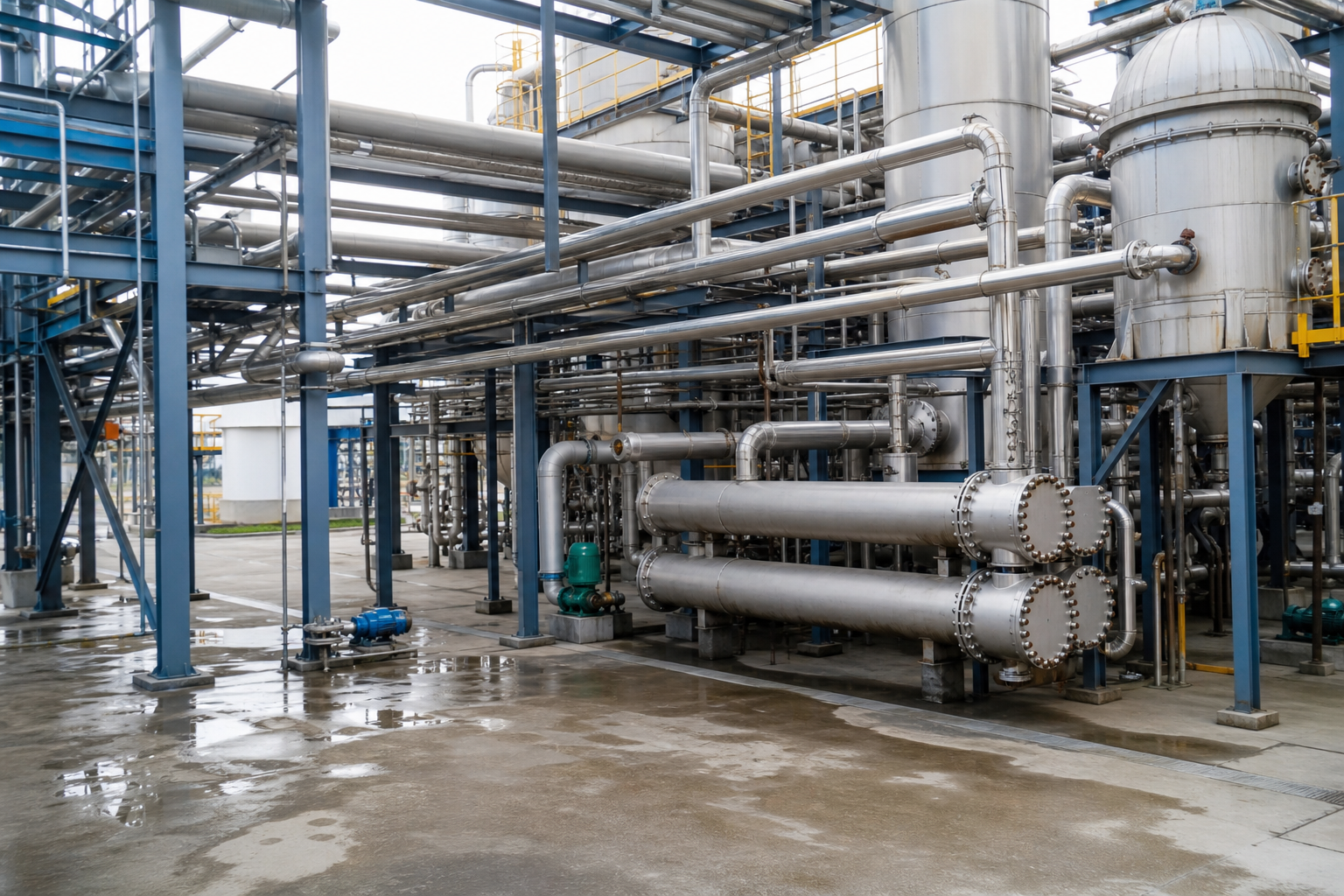
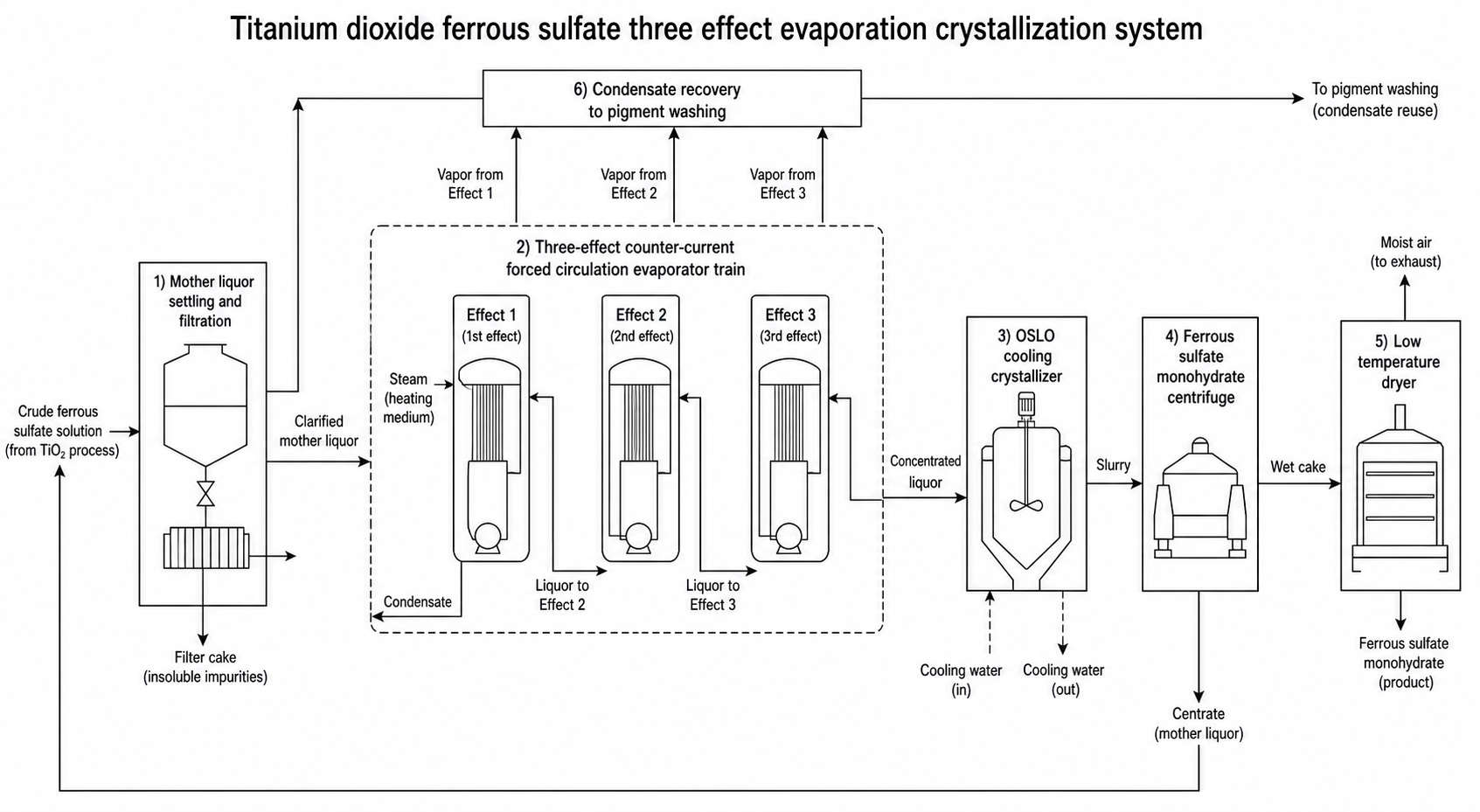
The mother liquor is settled for TiO2 fines and polished by filtration — the pigment particles that would otherwise plate onto heat transfer surfaces are removed where removal is cheap. Preheaters on the effects’ vapor recover heat into the incoming liquor.
Concentration runs counter-current across three forced-circulation effects: fresh steam enters the first effect, and each subsequent effect boils on the previous one’s vapor — with the liquor advancing toward the hotter effects as it concentrates, so the thickest slurry meets the driving steam where pumping it is still economical. Tube velocities in the published 1.8–2.5 m/s range keep the ferrous salt from depositing; the effects hold their published temperature profile (first effect 125–130°C, third 85–90°C) through the train.
At concentration, the liquor advances to OSLO cooling crystallization — the growth-classified crystallizer whose suspension zone grows large, uniform monohydrate crystals while fines recycle — and gradient cooling walks the solubility curve to the FeSO4·H2O phase. Crystals centrifuge to low cake moisture and dry at low temperature to the feed-grade specification; mother liquor returns to the effects with the condensate — published recovery above 98% — recycled to the pigment plant’s washing circuit.
Equipment Configuration
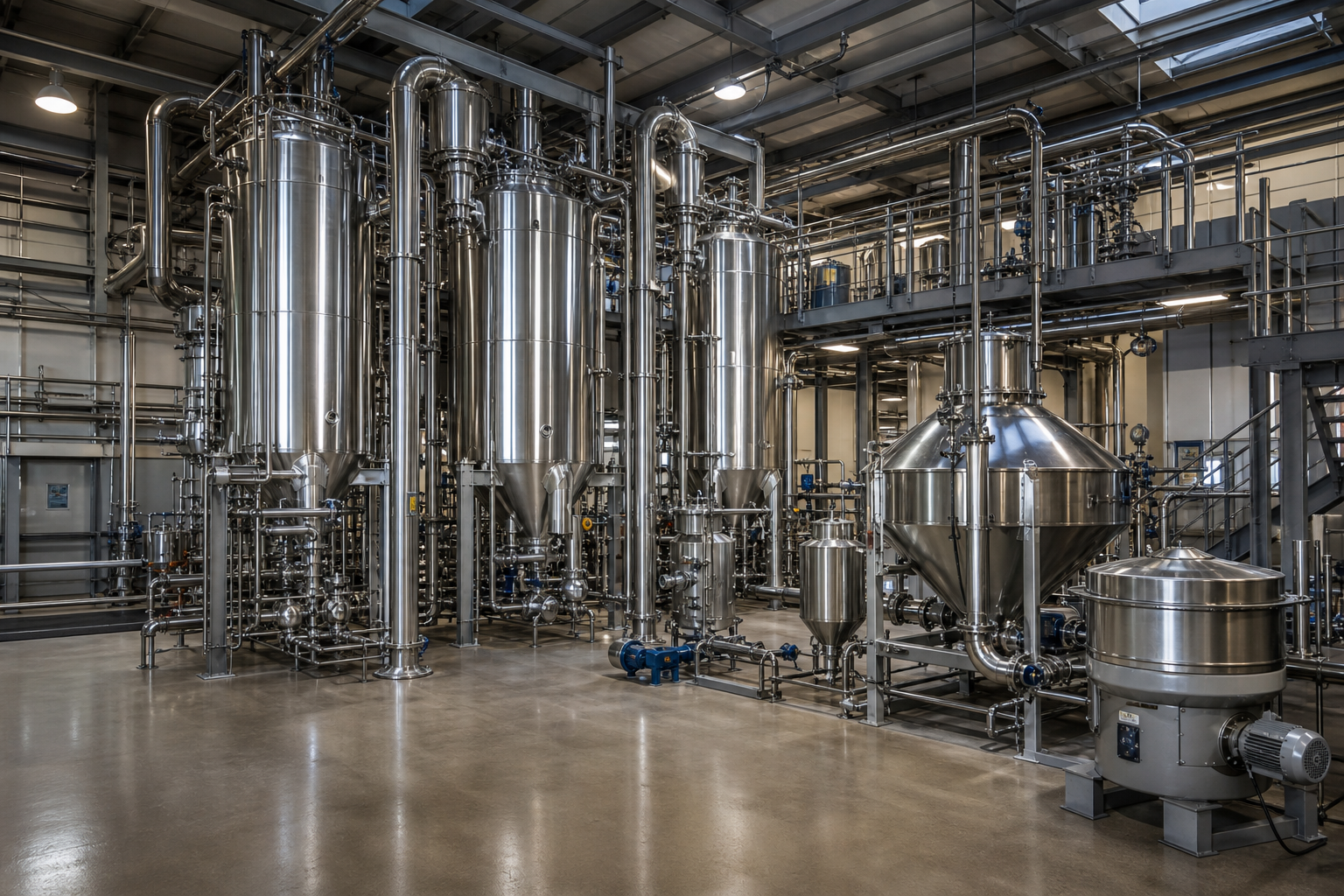
One set of the following equipment is typical for this duty:
- Settling and fine-filtration pretreatment of TiO2 particles
- Three-effect counter-current forced-circulation train, 2205 duplex heating surfaces
- Vapor preheaters on the feed path
- OSLO cooling crystallizer for monohydrate phase control
- Centrifuge and low-temperature dryer for feed-grade product
- Mother-liquor recycle; condensate recovery to pigment washing; DCS control
Performance & Outcome
Compiled from published industry project data, indicative: trains of this class recover ferrous sulfate at above 95% (published), produce monohydrate at 98.5–99.2% purity (published) with condensate reuse above 98%, and consume roughly 0.32–0.4 t steam per tonne of water evaporated (published) on three-effect economy. Figures are per project liquor chemistry.