The vapor compressor is the heart of every mechanical vapor recompression system: it converts electrical energy into the thermal energy that drives evaporation, and its efficiency and reliability set the ceiling on system performance. Selecting the right machine comes down to four variables—vapor flow, required temperature lift, boiling point rise of the liquor, and budget. In practice, Roots (positive displacement) compressors serve small to medium duties with moderate temperature lift at the lowest cost; single-stage centrifugal machines dominate large continuous systems; integrally geared centrifugal compressors cover high-flow, high-pressure-ratio applications; and axial machines are reserved for the very largest, low-ratio duties. This guide explains how each type works, where it fits, and how to run the selection for your project.
What the Compressor Actually Does in an MVR Loop
In an MVR evaporator, the liquid boils at low pressure and generates secondary vapor loaded with latent heat. The compressor draws this vapor, raises its pressure and temperature—typically by a temperature lift of a few to some twenty Kelvin depending on the process—and returns it to the heating side of the heat exchanger, where it condenses and releases that heat back to the evaporating liquor. Because the latent heat circulates in a closed loop instead of being rejected to a condenser, the system needs external steam only for startup and small makeup flows, as detailed in our MVR vs multi-effect energy and cost comparison.
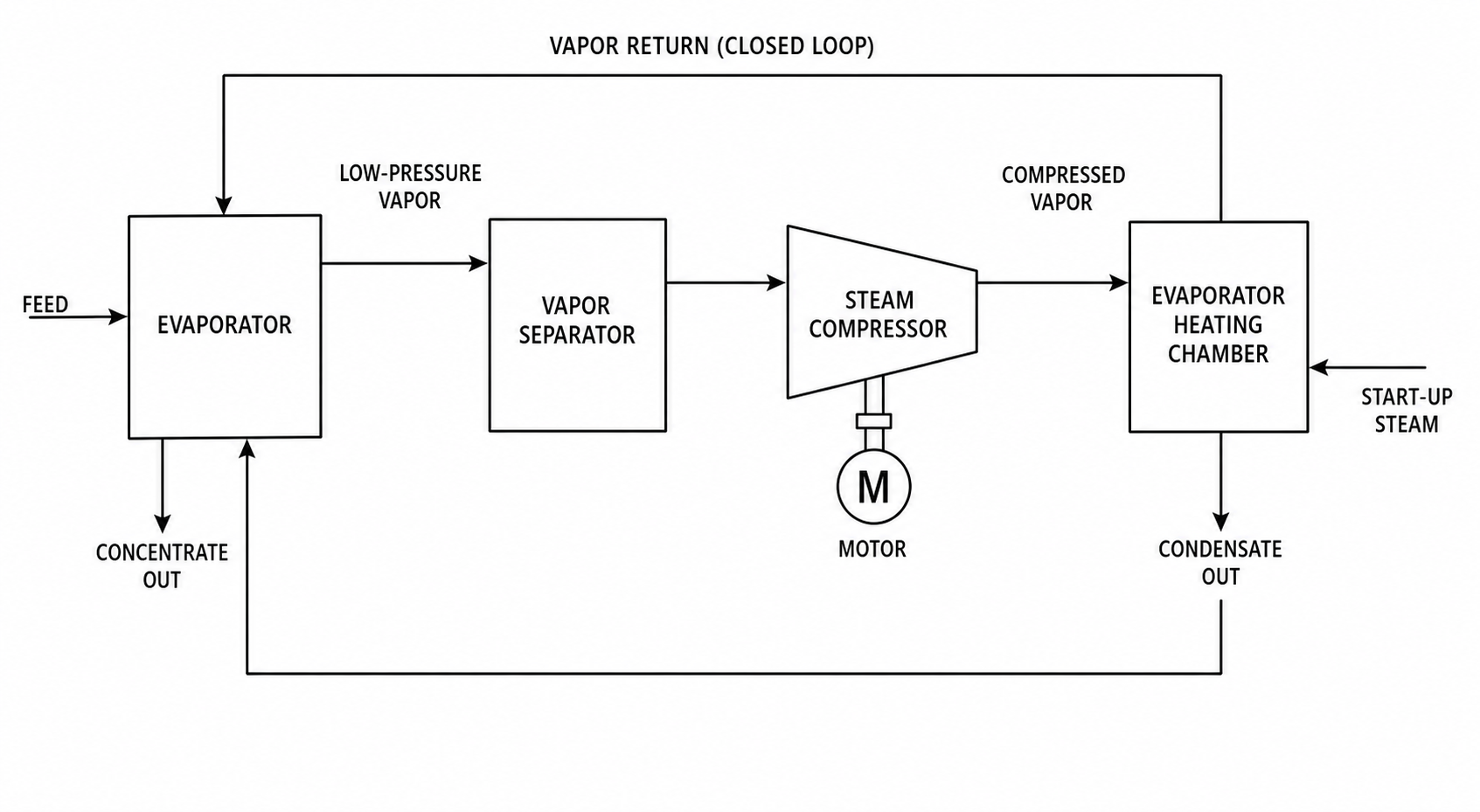
Two consequences follow directly. First, every Kelvin of temperature lift costs compressor power, so the machine must be matched to the minimum lift the process actually needs—no more. Second, because the compressor runs on process vapor, its mechanical health depends on vapor quality: liquid droplets erode impellers, and excessive superheat wastes compression work and risks overheating. Selection is therefore as much about the interface between compressor and process as about the machine itself.
The Four Compressor Types at a Glance
Four machine families cover virtually all MVR installations. Their working principles differ fundamentally: positive displacement machines trap and transport fixed volumes of vapor, while dynamic machines impart velocity to the vapor and convert it to pressure.
| Type | Working Principle | Best-Fit Duty | Trade-offs |
|---|---|---|---|
| Roots (positive displacement) | Two rotors mesh and force vapor through the casing; output does not depend on a speed-head curve | Small to medium evaporation duties with moderate temperature lift; tight budgets | High single-stage compression ratio (over 2.0 achievable), simple and cheap, but limited unit flow, higher noise and pulsation; large duties need parallel units |
| Single-stage centrifugal | Impeller accelerates vapor; diffuser converts velocity to pressure | Large continuous systems with high vapor flow | High flow and good efficiency; sensitive to inlet vapor state—droplets and superheat must be controlled |
| Integrally geared centrifugal | Multiple impellers on a speed-increasing gear box reach high rotational speeds | Large MVR systems needing both high flow and high pressure ratio | Covers the demanding corner of the envelope at higher cost and complexity |
| Axial | Vapor flows parallel to the shaft through rows of moving and stationary blades | Very large flows at low pressure ratio | Utility-scale territory; rarely economical for typical process-plant MVR duties |
Roots Compressors: The Small-Plant Workhorse
The Roots compressor is a positive displacement machine with two meshing rotors. Because its delivery does not ride on a speed-head curve the way a centrifugal machine’s does, vapor flow stays stable across operating points—an operating characteristic plant operators appreciate. A single stage can achieve a high compression ratio, which translates directly into usable temperature lift for moderate-BPR liquors.
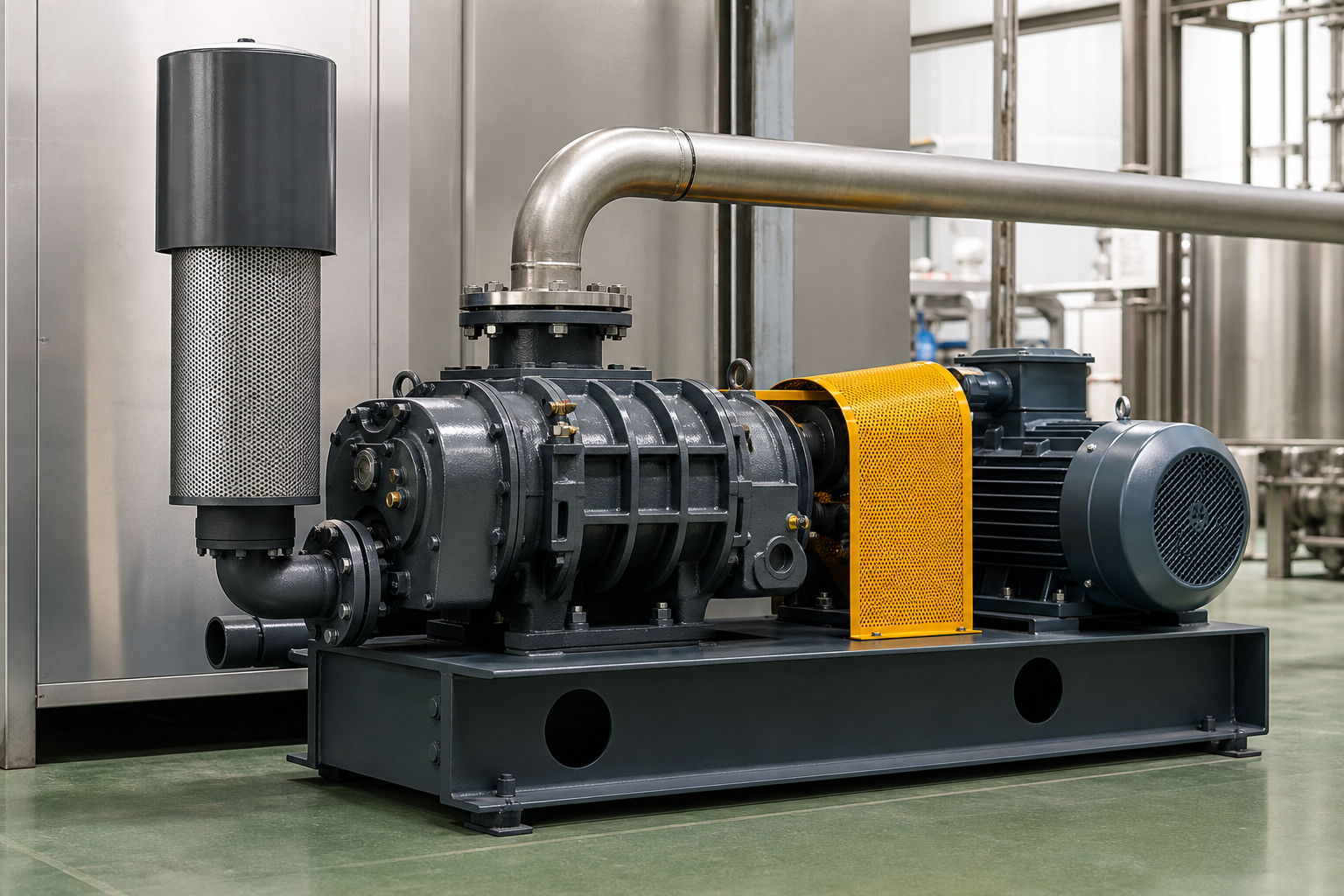
Its strengths are simplicity, low first cost, and easy maintenance, which is why it is the default choice for small and medium MVR projects. The limitations are equally clear: unit capacity is lower than a centrifugal of comparable size, noise and pressure pulsation are higher, and very large vapor flows require multiple machines in parallel—at which point a centrifugal machine usually becomes the better answer.
Centrifugal and Integrally Geared Machines for Large Duties
When vapor flow grows, the centrifugal compressor takes over. A single centrifugal stage achieves pressure ratios well beyond what a positive displacement machine delivers economically, and the machine scales gracefully to the largest process duties. Its single-point sensitivity is inlet vapor condition: the impeller must see controlled superheat and essentially droplet-free vapor. Entrainment from the evaporator causes water hammer and erosion; insufficient superheat invites condensation inside the machine.
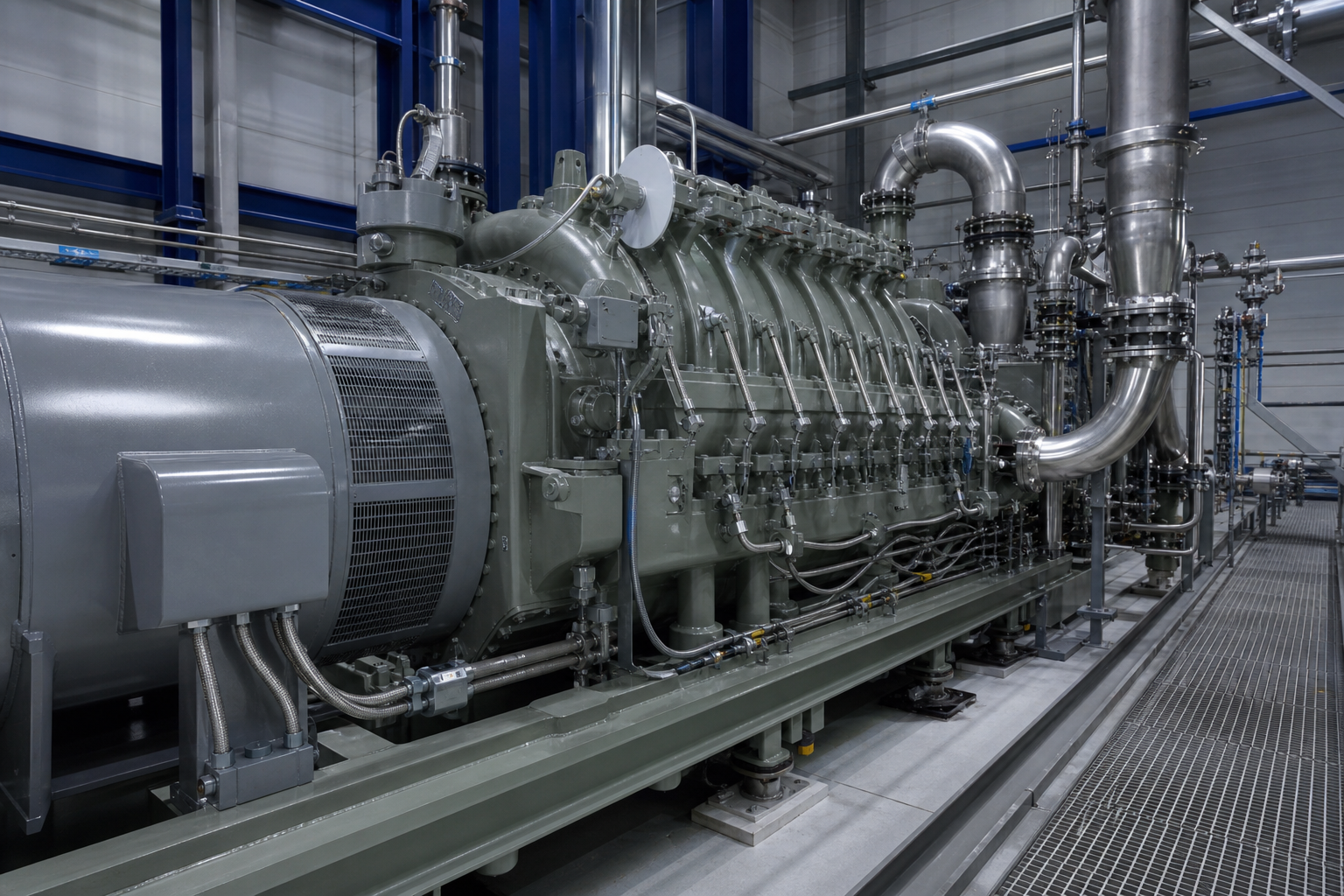
For the demanding corner of the map—high flow and high pressure ratio together—the high-speed integrally geared centrifugal compressor combines several impeller stages with a speed-increasing gearbox, reaching rotational speeds and pressure ratios a single-stage machine cannot. Where the required lift is beyond one stage but the flow is not huge, multistage centrifugal machines or two compressors in series close the gap.
Matching Temperature Lift to Boiling Point Rise
The most common selection error is undersizing the lift. The compressor’s temperature rise must cover three consumers: the boiling point rise of the liquor, the driving temperature difference across the heat exchanger surface, and system pressure losses. For low-BPR fluids such as clean water-like liquors, a lift covering roughly 5–10°C of BPR keeps the machine small and efficient. High-salinity liquors can impose BPE of 15–20 K or more (typical published values); in that territory a single compression step becomes uneconomical, and the standard answers are two-stage compression, an integrally geared multistage machine, or a hybrid MVR arrangement with thermal recompression trimming the difference.
The corollary: high-BPR duties pay an energy penalty for every effect of compression, which is one of the main reasons very high-BPE liquors sometimes remain better served by multi-effect designs—an economic trade examined in the comparison article linked above.
Protecting the Machine: Inlet Vapor Quality
Compressor reliability is decided at the inlet. Three measures matter most:
- Droplet separation. A demister or separator upstream of the machine—and often a second separation stage between evaporator and compressor—keeps liquid carryover from reaching the impellers or rotors, where it causes impact damage and corrosion.
- Superheat control. The vapor must arrive with a small, controlled margin of superheat so that no condensation occurs inside the compression path, but not so much that compression work is wasted raising vapor that is already hot.
- Corrosion management. Chloride-rich and acidic vapors demand appropriate metallurgy. Titanium and duplex stainless impellers and rotors are the standard answers in high-chloride environments such as brine concentration and salt crystallization duties (illustrative applications).
Variable-Speed Operation and Load Following
Because evaporation duty rarely sits exactly at design point, the ability to turn the compressor down matters as much as peak efficiency. Variable-frequency drives let a centrifugal machine follow load by adjusting speed, avoiding the throttling losses of constant-speed operation; Roots machines also benefit, with speed turndown adjusting delivered flow. Correct speed control keeps the machine on its efficiency island during part-load operation and reduces mechanical stress during startup, when the compressor should ramp gently as the evaporator establishes stable vapor generation.
Maintenance, Noise, and Vendor Considerations
Scheduled attention concentrates on bearings, seals, and vibration monitoring—compressor maintenance is the backbone of long-cycle MVR availability, and a disciplined program of periodic inspection is what separates plants that run years between overhauls from plants that do not. Noise and pulsation are inherent to Roots machines in particular and should be addressed with silencers and piping design at the engineering stage rather than after commissioning complaints.
When comparing vendors, weigh the spare-parts and service footprint as heavily as the performance curve: a marginally cheaper machine with distant service support becomes the expensive one at the first unplanned stoppage. Material certificates for wetted parts, impeller or rotor repair options, and the availability of site commissioning support are legitimate selection criteria.
A Practical Selection Sequence
Run the decision in four steps. First, compute the required temperature lift: liquor BPR plus heat-exchange driving difference plus pressure-drop margin. Second, establish the vapor flow at the evaporator’s operating pressure. Third, place yourself on the type map: moderate lift and small-to-medium flow point to a Roots machine; large flow at moderate lift to a single-stage centrifugal; large flow with high lift to an integrally geared or multistage centrifugal or a two-stage arrangement; very large flow at low ratio, rarely, to an axial machine. Fourth, correct for environment—metallurgy for corrosive vapors, inlet separation quality, noise constraints, and the vendor’s service reach—before finalizing the budget.
For projects targeting zero-liquid-discharge or salt recovery, where high-BPR, crystallizing liquors are the norm, compressor selection and evaporator configuration must be engineered together; the ZLD systems and salt separation and resource recovery pages (illustrative applications) describe how the machine choice is embedded in the overall process design.
FAQ
Which compressor type suits a small MVR evaporator?
Roots (positive displacement) compressors are the usual choice for small to medium duties. They are simple, inexpensive, easy to maintain, and a single stage delivers a high compression ratio. Their limits are unit capacity, noise, and pulsation—beyond a certain vapor flow, parallel units or a centrifugal machine become preferable.
How does boiling point rise affect compressor selection?
The compressor’s temperature lift must cover the liquor’s boiling point rise plus the heat-exchange temperature difference and pressure losses. Low-BPR liquors (roughly 5–10°C) suit single-stage machines; BPR above 15–20 K typically requires two-stage compression, an integrally geared multistage centrifugal, or a hybrid MVR+TVR arrangement.
Why is inlet vapor quality so critical for centrifugal compressors?
Centrifugal impellers run at high tip speeds where liquid droplets cause erosion and water-hammer loads, while insufficient superheat allows condensation inside the machine. Demisters or separators upstream—often with a second separation stage—and controlled superheat protect the compressor and its efficiency.
What maintenance does an MVR steam compressor need?
Periodic inspection of bearings and seals, continuous vibration monitoring, and verification of inlet superheat and separation performance. Compressor maintenance is the single most important contributor to long-cycle MVR plant availability, so vendor spare-parts support belongs in the selection decision.