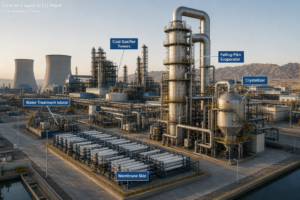
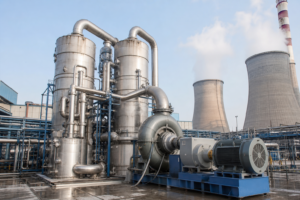
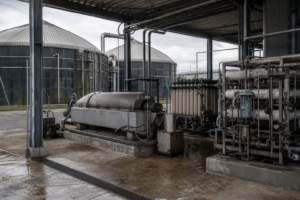
Potassium chloride purification by evaporation and crystallization turns raw KCl — mined sylvinite product, salt-lake harvest or industrial by-product — into premium-grade granular potash, and the engineering center of gravity is a forced-circulation MVR evaporator paired with a DTB (draft tube baffle) crystallizer. In a vendor-published technical reference flowsheet — an external industry reference, not an EvapCryst delivery, and indicative rather than a project guarantee — raw KCl is dissolved into a near-saturated solution at about 34% concentration and 100°C, chemically purified to remove sulfate and hardness ions, then evaporated under MVR at 95-100°C with supersaturation held at just 1.5-2.0% above saturation — tight enough to grow 0.2-1.5 mm premium crystals rather than fines, and gentle enough to keep the heat exchanger free of scale. This page walks through the complete process design, the equipment selection logic, and the control strategy that makes an MVR KCl plant economical at compressor power ratings in the 250-300 kW class for roughly 1.8 t/h of evaporation. Operating values here form an illustrative envelope from published external references, not a project datasheet.
Why KCl Duty Demands a Specific Design
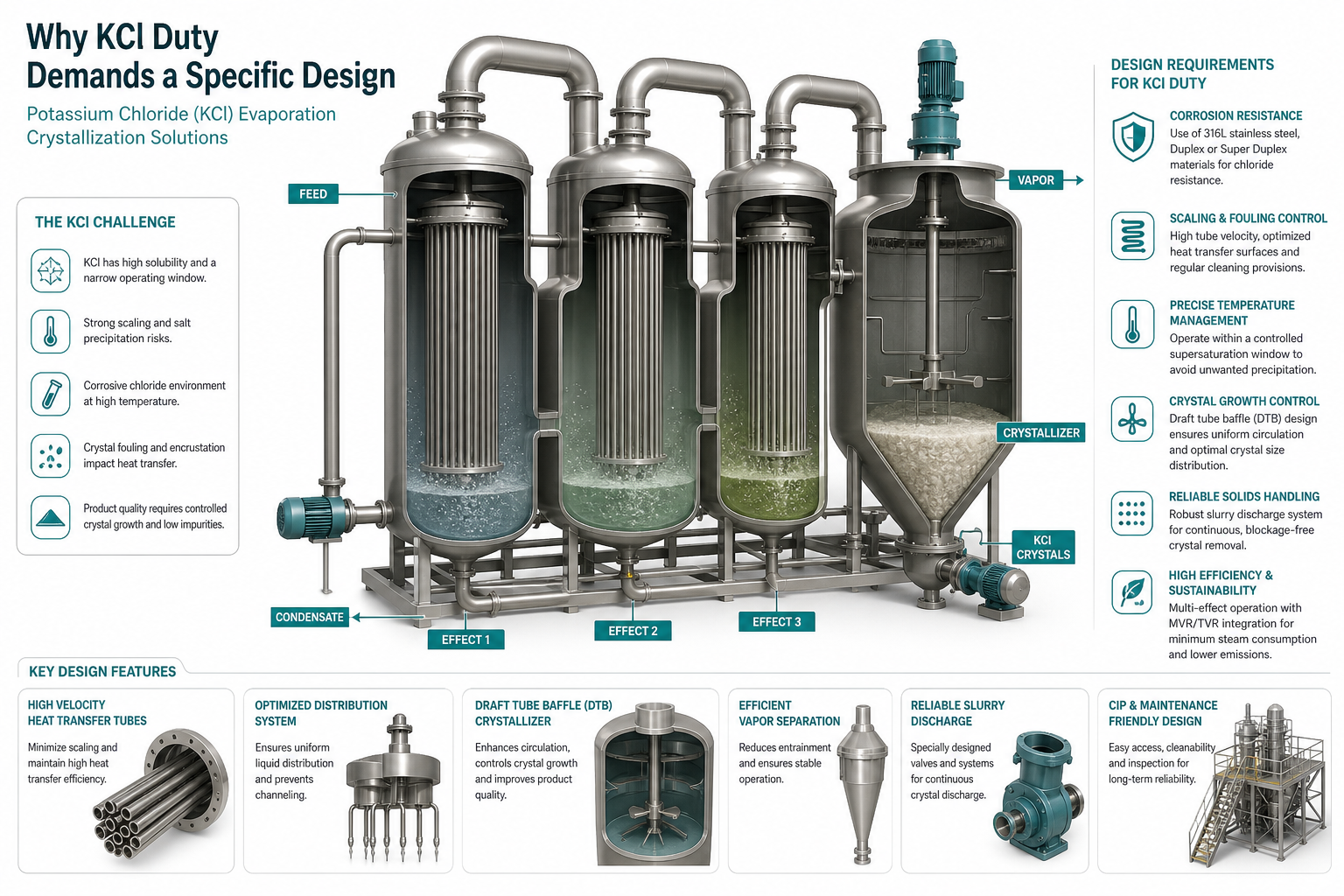
Three properties of potassium chloride shape the flowsheet. First, published solubility data span roughly 28 g/100 g water cold to about 56 g/100 g water at 100°C, so hot dissolution followed by controlled crystallization is the natural purification route — impurities that are less soluble stay behind in the mother liquor. Second, the chloride environment is corrosive to standard austenitics, so pH is held at 6-7 and materials are selected for chloride service. Third, the market pays for particle size: premium Class-I potash is specified by granulometry, so the crystallizer must nucleate few crystals and grow the population it has — a DTB design with controlled supersaturation, not an aggressive boiling body.
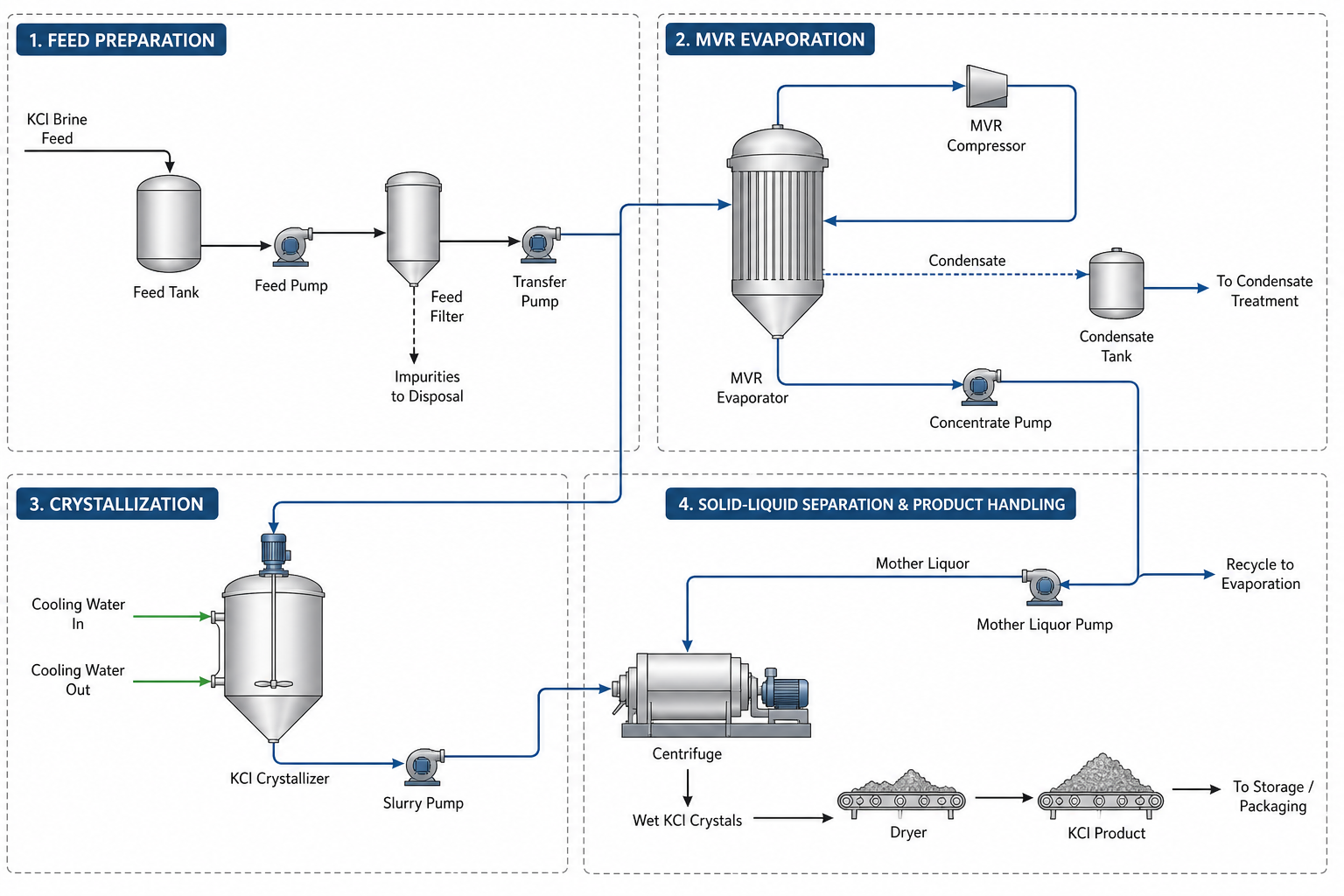
Process Flow: Four Sections of a Representative MVR KCR Plant
1. Pretreatment and Dissolution
Raw KCl is dissolved in recycled mother liquor and hot condensate into a saturated solution at approximately 34% KCl and 100°C. Plate heat exchangers preheat the incoming stream toward 90°C using hot condensate from the evaporator, banking roughly 30% waste-heat recovery before the liquor ever reaches the evaporation section. Chemical purification follows: barium chloride precipitates sulfate (BaSO₄), an EDTA chelating agent sequesters calcium and magnesium, and a 5 μm precision filter removes the reaction precipitates before they can seed scale in the evaporator. Final pH adjustment to 6-7 protects the steel from chloride corrosion under the operating conditions.
2. MVR Evaporation-Crystallization
The core selection is a forced-circulation evaporator for its anti-scaling behavior — high circulation velocity suppresses nucleation on the heat transfer surface — feeding a DTB crystallizer for crystal size control. Operating temperature is 95-100°C at a slight vacuum (-5 to 0 kPa gauge), and supersaturation is held at ΔC = 1.5-2.0% via an online densitometer with temperature interlock: the loop that decides product granulometry and, over weeks, whether the plant stays clean. Secondary vapor is recompressed by a centrifugal steam compressor lifting the vapor by a temperature difference of 8-10°C at a pressure ratio of 1.8-2.2 — the envelope in which the vendor flowsheet pairs a 250-300 kW power rating with about 1.8 t/h of water evaporation (capacity-basis note under Capacity Scaling below).
3. Post-Treatment: Dewatering, Drying, Sizing
Crystal slurry reports to a horizontal screw centrifuge delivering a wet cake at ≤5% moisture, then to a fluidized-bed dryer with 120°C hot air bringing final product moisture to ≤0.1%. Vibratory screening cuts the product band at 0.2-1.5 mm, meeting Class I premium grade requirements; oversize is crushed and returned with undersize to dissolution.
4. Mother Liquor Management
Mother liquor recycles at a controlled 20-30% rate — enough to recover KCl value, bounded so that accumulated impurities (MgCl₂, NaCl and other soluble companions) do not poison crystal growth. The purge goes to a settling pond for residual KCl recovery followed by pH neutralization to discharge limits. This is the stream that quietly decides the plant’s real yield: purge too hard and potash leaves with the impurities; purge too softly and crystal quality walks downhill.
At procurement level the plant resolves into four core modules:
| Module | Candidate Equipment Types | Selection Rationale | Indicative Operating Envelope |
|---|---|---|---|
| Dissolution and purification | Plate heat exchangers; reagent dosing; precision filtration | Sulfate and hardness removal protects the evaporator | ~34% saturated liquor near 100 °C (reference) |
| MVR evaporation-crystallization | Forced-circulation body; DTB crystallizer; centrifugal compressor | Anti-scaling circulation plus classified crystal growth | ΔC 1.5-2.0%; 250-300 kW class (reference) |
| Dewatering, drying, sizing | Screw centrifuge; fluidized-bed dryer; vibratory screen | Class-I granulometry is made at the screen and dryer | Wet cake ≤5%; product ≤0.1% moisture |
| Mother liquor management | Recycle loop; settling pond; neutralization | Purge balance protects yield and crystal quality | 20-30% recycle (reference) |
Configuration, materials, and ranges depend on actual feed, corrosion review, fouling behavior, utilities, and project capacity.
Key Operating Parameters at a Glance
| Section | Parameter | Vendor-Published Reference Value |
|---|---|---|
| Dissolution | KCl concentration / temperature | ~34% saturated solution / ~100°C, preheated to 90°C |
| Purification | Reagents / polishing | BaCl₂ (SO₄²⁻ removal), EDTA (Ca²⁺/Mg²⁺), 5 μm filter |
| Evaporation | Temperature / pressure | 95-100°C / -5 to 0 kPa·G |
| Crystallization | Supersaturation control | ΔC = 1.5-2.0%, online densitometer + temperature interlock |
| Compressor | Type / lift / power | Centrifugal, ΔT 8-10°C, ratio 1.8-2.2, 250-300 kW at ~1.8 t/h evaporation (flowsheet basis; power likely whole-plant, see Capacity Scaling) |
| Dewatering | Centrifuge wet cake | ≤5% moisture |
| Drying | Fluid bed / product moisture | 120°C hot air, ≤0.1% final moisture |
| Sizing | Product cut | 0.2-1.5 mm (Class I premium grade) |
| Mother liquor | Recycle rate | 20-30%, purge to settling recovery + neutralization |
Values are vendor-published reference points from an external flowsheet description, not an EvapCryst delivery; site-specific design may differ.
Why Forced Circulation + DTB Instead of Falling Film
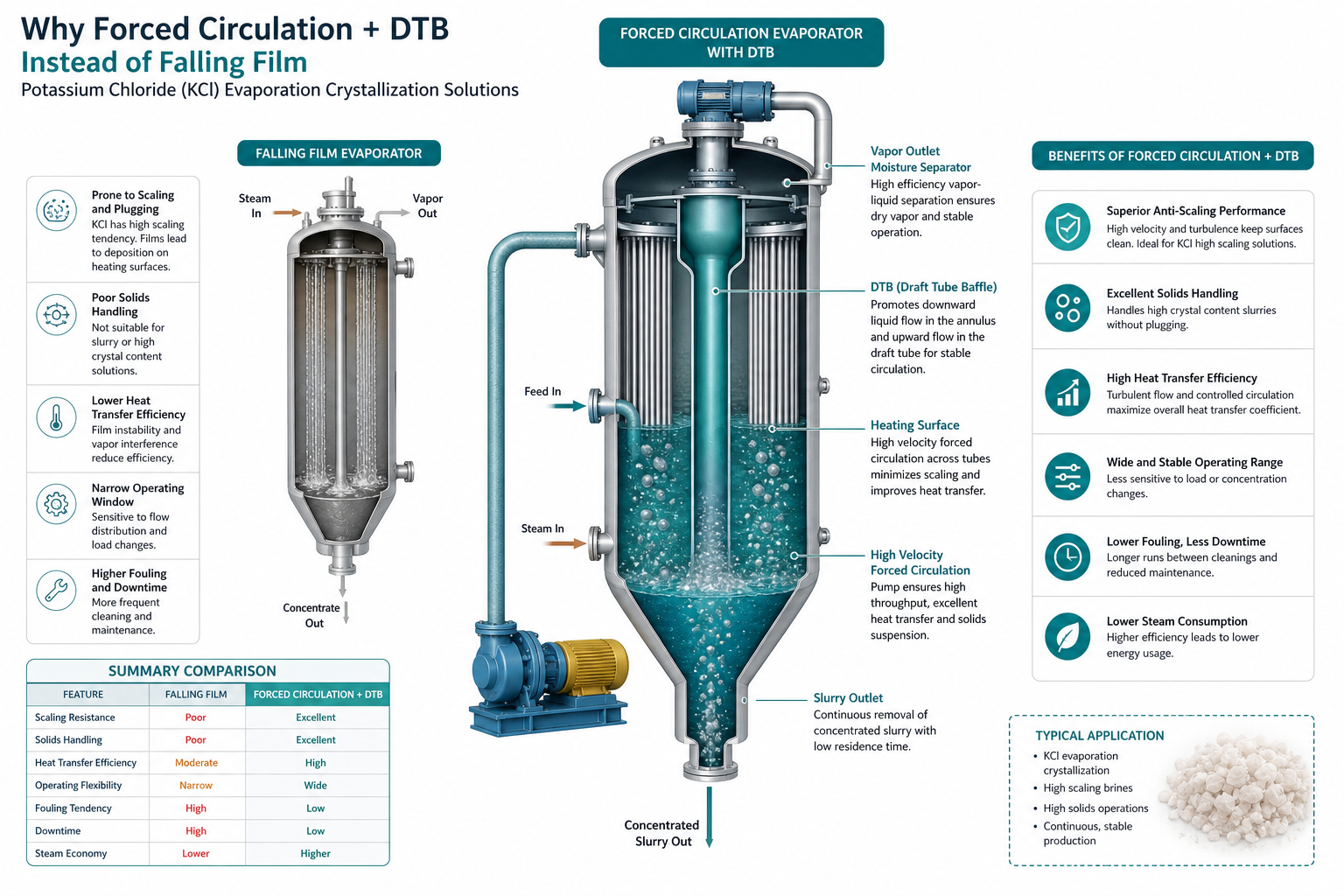
Crystallizing duty disqualifies thin-film surfaces: a falling film evaporator is superb for clean concentration — our falling film solutions page details why — but KCl service crystallizes salt on any wall where the film thins and supersaturation spikes. The forced-circulation body keeps bulk velocity high and boiling suppressed in the tubes, so crystals stay in suspension and the heat exchanger sees liquid, not slurry drying onto metal. Downstream of it, the DTB crystallizer gives the classified growth environment: draft tube circulation for gentle particle suspension, a baffle zone that elutriates fines out of the growth bed, and a cleared liquid zone where the fines dissolve back. The result is the coarse, uniform particle distribution that fertilizer blending and industrial KCl customers pay premiums for — the same crystal-size logic applied across our salt separation technologies.
Control System: Three Loops That Protect the Plant
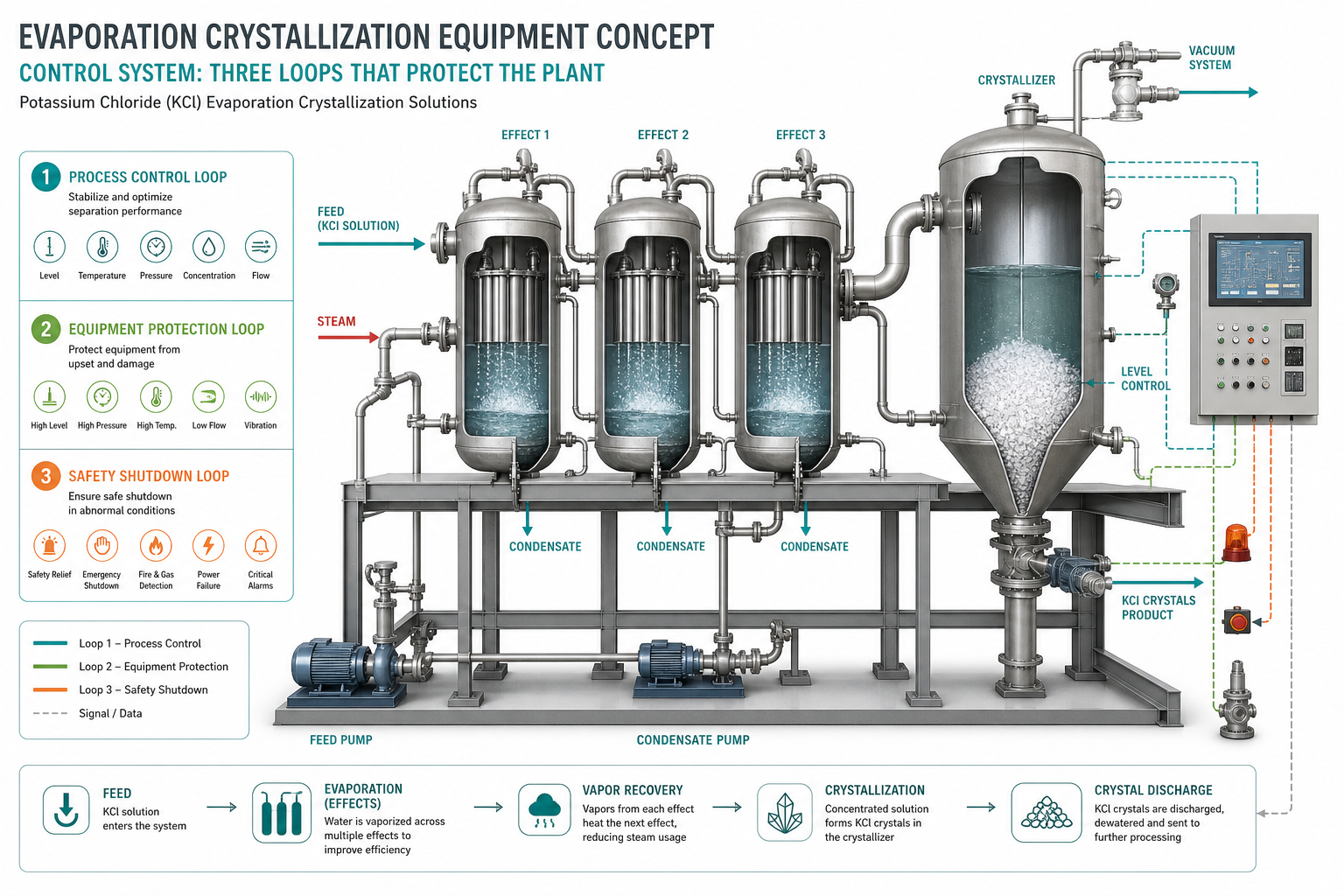
Concentration closed loop. Feed flow is trimmed in real time by conductivity and density measurement to hold evaporator level and liquor strength constant, keeping the crystallizer feed stable through feed-grade swings.
Supersaturation and particle size. An online particle size analyzer (FBRM class) closes the loop from crystal population back to evaporation rate — the automated equivalent of an operator watching crystal growth through a sight glass, but continuous and unfatigued.
Compressor anti-surge. Inlet guide vanes and a vent valve interlock keep operation a 10% safety margin above the surge line, because an MVR compressor that surges on a crystallizer body does not merely trip — it can shake vapor piping and destroy the machine. A SCADA layer (PLC such as Siemens S7-1500 class with historian and remote monitoring) ties the three loops together with sequenced start-up and wash routines.
Energy Efficiency Engineering
Beyond MVR itself, three measures compound into the plant’s energy performance: heat integration returning 90°C condensate to raw-material preheating (recovering on the order of 30% of the low-grade waste heat), variable frequency drives on compressor, circulation and feed pumps trimming electricity demand by an indicative 15-20% against fixed-speed operation across the turndown range, and a vacuum system combining a steam ejector with a liquid ring pump to hold the slight vacuum that sets the boiling point. Together with MVR evaporation technology, these are the levers that let a KCR plant run on electricity essentially alone — no steam boiler in the battery limits — with live steam only for ejector service. The same fertilizer-sector logic, applied to NPK-adjacent streams, appears on our fertilizer evaporation and crystallization page.
Feed Sources and Product Outlets
The same core flowsheet absorbs potassium chloride from three very different origins. Mined sylvinite ore after flotation still carries enough NaCl and insolubles that dissolution-purification-crystallization upgrades it to fertilizer or industrial grade. Salt-lake harvest and brine operations deliver KCl with magnesium and sulfate signatures from the evaporation ponds, pushing the EDTA and barium dosing design but not the process structure. Industrial by-product KCl — for example from chemical processes where potassium values end up in chloride liquors — arrives dilute and variable, sizing the evaporator larger relative to its crystallizer. On the outlet side, the product cuts span standard fertilizer granulometry through industrial KCl for electroplating, drilling fluids and water softener regeneration; the sizing screen, not the crystallizer, is what separates these grades, which is why flexible screening and crushing loops are worth their capital.
Capacity Scaling and Project Economics
MVR KCl plants scale in compressor and body count rather than in operating severity. A single centrifugal compressor of the 250-300 kW class serves roughly 1.8 t/h evaporation in that vendor-published reference flowsheet — a capacity-basis caution: read as compressor-only figures, this pairing implies roughly 140-165 kWh per tonne evaporated, far above the 20-50 kWh/t typical of MVR duty, so the power rating most plausibly reflects whole-plant installed capacity rather than compressor shaft power alone, and your own sizing should be re-derived from the actual evaporation duty. Larger projects either step up to higher-power machines or run multiple bodies sharing utility and control infrastructure. The crystallizer grows with body diameter, and the classified-bed behavior of the DTB design holds particle quality across the size range, which is why the flowsheet scales predictably. Capital is dominated by the materials bill — chloride service prices every wetted steel surface — followed by the compressor; operating cost is dominated by electricity, which is exactly where the 15-20% VFD saving and the 30% condensate heat recovery compound over the plant life. For phased projects, forced-circulation bodies can be added in parallel behind a common dissolution and purification front end, letting capacity follow the market without redesigning the process.
When This Route May Not Fit
An MVR KCl plant of this shape earns its place only where premium granulometry actually commands a premium. Standard-fertilizer markets served by flotation-grade material do not need DTB crystal engineering, and paying for 0.2-1.5 mm Class-I control against a commodity order book is capital without a buyer. The route also misfits feedstocks whose impurity load overwhelms the purification front: high-magnesium salt-lake harvests or sulfate-rich by-product chlorides can push BaCl₂ and EDTA consumption past economic sense, and the honest flowsheet there starts with ore selection, not crystallizer selection. Sites without dependable electricity should stay with steam-driven multi-effect, because compressor service on a weak grid becomes the plant’s failure mode. And very small duties cannot amortize a 250-300 kW class compressor at all — batch cooling crystallization is the proportionate answer.
What Must Be Verified
Before a KCl crystallization project is committed, the following must be verified against site data rather than the vendor-published reference above. A full raw-material analysis — KCl grade, NaCl, MgCl₂, sulfate, calcium, magnesium, insolubles — because the purification recipe and reagent consumption both scale from it. Dissolution behavior of the actual ore or harvest in recycled mother liquor, confirming the 34%-class saturation target is reachable. The impurity accumulation model behind the 20-30% recycle-and-purge balance, run on projected feed swings. Compressor lift verified against liquor boiling point elevation at operating concentration. Product granulometry targets confirmed against real offtake specifications, screen and crush loop sized for the grade mix. And a power-quality review covering the anti-surge margin and ride-through before the electrical single-line diagram is frozen.
FAQ
Why evaporate KCl hot rather than cool-crystallize it?
Hot evaporation-crystallization combines purification with water removal in one step: impurities less soluble than KCl stay dissolved while water is driven off, and the DTB crystallizer grows premium granulometry directly. Cooling crystallization is used where steam or power economics favor it, but MVR evaporation usually wins on total energy cost.
What impurities must be removed before evaporation?
Sulfate (precipitated with BaCl₂), calcium and magnesium hardness (sequestered with EDTA), and suspended solids caught by 5 μm filtration — leaving them in the liquor invites scale in the heat exchanger and off-spec crystal growth in the DTB body.
How is crystal size controlled?
By holding supersaturation in the narrow 1.5-2.0% band, DTB fines elutriation, and online particle-size feedback trimming the evaporation rate — crystal size distribution is a control-system outcome, not an accident of feed quality.
What happens to the mother liquor?
20-30% recycles to dissolution; the purge passes through settling recovery of residual KCl and pH neutralization before discharge, balancing product recovery against impurity accumulation.
Does an MVR KCl plant need a steam boiler?
Essentially no: the evaporator runs on recompressed vapor with electricity as the energy input, and only small ejector steam demand remains, which simplifies permitting and site utilities for new plants.
Next step: send your raw-material analysis, capacity, and target product grade, and receive a first-pass screening of the process direction and boundary conditions — inputs exchanged for engineering direction.